ISO 9001 Implementation: Building a Quality Management System That Drives Business Results
Turn this article into takeaways for your work.


Each assistant summarizes the article only for you and suggests best practices for your work.
A precision components manufacturer decided to pursue ISO 9001 certification because customers required it. They viewed it as a compliance burden:extra paperwork, audits to pass, hoops to jump through. Their quality manager warned them: "We can implement ISO just to get the certificate, or we can use it to actually improve our business."
They chose improvement. Eighteen months later, they had their certificate. But more importantly, their on-time delivery improved from 78% to 94%, customer complaints dropped 60%, and internal rework costs fell by $1.2 million annually. ISO 9001 wasn't bureaucracy:it was a framework that revealed inefficiencies they'd tolerated for years.
That's the difference between compliance and commitment. One gets you a certificate to hang on the wall. The other transforms your operations.
Understanding ISO 9001:2015: More Than a Certificate
ISO 9001 is the international standard for quality management systems. According to ASQ, ISO 9001 is the international management system standard that specifies requirements for a quality management system (QMS), helping organizations demonstrate their ability to consistently provide products and services that meet customer and regulatory requirements. It defines requirements for how organizations should manage processes, ensure customer satisfaction, and drive continuous improvement.
The 2015 revision modernized the standard with several important changes:
Risk-based thinking: You must identify risks and opportunities throughout your operations, not just respond to problems after they occur.
Process approach: Emphasize understanding how your processes connect and interact, not just documenting individual procedures.
Leadership involvement: Top management must demonstrate commitment to the QMS, not delegate it entirely to quality departments.
Flexibility in documentation: The standard specifies what you must do, not exactly how to document it, allowing for simpler, more practical systems.
The Seven Quality Management Principles
ISO 9001 is built on seven fundamental principles that guide effective quality management:
Customer focus: Understanding and meeting customer requirements while aiming to exceed expectations.
Leadership: Establishing unity of purpose and creating conditions for people to achieve objectives.
Engagement of people: Competent, empowered, and engaged people enhance organizational capability.
Process approach: Understanding and managing interrelated processes as a system improves consistency and efficiency.
Improvement: Successful organizations focus on continual improvement as a permanent objective.
Evidence-based decision making: Decisions based on analysis of data and information are more likely to produce desired results.
Relationship management: Managing relationships with interested parties (suppliers, customers, employees) optimizes performance.
These principles aren't just philosophy:they're practical guidelines that separate effective quality systems from bureaucratic ones.
Value Beyond Certification
Too many organizations implement ISO 9001 purely for customer requirements or market access. That misses the real opportunity.
A well-implemented QMS provides:
Process clarity: Understanding how work actually flows through your organization, where handoffs occur, and where delays or errors creep in.
Consistent execution: Reducing variation caused by different people doing things different ways.
Early problem detection: Systems to identify issues before they become customer complaints or major failures.
Data-driven decisions: Information about performance trends that enable proactive improvement.
Organizational discipline: The habit of planning work, executing as planned, checking results, and taking action based on what you learn.
These capabilities improve operational performance regardless of whether you pursue certification. The certificate proves you've achieved them; the capabilities deliver the business results.
Implementation Roadmap: A Phased Approach
Successful ISO 9001 implementation follows a systematic approach that builds capability progressively while avoiding paralysis from trying to do everything at once.
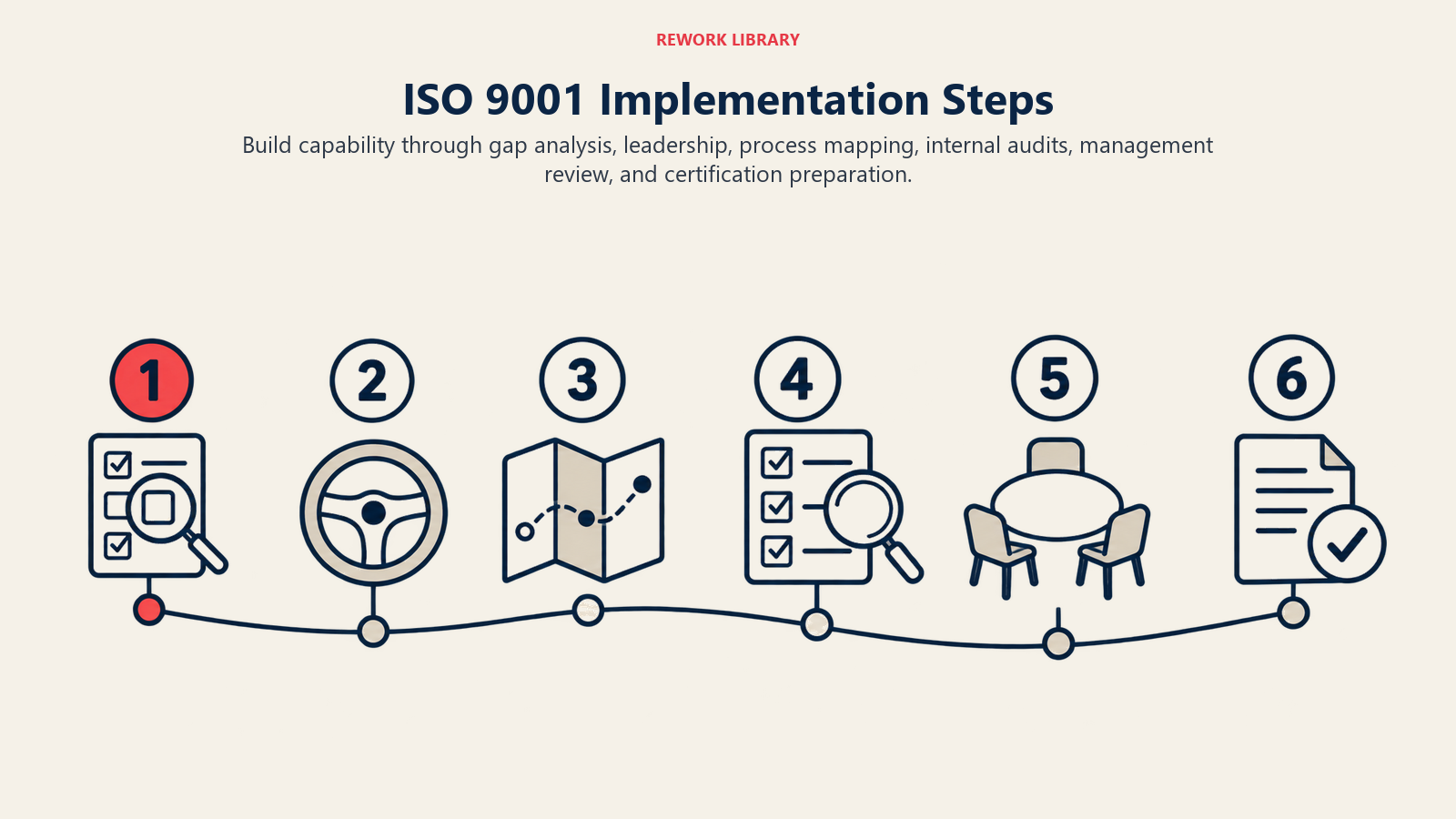
Phase 1: Gap Analysis and Readiness Assessment
Before you start implementing, understand where you are relative to ISO 9001 requirements.
Conduct a gap analysis by reviewing each clause of the standard and honestly assessing current practices:
- What do we already do that meets requirements?
- What do we do partially that needs strengthening?
- What are we missing entirely?
Don't just check boxes. Understand the intent behind requirements and whether your current practices deliver that intent, even if they're not documented formally.
A food processing company discovered during gap analysis that they actually had most required processes:purchasing controls, production planning, inspection procedures:but they weren't documented consistently, and nobody thought of them as a connected quality system. Their implementation focused more on documenting and connecting existing practices than creating entirely new systems.
Phase 2: Leadership Engagement and Resources
ISO 9001 requires top management commitment, not just approval. Leadership must:
Establish quality policy: Clear statement of organizational commitment to quality and customer satisfaction.
Set quality objectives: Measurable goals that align with business strategy.
Ensure resource availability: Allocate time, money, and people to implement and maintain the QMS.
Communicate importance: Explain why quality management matters to business success.
Lead by example: Demonstrate commitment through actions, not just words.
Appoint a Management Representative or Quality Manager with authority and access to top leadership. This person coordinates implementation but shouldn't own it alone:quality is everyone's responsibility.
Establish a cross-functional steering team that includes operations, engineering, supply chain, and sales. ISO 9001 affects the entire organization, not just the quality department.
Phase 3: Process Mapping and Documentation
You can't manage what you don't understand. Map your core processes from customer order through product delivery:
Identify major processes: What are the key activities that transform inputs into outputs?
Define process interactions: How do processes connect? What information or materials flow between them?
Assign process owners: Who is responsible for each process performing as intended?
Determine process controls: How do you ensure processes deliver intended results?
Establish measurements: How will you know if processes are effective and efficient?
Document processes at an appropriate level. ISO 9001 doesn't require procedure manuals for everything. Focus documentation on:
- Activities where consistency matters most
- Handoffs between departments or shifts
- Tasks performed infrequently that need reference material
- Requirements imposed by customers or regulations
A machining operation initially created 47 detailed procedures covering every possible activity. Their quality manager wisely asked, "Will operators actually use these?" They consolidated to 12 key procedures with visual work instructions at machines for specific operations. The simpler system got followed consistently; the comprehensive one gathered dust.
Phase 4: Internal Audit Program Establishment
Internal audits are your primary tool for verifying that the QMS works as intended and identifying improvement opportunities.
Develop an audit schedule that covers all processes annually, with more frequent audits for critical or unstable areas.
Train internal auditors:typically 2-3 days of training covering audit principles, techniques, and ISO 9001 requirements. Select auditors from various departments to bring diverse perspectives.
Create audit checklists and protocols, but don't let audits become mechanical checkbox exercises. The goal is understanding whether processes deliver intended results, not catching people in procedural violations.
Plan, execute, report, and follow up on audits formally. Track findings, verify corrective actions, and use audit results in management review.
Phase 5: Management Review System
ISO 9001 requires top management to review the QMS periodically (typically quarterly or semi-annually) to ensure it remains suitable, adequate, and effective.
Management review meetings analyze:
Inputs:
- Audit results and nonconformances
- Customer feedback and complaints
- Process performance and product quality metrics
- Status of corrective actions
- Risks and opportunities
- Results from previous management reviews
Outputs:
- Decisions about improvements needed
- Changes to the QMS
- Resource needs
- Actions to address risks and opportunities
These shouldn't be status update meetings. They're strategic sessions where leadership uses QMS data to make decisions about system effectiveness and business improvement.
Phase 6: Certification Audit Preparation
Once your QMS is operating consistently (typically 3-6 months of stable operation), you're ready for certification audit.
Select a registrar (certification body) accredited to issue ISO 9001 certificates. Consider their industry experience, auditor quality, and reputation.
Certification involves two audit stages:
Stage 1: Documentation review to verify your QMS addresses all standard requirements and identify any gaps before the formal audit.
Stage 2: On-site audit where auditors interview people, observe processes, and review records to verify implementation.
Prepare by conducting thorough internal audits beforehand. Fix any major issues. Ensure people understand their roles and can explain how their work fits into the QMS.
Don't coach people to give specific answers. Auditors recognize rehearsed responses. Instead, ensure people genuinely understand what they do and why it matters.
Key Requirements: Critical Elements of ISO 9001
Let me highlight the most important clauses and what they really mean in practice.
Context of the Organization (Clause 4)
You must understand external and internal issues that affect your ability to deliver products and services:market conditions, technology changes, competitive pressures, internal capabilities and constraints.
Identify interested parties (customers, suppliers, employees, regulators) and their requirements. Your QMS must address these requirements, not exist in isolation.
This clause pushes you to think strategically about quality management, not just operationally. What risks and opportunities does your context create? How does your QMS adapt to changing conditions?
A contract manufacturer serving aerospace and medical device customers recognized these industries had very different quality expectations and regulatory requirements. Their QMS included different control levels for different customer segments, rather than one-size-fits-all approaches.
Leadership and Commitment (Clause 5)
Top management must demonstrate leadership by:
- Taking accountability for QMS effectiveness
- Ensuring quality policy and objectives align with strategy
- Integrating QMS requirements into business processes
- Promoting process approach and risk-based thinking
- Ensuring resources are available
- Communicating the importance of effective quality management
This isn't about attending quarterly meetings. It's about making quality management central to how the business operates.
Risk and Opportunity Management (Clause 6)
The 2015 revision introduced risk-based thinking throughout the standard. You must:
Identify risks: What could prevent you from meeting requirements or achieving objectives?
Assess risks: How likely are they? How significant would impacts be?
Plan actions: How will you address risks through prevention, mitigation, or contingency?
Monitor effectiveness: Did risk management actions work?
This doesn't require formal risk management methodology. For most manufacturers, understanding key vulnerabilities:supplier dependencies, equipment criticality, key person risks, customer concentration:and having plans to address them satisfies this requirement.
A small manufacturer identified their main risk as dependency on a single CNC machine for critical operations. They addressed this by maintaining spare critical components, training additional operators, and establishing an agreement with a nearby shop for emergency capacity. Simple, practical risk management.
Operational Planning and Control (Clause 8)
This clause covers the core of manufacturing operations:
Product requirements: How do you determine what customers need?
Design and development: How do you create products that meet requirements? (If applicable)
Control of external providers: How do you ensure purchased materials and services meet requirements?
Production control: How do you manage production to ensure consistent output?
Product release: How do you verify products meet requirements before delivery?
Control of nonconforming outputs: How do you prevent defective products from reaching customers?
These aren't just quality department responsibilities. Operations, engineering, and supply chain must all understand how their activities fit into operational control.
Performance Evaluation (Clause 9)
You must monitor, measure, analyze, and evaluate the QMS to determine:
- Whether products and services meet requirements
- Customer satisfaction levels
- QMS effectiveness
- Process performance
- Need for improvements
This means establishing meaningful metrics, collecting data consistently, analyzing trends, and using results to make decisions.
Don't fall into the trap of measuring everything. Focus on metrics that matter to business performance and customer satisfaction. More data doesn't mean better information.
Improvement (Clause 10)
The standard requires continual improvement of the QMS. When nonconformances or problems occur, you must:
- React to the issue and take immediate control
- Evaluate the need for action to eliminate root causes
- Implement corrective action
- Review effectiveness of actions taken
- Update risks and opportunities if necessary
- Make changes to the QMS if needed
This closes the loop from problem identification through root cause elimination to verification that solutions work.
Documentation Requirements: Right-Sized Documentation
ISO 9001 has become much more flexible about documentation. The standard requires:
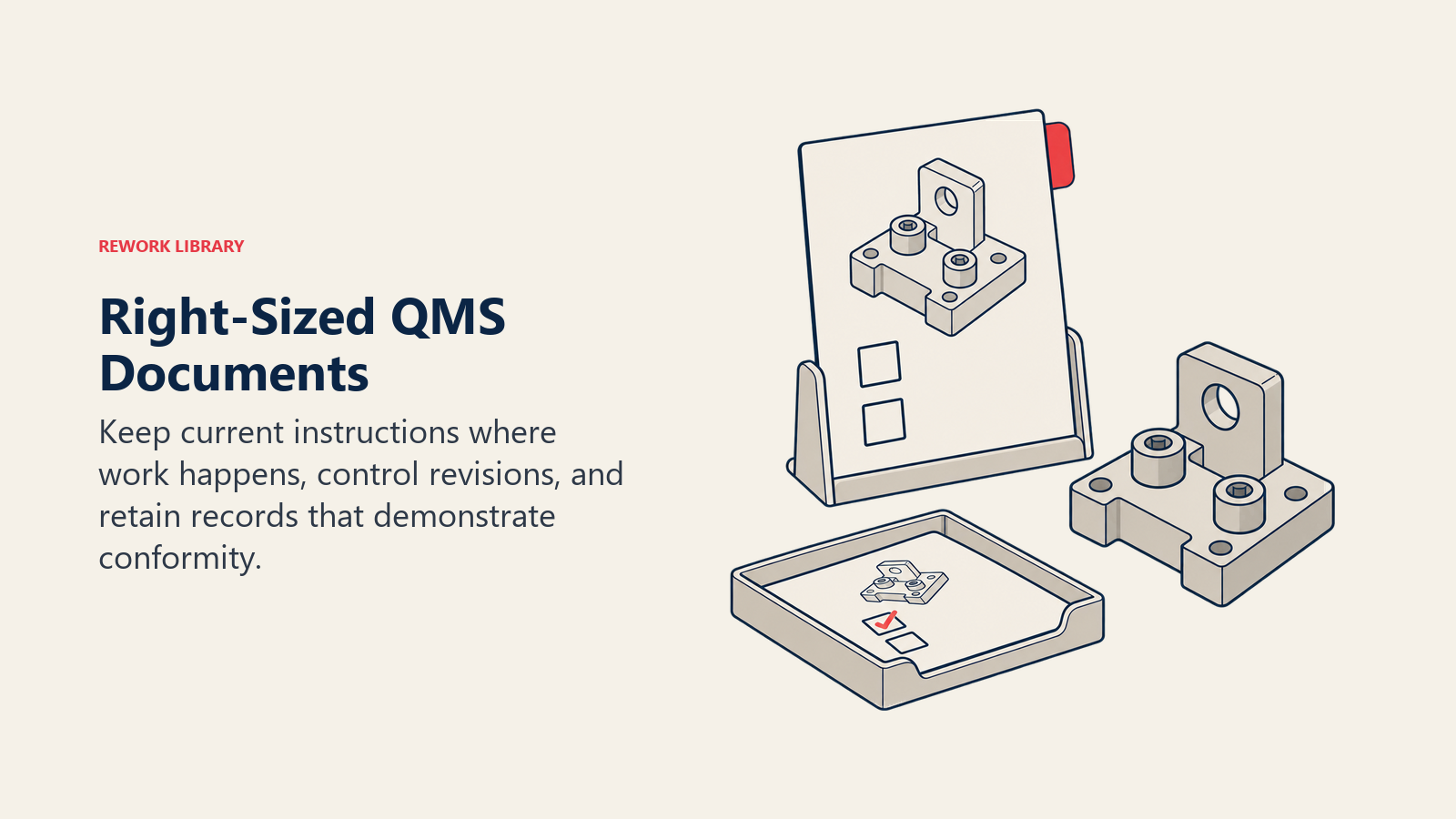
Documented information to support the QMS: Whatever documentation your organization needs to operate effectively.
Records to demonstrate conformity: Evidence that you've done what you said you'd do.
But it doesn't mandate a quality manual, specific procedures, or particular formats. You decide what documentation helps your organization operate effectively.
Quality Manual (Optional But Recommended)
While not required, a quality manual provides useful overview of your QMS:
- Scope and boundaries of the system
- How the organization addresses each standard requirement
- Process interactions and relationships
- References to more detailed procedures
Keep it high-level. The quality manual explains the what and why; detailed procedures explain the how.
Documented Procedures and Work Instructions
Create procedures for activities where consistency matters:
- Complex processes with multiple steps or handoffs
- Infrequent activities that need reference material
- Critical operations where errors have serious consequences
- Customer or regulatory requirements
Use simple language and visual aids. The goal is helping people do work correctly, not impressive documentation.
A plastics manufacturer found that thick procedure manuals sat unused. They converted to one-page visual instructions posted at workstations. People actually referenced them, and process consistency improved dramatically.
Records and Forms
Records provide evidence that processes are working. Maintain records for:
- Training and competency verification
- Equipment calibration and maintenance
- Inspection and testing results
- Audit findings and corrective actions
- Management review decisions
- Customer complaints and resolutions
Design forms and records to capture necessary information efficiently. Don't collect data you won't use:every record has a cost in time and storage.
Document Control and Records Management
ISO 9001 requires controlling documents to ensure:
- Current versions are available where needed
- Documents are reviewed and approved before use
- Changes are identified and controlled
- Obsolete documents are removed from use
And managing records to ensure:
- Records are legible and readily identifiable
- Records are protected from damage or loss
- Records are retained per defined requirements
Modern document management systems make this easier, but even simple version control and filing systems can meet requirements if maintained consistently.
Internal Audits: Building Audit Capability
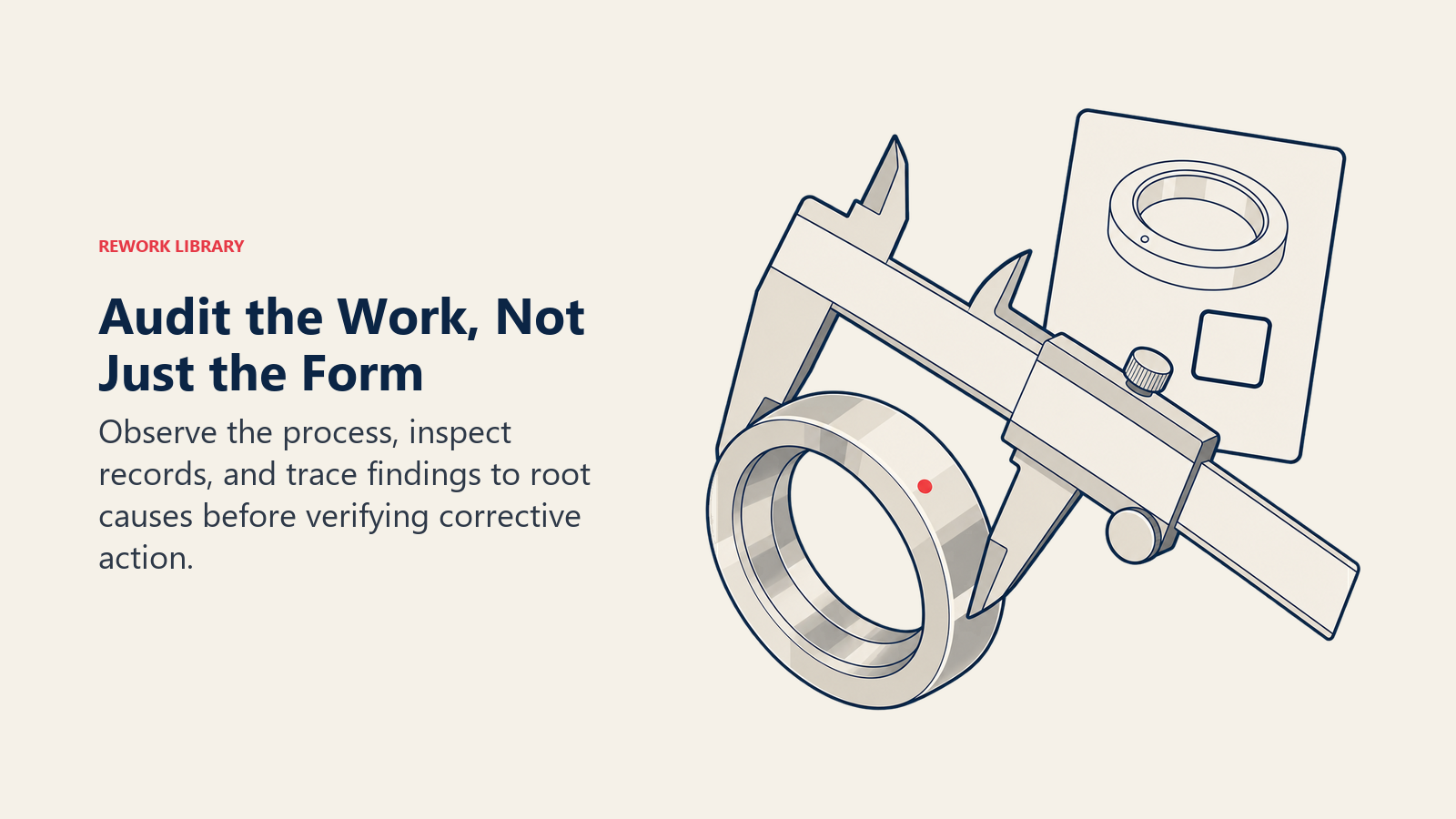
Internal audits are among the most valuable elements of ISO 9001:if done well. Done poorly, they're compliance theater that wastes time without improving anything.
Audit Program Planning
Develop an annual audit schedule based on:
Process importance: Critical processes get audited more frequently.
Past performance: Areas with problems or changes need more attention.
External requirements: Customer or regulatory audits might prompt internal verification beforehand.
Plan audits with enough detail that auditors know scope and objectives, but with flexibility to pursue issues discovered during the audit.
Training Internal Auditors
Good auditors need training in:
- ISO 9001 requirements and intent
- Audit principles and techniques
- Interviewing and evidence gathering
- Distinguishing nonconformances from observations
- Writing findings that are clear and actionable
Internal auditor courses typically run 2-3 days. Then pair new auditors with experienced ones for several audits before they lead independently.
Select auditors from different departments and functions. This brings diverse perspectives and helps auditors see beyond their own areas' assumptions.
Conducting Effective Audits
The best audits feel like business conversations, not interrogations.
Start by understanding what the process is supposed to accomplish. Review procedures and process documentation beforehand so you're not reading during the audit.
Ask open-ended questions:
- "Tell me about your role in this process."
- "How do you know if this operation is running correctly?"
- "What do you do when problems occur?"
- "How was this decision made?"
Observe actual work. Watch how things really happen, not just what people say happens. Verify claims by examining records and physical evidence.
When you find issues, dig for root causes. Don't just note that a procedure wasn't followed:understand why. That context makes findings more actionable.
Root Cause Analysis and Corrective Action
Audit findings should trigger investigation of root causes, not just correction of the specific instance discovered.
If an auditor finds that one operator didn't follow a procedure, the corrective action shouldn't be "retrain the operator." Dig deeper:
- Why didn't the operator follow the procedure?
- Was the procedure unclear, impractical, or unknown?
- Do other operators have the same issue?
- Is this symptom of a systemic problem?
Effective corrective action addresses system issues that allowed problems to occur, not just individual mistakes.
Using Audits for Improvement, Not Policing
The goal of internal audits is improvement, not finding fault. Create an environment where people see audits as helpful rather than threatening.
Frame findings as opportunities: "Here's a gap we found. How can we address it?" rather than "Here's what you did wrong."
Focus on process effectiveness, not just conformity. A process might conform to documented procedures but still produce poor results. Good audits identify both types of issues.
Share positive findings too. When processes work well or teams demonstrate effective practices, highlight these as examples for others.
Common Implementation Challenges: Overcoming Obstacles
Even with good planning, you'll face challenges. Here's how to address the most common ones:
Employee Resistance and Buy-In
People resist ISO 9001 when they see it as extra work without value. Overcome resistance by:
Involving people early: Engage operators, supervisors, and specialists in mapping processes and developing procedures. They'll support systems they helped create.
Demonstrating value: Show how QMS improvements solve problems people already struggle with.
Keeping it simple: Don't create bureaucracy. Build systems that help people do work more effectively.
Celebrating successes: Recognize improvements that result from QMS implementation.
A fabrication shop faced major resistance until they used process mapping to identify why orders were frequently expedited. The QMS revealed communication gaps between sales and production. Fixing these gaps reduced expediting dramatically, which got shop floor buy-in immediately.
Documentation Burden
Over-documentation is a common trap. Avoid it by:
Documenting what adds value: If a document won't help someone do work better, don't create it.
Using visual management: Photos and diagrams often work better than text procedures.
Leveraging existing documents: You probably have procedures, forms, and instructions already. Organize them rather than creating everything from scratch.
Reviewing and simplifying: Periodically review documentation and eliminate what's not being used.
Maintaining Momentum Post-Certification
Many organizations celebrate getting their certificate, then let the QMS decay. Prevent this by:
Integrating QMS into business reviews: Don't treat quality system performance as separate from business performance.
Continuing improvement: Use the QMS to identify and implement improvements, not just maintain the status quo.
Refreshing training: As people turn over or processes change, keep training current.
Taking audits seriously: Internal and surveillance audits should drive real improvement, not just maintain certification.
Integration with Existing Systems
If you already use lean, Six Sigma, or other improvement methodologies, ISO 9001 should complement them, not compete.
ISO 9001 provides the management system framework. Lean, Six Sigma, or other tools fit within that framework as methods for achieving objectives and driving improvement.
A medical device manufacturer integrated ISO 9001 with their lean program by making standard work and visual management part of their documented QMS. Process improvement projects became inputs to management review. The systems reinforced each other rather than creating dueling priorities.
Continuous Improvement: Beyond Certification Maintenance
Getting certified is an achievement. But the real value comes from using your QMS to drive ongoing improvement.
Using QMS Data for Strategic Decisions
Your QMS generates valuable data:customer feedback, process performance, nonconformance trends, audit findings. Use this information strategically:
- Which products or processes have the most quality issues?
- What are the most common customer complaints?
- Where are you spending the most on poor quality?
- What risks are materializing that need attention?
Bring QMS data into business planning discussions. Let quality performance influence resource allocation, capacity planning, and strategic priorities.
Evolving the System Based on Business Needs
Your QMS shouldn't be static. As your business changes:new products, new customers, new processes, organizational growth:your QMS must evolve.
Review your quality objectives annually. Do they still align with business strategy? Do they drive the right behaviors?
Periodically reassess risks and opportunities. What's changed in your internal or external context? Are previous risk assessments still valid?
Update processes and documentation as you improve operations. The QMS should reflect current best practice, not outdated procedures.
Recertification and Surveillance Audits
ISO 9001 certificates are valid for three years, with surveillance audits typically conducted annually. These audits verify that you're maintaining your QMS and continuing to meet requirements.
Treat surveillance audits as opportunities to validate improvement, not just compliance exercises. Share changes you've made, improvements you've achieved, and lessons you've learned.
Recertification at the three-year mark involves a more thorough audit similar to the initial certification. It's a chance to step back and evaluate how effective your QMS has been at driving business performance.
ISO 9001 as Foundation for Operational Excellence
ISO 9001 isn't the end goal:it's a foundation. Organizations that extract maximum value from their QMS use it as a springboard for deeper operational excellence:
Industry-specific standards: Many sectors have ISO 9001-based standards with additional requirements:ISO/TS 16949 for automotive, AS9100 for aerospace, ISO 13485 for medical devices. Your ISO 9001 QMS provides the base for these more rigorous standards.
Integrated management systems: You can integrate ISO 9001 with environmental management (ISO 14001), health and safety (ISO 45001), or information security (ISO 27001) into a unified system.
Advanced quality methods: Your QMS provides the management framework to support Six Sigma, lean manufacturing, total productive maintenance, or other improvement methodologies.
Operational discipline: The habits of planning, executing, checking, and acting that ISO 9001 builds become part of organizational culture, enabling continuous improvement across all aspects of the business.
That precision components manufacturer from the opening? Five years after certification, they barely think about ISO 9001 compliance. The processes, discipline, and continuous improvement mindset have become how they operate. They've added lean manufacturing and Six Sigma projects, all supported by the QMS framework. Their customers still require certification, but that's not why they maintain the system. They maintain it because it makes them a better business.
That's when you know ISO 9001 has delivered real value:when it's not a compliance burden but simply the way you work.
Learn More
- Manufacturing Quality Management Overview: Building Defect Prevention Systems
- Six Sigma in Manufacturing: Data-Driven Quality Improvement
- Root Cause Analysis Methods: Getting to the Heart of Manufacturing Problems
- Statistical Process Control: Monitoring and Preventing Variation
- Defect Prevention Strategies: Building Quality at the Source
- Quality Control vs Quality Assurance: Understanding the Difference

Co-Founder, Rework.com
On this page
- Understanding ISO 9001:2015: More Than a Certificate
- The Seven Quality Management Principles
- Value Beyond Certification
- Implementation Roadmap: A Phased Approach
- Phase 1: Gap Analysis and Readiness Assessment
- Phase 2: Leadership Engagement and Resources
- Phase 3: Process Mapping and Documentation
- Phase 4: Internal Audit Program Establishment
- Phase 5: Management Review System
- Phase 6: Certification Audit Preparation
- Key Requirements: Critical Elements of ISO 9001
- Context of the Organization (Clause 4)
- Leadership and Commitment (Clause 5)
- Risk and Opportunity Management (Clause 6)
- Operational Planning and Control (Clause 8)
- Performance Evaluation (Clause 9)
- Improvement (Clause 10)
- Documentation Requirements: Right-Sized Documentation
- Quality Manual (Optional But Recommended)
- Documented Procedures and Work Instructions
- Records and Forms
- Document Control and Records Management
- Internal Audits: Building Audit Capability
- Audit Program Planning
- Training Internal Auditors
- Conducting Effective Audits
- Root Cause Analysis and Corrective Action
- Using Audits for Improvement, Not Policing
- Common Implementation Challenges: Overcoming Obstacles
- Employee Resistance and Buy-In
- Documentation Burden
- Maintaining Momentum Post-Certification
- Integration with Existing Systems
- Continuous Improvement: Beyond Certification Maintenance
- Using QMS Data for Strategic Decisions
- Evolving the System Based on Business Needs
- Recertification and Surveillance Audits
- ISO 9001 as Foundation for Operational Excellence
- Learn More