Predictive Maintenance Strategy: From Reactive to Predictive Equipment Care
Turn this article into takeaways for your work.


Each assistant summarizes the article only for you and suggests best practices for your work.
A bearing failure on a critical production line costs a medical device manufacturer $47,000 in lost production, emergency repairs, and expedited shipping to meet customer commitments. The equipment had been maintained on schedule according to the manufacturer's recommendations. But scheduled maintenance couldn't detect the early warning signs that the bearing was wearing abnormally due to slight misalignment.
This scenario plays out across manufacturing facilities every day. Equipment failures cause 20-50% of unplanned downtime in most plants. Yet many of these failures could be predicted and prevented if manufacturers had better visibility into equipment health.
Predictive maintenance represents a fundamental shift from reacting to failures or following fixed schedules to understanding actual equipment condition and intervening before problems occur.
Predictive Maintenance as Condition-Based, Data-Driven Equipment Care
Predictive maintenance uses condition monitoring data and analytics to predict when equipment is likely to fail, enabling proactive intervention. Unlike reactive maintenance (fix it when it breaks) or preventive maintenance (service it on a schedule), predictive maintenance asks: what is this equipment telling us about its health right now?
The evolution from reactive to predictive maintenance follows a clear maturity model. Reactive maintenance costs the most. unplanned downtime, emergency labor rates, expedited parts shipping, and secondary damage from catastrophic failures. Time-based preventive maintenance reduces failures through regular service but performs unnecessary maintenance on healthy equipment and misses developing problems between service intervals.
Condition-based maintenance improves on this by triggering maintenance based on actual equipment condition rather than elapsed time. Predictive maintenance takes this further, using analytics to forecast when failure is likely and optimizing intervention timing. The ultimate goal is prescriptive maintenance that not only predicts failures but automatically recommends optimal corrective actions.
The business case for predictive maintenance is strong: according to industry research, manufacturers achieve 30-50% reduction in maintenance costs, 70-75% reduction in equipment downtime, 25-30% improvement in labor productivity, and 20-25% extension of asset life. But these benefits require investment in technology, skills, and process changes.
Understanding Maintenance Strategy Evolution
Run-to-failure maintenance is appropriate for non-critical equipment where failure doesn't impact production and repair costs less than prevention. A conveyor belt guide that costs $50 to replace and causes no downtime isn't worth extensive monitoring. The key is consciously deciding what falls into this category rather than defaulting to run-to-failure.
Time-based preventive maintenance works for wear items with predictable lifecycles. Change oil every 2,000 operating hours. Replace filters every six months. Replace bearings every two years. This prevents many failures, but some equipment fails before the scheduled interval while other equipment gets serviced unnecessarily.
Condition-based maintenance monitors equipment parameters and triggers maintenance when readings exceed thresholds. Check vibration levels weekly. When vibration on bearing #3 exceeds 0.3 inches/second, schedule maintenance. This avoids unnecessary service while catching developing problems.
Predictive maintenance with analytics applies statistical models and machine learning to condition data to forecast future failures. The system learns normal operating patterns for each piece of equipment, detects anomalies, and predicts remaining useful life. This enables optimal maintenance scheduling. not too early (wasting component life) or too late (causing failure).
Prescriptive maintenance, the future state, automatically generates work orders, requisitions parts, and suggests specific corrective actions based on the predicted failure mode. The system not only says "this motor will fail in 7 days" but also "order part #XYZ, schedule technician #2 who has motor certification, and complete repair during planned downtime on Thursday."
Technologies Enabling Prediction
Vibration analysis is the most established predictive maintenance technology. Accelerometers mounted on rotating equipment detect abnormal vibration patterns that indicate bearing wear, imbalance, misalignment, or looseness. Each fault type produces characteristic vibration signatures that trained analysts can identify weeks or months before failure.
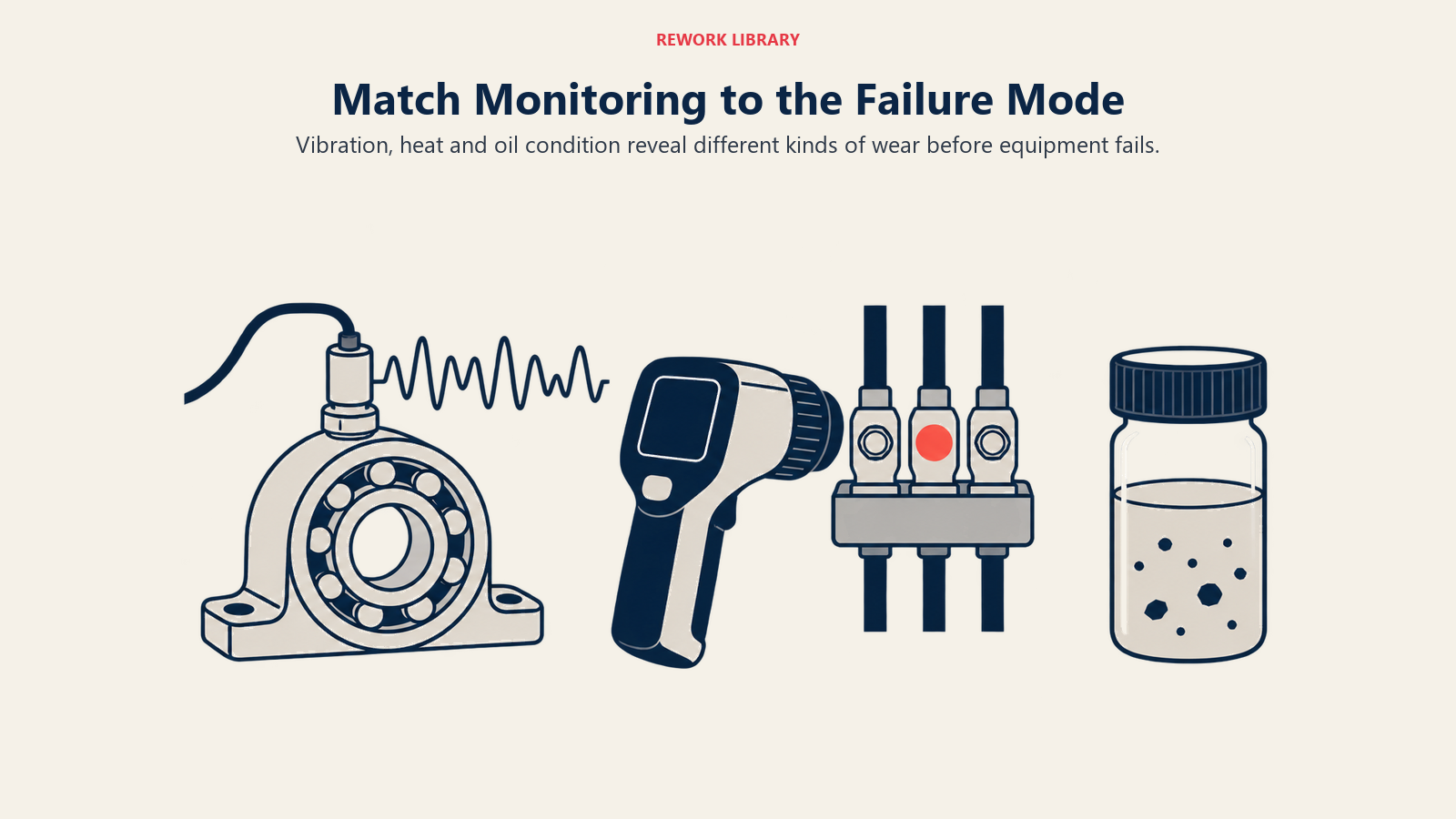
Thermography uses infrared cameras to detect temperature abnormalities. Hot spots on electrical connections indicate loose terminals or overloaded circuits. Temperature differences across motor casings suggest bearing problems or cooling system issues. Thermal imaging requires minimal equipment contact, making it ideal for energized electrical systems.
Oil analysis reveals equipment wear through microscopic metal particles in lubricating oil. Particle counts and composition identify which components are wearing (steel particles from gears, copper from bearings). Oil chemistry analysis detects contamination, oxidation, and additive depletion. This is especially valuable for large, expensive equipment like turbines and compressors.
Ultrasonic testing detects high-frequency sounds that humans can't hear. Compressed air leaks, electrical arcing, bearing friction, and steam trap failures all emit ultrasonic signatures. Ultrasonic tools can detect these problems before they become visible or cause failure.
Motor current signature analysis monitors the electrical current drawn by motors. Changes in current patterns indicate mechanical problems like broken rotor bars, bearing wear, or load abnormalities. This non-invasive technique works on any motor-driven equipment without specialized sensors.
IoT sensors enable continuous monitoring of vibration, temperature, pressure, flow, and other parameters. Unlike periodic inspections, continuous monitoring detects rapidly developing problems and captures intermittent issues. Modern wireless sensors make installation practical even on equipment in difficult-to-access locations.
Building a Predictive Maintenance Program
Criticality assessment answers the question: which equipment should we monitor? Not everything justifies the investment. Prioritize based on failure impact to production, safety risks, maintenance cost, and failure frequency. An asset that causes $10,000/hour of lost production when it fails deserves monitoring. A backup pump with a redundant spare probably doesn't. Link assessments to equipment effectiveness metrics.
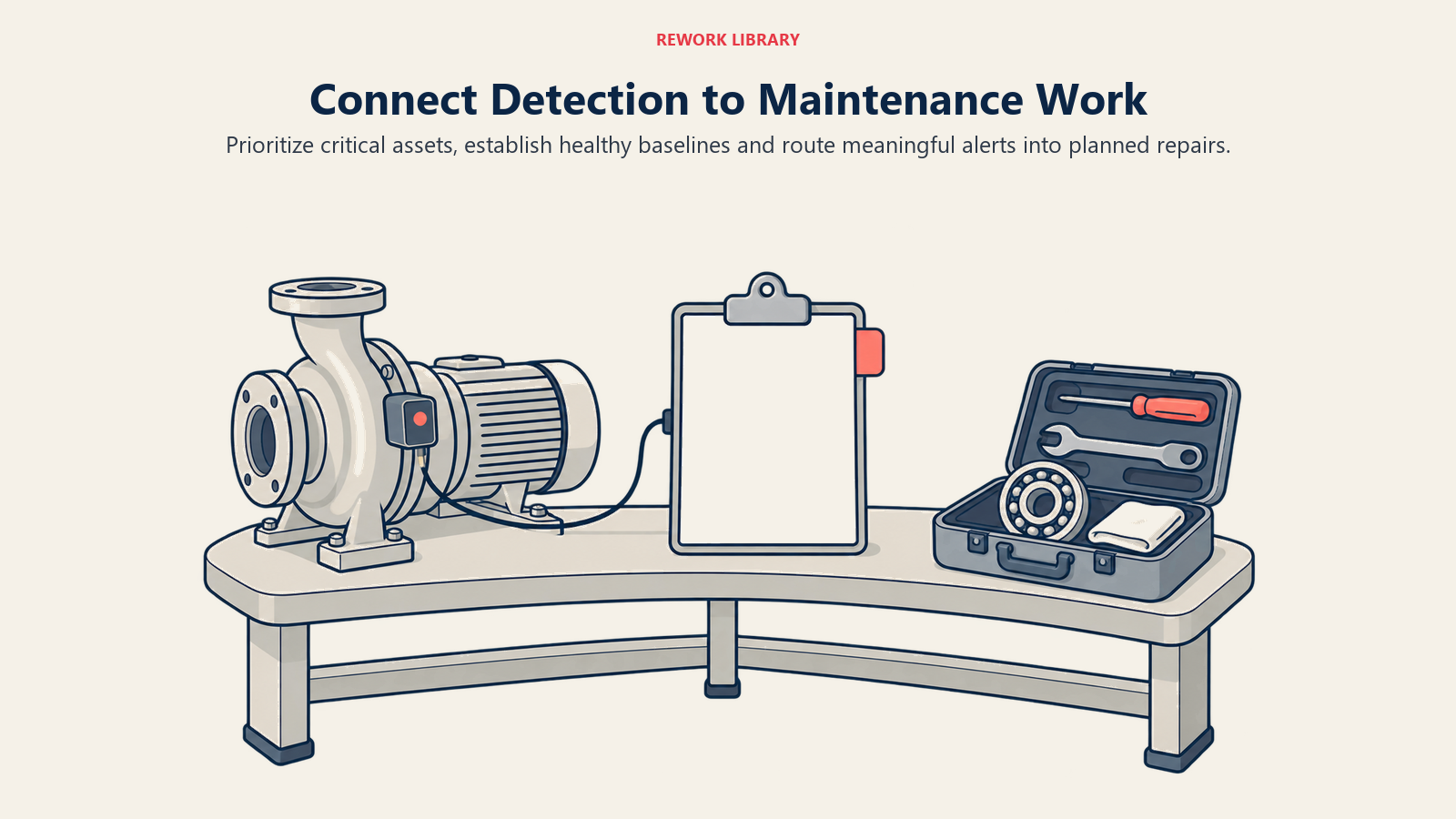
Technology selection depends on equipment type and failure modes. Rotating equipment benefits from vibration analysis. Electrical systems need thermography. Hydraulic systems require oil analysis. Don't try to boil the ocean. start with the highest-priority assets and the most appropriate technologies.
Baseline establishment and threshold setting require collecting data from equipment in known good condition. What does normal vibration look like on this pump? What's the typical oil temperature? These baselines enable detection of meaningful deviations. Thresholds define when to alert (caution level) and when to take immediate action (critical level).
Alert and workflow configuration ensures the right people get actionable information. The reliability engineer needs different information than the maintenance supervisor. Configure alerts to include context: which equipment, what parameter exceeded threshold, history of recent readings, and recommended actions.
Integration with CMMS/EAM systems closes the loop from detection to action. When the predictive maintenance system identifies a developing problem, it automatically creates a work order in the maintenance management system, pulling in equipment history, spare parts information, and maintenance procedures. This integration ensures problems don't get lost and enables tracking of issue resolution.
Analytics and Machine Learning
Time series analysis and trending identify gradual changes that indicate developing problems. Plotting vibration levels over time shows whether readings are stable, gradually increasing, or suddenly changing. Trend analysis can estimate when a parameter will exceed the failure threshold, enabling optimal maintenance timing.
Machine learning models for failure prediction learn from historical data to predict future failures. The model ingests hundreds of variables. operating parameters, ambient conditions, production schedules. and identifies complex patterns that predict failure. These AI-powered models improve as they see more data, becoming more accurate over time.
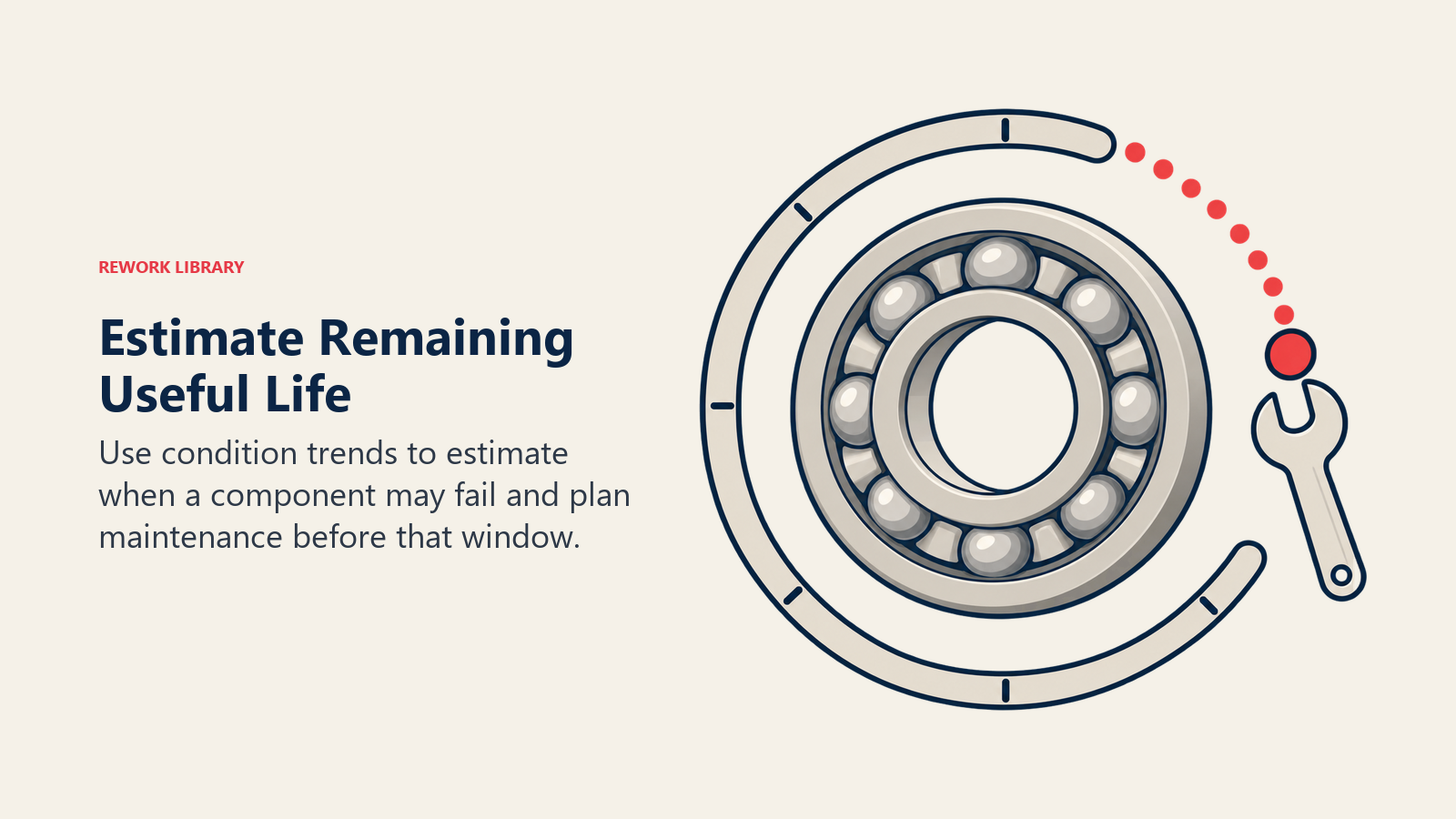
Remaining useful life (RUL) estimation answers the critical question: how much longer can this equipment run before failure? Rather than a binary "failure predicted," RUL provides a timeline: this component has 23 days of remaining useful life at current operating conditions. This enables scheduling maintenance during planned downtime rather than scrambling when equipment fails.
Anomaly detection algorithms identify unusual patterns without requiring explicit threshold definitions. The system learns what "normal" looks like for each piece of equipment and alerts when behavior deviates significantly from that norm. This catches novel problems that fixed thresholds might miss.
Organizational Considerations
Skills requirements for condition monitoring include understanding equipment mechanics, familiarity with condition monitoring technologies, ability to interpret data and trends, and integration of multiple data sources for diagnosis. These skills don't exist in most maintenance departments today. You'll need training, external partnerships, or new hires.
Maintenance planning processes must shift from reactive repair and calendar-based PM to condition-based work order generation and optimized intervention timing. The planner's role evolves from scheduling predefined tasks to analyzing condition data and determining optimal responses.
Collaboration between maintenance and operations becomes essential. Operations provides context about equipment usage and production schedules. Maintenance provides expertise in condition monitoring and repair. Effective predictive maintenance requires both perspectives. understanding not just that equipment is degrading but what production impact various response scenarios would have.
Continuous improvement based on data insights means tracking false positives, analyzing why predictions were wrong, refining thresholds and models, and documenting failure modes to improve future detection. The predictive maintenance program should get more accurate over time as you learn.
From Cost Center to Competitive Advantage
Predictive maintenance transforms maintenance from a necessary cost into a source of competitive advantage. When your equipment runs reliably because you prevent failures, you can commit to shorter lead times with confidence. When you optimize maintenance timing, you reduce costs while improving performance.
The technology has matured and become more accessible. Cloud-based platforms, affordable IoT sensors, and pre-built analytics models mean predictive maintenance is no longer just for large enterprises with dedicated data science teams.
But technology alone doesn't deliver results. Success requires clear priorities (which equipment matters most?), appropriate technology selection, skilled people who can interpret data and take action, integrated processes that connect detection to resolution, and continuous refinement based on experience.
Start small, prove value with a few critical assets, and then scale systematically. The goal isn't monitoring everything. it's preventing the failures that matter most.
Learn More

Co-Founder, Rework.com