AI and Machine Learning in Manufacturing: Intelligent Operations and Decision-Making
Turn this article into takeaways for your work.


Each assistant summarizes the article only for you and suggests best practices for your work.
An automotive parts manufacturer was scrapping 3.2% of production due to surface defects that human inspectors caught too late in the process. They'd tried adding more inspection stations, retraining inspectors, and tightening tolerances. Nothing moved the needle significantly.
Then they deployed computer vision with machine learning. The system inspects 100% of parts in real-time, identifying defects invisible to human inspectors and patterns that predict future failures. Scrap dropped to 0.8%. But more importantly, the system now catches subtle process drift hours before it produces defective parts, enabling corrections that prevent problems rather than detecting them.
This is AI's promise in manufacturing, not replacing human expertise but amplifying it with systems that learn from data, spot patterns humans miss, and make better predictions at speeds humans can't match.
AI as Systems That Learn from Data
Artificial intelligence in manufacturing encompasses technologies that enable machines to perform tasks requiring human-like intelligence, recognizing patterns, making decisions, solving problems, and learning from experience. Machine learning is a subset of AI where systems improve their performance through exposure to data without being explicitly programmed.
Understanding the distinctions matters for practical implementation. AI is the broader concept of machines performing intelligent tasks. Machine learning uses algorithms that learn patterns from data to make predictions or decisions. Deep learning, a subset of machine learning, uses neural networks with multiple layers to learn complex representations from large datasets.
Supervised learning requires labeled training data, thousands of images tagged as "good part" or "defective part," historical data showing which machine settings produced quality output. The model learns the relationship between inputs and outcomes. Unsupervised learning finds patterns in data without predefined labels, useful for anomaly detection where you can't anticipate every possible problem.
Manufacturing-specific AI applications leverage domain expertise combined with data. The most successful implementations don't try to have AI figure everything out from scratch. They incorporate decades of manufacturing knowledge into the model architecture, training approach, and interpretation of results.
High-Value Use Cases
Predictive quality represents AI's highest-impact manufacturing application. Traditional quality control detects defects after they occur. Predictive quality systems analyze real-time process data, machine settings, material properties, environmental conditions, to predict when the process will produce defective parts. This enables corrections before defects happen rather than scrap after the fact.
A precision machining company implemented predictive quality for a critical drilling operation. The AI model monitors 42 process parameters and material characteristics. When the model predicts quality drift, it alerts the operator and suggests parameter adjustments. This shifted their approach from reactive inspection to proactive process control, reducing scrap by 67%.
Visual inspection and automated quality control use computer vision to inspect parts faster and more consistently than humans. Cameras capture images. AI models analyze those images for defects, dimensional variations, assembly errors, and surface finish issues. These systems inspect 100% of production at line speed, eliminating sampling and the fatigue-related inconsistency of human inspection.
Predictive maintenance and failure prediction analyzes equipment sensor data to forecast failures before they occur. Vibration patterns, temperature trends, power consumption, and acoustic signatures feed machine learning models that predict when components will fail. This enables scheduled replacement during planned downtime rather than emergency repairs during production.
Demand forecasting and production optimization uses machine learning to predict future demand more accurately than traditional statistical methods. These models incorporate far more variables than humans can handle, historical sales, seasonality, economic indicators, weather patterns, promotional activities, competitive dynamics. Better forecasts enable optimal inventory levels and production schedules.
Supply chain optimization applies AI to the complex decisions of sourcing, logistics, and inventory placement. Machine learning models balance cost, lead time, quality, and risk across thousands of scenarios to recommend optimal decisions. These systems continuously adapt as conditions change.
Process parameter optimization finds the ideal settings for complex manufacturing processes. Traditional design of experiments approaches can't handle the dimensionality of modern processes with hundreds of adjustable parameters. AI explores the parameter space efficiently, learning which combinations produce optimal results for quality, throughput, and cost.
Anomaly detection in operations identifies unusual patterns that indicate problems. Unlike threshold-based alerts that require someone to define what "abnormal" means, anomaly detection models learn normal operating patterns and flag deviations. This catches novel problems and subtle issues that predefined rules miss.
Computer Vision Applications
Automated defect detection has become the most mature AI application in manufacturing. A pharmaceutical packaging line uses vision AI to inspect blister packs for missing tablets, damaged packaging, incorrect labels, and foreign material. The system processes 600 packages per minute, identifying defects human inspectors miss while eliminating the bottleneck of manual inspection, significantly improving first pass yield.
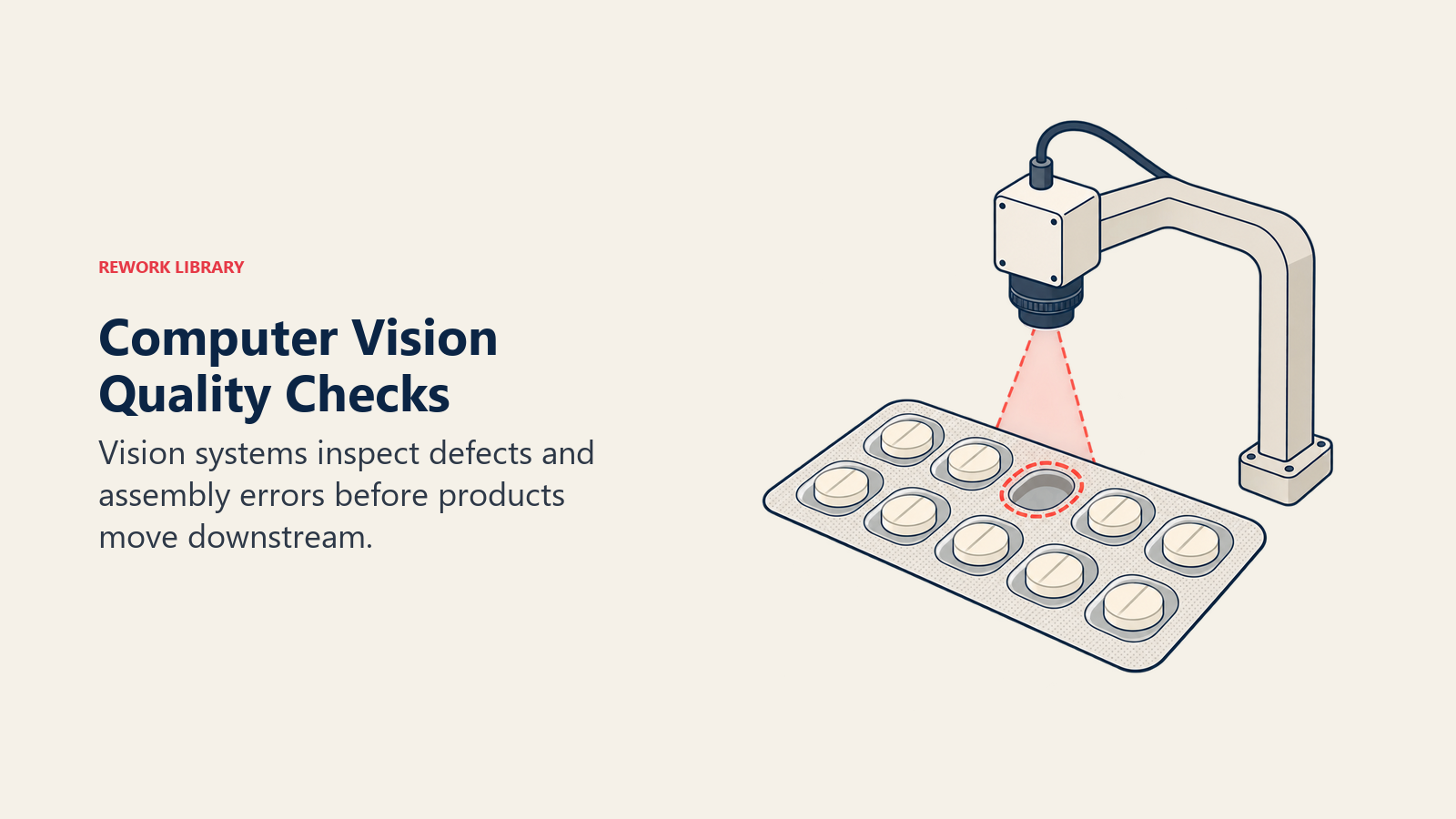
Assembly verification ensures components are present and correctly oriented before the product advances. Computer vision checks that all fasteners are installed, wiring is routed correctly, and labels are applied properly. This catches errors immediately rather than discovering them during final testing or, worse, customer returns.
Reading gauges and meters automates data collection from analog instruments. Many facilities still rely on operators walking through the plant recording gauge readings. Vision AI can "read" these instruments automatically, feeding data directly into monitoring systems without requiring sensor installation on every piece of equipment.
Safety compliance monitoring detects unsafe behaviors and conditions. AI analyzes video feeds to identify workers not wearing required PPE, unsafe proximity to moving equipment, or proper lockout/tagout procedures. This provides safety teams with objective data while enabling real-time intervention to prevent accidents.
Practical Implementation Path
Use case identification and prioritization determines where AI delivers the most value with the least risk. Evaluate potential applications based on business impact (what's the financial benefit?), data availability (do you have the data to train models?), implementation complexity, and organization readiness. Start with high-value, lower-complexity applications to build capability and confidence.
Data requirements and quality often determine success or failure. Machine learning models need substantial data, thousands to millions of examples depending on the application. That data must be accurate, relevant, and representative of the conditions the model will encounter in production. Investing time in data collection, cleaning, and preparation pays dividends in model performance.
The build versus buy decision has shifted toward buy for many manufacturing AI applications. Specialized vendors offer pre-trained models for common applications like visual inspection, predictive maintenance, and demand forecasting. These commercial solutions accelerate deployment and leverage learning from thousands of implementations. But custom development makes sense for truly unique processes or when AI becomes a competitive differentiator.
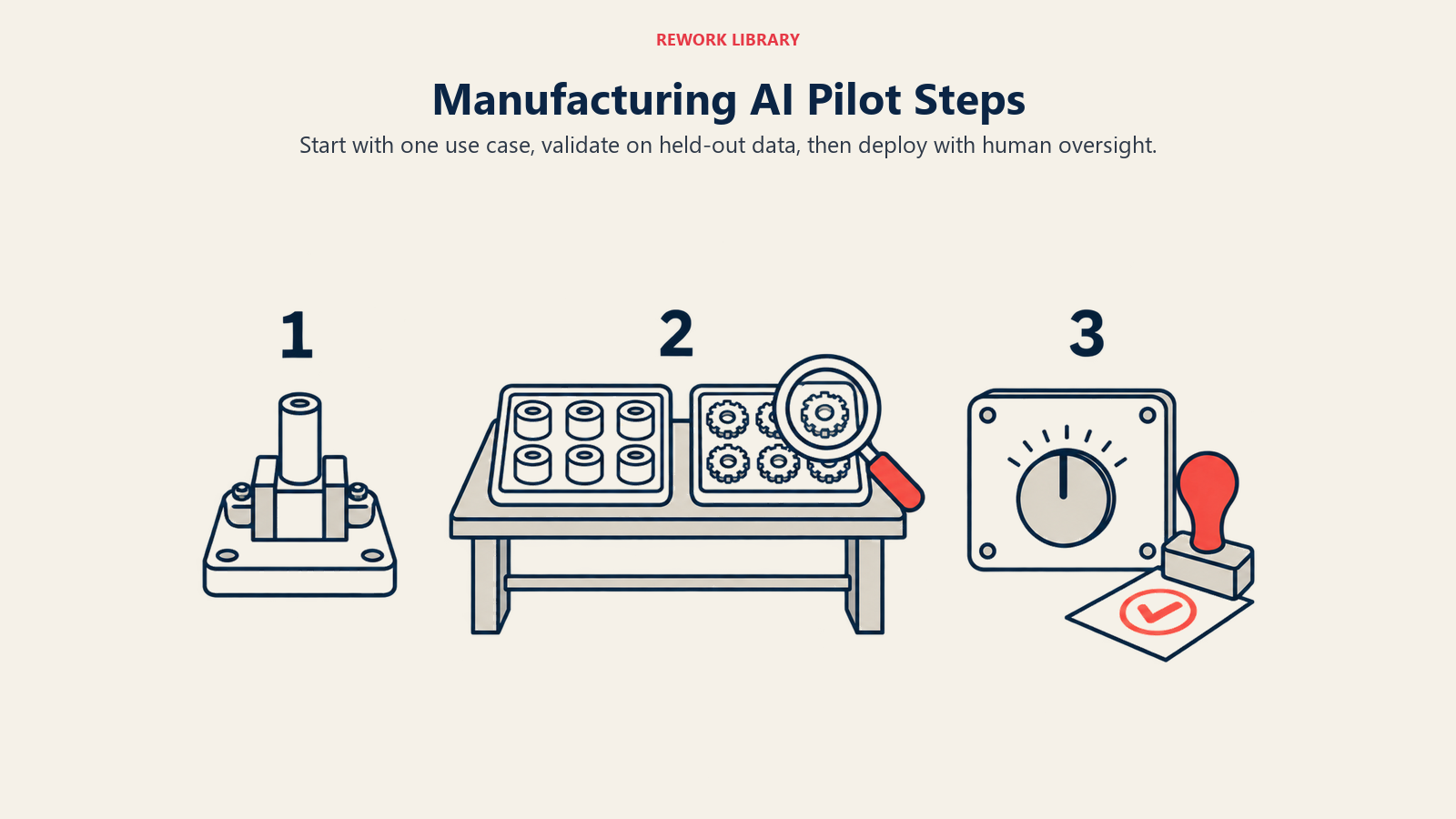
Proof of concept methodology reduces implementation risk. Select a narrow use case with clear success criteria, allocate 8-12 weeks for POC development and testing, evaluate results objectively against the business case, and proceed to production deployment only if POC demonstrates value. Pilots that fail quickly and cheaply are valuable learning experiences.
Model training and validation requires statistical rigor. Split your data into training sets (used to teach the model), validation sets (used to tune the model), and test sets (used to evaluate final performance on data the model has never seen). This prevents overfitting where models perform well on training data but fail in production.
Deployment and monitoring is where theory meets reality. Start with the model advising humans rather than making autonomous decisions. Monitor model predictions versus actual outcomes. Retrain periodically as conditions change. Establish clear escalation paths when the model encounters situations outside its training.
Building the Data Foundation
Data collection and storage infrastructure must precede AI implementation. You need databases that can store time-series sensor data, image repositories for vision applications, data lakes for unstructured data, and ETL processes to collect data from manufacturing systems. Cloud platforms offer scalable storage and computing resources without upfront infrastructure investment.
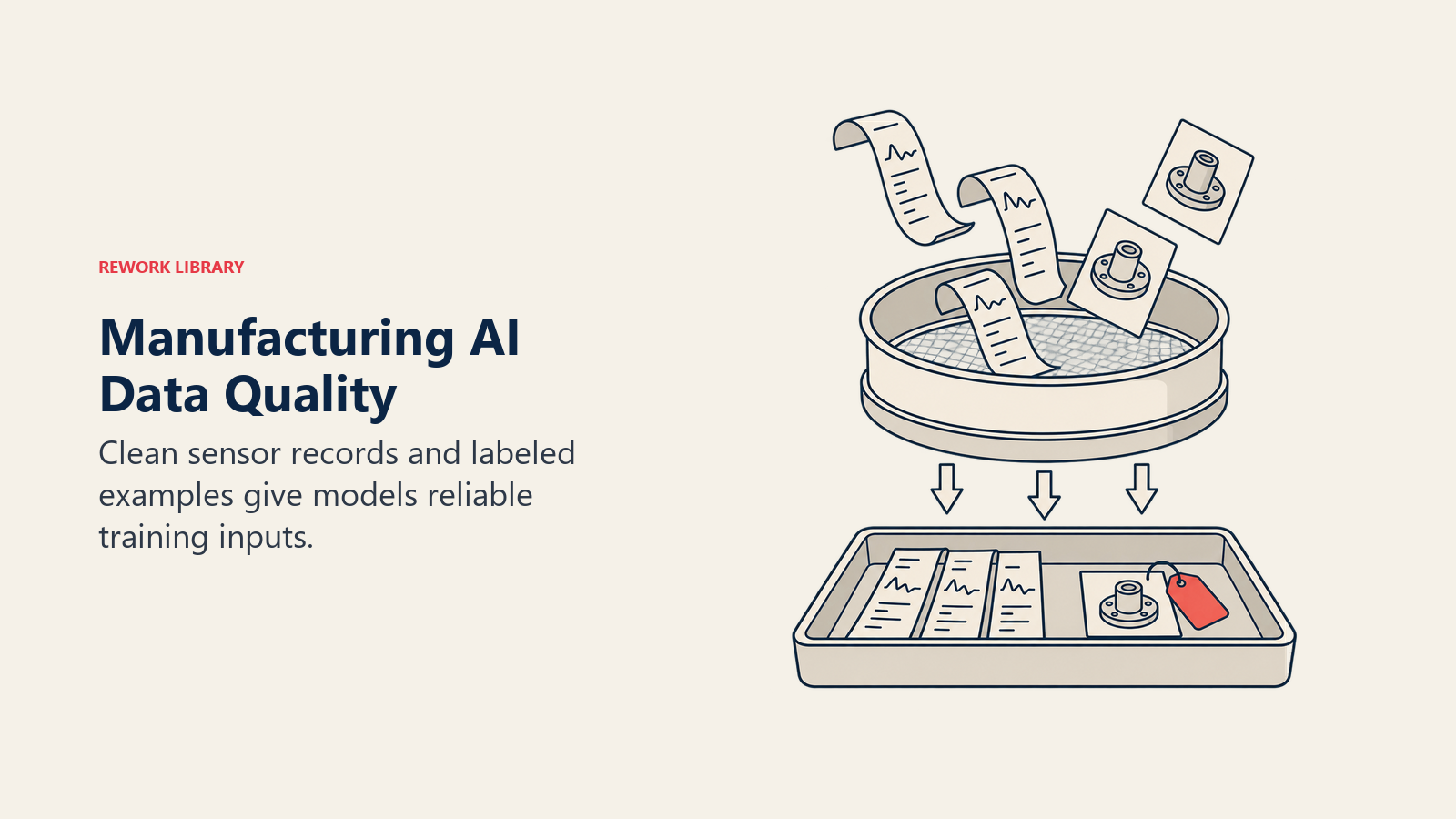
Data quality and cleaning addresses the reality that manufacturing data is messy. Sensors drift, communication links fail, operators enter data incorrectly. Data cleaning identifies and corrects errors, handles missing values, removes outliers, and normalizes data from different sources. Budget 40-60% of initial AI project effort for data quality work.
Feature engineering transforms raw data into inputs that machine learning models can use effectively. Raw sensor data becomes statistical summaries (mean, variance, trends), time-based features (hour of day, day of week), and derived metrics (ratios, rates of change). Domain expertise guides feature engineering, manufacturing engineers understand which variables matter and how they relate.
Labeled data for supervised learning means someone must classify examples so the model can learn. For visual inspection, technicians must label thousands of images as good or defective. For predictive maintenance, historical failure records must be linked to sensor data leading up to those failures. Data labeling is tedious but essential work.
Organizational Readiness
Data science talent requirements include statistical and machine learning expertise, programming skills (Python, R), domain knowledge about manufacturing processes, and ability to communicate technical results to business stakeholders. Few organizations have this talent internally. Options include hiring data scientists, upskilling existing engineers, or partnering with external specialists.
Partnership models bridge the talent gap. Manufacturing AI vendors provide domain expertise and proven models. System integrators handle deployment and ongoing support. University partnerships give access to research and interns. The right model depends on your strategic importance of AI and internal capability.
Change management for AI-driven decisions addresses human resistance to trusting machine recommendations. Operators with decades of experience don't naturally defer to algorithms. Transparent models that explain their reasoning build trust. Starting with AI as advisor rather than decision-maker allows validation. Demonstrating results convinces skeptics better than theoretical arguments.
Ethics and responsible AI considerations prevent unintended consequences. Ensure training data doesn't encode biases that lead to unfair decisions. Maintain human oversight for high-stakes decisions. Protect data privacy and security. Be transparent about AI's limitations. These aren't just compliance issues, they protect your business and employees.
Transformation Through Intelligence
AI in manufacturing isn't about futuristic robots or science fiction scenarios. It's about applying proven technologies to longstanding problems in new ways that deliver measurable business results.
The manufacturers seeing the greatest value started with specific problems (too much scrap, unreliable equipment, inaccurate forecasts) rather than generic "AI initiatives." They invested in data foundations before models. They piloted small, learned fast, and scaled what worked. They combined AI capabilities with manufacturing expertise rather than treating technology as a replacement for experience.
The competitive advantage goes to manufacturers who deploy AI systematically across multiple use cases, building a virtuous cycle where better data enables better models that enable better decisions that generate more data.
The technology is ready. The question is whether you're building the capabilities to use it.
Learn More
