Global Manufacturing Strategy: Location, Configuration, and Coordination for Competitive Advantage

Turn this article into takeaways for your work.


Each assistant summarizes the article only for you and suggests best practices for your work.
A medical device company manufactured everything in California where it was founded. Labor costs were high. Logistics to European and Asian customers added weeks and significant expense. But moving production offshore felt risky. Then a competitor opened facilities in Ireland and Singapore, capturing regional customers with faster delivery and lower prices. The California-only strategy that felt safe became a competitive disadvantage. Geographic concentration created vulnerability instead of control.
Manufacturing location isn't just an operational decision. It's strategic positioning that determines cost structure, market access, supply chain resilience, and competitive capability. Where you make things shapes what you can make, how quickly you can deliver, what margins you can achieve, and which customers you can serve effectively. Geographic strategy either creates sustainable advantage or permanent handicap.
Why Location Matters
Manufacturing geography affects multiple dimensions of competitive performance simultaneously. Low-cost locations reduce unit costs but might increase logistics expenses or quality risks. Market-proximate locations enable fast delivery but fragment scale. Single-site concentration provides control but creates vulnerability. There's no perfect answer. The right geography balances trade-offs aligned with your strategic priorities.
Labor cost variations are dramatic. Manufacturing labor in Mexico costs 30% of US rates. Eastern European wages run 25% of Western Europe. Southeast Asia averages 10-15% of developed markets. For labor-intensive manufacturing, location determines whether products are cost-competitive. High-wage locations must compensate through automation, productivity, or value-added services that justify premiums.
But labor is only one cost element. Total cost of ownership includes logistics, inventory, quality, lead time, and risk. A low-wage facility far from customers might cost more delivered than a high-wage facility nearby. Inventory in transit and safety stocks for long lead times offset wage savings. Quality issues and rework from distant suppliers destroy margin. Comprehensive cost analysis prevents optimizing one element while sub-optimizing total cost.
Market access drives location when customer proximity matters. Heavy products ship expensively. Perishable goods need short supply chains. Customers requiring engineering support need local presence. Regional manufacturing enables responsive service that distant facilities can't match regardless of cost. Being close to customers isn't just about logistics. It's about relationships and responsiveness.
Talent and capabilities cluster geographically. Precision machining concentrates in Germany and Switzerland. Electronics in Southeast Asia and China. Automotive in the Midwest and Germany. These clusters provide skilled labor, specialized suppliers, and institutional knowledge that's hard to replicate elsewhere. Sometimes you locate where capabilities exist rather than trying to build them from scratch in lower-cost regions.
Risk diversification requires geographic distribution. Natural disasters, political instability, trade conflicts, and pandemics affect regions differently. Single-site manufacturing creates existential risk. Multi-region networks provide resilience through redundancy. But resilience costs. You're trading efficiency for security.
Network Configuration Options
Global manufacturing networks configure in different patterns depending on strategic priorities and industry economics. Understanding configuration options helps design networks that fit your business rather than defaulting to industry norms.
Global platforms manufacture high-volume products at low-cost locations and ship worldwide. This concentration maximizes scale economies and process optimization. One facility becomes world-class at specific products. But global platforms create long supply chains, high inventory, and inflexibility. They work best for stable, standardized products where scale matters more than responsiveness.
Regional manufacturing establishes facilities serving major markets. A European facility serves Europe. An Asian facility serves Asia. North American facility serves the Americas. This approach balances scale within regions against proximity to markets. Lead times shorten. Inventory requirements decrease. Local presence enables customer engagement. But regional manufacturing multiplies facilities and dilutes scale.
Local manufacturing serves individual countries or small regions. This fits regulatory requirements (like pharmaceuticals), customization needs, or protectionist trade policies. Local manufacturing maximizes responsiveness and regulatory compliance but sacrifices scale completely. Unit costs are high. Process consistency is challenging. You make this choice when market access requires it, not because it's economically optimal.
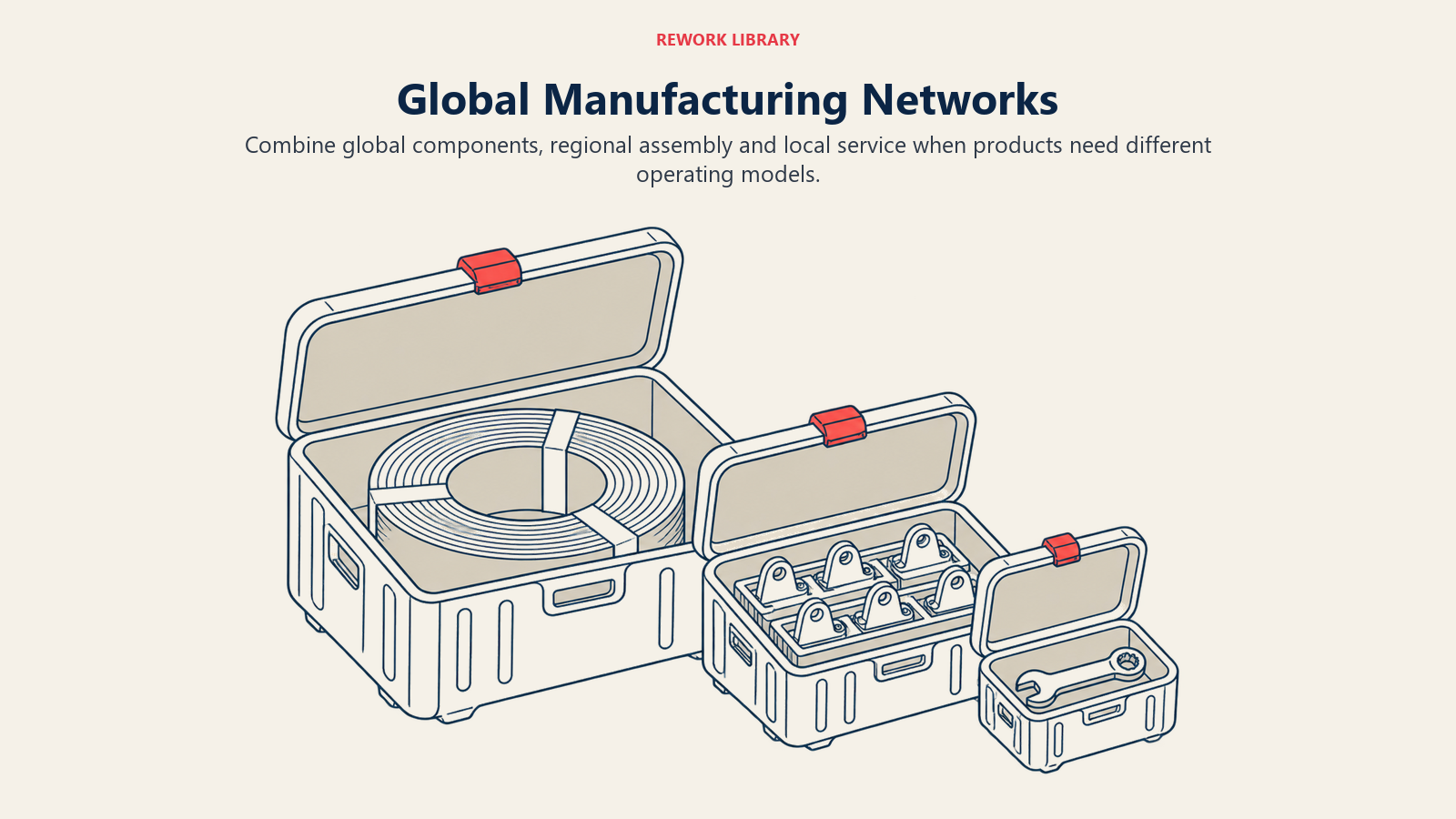
Hybrid networks combine these approaches. Global platforms for commodity components. Regional assembly for customization. Local presence for service and emergency supply. Most large manufacturers end up with hybrid networks because no pure strategy fits all products and markets. The key is making hybrid choices deliberately rather than accumulating facilities reactively.
Location Selection Analysis
Choosing manufacturing locations requires systematic evaluation of multiple factors. Gut feeling about regions doesn't cut it. Neither does following competitors or chasing lowest labor rates. Good location decisions result from comprehensive analysis.
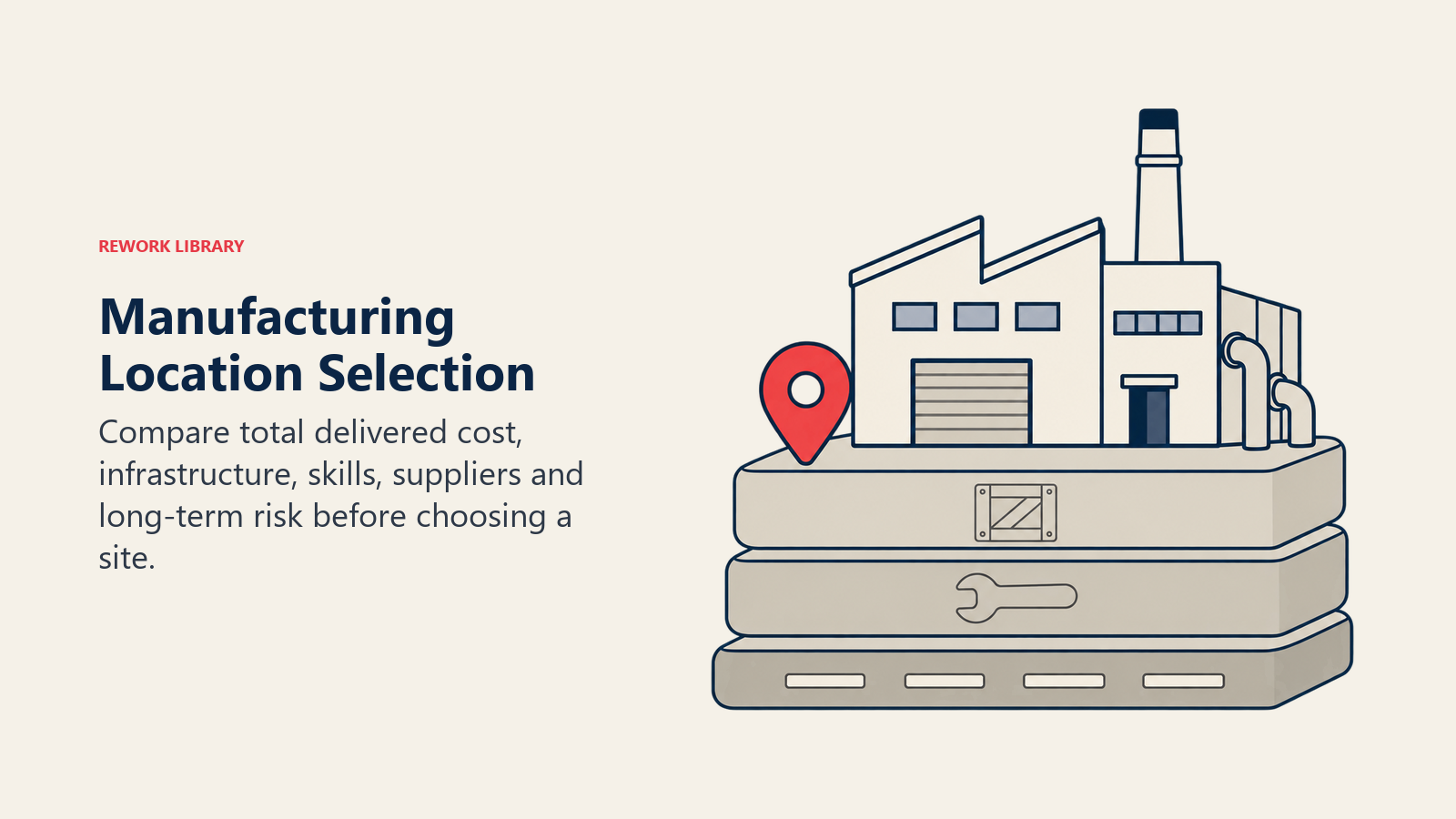
Cost modeling compares total delivered cost from alternative locations. Build models including labor, materials, utilities, overhead, logistics, inventory, and quality costs. Model multiple scenarios because cost factors change. Oil prices affect logistics. Currency fluctuations shift labor costs. Tariffs reshape trade economics. Scenario analysis reveals which locations hold up across different futures versus which are optimal only under specific assumptions.
Infrastructure assessment evaluates transportation networks, utilities, telecommunications, and support services. Good infrastructure prevents operational constraints and enables efficient operations. Poor infrastructure creates costs that offset wage advantages. Can the location support your technology requirements? Is power reliable? Are ports and airports accessible? Can you get materials delivered reliably? These operational realities matter more than theoretical costs.
Talent availability determines whether you can staff operations with required skills. Look beyond average education levels to specific technical capabilities your processes need. Is there a talent pool with relevant experience? Can you recruit engineers and managers? What training programs exist? How hard is it to retain people? Locations with talent clusters work better than locations requiring you to develop all capabilities from scratch.
Regulatory environment affects operating costs and risks. Some locations have streamlined permits and business-friendly policies. Others have bureaucratic complexity that consumes management time and creates uncertainty. Environmental regulations vary. Labor laws differ. Tax policies matter. Understand the full regulatory burden before committing to locations.
Supplier ecosystems provide or constrain supply chain effectiveness. Locations with established supplier networks enable just-in-time delivery and fast problem-solving. Locations requiring you to bring suppliers with you or ship materials long distances increase inventory and reduce flexibility. Proximity to suppliers often matters more than proximity to customers.
Political and economic stability determines long-term viability. Some regions offer low costs today but create risks through political instability, property rights uncertainty, or economic volatility. These risks might be acceptable for short-term operations but not for major capital investments you need to last 20 years. Assess both current conditions and trajectory.
Operating Model Decisions
Global manufacturing networks require operating models that coordinate across sites while allowing appropriate local autonomy. Too much centralization kills local initiative. Too much autonomy prevents network optimization. The right balance depends on your strategy and products.
Standardization versus localization determines how much processes vary across sites. Standardized processes enable products to move between sites, simplify training, and transfer best practices easily. But standardization might force processes that don't fit local conditions or prevent taking advantage of local capabilities. Standardize where consistency creates value. Localize where adaptation improves performance.
Technology transfer shares manufacturing capabilities across the network. When one site develops superior processes, others should adopt them. When new products launch, production knowledge must transfer to all relevant sites. This requires formal technology transfer programs, not just documentation sharing. People need to teach people. Processes need to adapt to local conditions while maintaining core performance.
Decision rights allocation defines what sites control versus what headquarters directs. Sites typically manage daily operations, local improvement, and workforce decisions. Headquarters allocates products across sites, sets standards, and makes capital investments. Hybrid decisions like supply chain involve both levels. Clear decision rights prevent confusion and conflict.
Performance measurement holds sites accountable while supporting network objectives. Site-level metrics track operational excellence. Network metrics ensure system optimization. Both matter. Sites shouldn't optimize locally at network expense. Networks shouldn't sacrifice all local performance for aggregate numbers. Balanced scorecards align incentives.
Future Trends Reshaping Location Strategy
Global manufacturing geography is shifting. Trends that seemed permanent are reversing. New factors are emerging. Yesterday's location strategies might be obsolete tomorrow.
Reshoring and near-shoring are bringing manufacturing closer to major markets. According to Deloitte's 2026 Manufacturing Outlook, 74% of manufacturers are reshoring or nearshoring operations. This shift responds to supply chain disruptions, rising wages in traditional low-cost regions, automation reducing labor content, and desires for responsiveness. Reshoring doesn't mean returning everything to high-wage countries. It means rebalancing networks toward greater proximity even if that means modestly higher unit costs.
Automation changes location economics. When labor represents 5% of product cost instead of 40%, wage rates matter less than logistics, skills, and infrastructure. Automated manufacturing can locate where it makes strategic sense rather than where labor is cheapest. This enables manufacturing in higher-cost regions that offer other advantages.
Sustainability considerations affect location decisions. Carbon footprints from long supply chains create regulatory and customer pressures. Some companies are choosing locations that reduce transportation miles and enable renewable energy access. Sustainability isn't just compliance. It's competitive positioning with customers who care about environmental impact.
Geopolitical risk has increased. Trade conflicts, sanctions, and nationalism create location risks that were dormant for decades. Companies are rethinking Chinese concentration, diversifying across regions, and maintaining redundant capacity in stable jurisdictions. Geographic diversification is insurance against geopolitical disruption.
Digital technologies enable distributed manufacturing that wasn't previously viable. Advanced manufacturing execution systems, remote monitoring, and collaboration platforms allow companies to operate multiple sites with less physical presence required. This reduces the overhead penalty of distributed networks making more locations viable.
Building Network Resilience
Recent supply chain disruptions have elevated resilience from nice-to-have to strategic necessity. Location strategy must now balance efficiency and resilience explicitly.
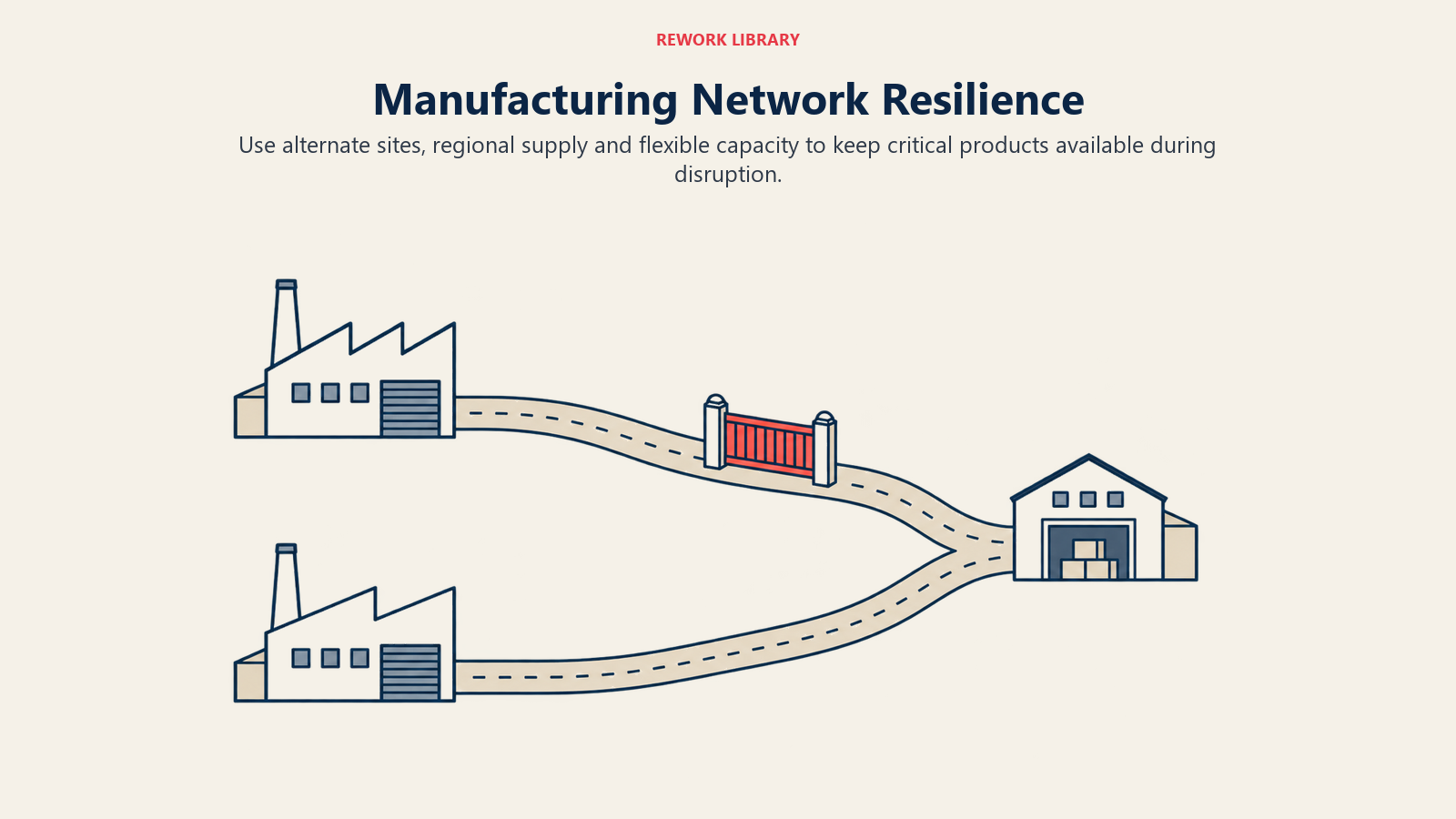
Dual sourcing critical products from geographically separated facilities provides backup when one site goes down. This costs scale economies and increases complexity. But for critical products where supply interruption is catastrophic, dual sourcing is insurance worth buying.
Regional autonomy in materials and suppliers reduces dependency on single supply chains. If each region sources materials locally when possible, regional supply chains become more resilient even if global optimization suffers. The trade-off between global efficiency and regional resilience must be conscious.
Inventory positioning in multiple locations creates buffers against supply chain disruptions. Strategic inventory costs working capital but enables serving customers when primary facilities are disrupted. This is particularly important for long-lead-time products where production interruptions take months to overcome.
Flexible capacity that can shift between products or regions provides operational resilience. When demand shifts unexpectedly or supply disruptions occur, flexible facilities can respond. Dedicated facilities optimize specific products but lack resilience. The right balance depends on demand stability and disruption risk.
Moving Forward
Global manufacturing strategy determines competitive position for years. Location decisions involve major capital commitments that are expensive and slow to change. Getting geography right matters enormously.
Don't follow competitors or industry norms blindly. What works for others might not fit your products, customers, or strategic priorities. Analyze comprehensively based on your specific circumstances. The right answer for your business might differ from industry patterns.
Think in networks, not sites. The question isn't whether location X is good. It's whether a network including location X creates competitive advantage. Individual sites must fit into coherent network strategies that optimize the total system.
Balance cost efficiency and strategic flexibility. The lowest-cost network today might lack resilience or adaptability for tomorrow's requirements. Build in flexibility even if it costs marginally more. The premium for flexibility becomes insurance against uncertainty.
Plan for evolution, not permanence. Global manufacturing networks must adapt as products, markets, technologies, and geopolitics evolve. Treat network design as continuous process, not one-time decision. Review regularly. Adjust as conditions change. Static networks become obsolete.
Remember that manufacturing location shapes capability as much as cost. Where you make things determines what expertise you develop, which innovations occur, and what partnerships form. Geographic choices create path dependencies that affect your business for decades. Make these choices with full awareness of their strategic implications.
Learn More
