Manufacturing Overhead Cost Allocation: Methods to Improve Product Costing Accuracy
Turn this article into takeaways for your work.


Each assistant summarizes the article only for you and suggests best practices for your work.
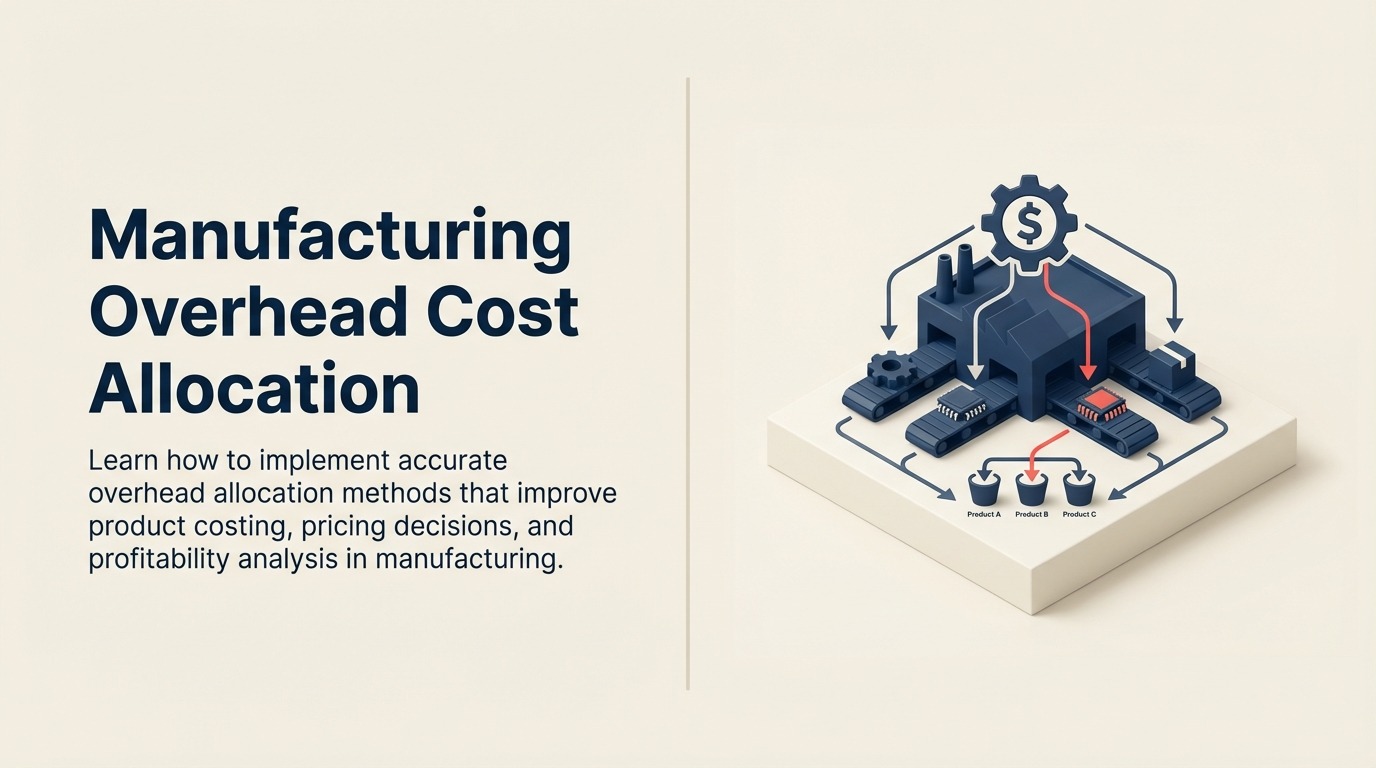
Manufacturing overhead allocation is how you assign indirect costs (rent, utilities, depreciation, supervision, quality) to individual products. Overhead runs 30 to 50% of total manufacturing cost and reaches well beyond direct labor and material, so the allocation method you pick determines whether your product costs are accurate. Traditional plant-wide rates spread overhead by a single base like labor hours and often distort costs. Activity-based costing assigns overhead by what each product actually consumes.
A mid-sized electronics manufacturer discovered their flagship product wasn't as profitable as they thought. After implementing activity-based costing, they realized their traditional overhead allocation had been understating costs by 35%. The product they'd been pushing hardest was actually losing money. This isn't unusual: most manufacturers using outdated allocation methods can't see the true economics of their products.
When overhead represents 30-50% of total manufacturing costs, getting allocation right matters. The method you choose determines what you measure, what you see, and ultimately what you decide. Bad allocation leads to mispriced products, misguided strategy, and margin erosion you can't explain.
Understanding Manufacturing Overhead
Overhead includes every manufacturing cost that isn't direct material or direct labor. That means factory rent, utilities, equipment depreciation, maintenance, quality control, production supervision, and dozens of other expenses. These costs are real, but they don't attach naturally to specific products.
Traditional methods solve this problem by spreading overhead using simple allocation bases like direct labor hours or machine hours. If Product A uses 10% of direct labor hours, it gets allocated 10% of overhead. Simple, consistent, and often wrong.
The problem appears when different products consume overhead resources at different rates. A complex product requiring extensive setup, quality inspection, and engineering support might use the same machine hours as a simple product that runs continuously. Traditional allocation treats them the same. The result is that high-volume, simple products subsidize low-volume, complex ones.
Traditional Allocation Methods
Most manufacturers start with direct labor hours. The logic seems sound: if labor drives overhead costs like supervision and benefits, then products using more labor should absorb more overhead. Calculate a plant-wide overhead rate by dividing total overhead by total direct labor hours, then apply this rate to each product.
This worked reasonably well when direct labor was a large cost component and production processes were similar across products. But modern manufacturing has changed. Direct labor is often less than 10% of product cost. Automation has reduced labor while increasing equipment and technology costs. Product complexity varies dramatically. A single plant-wide rate based on labor can't capture these realities.
Machine hours offer a better basis for equipment-intensive operations. If depreciation, power, and maintenance represent most overhead, then machine time becomes a more accurate driver. Products running longer on expensive equipment should absorb more overhead. The logic improves but limitations remain.
Both methods share a fundamental flaw: they assume overhead costs vary proportionally with a single activity. Real overhead includes dozens of cost pools driven by different activities. Setup costs relate to batch frequency, not production hours. Quality costs track inspection complexity. Engineering support depends on product customization. No single allocation base captures this diversity.
Activity-Based Costing
Activity-based costing (ABC) acknowledges that overhead consists of distinct cost pools with different drivers. Instead of one plant-wide rate, ABC identifies activities that consume resources and assigns costs based on activity consumption.
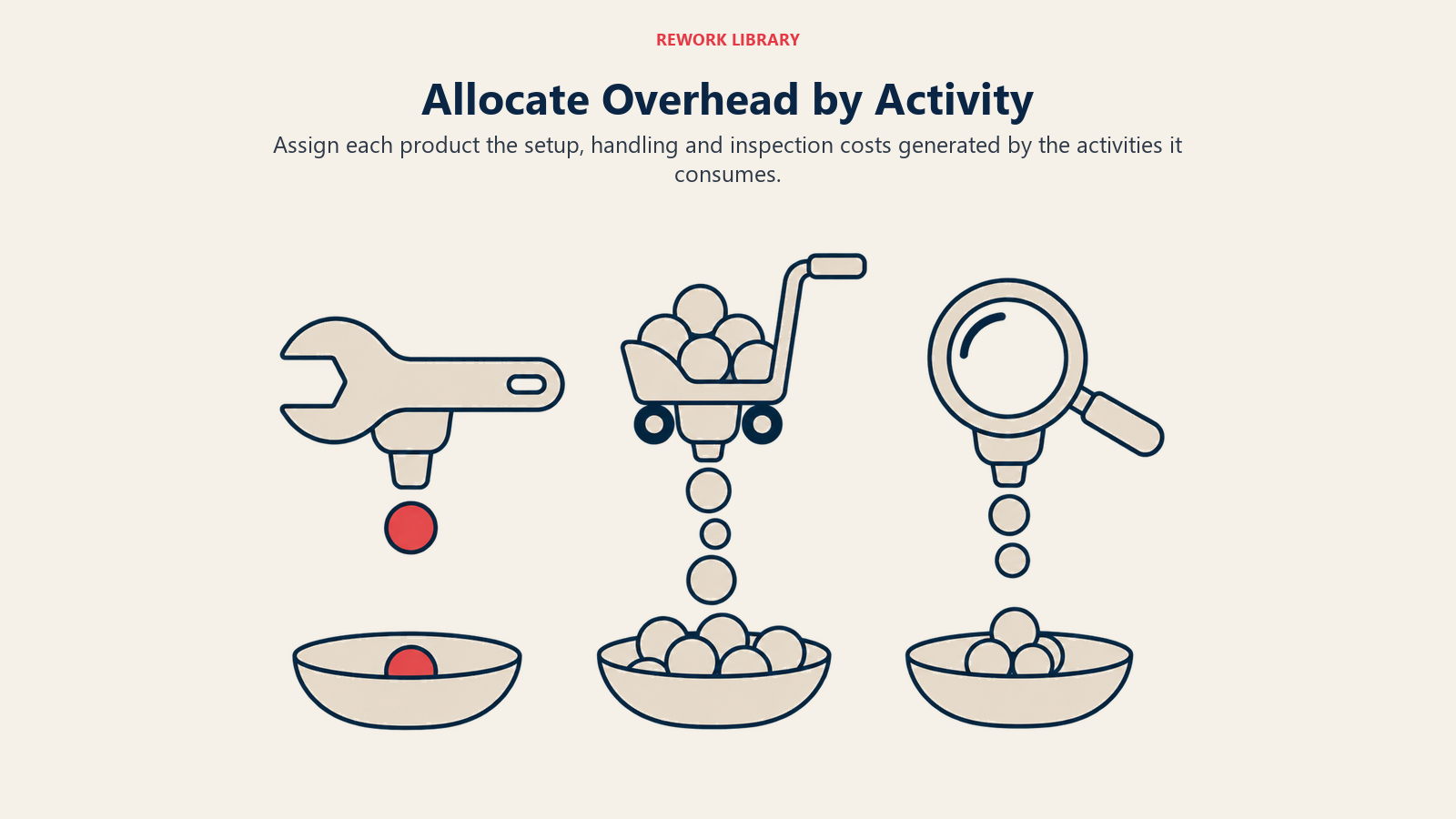
Start by identifying major activities: machine setup, material handling, quality inspection, engineering changes, production scheduling, maintenance. Each activity creates a cost pool containing all resources consumed. Then determine the driver that best explains cost variation. According to Harvard Business School research, effective cost allocation requires identifying cause-and-effect relationships between activities and costs. Setup costs might use number of setups. Material handling uses number of moves. Quality inspection tracks number of inspections.
Calculate an activity rate by dividing each cost pool by its total driver quantity. A setup costing $500 per occurrence becomes a rate. Products consuming activities get charged accordingly. A low-volume custom product requiring frequent setups, special material handling, and extensive inspection accumulates higher overhead than a high-volume standard product.
The difference can be dramatic. Traditional costing might allocate $15 overhead per unit across all products. ABC might reveal that simple products actually cost $8 while complex ones cost $35. This information transforms decision-making. You can see which products truly generate margin, which customers are profitable, and where process improvements deliver the biggest returns.
Here's how the main allocation methods compare on accuracy, effort, and where each one fits:
| Method | Allocation basis | Accuracy | Effort to maintain | Best fit |
|---|---|---|---|---|
| Plant-wide labor rate | Direct labor hours | Low | Low | Single product line, labor-heavy processes |
| Machine-hour rate | Machine run time | Moderate | Low | Equipment-intensive, automated operations |
| Activity-based costing | Multiple activity drivers | High | High | Diverse product mix, varying complexity |
| Time-driven ABC | Activity time x capacity rate | High | Moderate | Complex mix that needs ABC accuracy with less upkeep |
The pattern is consistent: accuracy rises as you move from a single allocation base to driver-based methods, and time-driven ABC recovers most of that accuracy without the transaction-tracking burden of full ABC.
Time-Driven ABC
Standard ABC improves accuracy but requires extensive effort to maintain. Tracking every activity transaction becomes burdensome. Time-driven ABC simplifies implementation while retaining most benefits.
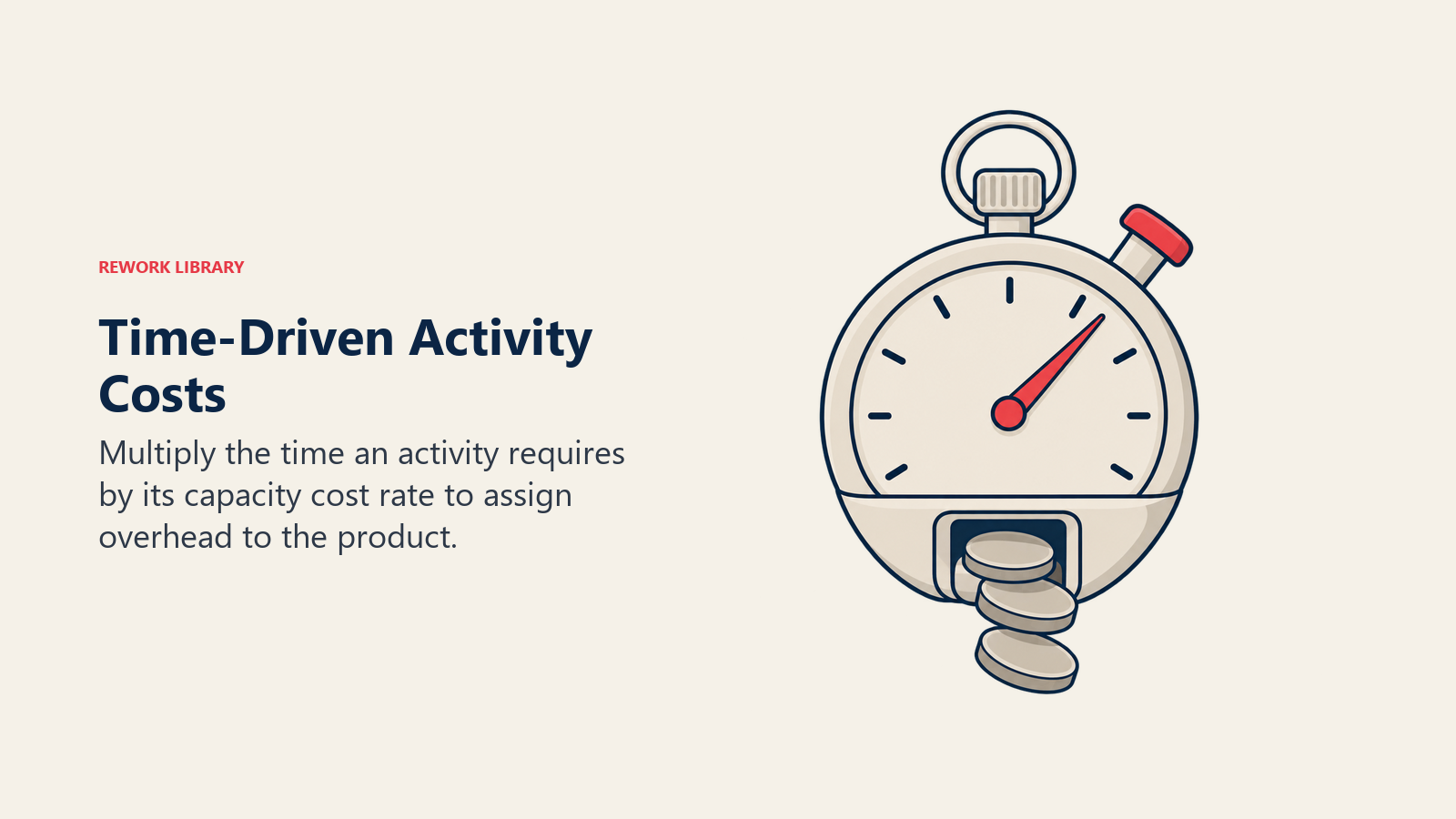
This approach estimates the time required for each activity rather than counting transactions. Instead of tracking 2,500 setups, calculate that setups require 30 minutes average. Multiply time by a capacity cost rate (total overhead divided by practical capacity hours) to determine product overhead.
The key advantage is flexibility. You can differentiate activities by complexity without creating separate cost pools. A standard setup takes 30 minutes at $120 per hour = $60. A complex setup requiring tool changes takes 90 minutes = $180. Products get charged based on actual resource consumption without maintaining detailed transaction databases.
Time-driven ABC also highlights capacity utilization. If your plant has 400,000 practical capacity hours and uses only 300,000, you're operating at 75% capacity. The unused capacity cost becomes visible, prompting conversations about volume growth or cost reduction that traditional costing obscures. Research from McKinsey shows that manufacturers implementing time-driven ABC typically identify 15-20% cost reduction opportunities.
Implementation Framework
Implementing better overhead allocation doesn't require revolutionizing your entire cost system. Start with a pilot focusing on products or product lines with suspected costing issues. High-volume and low-volume products in the same category make good candidates because traditional methods are most likely to distort their costs.
Begin by mapping major activities and estimating their costs. You don't need perfect precision. Interview production managers, quality leaders, and maintenance supervisors. Where do they spend time? What drives their workload? A rough breakdown of overhead by activity reveals patterns immediately.
Next, identify cost drivers for each activity pool. Look for measures that correlate with resource consumption and are already tracked or easy to measure. Perfect drivers aren't necessary. Good enough drivers that you'll actually maintain beat theoretically perfect drivers you'll abandon.
Calculate rates and apply them to pilot products. Compare results to traditional costing. The differences will either confirm your suspicions or surprise you. Either way, you'll understand product economics better than before.
Expand gradually based on results and organizational capacity. Don't try to implement comprehensive ABC across the entire business at once. Roll out activity-based thinking one product line or facility at a time. Build capability and demonstrate value before scaling.
Selecting Cost Drivers
Choosing the right cost drivers determines whether your allocation system tells the truth. Strong drivers correlate closely with resource consumption, are understandable to managers, and can be measured reliably.
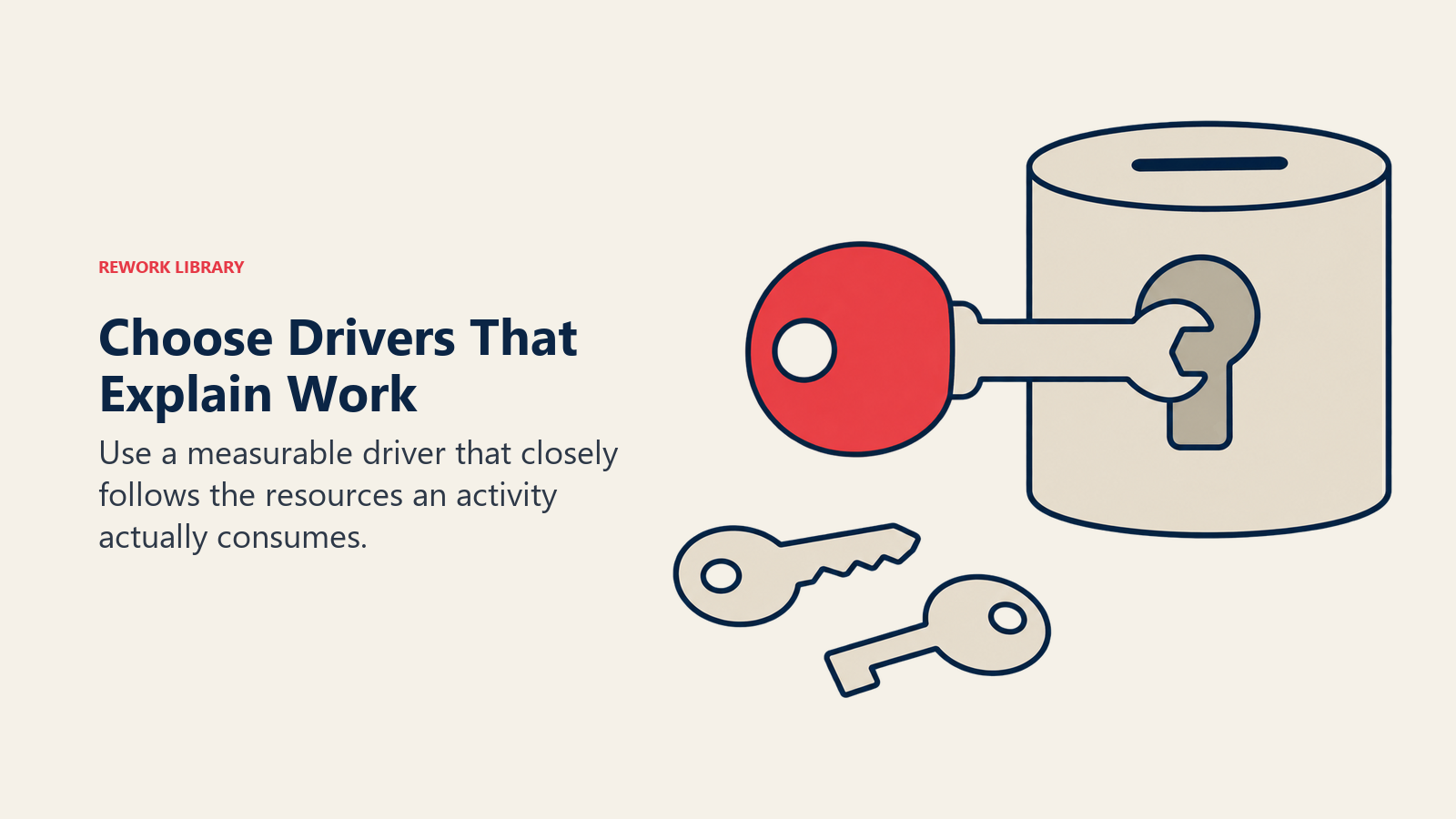
For production activities, drivers are usually straightforward. Machine hours for equipment costs. Setup frequency for changeover activities. Production runs for scheduling overhead. These measures exist in most manufacturing systems already.
Support activities require more thought. How do you allocate engineering support? Number of engineering change orders captures reactive support. Number of active part numbers reflects portfolio complexity. Hours spent on projects works but requires time tracking.
Quality costs might use inspection hours, number of inspections, or defect rates depending on what drives your quality organization's work. Material handling could use number of moves, pounds moved, or distance traveled. Choose the driver that best explains workload variation.
Test your drivers with correlation analysis if data exists. Plot activity costs against candidate drivers. The driver showing the strongest relationship wins. If no data exists, make your best judgment and validate with activity owners. The people doing the work usually know what drives their effort.
Technology and Systems
Modern ERP systems support activity-based costing, but implementation requires configuration and data integration. Cost pools must be defined. Activities need to be linked to drivers. Transaction data must flow from production, quality, and warehouse systems.
Specialized costing software can supplement ERP when comprehensive ABC is necessary. These tools handle complex allocation logic, provide analytical capabilities, and generate profitability reports that slice data by product, customer, channel, and region.
But don't let system complexity delay action. You can implement ABC in spreadsheets for pilot projects or small businesses. Extract cost data from your accounting system, build activity cost pools, calculate rates, and allocate to products. The insights from a spreadsheet-based pilot often justify investment in more sophisticated tools.
The real value isn't the system. It's the understanding that comes from thinking about overhead as collections of activities rather than monolithic expense. This mental shift changes how managers approach cost reduction, pricing, and product strategy.
Building a Cost-Driven Culture
Better overhead allocation isn't just a technical accounting improvement. It changes organizational conversations. When product managers see true product costs, they make different decisions about features, pricing, and volumes. Operations teams prioritize different improvement projects. Sales teams focus on different customers.
This requires education and engagement. Product managers need to understand why costs changed and what drives overhead consumption. Sales teams need to see customer profitability, not just revenue. Operations leaders need cost transparency to prioritize improvement efforts.
Some resistance is natural. People built strategies based on old cost data. New information can be uncomfortable. A product you've championed might prove less profitable than believed. A customer you've cultivated might destroy value. Handle this with empathy but clarity. Better information enables better decisions. The goal isn't blame. It's improvement.
Build feedback loops between costing accuracy and operational performance. When overhead allocation shows a product consuming excessive setup time, that signals an opportunity for setup reduction. When customer profitability analysis reveals that small orders are unprofitable, that prompts discussion about minimum order quantities or expedite fees. Good costing illuminates improvement opportunities.
Moving Forward
Accurate overhead allocation won't solve all profitability problems, but it reveals which problems to solve first. You can't improve what you can't measure accurately. Traditional allocation methods were designed for a different era of manufacturing. Modern production complexity demands more sophisticated approaches.
Start by questioning your current methods. If you use plant-wide rates based on direct labor and you run diverse products with varying complexity, your costs are probably distorted. If you've made pricing decisions based on cost information that didn't feel right, you might be seeing allocation errors.
Pilot activity-based thinking on high-impact products. The investment in better costing pays for itself quickly through improved pricing, smarter product mix decisions, and targeted cost reduction. You don't need perfection. You need truth that's closer to reality than what you're seeing now.
The manufacturers winning on cost don't necessarily have the lowest costs. They have the most accurate understanding of where costs hide and how to attack them. That understanding starts with honest overhead allocation.
Frequently Asked Questions
What is overhead cost allocation in manufacturing?
It's the process of assigning indirect manufacturing costs, such as rent, utilities, equipment depreciation, supervision, and quality control, to individual products. Because these costs don't attach naturally to any one product, you spread them using an allocation base or activity driver so each product carries a fair share of the total.
Why do traditional overhead allocation methods distort product costs?
Plant-wide rates assume overhead varies proportionally with a single activity like direct labor hours. Real overhead comes from many cost pools with different drivers: setups relate to batch frequency, inspection to complexity, engineering to customization. When one base stands in for all of them, high-volume simple products subsidize low-volume complex ones, hiding the true economics.
When should a manufacturer switch to activity-based costing?
Consider ABC when overhead is a large share of cost (30% or more), your product mix varies widely in complexity, and pricing decisions feel off. Start with a pilot on a few products where distortion is most likely, then expand. Time-driven ABC is a lighter alternative that keeps most of the accuracy with less maintenance.
How much of manufacturing cost is overhead?
Overhead commonly represents 30 to 50% of total manufacturing cost, and the share has grown as automation reduces direct labor while raising equipment, technology, and support costs. That size is exactly why allocation accuracy matters: small percentage errors on a large cost block swing product margins significantly.
Learn More
