OEM Relationship Management: Building Strategic Manufacturing Partnerships
Turn this article into takeaways for your work.


Each assistant summarizes the article only for you and suggests best practices for your work.
You've been supplying an OEM customer for three years. You're one of twelve suppliers providing similar components. When they need faster delivery, they call you last. When they have cost reduction targets, you get the squeeze. When they consolidate suppliers, you're at risk.
Then there's your other OEM customer. You've been their supplier for eight years. You're their preferred partner for this component family. When they have new products, you're involved early in design. When they need help with technical problems, they call you first. When they consolidate suppliers, you get more business.
The difference isn't your product or pricing. It's the relationship. One treats you as a transactional supplier. The other views you as a strategic partner. That distinction determines whether OEM relationships drive profitable growth or just consume capacity at thin margins.
Understanding OEM Relationship Dynamics
OEM (original equipment manufacturer) relationships have unique characteristics that require specialized management approaches.
OEM versus end-customer relationships differ fundamentally. End customers buy your products and care primarily about the product itself. OEMs integrate your products or components into their products and care about your reliability, quality, service, and total value contribution to their operations.
You're not just a vendor. You're part of their supply chain and operations. Your performance directly affects their ability to serve their customers. McKinsey's research shows that taking supplier collaboration to the next level can create 10-20% reductions in material costs.
Supplier tiers and strategic partnerships create hierarchy. OEMs typically categorize suppliers into tiers. Tier 3 suppliers provide commodity items with many alternatives. Tier 2 suppliers provide important items with fewer alternatives. Tier 1 or strategic suppliers provide critical items or services where the OEM deeply depends on the supplier's capability.
Your goal is moving from commodity tier to strategic tier, where relationships are stable, margins are better, and growth opportunities are larger.
Long-term agreements and commitments characterize strategic OEM relationships. Multi-year contracts, volume commitments, joint development programs, and shared investment in capabilities all signal strategic partnership versus transactional purchasing.
These commitments require demonstrating sustained excellence and building trust over years, not months. According to Deloitte, managing supplier relationships is the single most important factor to limit supply chain risk and cost.
Becoming a Preferred Supplier
Moving from approved supplier to preferred partner requires deliberate strategy and sustained performance.
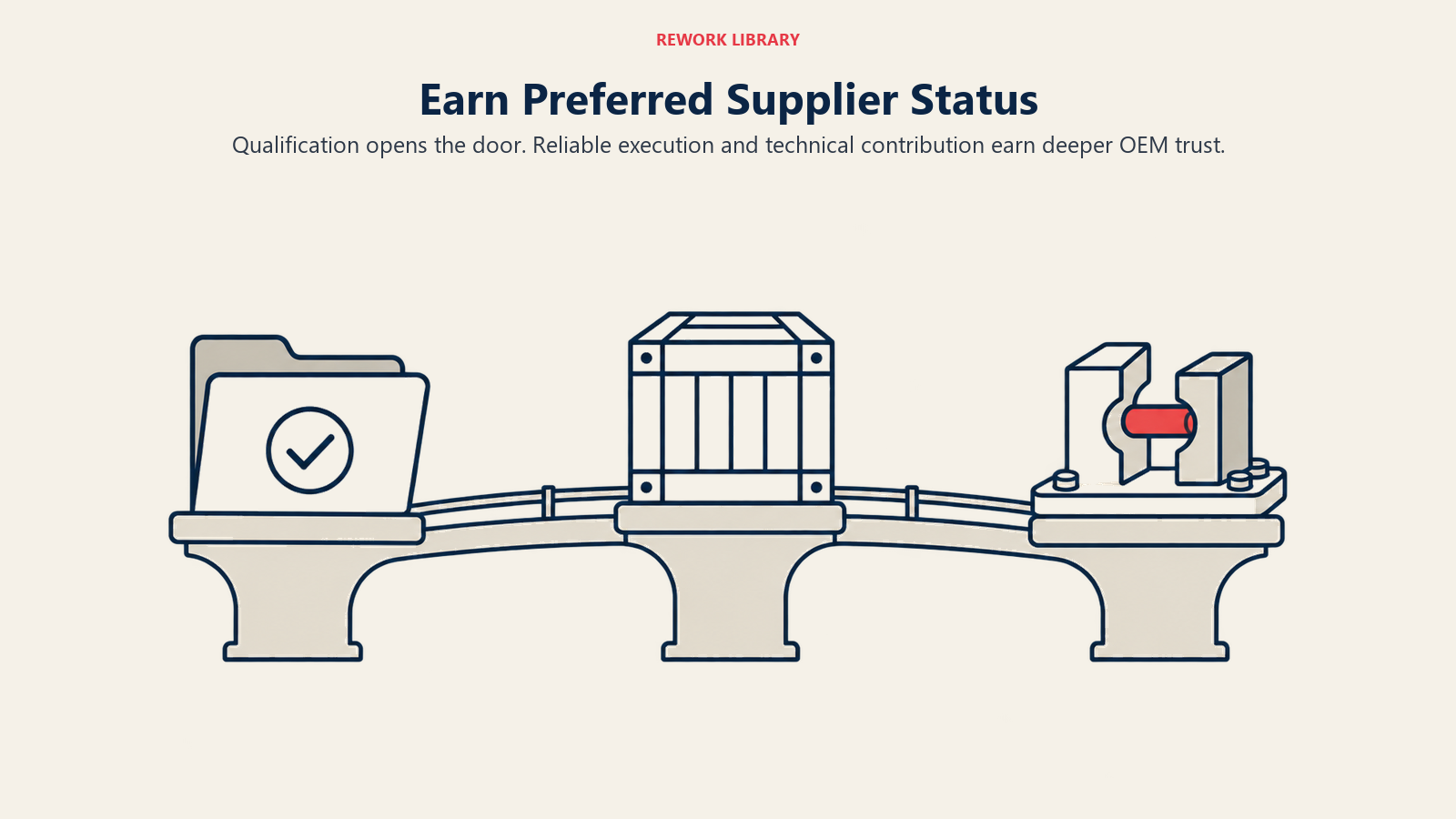
Initial qualification and approval gets you in the door. OEMs require supplier audits assessing quality systems, capacity and capability, financial stability, and technical competence. Passing qualification makes you eligible to quote and supply, but doesn't guarantee business.
Many suppliers stall at "approved but not preferred" status, receiving sporadic orders but never building substantial volume.
Building trust through performance moves you from approved to preferred. This means delivering consistent quality with minimal defects, meeting delivery commitments reliably, responding quickly to issues or changes, competing on price without sacrificing quality, and proactively communicating risks or problems.
OEMs give more business to suppliers they trust because trusted suppliers reduce their risk and overhead managing suppliers.
Moving from transactional to strategic requires demonstrating capabilities beyond basic production. Strategic suppliers contribute technical expertise to product development, suggest cost-saving design or process changes, invest in capabilities aligned with OEM needs, provide supply chain visibility and flexibility, and collaborate on long-term planning.
You're not just filling orders. You're contributing to the OEM's competitive success.
Share of wallet expansion happens as you prove performance and capability. Start with one part number or product line, earn trust, then expand to related items, new programs, or increased volume share.
Strategic suppliers often supply 80-100% of an OEM's needs in their category. Transactional suppliers fight for 20-30% share among multiple competitors.
Delivering What OEMs Value
Strategic OEM relationships are built on delivering what OEMs care about most.
Quality consistency and zero defects top every OEM's priority list. Defects create production disruptions, quality holds, customer complaints, and recall risk. Meeting customer quality requirements is non-negotiable. OEMs need suppliers who deliver right first time, every time.
This requires strong manufacturing quality management systems, statistical process control, mistake-proofing, and culture of quality consciousness throughout your organization.
Delivery reliability and flexibility mean hitting committed dates consistently and adapting when OEM needs change. If you promise delivery on the 15th, deliver on the 15th, not the 12th or the 17th. Both create problems for OEM production schedules.
Flexibility means responding to volume changes, expedited orders, or schedule shifts without compromising quality or demanding excessive premiums.
Cost competitiveness and improvement keep you viable as market conditions change. OEMs face constant pressure to reduce costs. If your costs only go up, you become uncompetitive.
Demonstrate continuous productivity improvements, material cost management, and willingness to share efficiency gains through periodic price reductions.
Innovation and technical support contribute beyond basic production. Can you suggest design improvements that reduce cost or improve performance? Can you solve technical problems that emerge? Can you support new product development?
Technical capability that helps OEMs succeed makes you strategically valuable, not just a production resource.
Supply chain resilience has become critical for OEMs after recent disruptions. Can you maintain supply during material shortages, provide visibility into your supply chain, develop backup sources for critical materials, and maintain financial stability during economic stress?
OEMs increasingly evaluate supplier resilience as carefully as quality and cost.
Managing the Partnership
Strategic relationships require structured governance and communication.
Regular business reviews and scorecards provide formal performance assessment. Quarterly or semi-annual reviews typically cover delivery performance metrics, quality performance and issues, cost competitiveness and improvement initiatives, capacity and forecasting alignment, and strategic opportunities or concerns.
Scorecards quantify your performance across key metrics. Green/yellow/red status makes expectations and performance clear.
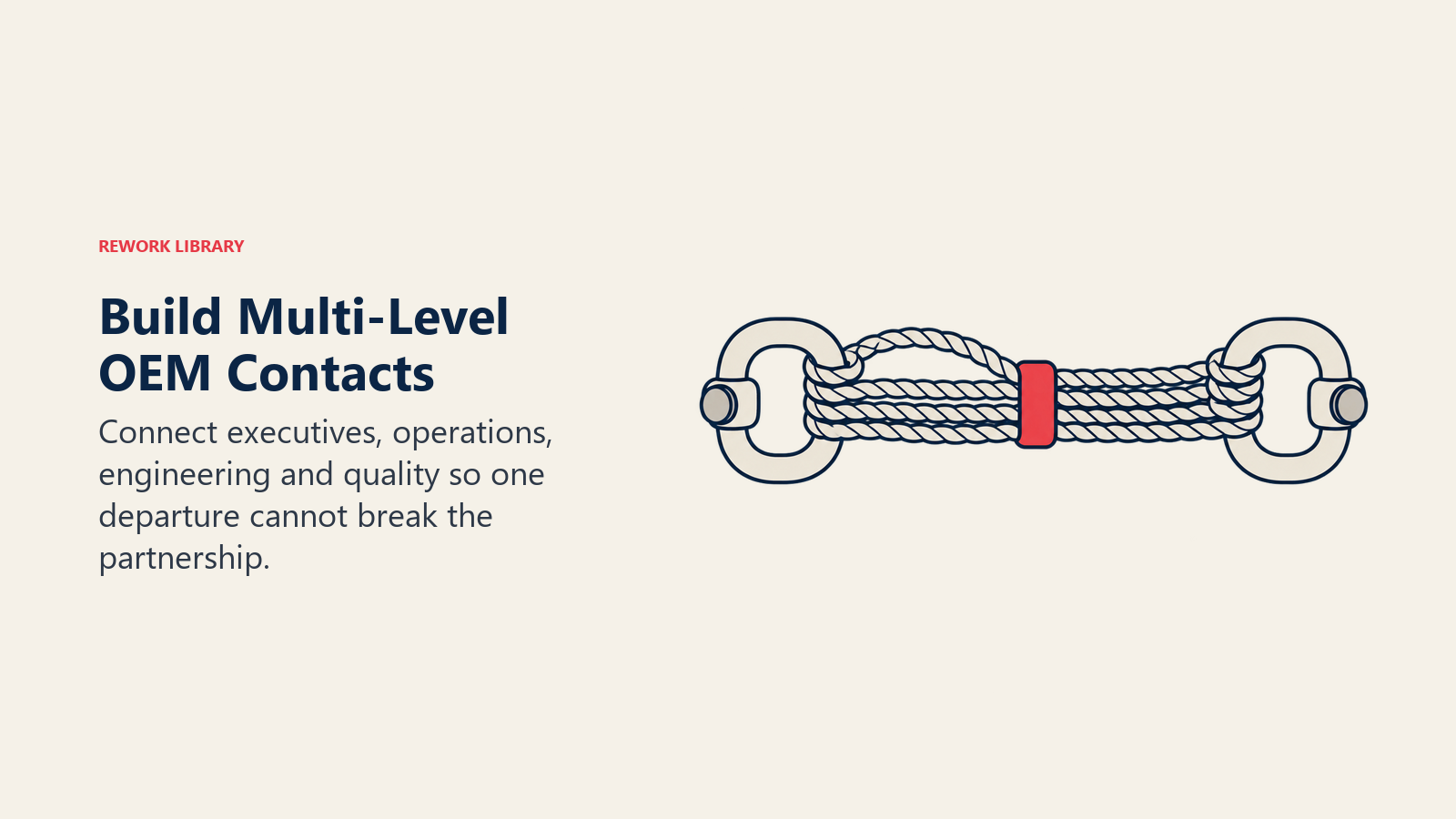
Multi-level relationship contacts prevent over-reliance on single relationships. Strategic partnerships connect at multiple levels: executive relationships for strategic alignment, operations relationships for daily execution, engineering relationships for technical collaboration, and quality relationships for continuous improvement.
If your only contact is one buyer who leaves, your relationship is fragile.
Issue escalation and problem-solving demonstrates how you handle inevitable problems. Every supplier occasionally has quality issues, delivery problems, or other challenges. What matters is how quickly you respond, how thoroughly you investigate root causes, how effectively you implement corrections, and how proactively you communicate.
OEMs trust suppliers who fix problems more than they trust suppliers who claim to never have problems.
Joint planning and forecasting aligns your capacity with OEM needs. Rolling forecasts of 12-18 months enable capacity planning, material commitments, and workforce decisions. Collaborative planning around new product launches, volume ramps, or transitions prevents surprises.
The better you understand OEM plans, the better you can support them.
Excelling Against OEM Standards
OEM expectations often exceed general industry standards.
Quality management system requirements may include ISO 9001 as baseline, industry-specific standards like IATF 16949 for automotive or AS9100 for aerospace, customer-specific requirements and audits, and statistical process control and capability studies.
Meeting these requirements isn't optional. It's the price of entry for OEM business.
Supplier development programs help suppliers improve performance. Many OEMs actively develop supplier capabilities through improvement workshops and training, technical support and expertise sharing, audit feedback and corrective actions, and best practice sharing across their supplier base.
Engage actively in these programs. They help you improve and demonstrate commitment to the partnership.
Continuous improvement expectations mean year-over-year performance improvement in quality, delivery, cost, and service. OEMs track improvement trajectories. Stagnant suppliers eventually get replaced by improving ones.
Document and communicate your improvements. Don't assume OEMs notice without you highlighting progress.
Audit preparation and response show your system maturity. OEM audits assess your quality systems, capacity and capability, process control and documentation, and management commitment.
Treat audits seriously. Poor audit performance damages relationships and can result in reduced business or de-listing.
Managing Relationship Risks
Strategic OEM relationships create dependencies that require active risk management.
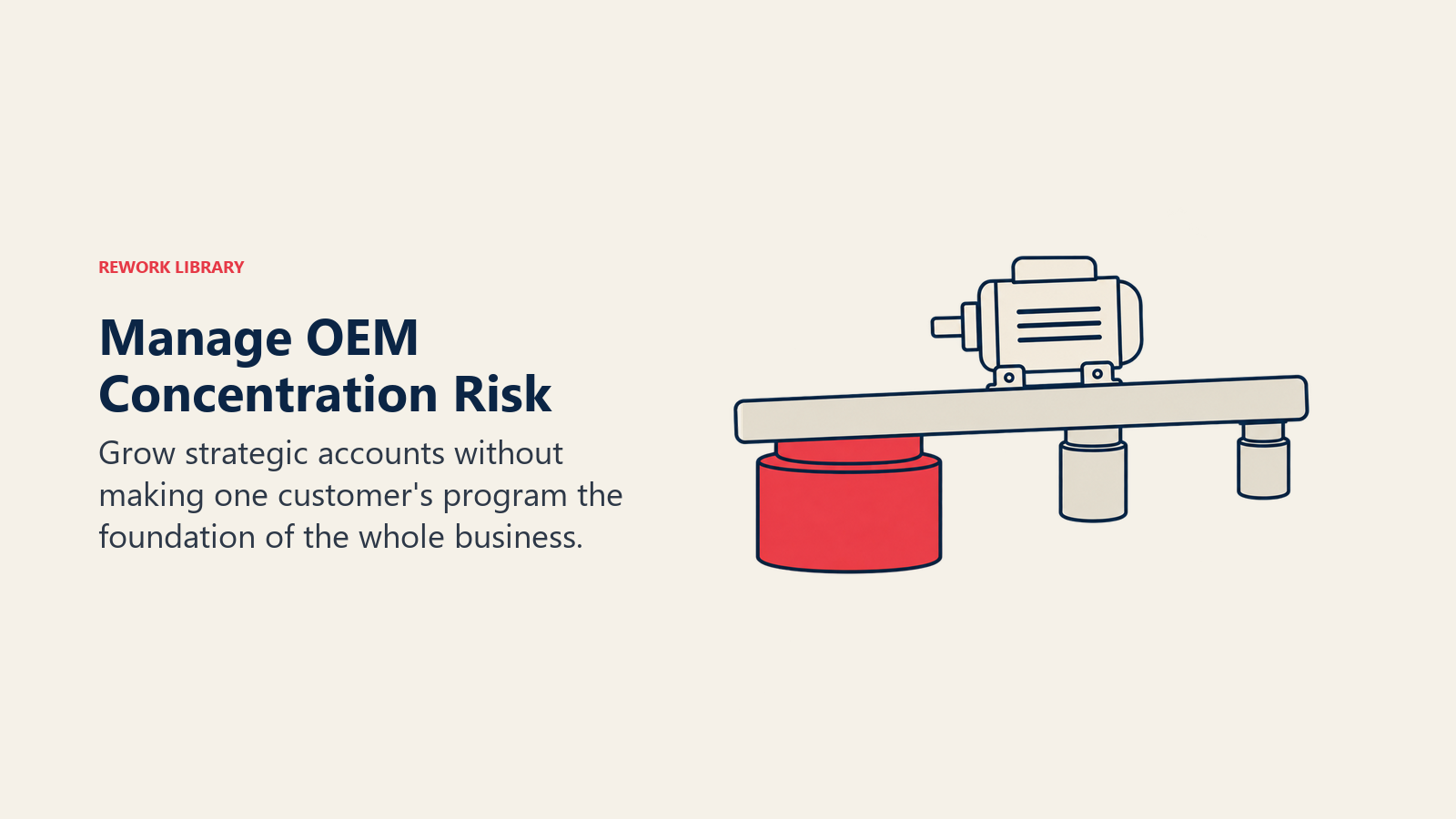
Over-reliance and concentration risk emerges when one customer represents too much of your revenue. If one OEM is 60% of your business and they lose a program or switch suppliers, your business is in crisis.
Diversify your customer base even as you build strategic relationships. Multiple strong OEM relationships provide stability.
Contract terms and protection should be negotiated carefully. Don't accept all risk through unlimited liability, one-way termination rights, or below-cost pricing commitments.
Balanced contracts protect both parties and enable sustainable relationships.
Succession planning and continuity prepare for relationship transitions. Your key contacts at OEMs will eventually move or retire. Have you built relationships with their successors? Is your value documented and understood beyond personal relationships?
Relationships depend on personal connections but shouldn't be fragile when people change roles.
Market dynamics and pricing pressure are constant realities. OEMs continuously benchmark supplier pricing and seek reductions. You need pricing that's competitive but maintains healthy margins.
Demonstrate your value clearly, improve efficiency continuously, and be willing to walk away from business that doesn't make economic sense.
Building Lasting Partnerships
Strategic OEM relationships represent some of the most valuable business relationships in manufacturing: large volumes, long-term commitments, and opportunities to grow as customers grow.
But they require sustained excellence, not just good initial performance. They demand investment in capabilities that serve customer needs. They need patience to build trust and prove value over years.
The manufacturers who excel at OEM relationships treat them as partnerships worth earning and protecting. They deliver reliably, improve continuously, communicate proactively, and invest in capabilities that serve customer success.
Done well, OEM relationships provide the stable foundation for profitable growth and industry leadership. They're worth the investment and discipline they require.
Learn More
