Sustainable Manufacturing Practices: Building Profitability and Environmental Responsibility
Turn this article into takeaways for your work.


Each assistant summarizes the article only for you and suggests best practices for your work.
A packaging manufacturer committed to cutting energy use 25% in three years. Investors called it expensive virtue signaling. Three years later, they'd exceeded the target and saved $2.3 million annually. Energy efficiency improvements paid for themselves in 18 months. Employee retention improved. Customers preferred a supplier with demonstrated environmental commitment. What skeptics dismissed as cost became competitive advantage.
Sustainability isn't just environmental responsibility anymore. It's business strategy. Customers demand it. Investors measure it. Regulations require it. Employees expect it. But the real case for sustainability is operational: sustainable practices typically reduce costs, improve efficiency, and create innovation opportunities. Environmental responsibility and profitability aren't opposites. Done right, they reinforce each other.
The Business Case
Sustainability skepticism often stems from viewing environmental initiatives as cost centers. Reduce pollution but increase costs. Use renewable energy but pay premiums. Meet regulations but sacrifice productivity. This framing is backwards. Most sustainability improvements reduce costs while improving environmental performance.
Energy represents 5-15% of manufacturing costs. Energy efficiency improvements directly reduce costs while cutting emissions. LED lighting uses 75% less power than incandescent while lasting longer. High-efficiency motors cut electricity consumption 20-30%. Heat recovery captures waste energy. Every BTU not wasted is money saved and emissions avoided.
Waste represents failed production. Materials you bought and paid to process that never became saleable products. Reducing waste means buying less material, processing less material, and disposing of less material. The cost savings from waste reduction typically exceed disposal cost savings by orders of magnitude. Lean manufacturing and circular economy principles align sustainability with profit.
Water conservation reduces costs in water-scarce regions and prepares businesses for increasing water prices. Treatment costs, discharge fees, and water itself all cost money. Using less water and recycling more reduce operating costs while decreasing environmental impact. Industrial water use optimization often pays for itself in under two years.
Customer and investor requirements make sustainability table stakes. Major customers require supplier sustainability reporting. Investors screen ESG performance. Consumers prefer sustainable brands. You can view these requirements as burdens or opportunities. Companies that lead sustainability efforts win customers. Those that lag lose them.
Talent attraction and retention benefit from sustainability commitment. Younger workers particularly care about working for companies whose values align with theirs. When recruiting engineers and operations managers, demonstrated environmental commitment is competitive differentiator. Retention improves when employees feel proud of their employer's impact.
Innovation often emerges from sustainability constraints. When you can't use certain materials or can't consume certain energy, you're forced to innovate. Process improvements. Material substitutions. Design changes. Sustainability requirements drive innovation that creates competitive advantage beyond environmental benefits. Constraints spark creativity.
Strategic Framework
Sustainability can't be bolt-on programs that someone in corporate responsibility manages separately from operations. It needs integration into business strategy and operational excellence.
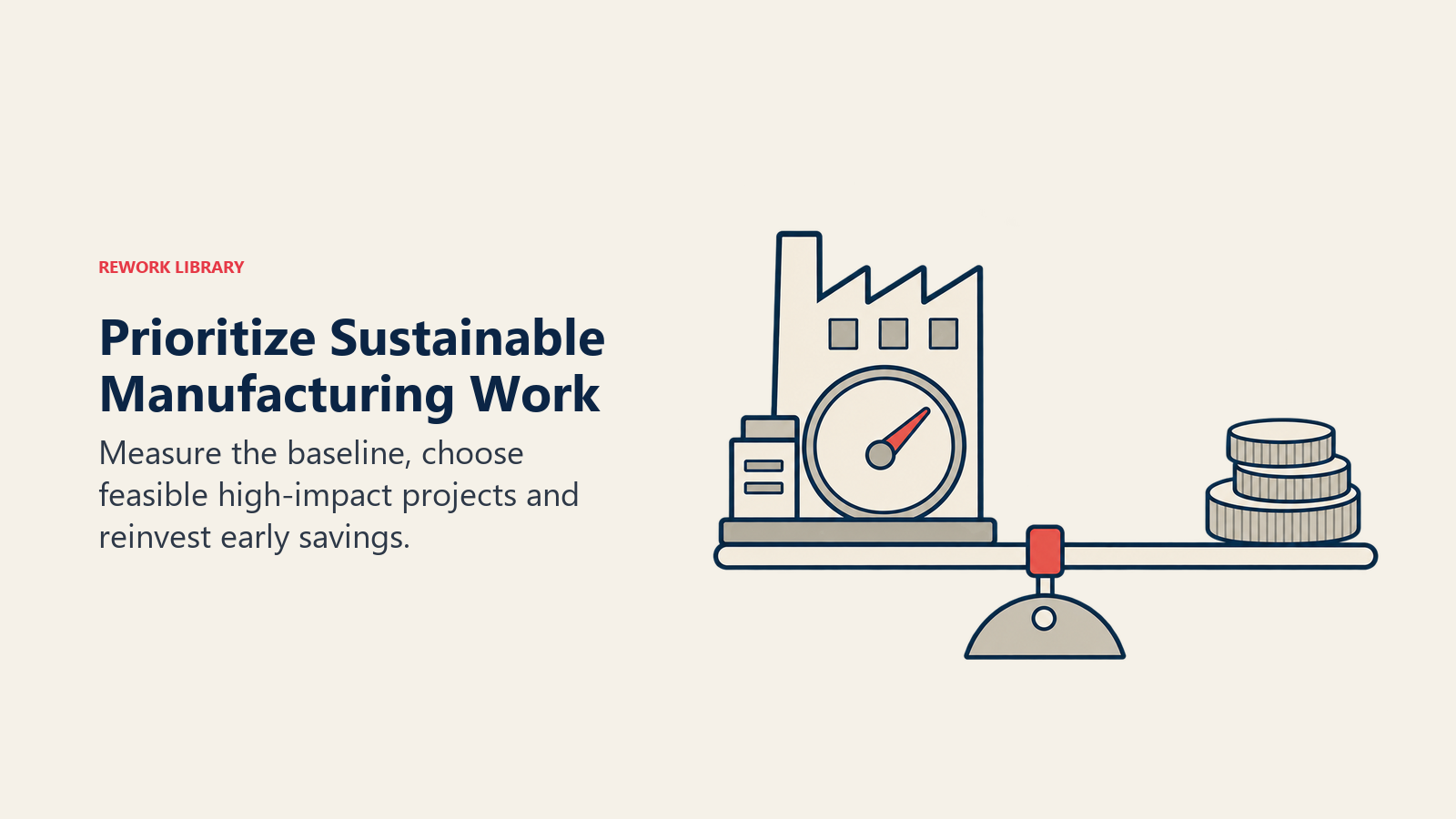
Start with baseline assessment. Measure current environmental performance: energy consumption, water use, waste generation, emissions, material inputs. You can't improve what you don't measure. Baseline data shows where you are and enables tracking progress. It also identifies major impact areas worth addressing first.
Set goals that balance ambition and achievability. Aggressive goals inspire but unachievable targets demoralize. Base goals on analysis of what's possible with known technologies and reasonable investment. Common frameworks include science-based targets (aligned with climate science), percentage reductions (50% waste reduction by 2030), or absolute targets (zero waste to landfill). Public commitments create accountability that drives action.
Prioritize initiatives based on impact and feasibility. Some opportunities deliver major environmental benefits with modest investment and fast payback. Others require significant capital for incremental improvement. Start with high-impact, achievable initiatives. Build momentum through early wins. Use savings from early projects to fund more ambitious ones.
Integrate with operational excellence rather than treating sustainability separately. Lean manufacturing eliminates waste including environmental waste. Six Sigma improves process control reducing scrap and rework. Total productive maintenance improves equipment reliability reducing energy waste from inefficient operation. These operational improvement methods simultaneously improve sustainability. Connect the dots explicitly.
Engage stakeholders including employees, customers, suppliers, communities, and investors. Sustainability isn't something done to organizations. It's something done with them. Employee ideas identify opportunities management misses. Customer input reveals which environmental initiatives matter to them. Supplier collaboration extends sustainability through the value chain. Community relationships build goodwill. Stakeholder engagement makes sustainability practical and aligned with business realities.
Implementation Priorities
Sustainability encompasses many initiatives. Focus drives results better than doing everything at once. Start with areas delivering biggest environmental impact and business value.
Energy efficiency provides the clearest business case. Audit current energy use. Identify major consumers. Evaluate efficiency improvement opportunities. LED lighting retrofits pay back in 2-4 years. High-efficiency motors pay back in 1-3 years. Building insulation and HVAC optimization reduce energy 20-40%. Variable frequency drives on fans and pumps cut power consumption dramatically. Energy efficiency isn't controversial. It's obviously good business that happens to help the environment.
Renewable energy reduces carbon footprint while providing long-term cost predictability. Solar panel costs have dropped 80% making installations economically attractive for many facilities. Wind power works where resources exist. Power purchase agreements enable renewable energy without capital investment. The economic case varies by location but improves annually as renewable costs decline and grid power costs increase.
Waste reduction targets the seven wastes of lean manufacturing: overproduction, waiting, transport, overprocessing, inventory, motion, and defects. All create environmental impact. Materials that become waste were extracted, processed, transported, and disposed of unnecessarily. Reducing waste reduces environmental impact at every stage. Plus waste reduction improves productivity and reduces costs. It's rare operational improvement that delivers environmental and financial benefits simultaneously.
Water conservation and treatment reduce costs and environmental impact. Map water flows through your facility. Where does water enter? How is it used? Where does it leave? Look for reuse opportunities. Cooling water might be reused for washing. Treated wastewater might be suitable for non-contact cooling. Closed-loop systems minimize fresh water consumption. Water efficiency often gets overlooked because water seems cheap but becomes expensive when you include treatment, heating, and disposal costs.
Sustainable materials sourcing considers environmental impact of raw materials. Can you use recycled content? Can you source from sustainable forestry or agriculture? Can you avoid materials with high environmental footprints? Material decisions during design determine lifecycle environmental impact. Working with engineering and suppliers to identify sustainable alternatives prevents locking in unsustainable materials.
Circular Economy Thinking
Linear manufacturing follows take-make-dispose models. Extract raw materials. Make products. Use them. Dispose of them. This linear flow is wasteful and increasingly uneconomic as material costs rise and disposal becomes expensive. The Ellen MacArthur Foundation describes the circular economy as a system where materials never become waste and nature is regenerated. Circular approaches close loops and retain value.
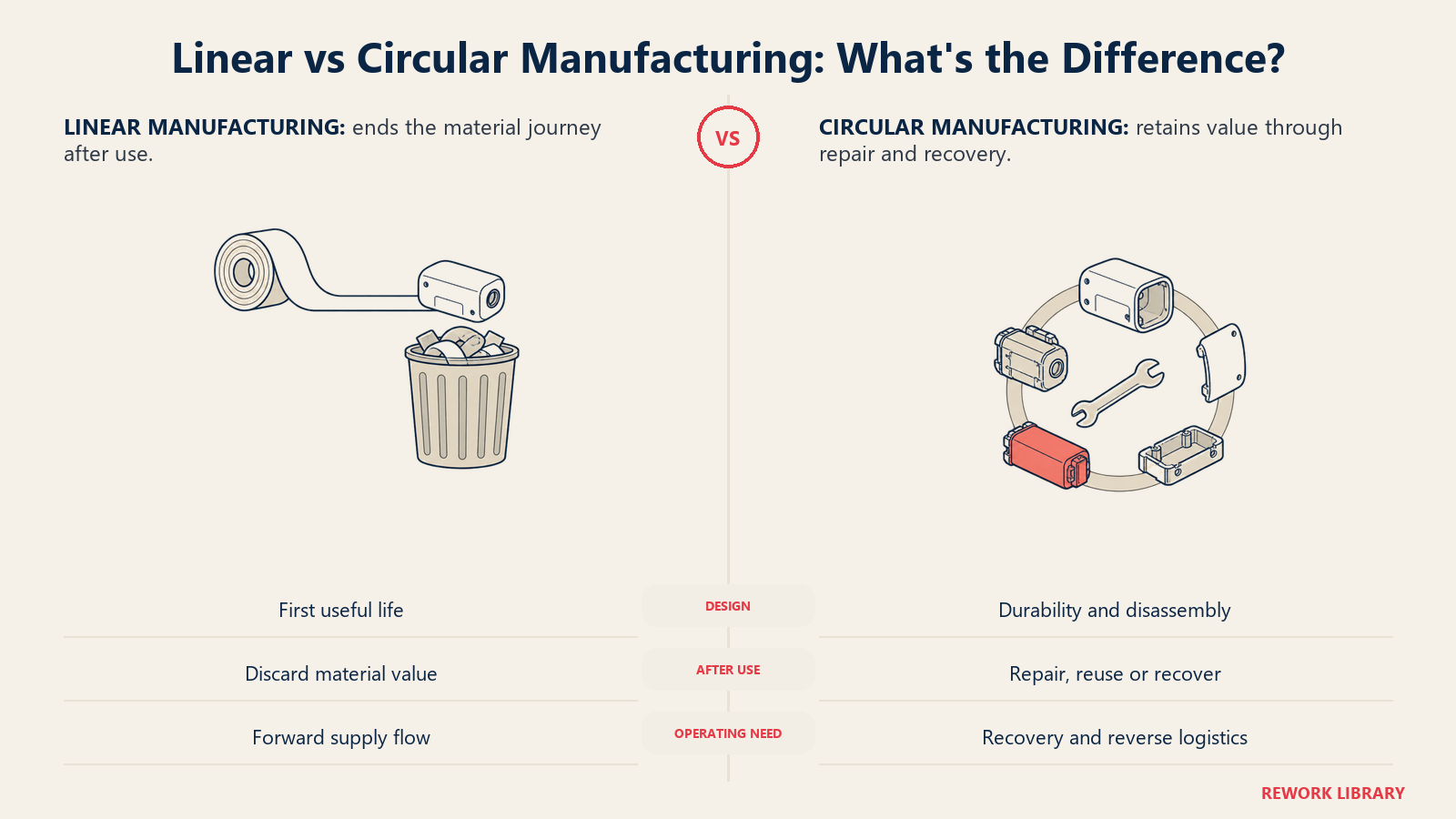
Design for durability, repair, and remanufacturing makes products last longer and enables value recovery. Modular designs enable component replacement. Standardized interfaces enable upgrades. Design choices determine whether products become waste after first use or can be recovered, refurbished, and remarketed. This requires collaboration between engineering, operations, and business model development.
Take-back programs recover products at end of first life for remanufacturing or material recovery. Some companies offer trade-in programs where customers return old products when buying new ones. These programs create reverse supply chains that supply remanufacturing operations or material recovery. But reverse logistics are complex and often uneconomic without design for disassembly and established recovery processes.
Industrial symbiosis treats waste from one process as feedstock for another. Your waste heat might be someone else's energy source. Your process byproducts might be their raw materials. Industrial parks and manufacturing clusters enable these exchanges. What you'd pay to dispose of becomes revenue when sold to others who need it. This requires collaboration and ecosystem thinking beyond individual facility optimization.
Product-as-a-service business models shift from selling products to selling outcomes. Customers pay for performance, not ownership. You retain ownership and responsibility for maintenance, upgrades, and end-of-life management. This aligns incentives for durability and enables recovery. The challenge is business model transition and customer acceptance. But it creates competitive differentiation and ongoing customer relationships.
Measurement and Reporting
Sustainability improvement requires measurement. What gets measured gets managed. And stakeholders increasingly demand transparency through sustainability reporting.
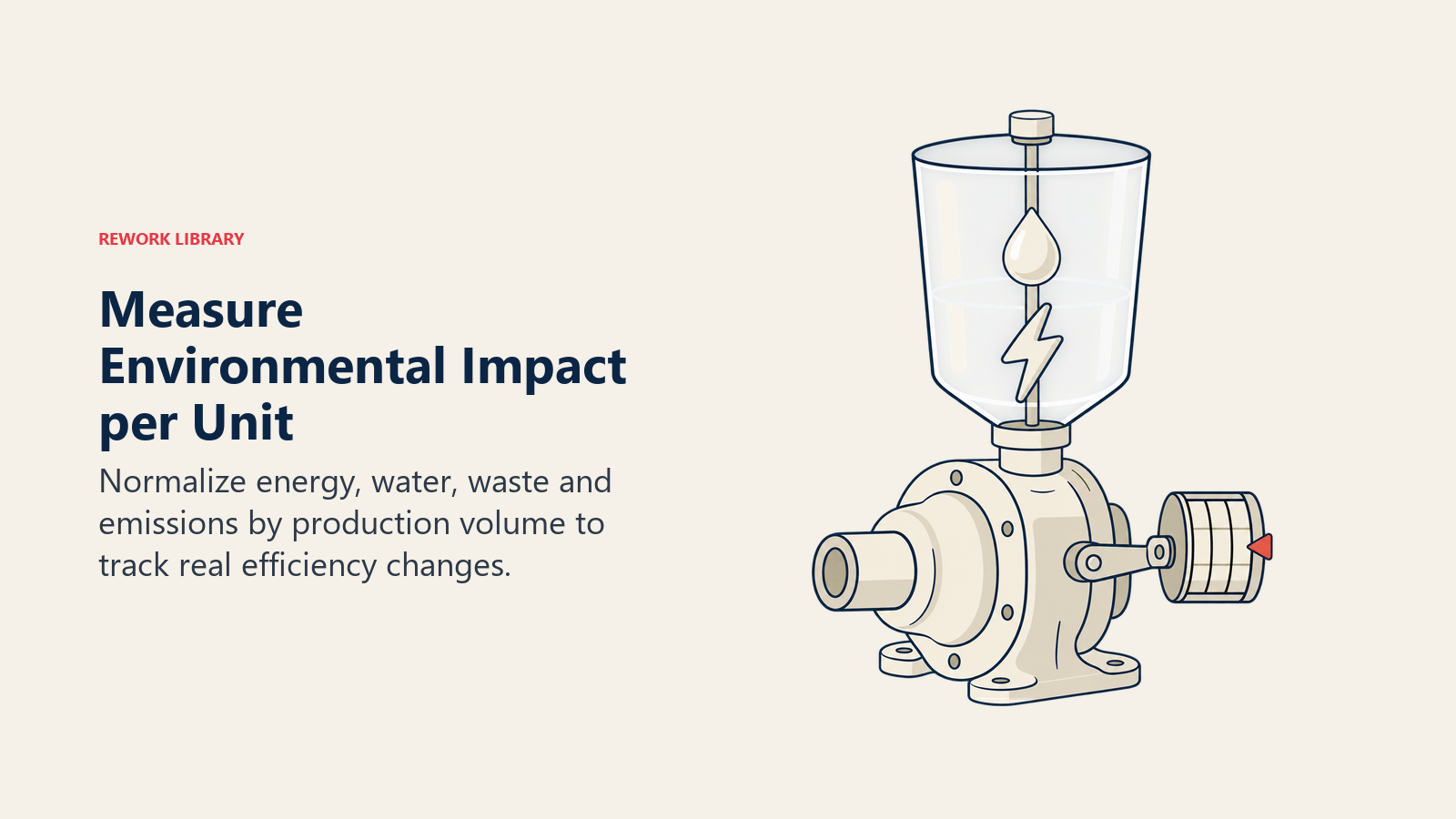
Key performance indicators track environmental performance metrics: energy use per unit produced, water consumption per unit, waste generated per unit, carbon emissions per unit. Normalize metrics by production volume so improvements reflect efficiency rather than just volume changes. Track trends over time and compare to targets. Display metrics publicly to create accountability.
Life cycle assessment evaluates environmental impact across product lifecycles from material extraction through manufacturing, use, and disposal. This comprehensive view reveals where impact concentrates and where improvements matter most. Sometimes manufacturing impact is small compared to material extraction or product use. LCA directs improvement efforts toward highest-impact stages.
Carbon accounting measures greenhouse gas emissions from operations (Scope 1), purchased energy (Scope 2), and value chain (Scope 3). This complex accounting enables carbon footprint reduction targets and supports climate commitments. Many companies set science-based targets aligned with limiting global warming. Carbon accounting provides data supporting these commitments.
Third-party certifications like ISO 14001 provide standardized frameworks and external validation. Certification demonstrates commitment and provides structure for environmental management systems. It also satisfies customers who require certified suppliers. The certification process itself drives improvement through systematic assessment and corrective action.
ESG reporting communicates sustainability performance to investors and stakeholders. Environmental, social, and governance metrics are increasingly material to investment decisions. Standardized frameworks like GRI, SASB, and TCFD enable consistent reporting. Public commitments and progress reporting create accountability and build trust with stakeholders.
Technology Enablers
Modern technology enables sustainability improvements that weren't previously feasible. Digital tools, sensors, and analytics optimize environmental performance.
IoT sensors monitor energy, water, and material use in real-time. This visibility enables active management rather than reactive response when bills arrive. When you can see consumption by equipment and time, you can identify waste and optimize usage. Real-time monitoring catches abnormal consumption indicating problems before they become major issues.
Digital twins simulate operations virtually enabling optimization without disrupting production. Test energy efficiency improvements virtually. Model material flow optimization. Evaluate equipment configurations. Virtual testing reduces risk and accelerates improvement by enabling experimentation without physical changes.
AI and machine learning optimize complex systems for environmental performance. Energy management systems use predictive algorithms to minimize consumption while maintaining production. Quality systems use machine learning to reduce scrap. Maintenance systems predict failures enabling preventive action that avoids waste from unplanned downtime.
Advanced recycling technologies enable material recovery that wasn't previously economic. Chemical recycling breaks down plastics to molecular level enabling true closed-loop recycling. Automated sorting using AI and vision systems separates mixed materials economically. As these technologies mature and scale, more materials become economically recyclable.
Building Momentum
Sustainability transformation doesn't happen overnight. It requires sustained commitment through ups and downs. Building momentum through early wins and continuous improvement sustains long-term progress.
Start with initiatives delivering quick wins. These build credibility and demonstrate that sustainability delivers business value. Use savings from early projects to fund more ambitious initiatives. Quick wins create virtuous cycles where sustainability success enables further sustainability investment.
Engage employees at all levels. Operators often identify efficiency opportunities that engineers miss. Maintenance staff understand equipment waste. Material handlers see logistics inefficiency. Tap this distributed knowledge through suggestion programs, improvement teams, and regular communication. Employee-driven sustainability is more sustainable than top-down mandate.
Celebrate progress publicly. Share energy savings. Highlight waste reduction achievements. Recognize teams driving improvements. Making progress visible reinforces commitment and motivates continued effort. It also demonstrates to customers and stakeholders that you're serious about sustainability.
Learn from setbacks honestly. Some sustainability initiatives won't work as planned. Technologies might underperform. Costs might exceed expectations. Improvements might not materialize. Acknowledge failures, understand causes, and adjust. Organizations that learn from sustainability setbacks get better. Those that hide them repeat mistakes.
Moving Forward
Sustainable manufacturing represents the convergence of environmental responsibility and operational excellence. You don't choose between profit and planet. You optimize both simultaneously through practices that reduce waste, improve efficiency, and create innovation opportunities.
Start where you are with honest assessment of current environmental performance. Set goals that balance ambition and achievability. Prioritize initiatives with strong business cases and environmental impact. Build momentum through early wins.
Remember that sustainability is journey, not destination. You'll never perfect environmental performance. But continuous improvement compounds into substantial impact over time. The manufacturers leading sustainability today didn't start perfect. They started committed and improved persistently.
Engage stakeholders throughout the journey. Sustainability done to organizations rarely sticks. Sustainability done with them becomes embedded in culture and operations. Employees, customers, suppliers, and communities all contribute perspectives and capabilities that improve outcomes.
View sustainability as competitive advantage, not compliance burden. The companies leading sustainability earn customer preference, attract better talent, reduce operating costs, and position themselves for futures where environmental performance matters increasingly. Sustainability creates value that shows up in margins, growth, and resilience.
Learn More
