Make vs Buy Decision Framework: Strategic Sourcing for Manufacturers
Turn this article into takeaways for your work.


Each assistant summarizes the article only for you and suggests best practices for your work.
Make-vs-buy decisions shape manufacturing strategy and profitability more than most executives realize. Gartner research emphasizes that risk events, evolving business models, and other factors necessitate changes in supply chain outsourcing decision-making. The choice to manufacture components internally or source from suppliers determines capital requirements, operational complexity, competitive positioning, and profit margins. Get it right and you build competitive advantage. Get it wrong and you waste capital on capabilities that don't create value.
Yet many manufacturers make these decisions casually: "we've always made that," "suppliers can't do it as well," "buying is cheaper." These assumptions often prove wrong under rigorous analysis. Strategic make-vs-buy requires systematic evaluation of costs, capabilities, risks, and strategic fit.
Understanding the Make-vs-Buy Decision
Make-vs-buy decisions determine which activities occur internally and which are sourced externally. They apply to components, subassemblies, processes, services, and entire product categories.
Strategic Implications
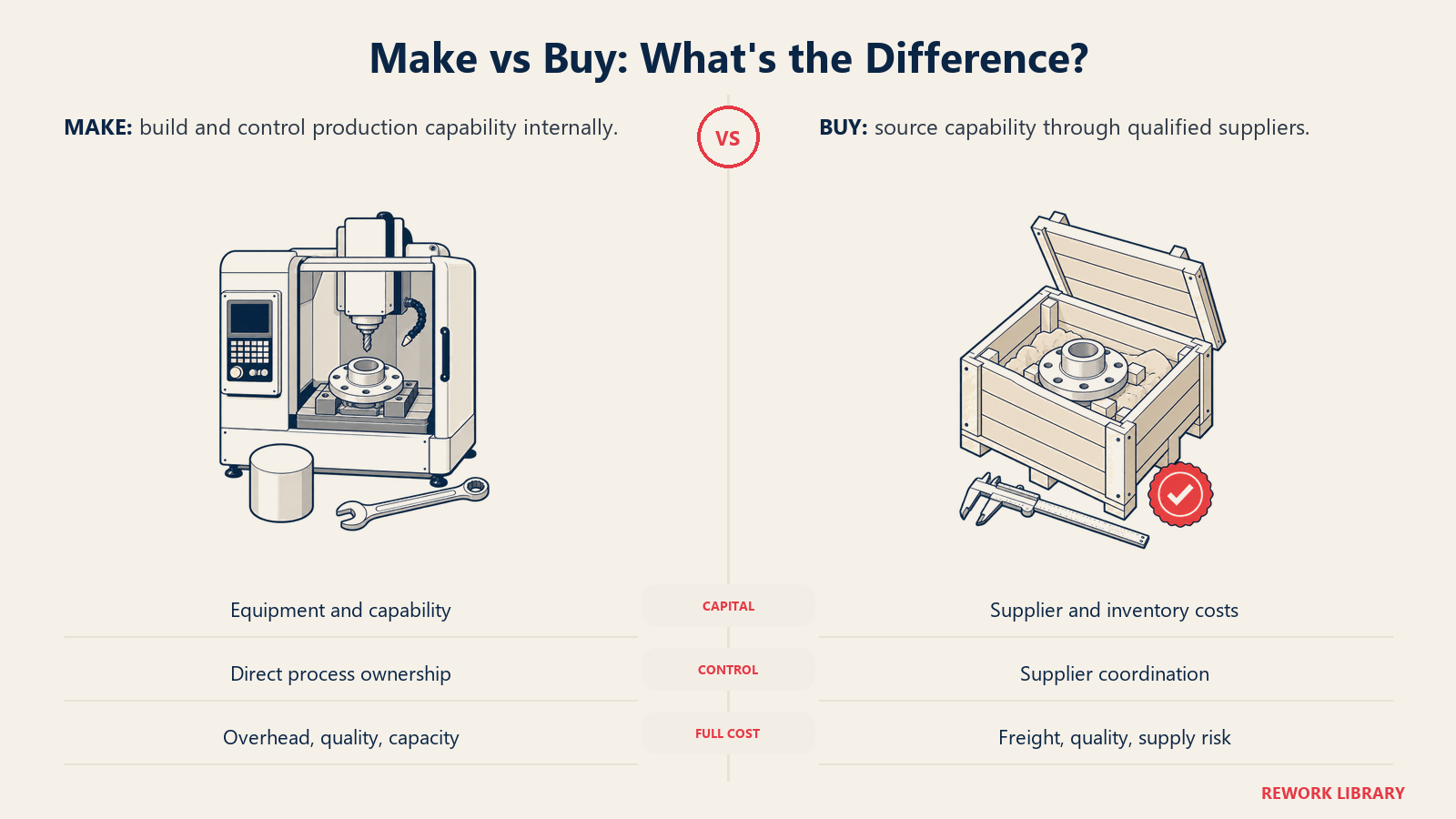
Make decisions commit capital to equipment, facilities, and capabilities. They create fixed costs that must be covered regardless of volume. They build internal expertise and control. They create vertical integration that can provide cost advantages or create rigidity.
Buy decisions preserve capital flexibility and transfer risk to suppliers. They create variable costs that scale with volume. They provide access to supplier expertise and economies of scale. They create dependency that can be strategic vulnerability or strategic advantage.
Neither approach is universally superior. The right choice depends on product characteristics, strategic importance, cost structure, and competitive environment.
When the Decision Matters Most
Make-vs-buy becomes critical during several scenarios:
Capacity constraints force prioritization. When you can't make everything, what should you make and what should you buy? Capacity planning strategy helps evaluate these trade-offs.
Capital limitations prevent adding capacity. Should you invest in capability or outsource and preserve capital?
Strategic shifts question current configurations. As markets or strategies change, yesterday's make decisions might need reconsideration.
New product development presents blank-slate opportunities. Without legacy commitments, you can choose optimal configuration.
Common Decision Triggers
Cost pressures prompt make-vs-buy reviews. When margins compress, manufacturers examine whether internal production still makes economic sense.
Quality issues trigger evaluation. If you can't achieve required quality internally or suppliers can't meet standards, make-vs-buy needs reconsideration.
Capacity changes create opportunities. New equipment investment might enable making what you previously bought. Or capacity reductions might force outsourcing what you previously made.
Supplier proposals can trigger analysis. An attractive supplier offer prompts evaluation of whether buying makes more sense than continuing to make.
Analysis Framework: Factors to Consider
Comprehensive make-vs-buy analysis considers quantitative costs and qualitative strategic factors.
Cost Analysis: Total Cost of Ownership
Simple cost comparison compares purchase price to internal production cost. But this misses significant costs on both sides.
Internal Production Costs Include:
Direct materials and labor are obvious. But also include:
Manufacturing overhead: utilities, maintenance, depreciation, supervision, quality control. Allocate accurately based on actual resource consumption, not simplistic overhead rates.
Indirect costs: purchasing, planning, inventory carrying, material handling, and administrative support. These often represent 15-20% beyond direct production costs.
Capital costs: equipment depreciation and opportunity cost of capital invested in production capability. A $1M equipment investment costs $100K-150K annually in depreciation and forgone return. Your manufacturing cost structure framework guides accurate cost allocation.
Quality costs: scrap, rework, inspection, and warranty expenses when quality problems occur.
Opportunity costs: what else could you produce with that capacity if not making this component?
External Purchase Costs Include:
Purchase price is obvious. But also include:
Freight and logistics: inbound transportation, receiving, and material handling.
Quality assurance: incoming inspection, supplier audits, and corrective action when problems occur.
Inventory carrying costs: safety stock to buffer against supplier delays and quality issues. Purchased items often require 30-50% more inventory than internal production.
Purchasing overhead: buyer time, supplier management, contract negotiation, and payment processing.
Risk management costs: developing backup suppliers, maintaining technical knowledge, and managing supply disruptions.
Total cost of ownership often differs significantly from simple price comparisons. A $10 component purchased might carry $13 total cost. An $11 internally produced component might carry $14 total cost when fully loaded. This $1 difference scaled across volume determines economic attractiveness.
Strategic Considerations: Core Competencies
Core competencies are capabilities that create competitive advantage, are difficult for competitors to replicate, and provide access to multiple markets. These should typically remain internal.
Ask: Does this capability differentiate us competitively? Can we develop and maintain world-class capability? Does it provide leverage across multiple products or markets?
If yes to all three, strong strategic argument exists for making. If no to any, buying might make more sense unless other factors override.
Non-core activities are candidates for outsourcing even if internal costs seem competitive. Your capital and management attention have opportunity costs. Focus internal resources on activities that create competitive advantage.
Quality and Control Factors
Internal production provides direct quality control. You can monitor processes, implement improvements immediately, and respond to problems without supplier coordination delays.
But internal quality isn't automatically superior. Specialized suppliers often achieve better quality through focus, scale, and expertise. A component representing 1% of your business might represent 50% of a supplier's business. They'll invest more in quality than you can justify. Strong manufacturing supply chain strategy includes supplier quality management.
Control over specifications, schedules, and changes matters for complex or rapidly evolving products. Internal production enables agile changes. Supplier relationships create coordination overhead and change delays.
Intellectual property protection argues for internal production when products embody proprietary technology you don't want suppliers to access. But non-disclosure agreements and supplier trustworthiness often provide adequate protection.
Capacity and Capability Assessment
Do you have or can you develop required capability? Making requires not just equipment but also expertise, process knowledge, quality systems, and supply chains for materials.
Buying something you've never made is less risky than making something you've never made. Learning curves and start-up problems create hidden costs and quality risks. Established suppliers have climbed these learning curves.
Capacity utilization matters. If you have excess capacity, using it for additional products spreads fixed costs and improves economics. If you're at capacity, making requires adding capacity at high cost or sacrificing other products. Production bottleneck analysis reveals true capacity availability.
Capability development timeline affects decisions. If capability development takes 18 months but you need products in 6 months, buying is the only viable option in the short term. Long-term strategy might still favor developing capability and transitioning to make.
Risk Evaluation
Multiple risk types affect make-vs-buy decisions:
Supply risk: supplier financial problems, quality issues, capacity constraints, or delivery failures. Mitigated through supplier diversification and qualification.
Demand risk: volume uncertainty makes internal fixed costs risky. Buying converts fixed costs to variable, reducing demand risk.
Technology risk: products using emerging or uncertain technologies carry obsolescence risk. Buying transfers this risk to suppliers who might serve multiple customers and spread risk.
Quality risk: who delivers consistent quality matters. Don't assume either internal or external is inherently lower risk. Assess based on actual capability.
Geopolitical risk: global supply chains face currency, trade policy, and logistics risks. Domestic manufacturing reduces these but might cost more.
Decision Process: Systematic Evaluation Approach
Structured decision processes prevent biased decisions driven by assumptions rather than facts.
Quantitative Analysis Methods
Break-even analysis calculates the volume at which make and buy costs are equal. Below break-even, buying is cheaper. Above break-even, making is cheaper.
Calculate break-even as: Break-even Volume = Fixed Cost Difference ÷ (Variable Cost per Unit Buy - Variable Cost per Unit Make)
If making requires $500K fixed investment but costs $2 per unit less than buying, break-even is 250,000 units. If annual volume is 300,000, making saves $100K annually after recovering fixed costs.
Net present value (NPV) analysis accounts for multi-year cash flows and time value of money. Calculate NPV of make scenario (equipment investment plus annual costs) versus buy scenario (annual purchase costs) over relevant time horizon (typically 5-7 years).
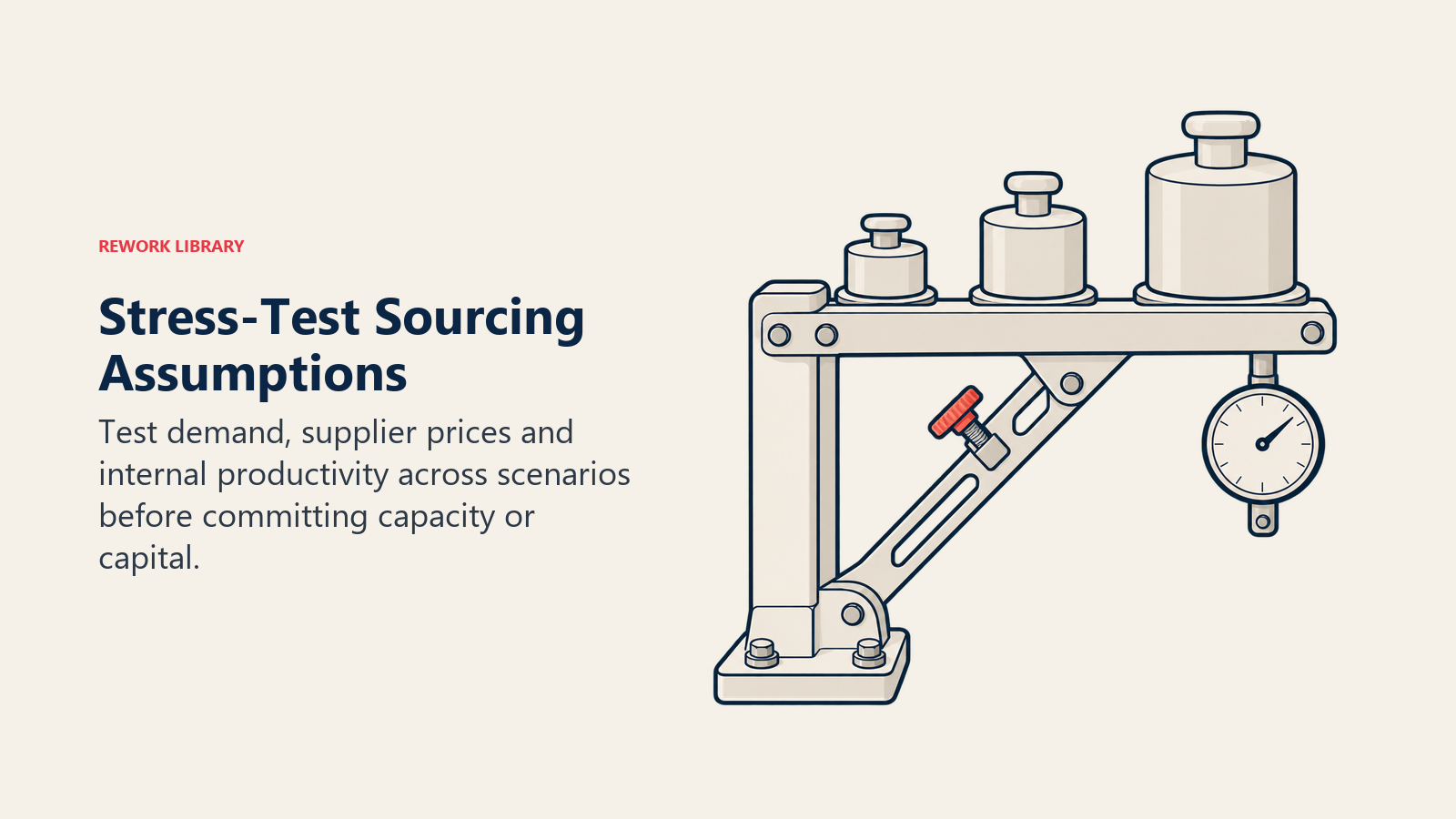
Sensitivity analysis tests how different assumptions affect conclusions. What if volume grows 20%? What if supplier prices increase 10%? What if internal productivity improves 15%? Understanding sensitivity to assumptions reveals decision robustness.
Qualitative Factor Weighting
Not all factors convert to monetary terms easily. Strategic fit, quality control, flexibility, and risk require qualitative assessment.
Create decision matrix listing key factors (cost, quality, flexibility, strategic fit, risk). Weight factors by importance (total weights = 100%). Score each option (make vs. buy) on each factor (1-10 scale). Calculate weighted scores.
Example:
- Cost (30%): Make=7, Buy=8
- Quality (25%): Make=8, Buy=7
- Strategic Fit (20%): Make=9, Buy=5
- Flexibility (15%): Make=6, Buy=9
- Risk (10%): Make=7, Buy=6
Weighted Make Score = 0.30×7 + 0.25×8 + 0.20×9 + 0.15×6 + 0.10×7 = 7.6 Weighted Buy Score = 0.30×8 + 0.25×7 + 0.20×5 + 0.15×9 + 0.10×6 = 7.0
This structured approach makes assumptions explicit and enables discussion about weights and scores.
Scenario Planning
Test decisions under different scenarios: best case (volume high, costs favorable), expected case (most likely outcome), worst case (volume low, costs unfavorable).
If make is superior in all scenarios, it's robust. If make is superior only in best case, it's risky. If outcomes are mixed, consider hybrid approaches or staged decisions.
Scenarios should reflect meaningful uncertainties, not just arbitrary variations. Base scenarios on realistic market possibilities and risk drivers.
Implementation Considerations: Executing the Decision
Making the right decision is only half the challenge. Execution determines whether theoretical benefits materialize.
Transitioning from Make to Buy
Phase transitions gradually rather than abruptly. Run parallel production while qualifying suppliers. This prevents supply disruptions if supplier problems emerge.
Transfer knowledge systematically. Suppliers need specifications, quality standards, testing procedures, and failure mode understanding. Document everything. What's obvious to your engineers isn't obvious to suppliers.
Maintain residual capability temporarily. Keep equipment and knowledge available for several cycles after transitioning. Supplier problems might require temporary reversion to internal production.
Manage workforce impacts ethically. Workers who made products you'll buy face displacement. Redeploy to other products, provide training for new skills, or offer severance packages. How you treat people affects morale for everyone.
Transitioning from Buy to Make
Develop capability incrementally. Start with simpler versions or lower volumes to build expertise before full production. Learning curves are real. Don't assume you'll immediately match supplier productivity.
Invest adequately in equipment, training, and quality systems. Underfunding creates quality problems and cost overruns that undermine the decision's economics.
Maintain supplier relationships during transition. Equipment problems or unexpected difficulties might require temporary supplier support. Don't burn bridges prematurely.
Measure actual vs. expected performance. Track costs, quality, and delivery performance. If economics don't materialize as expected, acknowledge and adjust rather than defending a failing decision.
Hybrid Approaches
Consider hybrid strategies: make some, buy some. This maintains internal capability and market knowledge while leveraging supplier scale and expertise for overflow capacity.
Or make initially to develop capability and knowledge, then transition to buy once suppliers can replicate what you've learned. This prevents knowledge loss while ultimately gaining supplier economics.
Or buy initially to meet time-to-market demands, then transition to make once you've developed capability. This balances speed with long-term economics.
Learn More
Deepen sourcing strategy expertise:
- Manufacturing Business Models explains how make-vs-buy fits business models
- Manufacturing Cost Structure provides cost analysis foundations
- Capacity Planning Strategy covers capacity implications of make-vs-buy
- Manufacturing Value Chain shows make-vs-buy's role in value creation
- Production Planning Fundamentals explains planning for mixed make-buy scenarios
- Lean Manufacturing Principles guides efficiency improvements for internal production
Make-vs-Buy as Dynamic Strategy
Make-vs-buy isn't a one-time decision. As volumes change, technologies evolve, and competitive landscapes shift, yesterday's optimal decision might need reconsideration. Review significant make-vs-buy decisions every 2-3 years.
Don't make decisions based on current state alone. Consider future states. Growing products might justify making even if current volumes favor buying. Declining products might justify outsourcing even if current volumes favor making.
And don't make decisions based solely on costs. Strategic fit, quality, flexibility, and risk all matter. The cheapest option that compromises strategy or creates unacceptable risks isn't optimal.
Build make-vs-buy decision capability organizationally. Create standard analysis templates, decision criteria, and approval processes. This ensures consistency, prevents biased decisions, and captures learning across decisions.
That discipline transforms make-vs-buy from occasional cost exercises into strategic capability that continuously optimizes your manufacturing configuration for competitive advantage.
