Manufacturing Labor Productivity Metrics: Measuring and Improving Workforce Performance
Turn this article into takeaways for your work.


Each assistant summarizes the article only for you and suggests best practices for your work.
Your labor costs are 22% of revenue:right in line with industry benchmarks. Production volume is up 8% year-over-year. Overtime is under control. By most measures, your labor performance looks solid.
But dig deeper and you find troubling patterns. Line 1 produces 15% more units per labor hour than Line 2 running the same product. Second shift consistently runs 12% slower than first shift. Some operators complete setups in 18 minutes while others need 35 minutes for the same changeover.
These variations cost you hundreds of thousands of dollars annually, but they're invisible when you only track aggregate labor metrics. Real labor productivity management requires granular measurement that reveals improvement opportunities and drives systematic gains.
Understanding Labor Productivity Fundamentals
Labor productivity measures how much output you generate for each unit of labor input. The concept is straightforward:the execution is nuanced.
Output per labor hour forms the core metric. If your operation produces 240 units using 20 labor hours, your productivity is 12 units per labor hour. Track this over time and you can see whether productivity is improving or declining.
But defining "output" and "labor hours" appropriately for your operation requires thought. For output, do you count units produced or units shipped? Do defective units count? How do you handle work-in-process? For labor hours, do you include only direct production time or all clocked hours? How do you account for training time, meetings, or equipment downtime?
There's no universal right answer:the key is defining your metrics consistently and using them to drive improvement, not to create an impressive-looking number that doesn't reflect reality. The BLS tracks manufacturing sector productivity through standardized metrics including labor productivity, hourly compensation, and unit labor costs.
Direct versus indirect labor requires separate treatment. Direct labor performs operations that transform products:assembly, machining, inspection. Indirect labor supports production without directly touching products:material handling, maintenance, supervision, quality engineering.
Both types of labor are necessary, but they require different productivity approaches. Direct labor productivity connects clearly to production volume. Indirect labor productivity is fuzzier:how do you measure the productivity of a maintenance technician or quality engineer?
Value-added versus non-value-added time distinguishes between activities that create value customers pay for versus activities that don't. Machining a part is value-added. Walking to get materials is non-value-added. Waiting for a machine to cycle is non-value-added.
Operators who are busy all day may be highly productive or incredibly inefficient depending on how much of their time is value-added versus non-value-added. Measuring this distinction reveals improvement opportunities that aggregate productivity metrics miss.
Labor efficiency and utilization capture different aspects of performance. Efficiency measures how actual labor compares to standard or expected labor. If a job should take 10 hours based on engineered standards but actually takes 12 hours, you're running 83% efficient (10/12).
Utilization measures what percentage of available time is spent on productive work. If operators are clocked in for 8 hours but only actively working on products for 6 hours, utilization is 75%.
You can be highly utilized but inefficient (working all the time but slowly) or highly efficient but under-utilized (working fast when you work but idle much of the time). Both metrics provide insight into different improvement opportunities.
Essential Labor Productivity Measures
Tracking the right metrics makes the difference between measuring activity and driving improvement.
Units per labor hour provides simple, trackable productivity measurement. Break this down by product line, shift, work cell, and even individual operators to reveal patterns. If Line A consistently produces more units per hour than Line B, understand why and replicate the best practices.
Track trends over time. Is productivity improving, stable, or declining? Even small improvements compounded over months create significant value. A 3% productivity improvement on $5 million in annual labor costs saves $150,000:enough to fund substantial improvement initiatives. BLS data shows that manufacturing productivity patterns vary significantly across industries.
Labor cost per unit inverts the productivity calculation to show cost impact directly. If you use 0.5 labor hours per unit at $25 per hour loaded cost, your labor cost per unit is $12.50. As productivity improves, labor cost per unit decreases even if wage rates increase.
This metric connects directly to product margins and pricing decisions. When evaluating whether to pursue new business, labor cost per unit helps determine if you can produce profitably at market pricing.
Earned hours versus actual hours compares theoretical labor based on standards to actual hours consumed. If you complete work that should require 100 standard hours but use 110 actual hours, you earned 100 hours while spending 110:a 91% efficiency.
This metric requires good labor standards, which many manufacturers lack or haven't updated in years. But when you have reliable standards, earned hours analysis quickly identifies efficiency gaps and quantifies improvement opportunities.
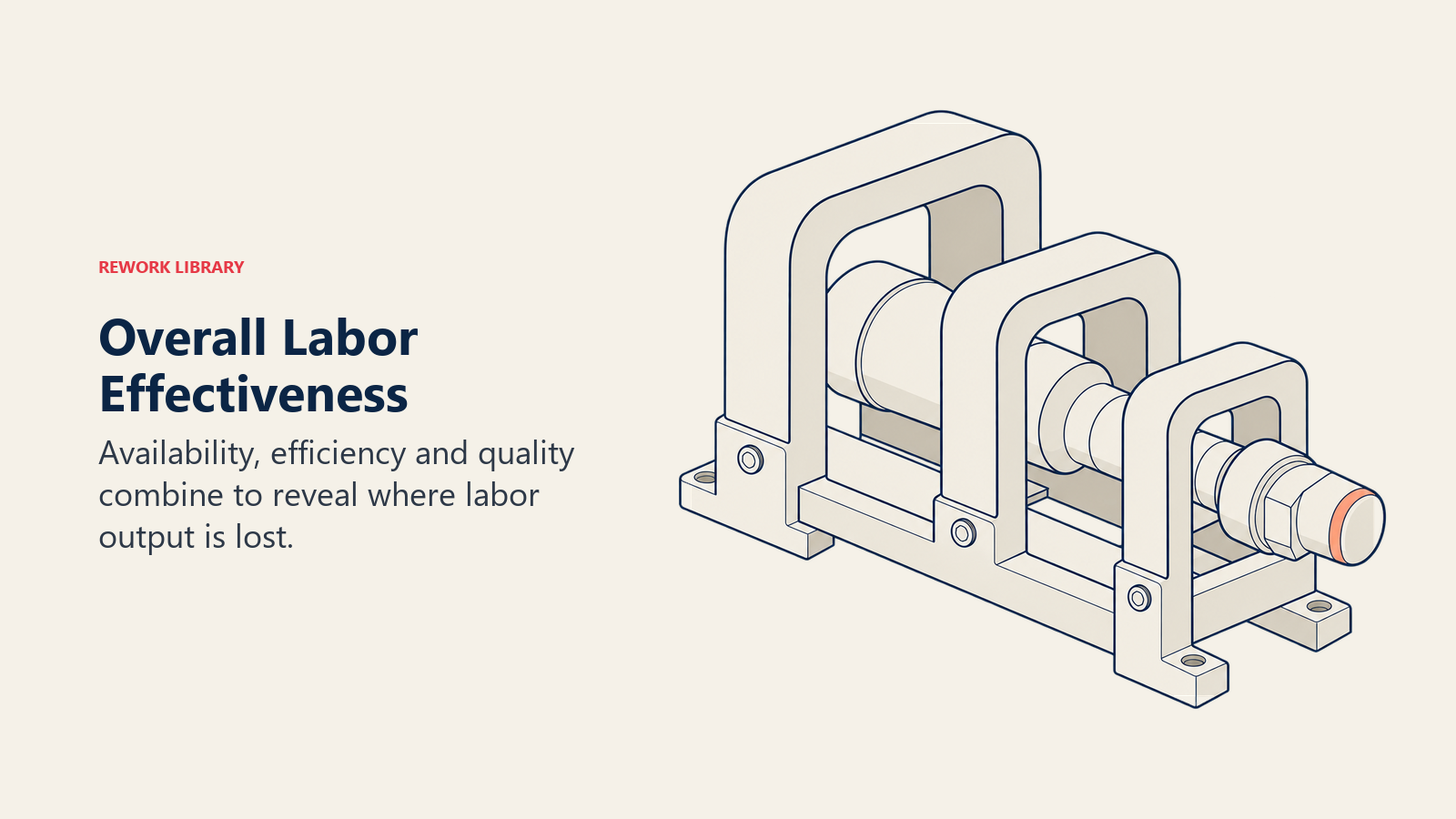
Overall labor effectiveness (OLE) combines several dimensions of labor performance analogously to overall equipment effectiveness (OEE). OLE might incorporate labor availability (scheduled versus lost time), labor efficiency (standard versus actual), and quality yield (good versus total production).
For example: 90% availability × 85% efficiency × 96% quality = 73% OLE. This comprehensive metric reveals whether problems stem from availability issues, efficiency problems, or quality losses.
Productivity index tracks your performance against a baseline. If last year your baseline was 100 units per labor hour and this year you're at 108, your productivity index is 108:an 8% improvement. According to BLS annual reports, manufacturing labor productivity increased 0.3% in 2024, though performance varied widely across industries. Indexing allows comparison across different products and time periods even as volumes and product mix shift.
Building Reliable Measurement Systems
Good metrics require good data, and good data requires systematic collection methods.
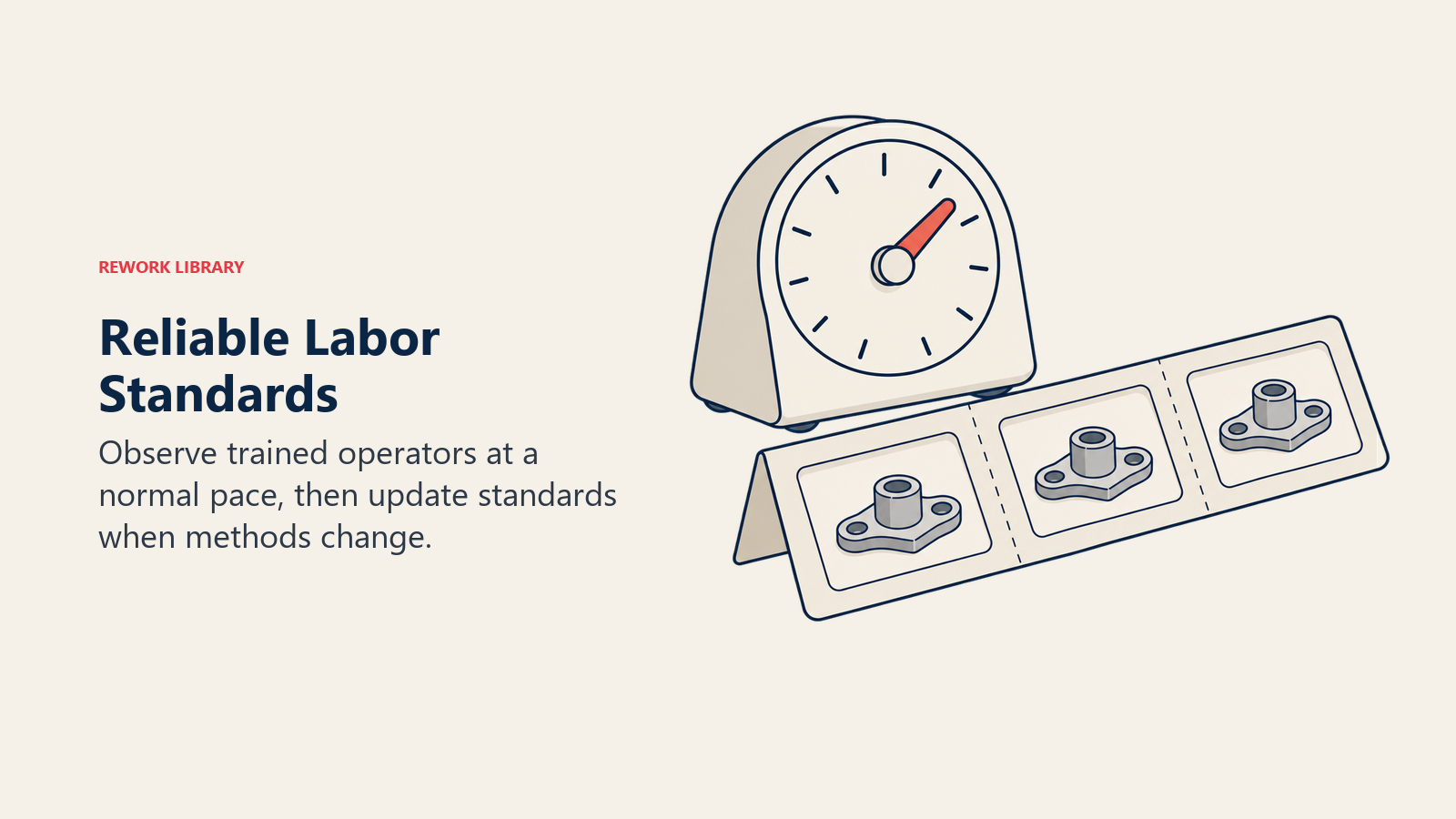
Time study and work sampling provide foundational labor standards. Time studies involve observing and timing specific operations to establish standard times. Work sampling statistically samples activities throughout the day to understand how time is actually spent.
Both methods require skill to execute properly. Poorly conducted time studies create unrealistic standards that frustrate operators and undermine the credibility of productivity metrics. When done well, they provide the foundation for meaningful measurement and improvement.
Labor reporting and timekeeping systems must capture labor hours with enough granularity to be useful. At minimum, track labor hours by department, shift, and major product categories. Better systems track down to individual operations, specific products, and discrete production orders.
Modern manufacturing execution systems (MES) can capture labor data automatically or semi-automatically, reducing paperwork and improving accuracy. But simple paper-based systems work fine if they're maintained consistently and entered accurately.
The key is making labor reporting easy enough that it actually happens and detailed enough to drive decisions. Systems that are too complex get bypassed or filled out incorrectly. Systems that are too simple don't provide actionable insights.
Standard times and labor standards establish the baseline for efficiency measurement. Standards should reflect achievable performance by trained operators working at normal pace:not the fastest operator working flat-out, and not the pace of someone learning the job.
Update standards when processes, equipment, or methods change significantly. Outdated standards make all your efficiency metrics meaningless.
Real-time tracking systems provide visibility into current performance, not just historical reports. Digital displays showing current productivity, efficiency, or units per hour allow immediate recognition of performance and quick response to problems.
Operators who see real-time productivity data can adjust their performance throughout the shift. Supervisors can intervene quickly when productivity drops rather than discovering problems days later in reports.
Using Metrics to Drive Systematic Improvement
Collecting metrics doesn't improve performance:analyzing them and taking action does.
Identifying productivity gaps and opportunities starts with breaking down your aggregate metrics. Look at productivity by product line, shift, day of week, operator, and work station. Where is performance strong versus weak? What patterns emerge?
The analysis often reveals surprises. You may discover that Monday productivity lags other days due to startup issues after the weekend. Or that certain products have much lower productivity than others with no clear reason. These patterns point to specific improvement opportunities.
Root cause analysis of productivity losses investigates why performance falls short of potential. Common causes include inadequate skills training and development, poor work methods or non-standard work, material shortages or quality issues, equipment problems or inadequate maintenance, excessive changeovers or small batch sizes, and poor workflow or facility layout.
Each cause requires different solutions. Time spent on root cause analysis prevents wasting effort on solutions that don't address the real problem.
Benchmarking and target setting create improvement goals. Compare your performance to industry benchmarks, best demonstrated performance within your own operation, theoretical performance based on engineered standards, or performance of similar processes at other facilities.
Stretch targets drive breakthrough thinking, while achievable targets maintain motivation. Balance ambition with realism based on your improvement capabilities and resources.
Improvement initiatives and tracking convert analysis into action. Prioritize improvements based on potential impact and feasibility. Launch focused improvement projects with clear goals, responsibilities, and timelines.
Track improvement initiatives just as rigorously as you track performance metrics. What improvements were implemented? What results were achieved? What's the status of ongoing initiatives? This accountability ensures improvements actually happen rather than being discussed endlessly.
Creating Sustainable Productivity Through Daily Management
The best productivity metrics are integrated into daily management rhythms, not just monthly reports.
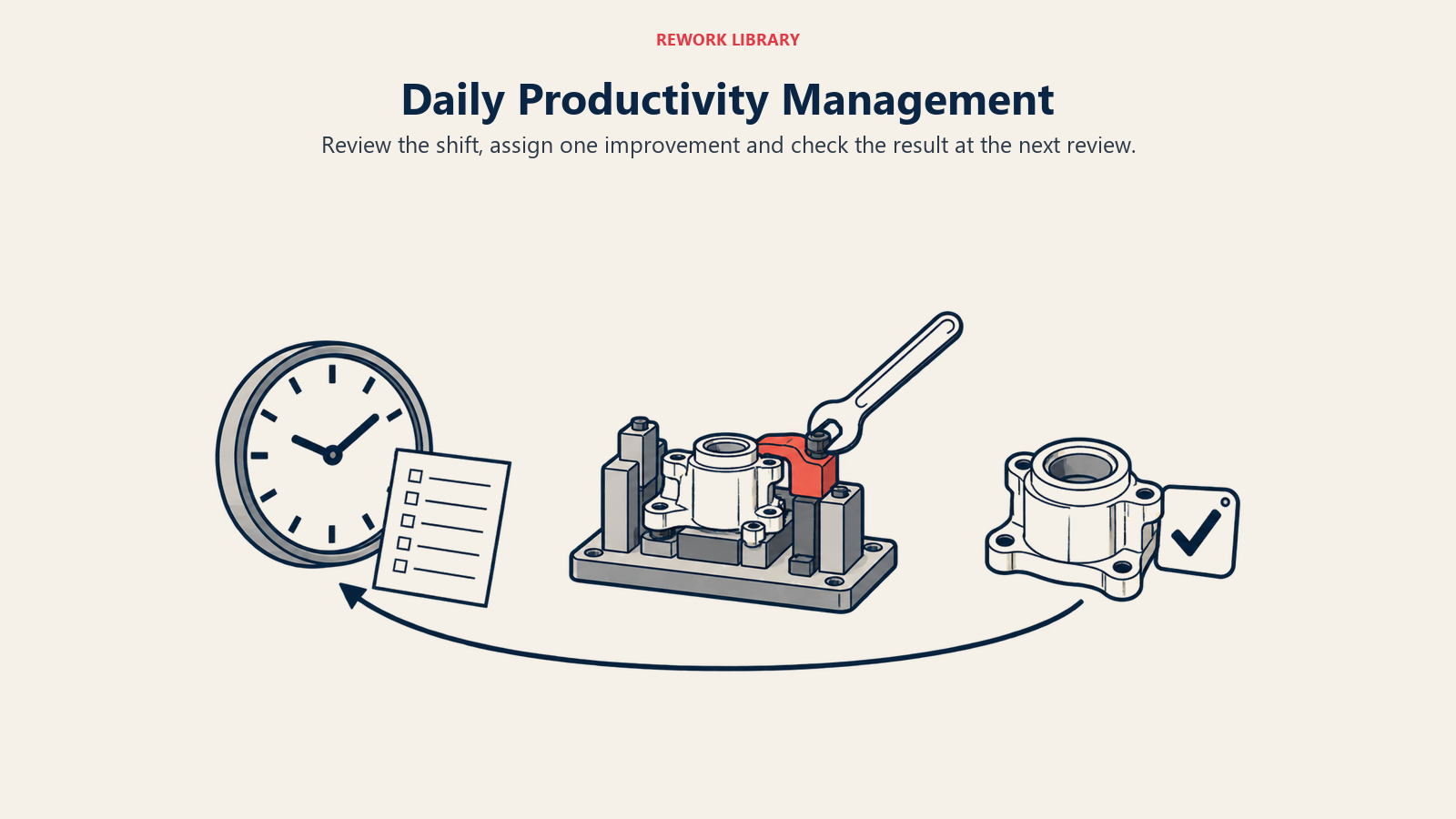
Daily performance reviews discuss previous day's or previous shift's productivity with supervisors and team leaders. What went well? What problems occurred? What's the plan to improve today?
These brief daily reviews keep productivity top of mind and allow quick response to emerging issues. Problems identified today get addressed today, not after a month of cumulative impact.
Visual management and feedback systems make performance visible to everyone. Production boards display current productivity, trend charts show week-over-week performance, and comparison charts highlight relative performance of different shifts or lines.
Visual systems create healthy competition and make excellence visible. Teams want to see their performance improve and match or exceed other teams' results.
Team engagement and accountability build ownership of productivity performance. When teams are involved in analyzing their own metrics, identifying improvement opportunities, and implementing solutions, productivity becomes their goal, not something imposed by management.
Teams who understand how their productivity affects business success and their own job security are motivated to improve. Teams who only experience productivity pressure without understanding or involvement resist.
Continuous improvement linkage connects productivity metrics to your broader improvement programs. Lean manufacturing, six sigma, or other improvement methodologies use productivity data to identify waste, set priorities, and measure results. Principles from Kaizen continuous improvement integrate naturally with productivity measurement.
Productivity metrics become input to improvement activities rather than just scorecards. This integration drives systematic, sustained improvement rather than episodic campaigns.
Common Measurement Mistakes to Avoid
Well-intentioned productivity measurement can backfire through predictable errors.
Measuring everything measures nothing effectively. Some manufacturers track dozens of labor metrics, creating information overload that obscures rather than illuminates. Focus on the vital few metrics that drive decision-making and improvement, not a comprehensive catalog of every possible measurement.
Using metrics punitively rather than developmentally destroys trust and creates gaming. If poor productivity results in punishment, people will manipulate data, hide problems, or blame factors outside their control. If poor productivity triggers investigation and support to improve, people will surface issues honestly.
Metrics should drive learning and improvement, not blame assignment. The goal is better performance, not identifying who to punish.
Comparing incomparable situations generates false conclusions. Comparing productivity across products with very different labor content, shifts with different equipment or staffing levels, or time periods with different product mix can be misleading.
Ensure comparisons are apples-to-apples or adjust for differences. Otherwise you'll "improve" productivity by simply shifting to easier work rather than actual efficiency gains.
Optimizing individual metrics at the expense of overall performance creates dysfunction. Maximizing units per labor hour by running only the fastest products may undermine service levels for other customers. Cutting labor costs by understaffing may reduce labor per unit but increase quality problems and equipment downtime.
Balance multiple metrics and optimize for overall business performance, not any single metric in isolation.
Failing to update standards as processes change makes efficiency metrics increasingly meaningless. When you've made significant process improvements but haven't updated standards, your efficiency may show 130%:which just means the standards are wrong, not that you've achieved superhuman performance.
Building Productivity Culture Through Measurement
The most successful manufacturers use productivity metrics to create cultures of continuous improvement and operational excellence.
This means transparency in sharing performance data. Everyone should know how their team, shift, and facility are performing. Hiding metrics or sharing them selectively creates suspicion and disengagement.
It requires celebrating improvement as much as punishing failure:probably more. Recognition for productivity gains, spotlight on teams that drive improvement, and appreciation for suggestions and ideas create positive motivation.
It demands investment in capabilities that enable productivity gains. Training that improves skills, equipment improvements that remove bottlenecks, process changes that eliminate waste, and better tools and systems that support efficiency all demonstrate that leadership is serious about improving performance, not just measuring it.
Labor productivity ultimately determines your cost competitiveness, your ability to price profitably, and your capacity to grow. Organizations that systematically measure and improve productivity build sustainable competitive advantages that compound over time.
Your workforce wants to be productive:no one enjoys struggling with inefficient processes or underperforming. Give them clear metrics, involve them in improvement, provide the tools and support they need, and recognize their progress. Productivity will follow.
Learn More

On this page
- Understanding Labor Productivity Fundamentals
- Essential Labor Productivity Measures
- Building Reliable Measurement Systems
- Using Metrics to Drive Systematic Improvement
- Creating Sustainable Productivity Through Daily Management
- Common Measurement Mistakes to Avoid
- Building Productivity Culture Through Measurement
- Learn More