IoT in Manufacturing: Unlocking Value Through Connected Equipment
Turn this article into takeaways for your work.


Each assistant summarizes the article only for you and suggests best practices for your work.
Most manufacturing equipment operates as black boxes. Machines run, occasionally break, and get fixed. You know inputs and outputs but lack insight into internal conditions causing problems before they manifest as failures. Temperature rises gradually before bearing failure. Vibration patterns change as misalignment develops. Power consumption drifts as efficiency degrades. Without instrumentation detecting these signals, you discover problems through breakdowns rather than preventing them.
Industrial Internet of Things (IIoT) transforms blind operations into intelligent, monitored systems. Sensors continuously measure conditions previously invisible. Connected equipment reports status in real-time rather than during scheduled inspections. Analytics identify patterns predicting failures, quality issues, or inefficiencies. This visibility enables proactive management. preventing problems rather than reacting to them. fundamentally changing manufacturing operations.
But IoT implementations can disappoint when disconnected from business value. Sensors generating data nobody uses. Dashboards showing metrics nobody acts on. Connectivity projects justified by vague "digital transformation" goals without clear ROI. Successful IIoT requires starting with specific problems worth solving, implementing focused solutions delivering measurable value, then expanding systematically. Understanding IIoT architecture, high-value use cases, and implementation considerations enables practical deployments rather than science projects.
IIoT Fundamentals
Industrial IoT differs from consumer IoT through reliability, security, and integration requirements reflecting manufacturing environments' demands.
IIoT creates networks of connected devices and sensors continuously capturing physical conditions and process variables. Unlike consumer IoT's smart thermostats and fitness trackers, industrial applications involve harsh environments, real-time requirements, and integration with control systems. Reliability matters. sensor failures can't shut down production. Security is critical. compromised systems could cause safety hazards or production disruptions.
The data flow moves from edge to cloud through multiple layers. Sensors capture physical phenomena. temperature, pressure, vibration, position, power consumption. Gateways aggregate sensor data and provide local processing. Networks transmit data to cloud platforms for storage and analysis. Applications consume data, generating insights and actions. This architecture balances real-time edge processing with cloud analytics' power and scale.
Industrial protocols and standards enable interoperable solutions. OPC UA provides platform-independent communication for industrial automation. MQTT offers lightweight messaging for IoT applications. Time-sensitive networking (TSN) enables deterministic communication for control applications. Standards prevent vendor lock-in and simplify integration across diverse equipment.
IIoT System Architecture
Understanding IIoT layers guides system design and technology selection.
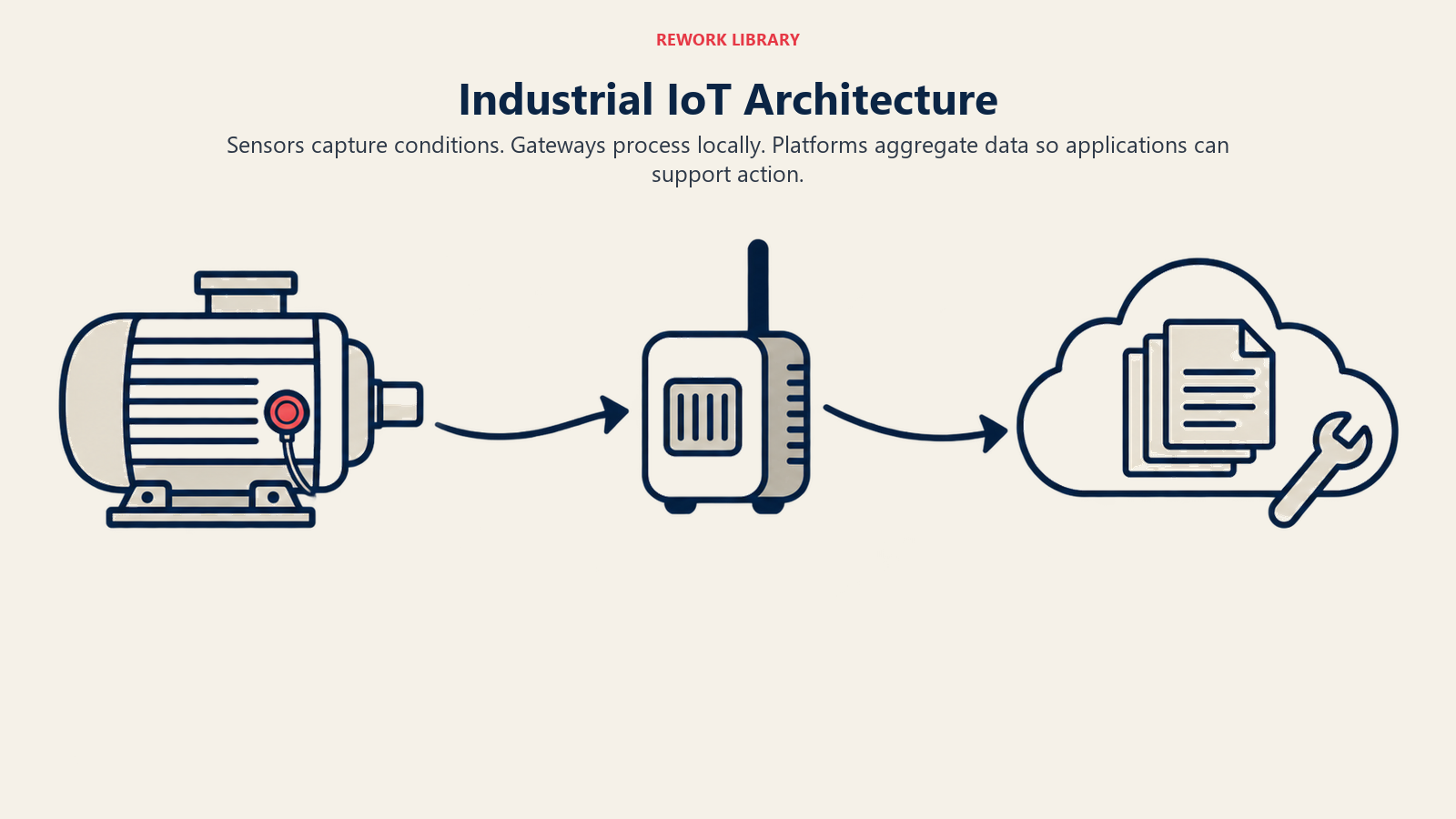
The sensor layer determines what gets measured. Temperature sensors monitor thermal conditions predicting failures or indicating process issues. Vibration sensors detect mechanical problems developing in rotating equipment. Pressure sensors track pneumatic and hydraulic systems. Current sensors measure electrical consumption. Position sensors track material flow. Vision systems capture images for quality inspection. Select sensors based on specific problems being addressed rather than instrumenting everything.
Sensor selection involves trade-offs. Higher-precision sensors cost more but provide better data. Wireless sensors simplify installation but require battery management or energy harvesting. Wired sensors offer reliability and continuous power but increase installation costs. Intrinsically safe sensors for hazardous environments add expense. Match sensor specifications to application requirements.
The connectivity layer transmits data from sensors to processing systems. Wired options include industrial Ethernet variants (PROFINET, EtherNet/IP) offering reliability and high bandwidth. Wireless technologies include industrial WiFi providing flexibility but requiring robust infrastructure, and cellular/5G enabling connectivity where WiFi isn't practical. Low-power wide-area networks (LPWAN) suit battery-powered sensors needing long range but low data rates.
Connectivity decisions depend on facility characteristics and application requirements. Existing infrastructure affects costs. facilities with WiFi can leverage it for new sensors. Real-time control applications need wired connections' deterministic performance. Asset tracking across large sites might use cellular. Battery-powered remote sensors might use LPWAN. Mixed connectivity strategies address varied requirements.
The edge/gateway layer provides local processing reducing cloud communication requirements while enabling low-latency applications. Edge devices filter raw sensor streams, transmitting only significant events or aggregated data. They run local analytics for immediate control. stopping production when quality issues detect, or adjusting parameters for optimization. Gateways translate between sensor protocols and enterprise systems, bridging operational and information technology.
Edge computing balances responsiveness with capability. Simple edge devices perform filtering and basic logic. Industrial PCs run complex analytics and machine learning models. The edge handles time-critical functions while cloud provides heavy computational power for training models and enterprise-wide analysis.
The platform layer aggregates, stores, and processes data from multiple sources. Cloud platforms offer scalable storage for historical data from all facilities. Data lakes accumulate raw information supporting diverse analytics. Time-series databases optimize for sensor data's temporal nature. Integration services connect IIoT systems with MES, ERP, and other enterprise applications.
Platform selection involves build versus buy decisions. Cloud providers offer IoT platforms (AWS IoT, Azure IoT, Google Cloud IoT) with managed services. Industrial automation vendors provide specialized platforms integrated with their ecosystems. Open-source options provide flexibility but require more internal capability. Most manufacturers benefit from commercial platforms' managed services rather than building from scratch.
The application layer delivers business value through analytics, visualization, and integration with business processes. Dashboards provide real-time visibility into operations. Predictive maintenance applications forecast equipment failures. Quality analytics identify process issues affecting product. Energy management applications optimize consumption. These applications convert raw connectivity into actionable insights.
High-Value Use Cases
Successful IIoT implementations target specific applications delivering clear business value rather than generic connectivity projects.
Equipment monitoring and OEE tracking provides fundamental visibility into manufacturing performance. Sensors detect when machines run, stop, or experience slowdowns. Integration with production systems tracks output quantities. Analytics calculate Overall Equipment Effectiveness and component metrics (availability, performance, quality). Real-time OEE visibility typically improves performance 5-10% as problems get attention faster and accountability increases.
Implementation starts with defining availability states. running, unplanned downtime, planned downtime, changeovers. Sensors determine current state through power monitoring, output counting, or machine signals. MES systems track production counts and quality. Dashboards display current and historical OEE by line, shift, product. Pareto analysis identifies biggest loss categories deserving improvement focus.
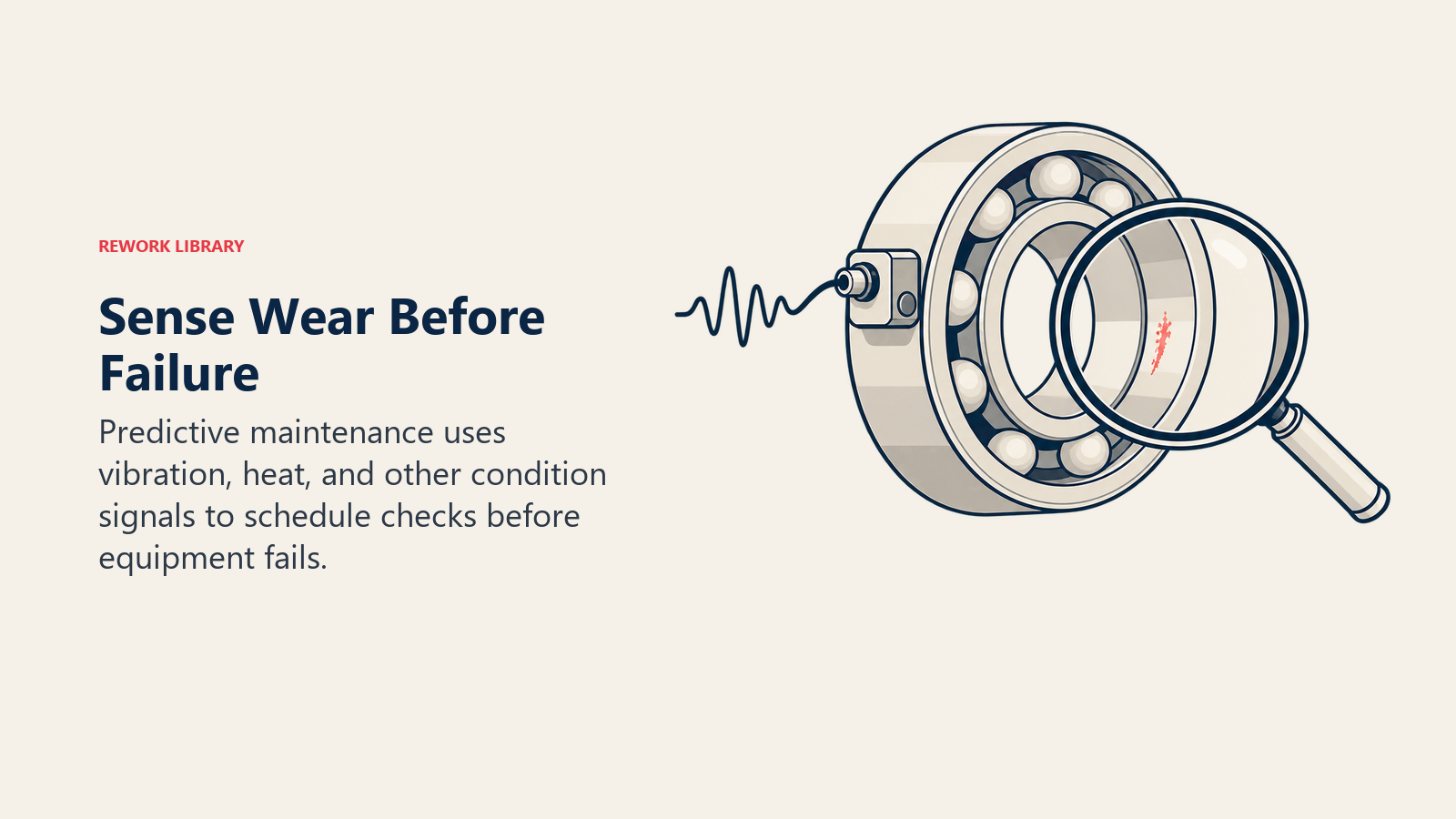
Predictive maintenance detects developing problems before failures occur, shifting from reactive to proactive maintenance. Vibration monitoring identifies bearing wear, misalignment, or imbalance in rotating equipment. Thermal imaging shows electrical connections overheating. Oil analysis detects contamination or degradation. Power consumption patterns indicate mechanical loading issues. Analytics combine these signals into failure predictions with weeks of warning.
Typical implementations instrument critical assets. production bottlenecks, expensive equipment, or assets with high failure impacts. Machine learning models train on historical failure data, learning patterns preceding breakdowns. As new sensor data streams in, models calculate failure probability. When risk exceeds thresholds, work orders generate automatically for inspection or preventive maintenance. This approach reduces unplanned downtime 30-50% while optimizing maintenance spending.
Quality monitoring in real-time catches defects during production rather than through downstream inspection. Vision systems inspect 100% of products at production speed, identifying visual defects human inspectors miss. Dimensional measurement systems verify critical features continuously. Process monitoring detects parameter drift causing quality degradation. Integration with control systems stops production at first defect rather than after producing scrap batches.
Return comes from multiple sources. Reduced scrap from catching issues faster. Lower inspection costs as automated systems replace manual inspection. Improved yields from tighter process control. Better customer satisfaction from fewer defects reaching market. Quality improvements of 20-50% defect reduction justify vision system investments quickly on high-volume products.
Energy consumption optimization identifies waste and enables load management. Equipment-level monitoring shows consumption patterns, highlighting inefficient operations. Compressed air monitoring detects leaks through pressure and flow analysis. Utility rate monitoring enables load-shifting to off-peak periods. HVAC and lighting control based on occupancy and ambient conditions eliminates waste. Energy savings typically range 10-20%, providing ongoing cost reduction while supporting sustainability goals.
Asset tracking and inventory visibility provides real-time location information for materials, products, and equipment. RFID tags or GPS trackers enable automatic position updates. Geofencing triggers alerts when assets enter or leave zones. Integration with MES and ERP maintains accurate inventory positions without manual scanning. Applications include work-in-process tracking, tool location management, and automated receiving/shipping verification.
Environmental monitoring ensures critical conditions stay within specifications. Temperature and humidity monitoring protects sensitive materials and processes. Cleanroom particle counters maintain controlled environments. Chemical storage monitoring detects leaks or unsafe conditions. Automated data logging satisfies regulatory requirements while providing audit trails. Alerts notify personnel of excursions requiring intervention.
Implementation Considerations
Practical deployment factors determine IIoT success beyond technology selection.
Retrofit versus greenfield opportunities present different challenges. New facilities can design IIoT into equipment specifications and infrastructure planning. Existing facilities require retrofitting sensors and connectivity onto legacy equipment that wasn't designed for it. Retrofit is messier but offers larger opportunity. most manufacturing happens in existing facilities. Focus retrofit efforts on highest-value equipment rather than attempting comprehensive instrumentation immediately.
Wireless connectivity in industrial environments faces challenges from metal structures, electrical noise, and interference. Site surveys characterize RF propagation before deploying wireless networks. Industrial-grade access points provide robustness beyond consumer WiFi. Network redundancy prevents single failures from losing connectivity. But wireless simplifies installation versus pulling cables through operating factories, making it attractive despite challenges.
Data volume and storage requirements grow quickly with comprehensive sensor networks. A single sensor might generate megabytes daily. A facility with thousands of sensors produces gigabytes. Multiple facilities generate terabytes. Storage architecture must accommodate this scale cost-effectively. Edge filtering reduces cloud transmission and storage by sending only significant events or aggregated data. Retention policies archive historical data to lower-cost storage.
Security considerations for connected devices protect against cyber threats that could disrupt operations. Network segmentation isolates IIoT systems from corporate networks and internet, limiting attack surfaces. Device authentication prevents unauthorized sensors from joining networks. Encrypted communication protects data in transit. Patch management updates sensor firmware addressing vulnerabilities. Security can't be afterthought. design it into architecture from the start.
Integration with existing systems delivers value by connecting IIoT data with business processes. MES integration combines sensor data with production context. ERP integration triggers procurement or maintenance actions. Quality system integration enables closed-loop process control. APIs enable these integrations without custom point-to-point development. Invest in integration capabilities early. isolated IIoT systems deliver limited value.
Building the Business Case
IIoT investments need clear financial justification despite strategic benefits.
ROI calculation starts with quantifying problem costs. For predictive maintenance, calculate current unplanned downtime cost, emergency repair expenses, and lost production value. For quality monitoring, quantify scrap costs, inspection labor, and customer quality issues. For energy management, calculate consumption costs and identify waste. These baseline costs show potential savings justifying IIoT investment.
Quick wins demonstrate value rapidly, building organizational support for broader deployment. Start with single use case on specific equipment. predictive maintenance on most problematic asset, quality monitoring for highest-scrap product, energy monitoring on largest consumer. Focused pilots deliver ROI within months rather than years while building implementation experience.
Pilot project design proves technical feasibility and business value before enterprise scaling. Select equipment representing broader deployment but manageable in scope. Define success metrics tied to business outcomes. Run long enough to demonstrate sustained value, not just initial novelty effect. Document lessons learned guiding subsequent deployments.
Scaling from pilot to enterprise multiplies value while managing risk. Standardize on proven technologies rather than continuing to experiment. Develop implementation playbooks codifying lessons learned. Build internal capability through training and process development. But scale systematically based on ROI priorities rather than attempting comprehensive deployment simultaneously.
Learn More
