Product Costing Methods for Manufacturers: Choosing the Right Approach for Profitability
Turn this article into takeaways for your work.


Each assistant summarizes the article only for you and suggests best practices for your work.
Your costing method determines what you see. And what you see determines what you decide. A precision machining company switched from standard costing to actual costing and discovered their most popular product lost money every time they made it. The standard rates they'd been using for years masked the true cost of rework and overtime. They'd been celebrating volume growth while bleeding cash.
Most manufacturers inherit their costing methodology. Someone set it up years ago, and it's never been questioned. But the method you use isn't neutral. It shapes how you think about profitability, which products you push, which customers you pursue, and which improvements you prioritize. The wrong method doesn't just give you bad numbers: it points you in the wrong direction.
The Core Methodologies
Product costing methods fall into three fundamental choices, each with different trade-offs and implications. Understanding these choices means understanding what information you need and what decisions your costing system must support.
Job costing tracks costs for individual production orders or batches. Each job gets its own cost sheet accumulating materials, labor, and overhead. This works when you make distinct products or custom configurations. Construction, aerospace, and custom manufacturing use job costing because each project is unique. You can see exactly what each job cost, compare it to the quote, and measure profitability at the job level.
Process costing spreads costs across large production volumes. Instead of tracking individual units, you accumulate costs by department or process for a time period, then divide by units produced. This fits continuous or repetitive production like chemicals, food processing, or electronics assembly. When you're making thousands of identical units, tracking each one individually makes no sense.
The distinction matters because job costing provides detail while process costing provides efficiency. Job costing tells you about individual profitability but requires more administrative effort. Process costing gives you average unit costs with less work but hides variation within the production batch. Choose based on your production environment and information needs, not on what your ERP system defaults to.
Standard versus Actual Costing
Standard costing establishes predetermined rates for materials, labor, and overhead, then compares actual results to standards. The differences become variances to analyze. This approach simplifies inventory valuation, speeds up product costing, and highlights performance deviations.
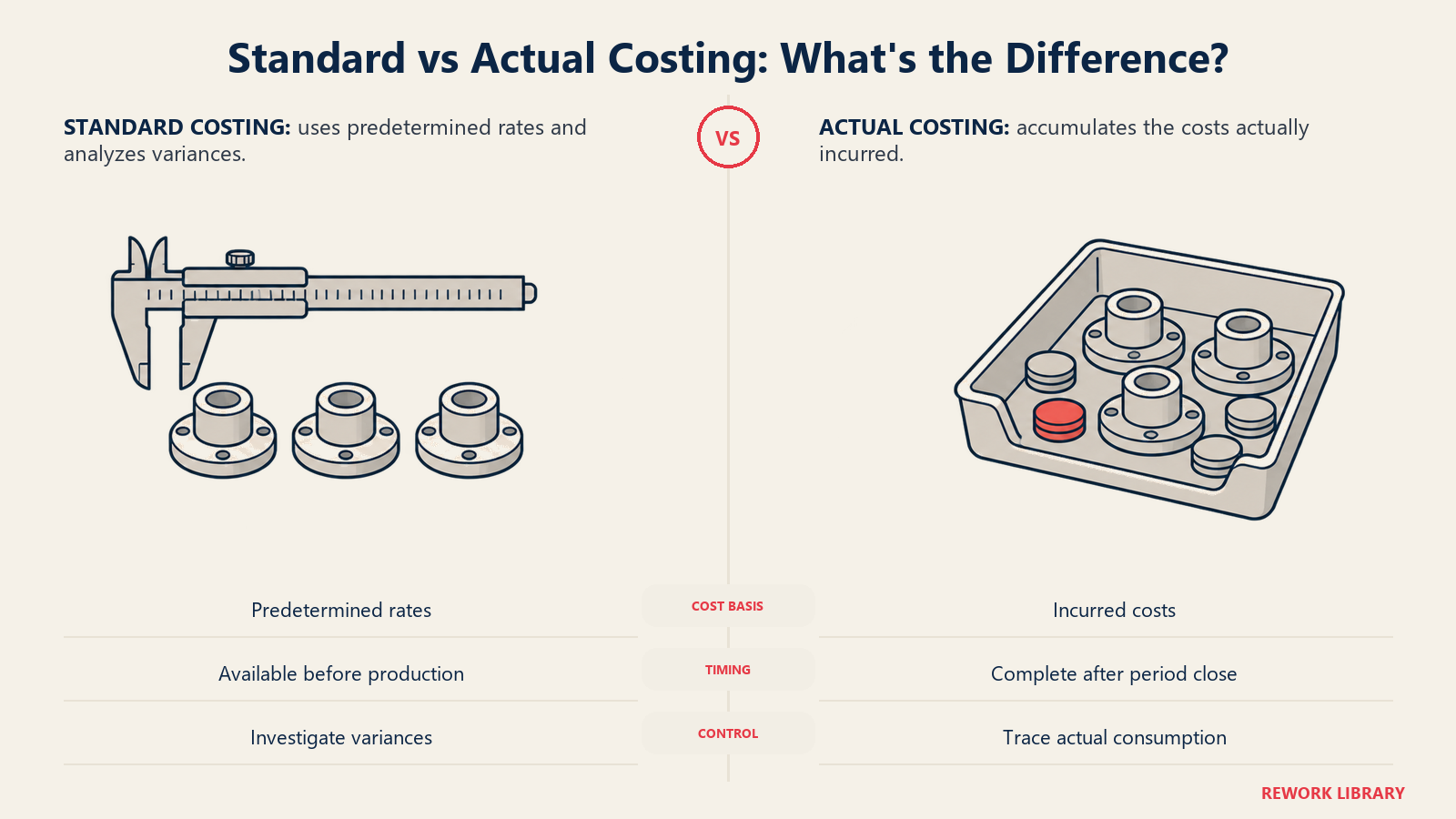
The power of standard costing is variance analysis. When material costs run 15% over standard, you investigate. Prices increased? Usage exceeded expectations? Scrap rates higher than normal? The variance triggers investigation. Standard costing turns cost accounting into a management tool rather than just a measurement exercise.
But standards can become stale. If you set them annually and conditions change, you're comparing reality to outdated assumptions. A company running on labor standards from two years ago doesn't see current performance. They see performance relative to old expectations. Some manufacturers update standards quarterly or even monthly to maintain relevance.
Actual costing uses real costs as they occur. Every unit absorbs the actual materials consumed, actual labor hours worked, and actual overhead incurred. According to manufacturing costing research, actual costing provides precise cost information without variance analysis. You always know what things really cost.
The challenge is timing and complexity. Actual costs aren't known until the period closes. Materials prices fluctuate. Labor rates vary with overtime. Overhead expenses arrive from different departments on different schedules. You can't cost products quickly, and you can't make pricing decisions until actual costs arrive. For companies needing rapid turnaround on quotes or inventory valuation, this delay creates problems.
Most manufacturers land somewhere in between, using standard costing with frequent updates or actual costing with estimated overhead rates. Pure approaches work in theory but often need modification in practice.
Absorption versus Variable Costing
Absorption costing treats all manufacturing costs as product costs. Direct materials, direct labor, variable overhead, and fixed overhead all get absorbed into inventory. This matches GAAP requirements and provides full cost information for pricing decisions.
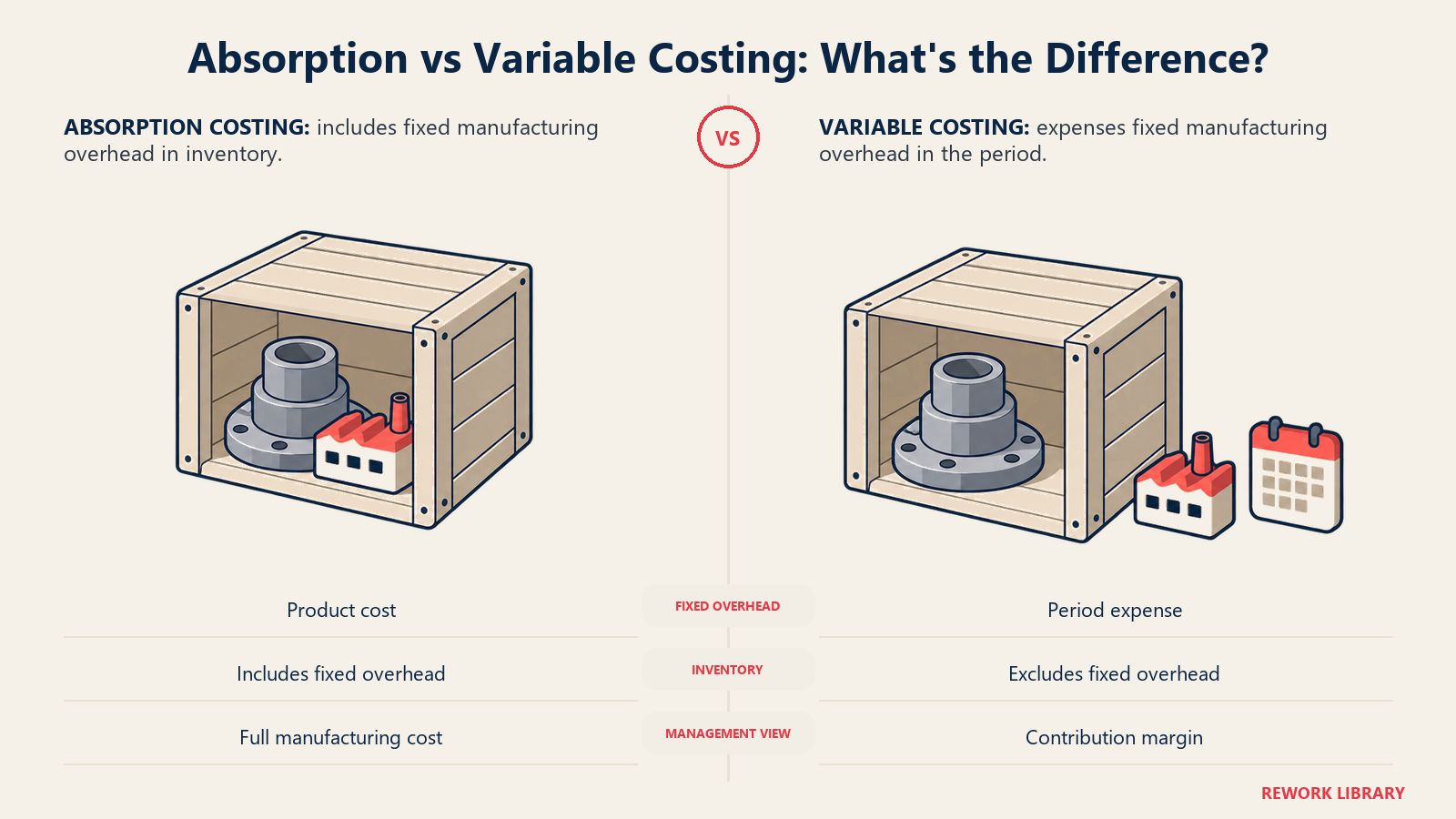
The logic is straightforward: fixed costs like factory rent and equipment depreciation are necessary for production, so products should bear them. When you price below full absorption cost, you're not covering all expenses. This view protects margin by ensuring prices reflect total manufacturing cost.
But absorption costing creates an incentive problem. Producing more units spreads fixed overhead across more inventory, lowering unit cost and increasing profit. Managers can improve reported profitability by building inventory even when demand doesn't justify it. This encourages overproduction, which ties up working capital and hides operational issues.
Variable costing includes only variable costs in product costs. Fixed manufacturing overhead goes straight to the income statement as a period expense. Unit costs fluctuate less with volume changes, and profitability ties more directly to sales than production volume. Research from Harvard Business Review shows that variable costing provides clearer insights for product mix decisions.
This approach aligns incentives better. Managers can't boost profits by overproducing. Contribution margin becomes visible, supporting better pricing and product mix decisions. You can see which products cover variable costs and contribute to fixed costs even if they don't cover full absorption costs.
The trade-off is external reporting. GAAP requires absorption costing for financial statements. Most manufacturers use absorption for external reporting and variable costing for internal decision-making. This dual approach adds complexity but provides better management information while maintaining compliance.
Matching Method to Business Needs
Choosing the right costing approach starts with understanding your production environment. If you make custom products or small batches with significant differences, job costing provides the detail you need. If you run high-volume repetitive production with homogeneous outputs, process costing reduces administrative burden while providing adequate information.
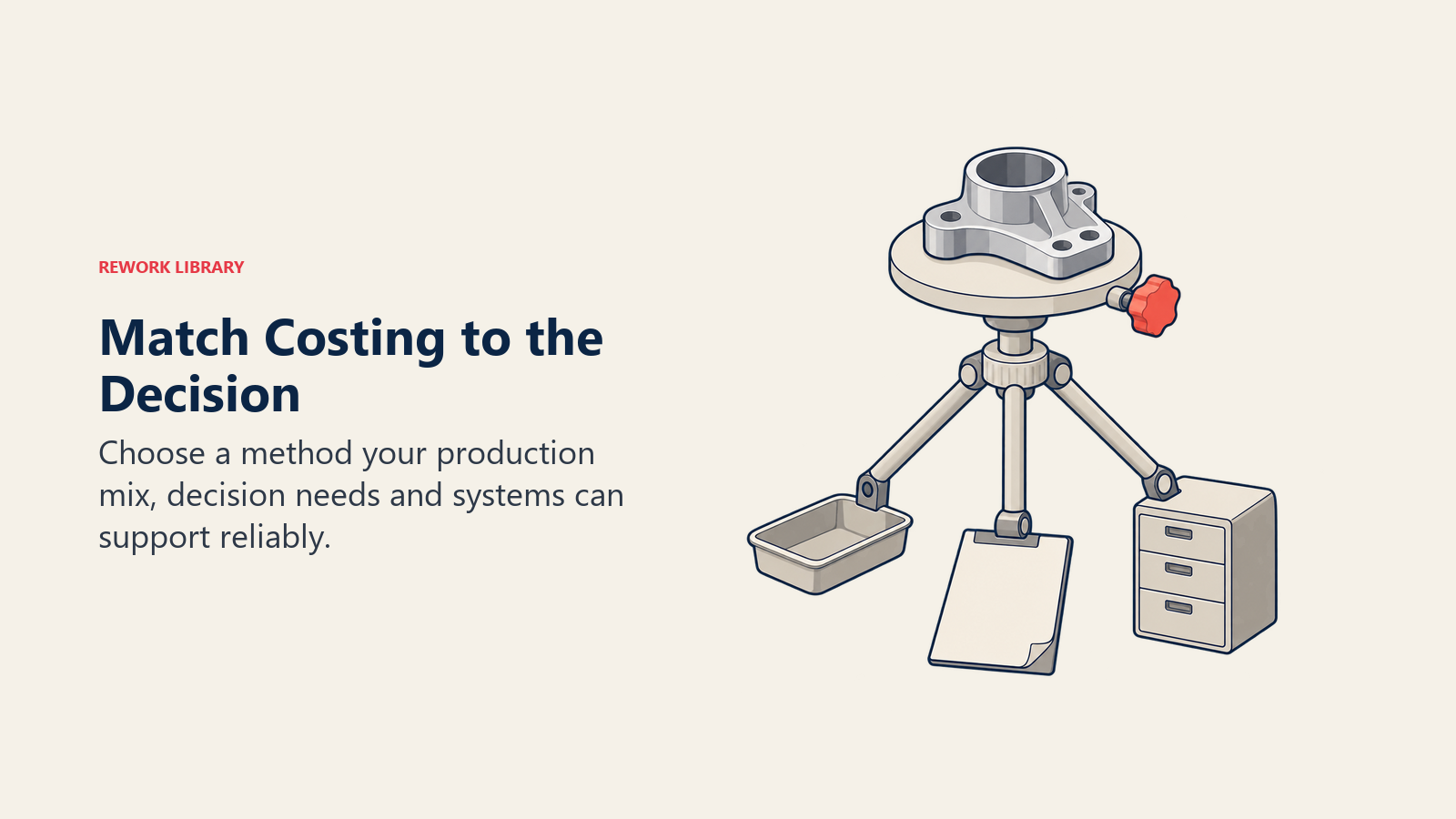
Consider decision requirements next. Do you need to quote individual jobs quickly? Standard costing with job costing lets you estimate costs before production starts. Do you need precise profitability for pricing review? Actual costing provides real costs without estimation error. Do you need contribution margin analysis for product mix decisions? Variable costing makes this visible.
System capabilities constrain choices too. Your ERP system might support certain methodologies better than others. Implementing sophisticated costing approaches without adequate system support creates manual workarounds that nobody will maintain. Sometimes a simpler approach fully supported by your systems beats a theoretically better approach requiring spreadsheet gymnastics.
Organizational capability matters as well. Activity-based costing might provide superior cost accuracy, but if your team can't maintain activity drivers or use the resulting information, you've created complexity without benefit. Start where your organization can execute successfully, then evolve as capability builds.
Hybrid Approaches for Complex Environments
Real manufacturing environments often need multiple costing methods simultaneously. A company might use process costing for high-volume standard products, job costing for custom work, and activity-based costing for complex low-volume items. Different products consume resources differently. A single methodology can't capture this diversity accurately.
The challenge is maintaining consistency while accommodating diversity. You need clear rules about when each method applies, how costs flow between methods, and how to report consolidated profitability. Without clear boundaries, you get confusion about which costs belong where.
Some manufacturers use standard costing at the operational level for speed and simplicity, then adjust to actual costs monthly or quarterly for more accurate profitability analysis. This provides rapid product costing for quoting and scheduling while ensuring periodic true-ups prevent standards from drifting too far from reality.
Others layer activity-based costing on top of traditional costing. Standard absorption costing handles inventory valuation and compliance reporting. Activity-based profitability analysis sits alongside it, using the same cost data but allocating it differently for management decisions. This dual-track approach maintains simplicity where it matters while providing insight where it's needed.
The key is clarity about what each approach accomplishes. Trying to make a single costing system do everything results in complexity that serves nothing well. Better to use simple approaches for routine needs and sophisticated analysis for high-impact decisions.
Implementation and Change Management
Changing costing methodologies disrupts the organization. Costs change. Product profitability shifts. Some products that looked good now look bad. Some that seemed marginal prove profitable. People who built their reputations on certain products or customers find their track records reinterpreted.
Start with education before implementation. Help managers understand why current methods produce the results they do and what new methods will reveal. Use examples from your actual business to make it concrete. When people understand the logic, they accept results more readily.
Run parallel systems during transition. Continue existing costing while implementing new approaches. Compare results and investigate differences. This helps validate the new system while giving people time to adjust. It also surfaces implementation errors before you commit fully.
Expect questions and resistance. Someone will point out that the new system shows their product losing money. They'll have legitimate questions about allocation logic and rate calculations. Answer them thoroughly. Sometimes they identify real implementation issues. Sometimes they're adjusting to uncomfortable truth. Either way, transparent discussion builds credibility.
Focus communication on decisions rather than just numbers. Show how better costing enables better pricing, smarter product mix optimization, and more targeted improvement efforts. Cost accounting is means, not end. The value lies in better decisions, not just more accurate numbers.
Using Cost Information Effectively
Costing methodologies provide information, but information alone doesn't improve profitability. You need processes that turn cost data into decisions and actions. Start with pricing discipline. When costing reveals products priced below cost, you need a plan. Sometimes that means price increases. Sometimes it means cost reduction targets. Sometimes it means discontinuation. But it always means conscious decision, not passive acceptance.
Product mix optimization comes next. When you understand true product profitability, you can guide sales efforts toward profitable products and customers. This doesn't mean abandoning unprofitable ones immediately, but it means making conscious choices about where to invest sales resources and which customers to grow.
Cost reduction efforts benefit from accurate costing too. When you can see which activities drive costs for different products, you can target improvements where they matter most. Reducing setup time delivers huge benefits for products with frequent setups but minimal impact on long-run products. Good costing directs improvement energy efficiently.
Customer profitability analysis extends product costing to the customer level. Some customers order high-margin products in efficient quantities. Others order low-margin products in small batches requiring special handling. Your costing system should illuminate these differences so you can manage customer relationships appropriately.
Moving Forward with Confidence
Perfect costing doesn't exist. Every method involves assumptions, estimates, and simplifications. The goal isn't perfection. It's sufficient accuracy to support good decisions. That standard is achievable regardless of your current situation.
Start by questioning whether your current method serves current needs. If you've grown more complex, if product diversity has increased, if pricing pressure has intensified, or if profitability has become harder to predict, your costing methodology might need evolution. Don't change for the sake of change. But don't maintain outdated approaches out of habit either.
Consider a costing assessment. Map your production environment, decision needs, and system capabilities. Identify gaps between what you have and what you need. Prioritize changes based on decision impact and implementation feasibility. Some improvements deliver huge benefits with modest effort. Others require significant investment for marginal gains. Be strategic.
Remember that costing methodology is a choice you control. You're not locked into approaches established years ago for different circumstances. As your business evolves, your costing can evolve too. The manufacturers who maintain competitive advantage adapt their management systems as their businesses change. Costing systems are no exception.
Learn More
