Batch vs Continuous Production: Choosing the Right Manufacturing Method
Turn this article into takeaways for your work.


Each assistant summarizes the article only for you and suggests best practices for your work.
Production method choice affects everything from costs and flexibility to quality and capital requirements. A manufacturer using batch production when continuous is appropriate carries excess changeover costs and longer lead times. One using continuous production for products better suited to batch production creates inflexibility and stranded capacity when demand shifts. This decision significantly impacts your manufacturing cost structure.
Understanding which method fits your products, markets, and capabilities determines operational efficiency and competitive positioning.
Batch vs Continuous Production: Core Differences
Batch Production Characteristics
Batch production makes discrete quantities of products in groups or lots. One batch completes before starting another. Each batch potentially uses different materials, settings, or processes.
Batches enable product variety through changing setups between runs. Pharmaceutical companies make multiple drug formulations on the same equipment by running batches sequentially. Food manufacturers produce multiple flavors or package sizes in batches. Metalworking shops produce different parts in batch sequences.
Equipment utilization occurs in campaigns: produce Product A for several hours or days, then changeover to Product B, then Product C. Each campaign requires setup to configure equipment for that specific product. Setup time is non-productive but necessary to enable variety. Lean manufacturing principles help minimize setup waste.
Batch size determines how long each campaign runs. Larger batches spread setup costs over more units but increase inventory and lead times. Smaller batches provide flexibility and reduce inventory but increase setup frequency and cost.
Continuous Production Characteristics
Continuous production operates without interruption for extended periods. Materials flow steadily through processes, converting inputs to outputs in continuous streams. Setup occurs rarely, often only for maintenance or major product changes.
Continuous processes suit high-volume, standardized products: chemicals, petrochemicals, bulk materials, utilities, and standardized consumer goods. Process industries dominate continuous production, though discrete manufacturers producing high volumes of standard products also use it.
Equipment runs 24/7 with minimal intervention. Operators monitor and adjust rather than manually processing each batch. Automation typically controls most operations. Shutdowns for changeovers are expensive because re-starting continuous processes takes time and resources. Overall equipment effectiveness tracking is critical for continuous operations.
Production planning focuses on throughput optimization rather than batch scheduling. The goal is maintaining steady flow at target rates, not maximizing individual machine utilization. Production planning fundamentals differ significantly between methods.
Hybrid Approaches
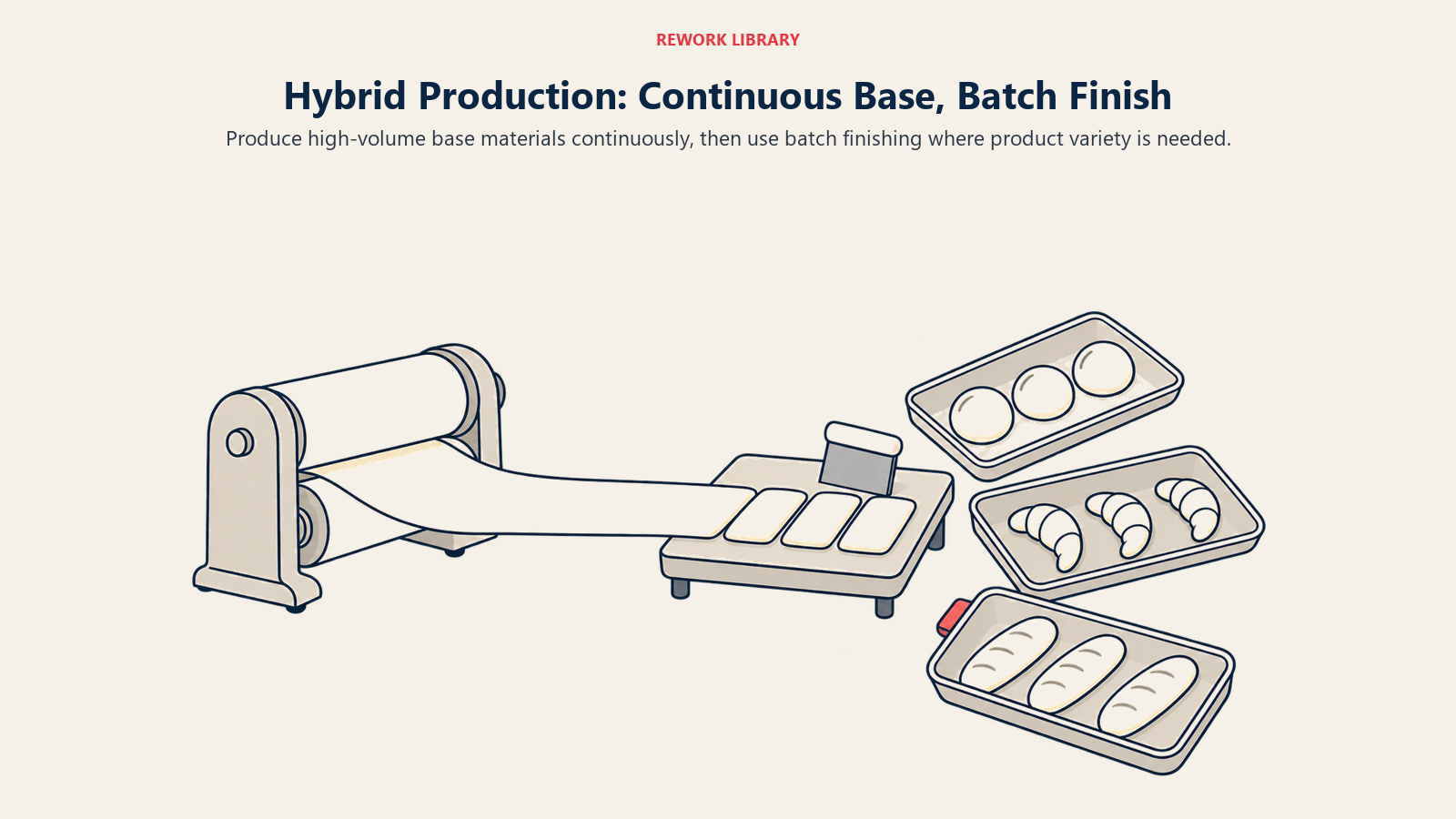
Many manufacturers combine methods. Continuous production of base materials or components feeds batch assembly or finishing. Chemical companies run continuous reactors but batch package products. Food manufacturers continuously produce dough but batch bake specific products.
Hybrid approaches balance continuous production's efficiency for high-volume steps with batch production's flexibility for variety-generating steps. This provides better overall economics than pure continuous or pure batch.
Comparative Analysis: Strengths and Limitations
Each method creates distinct advantages and disadvantages across multiple dimensions.
Cost Structure Differences
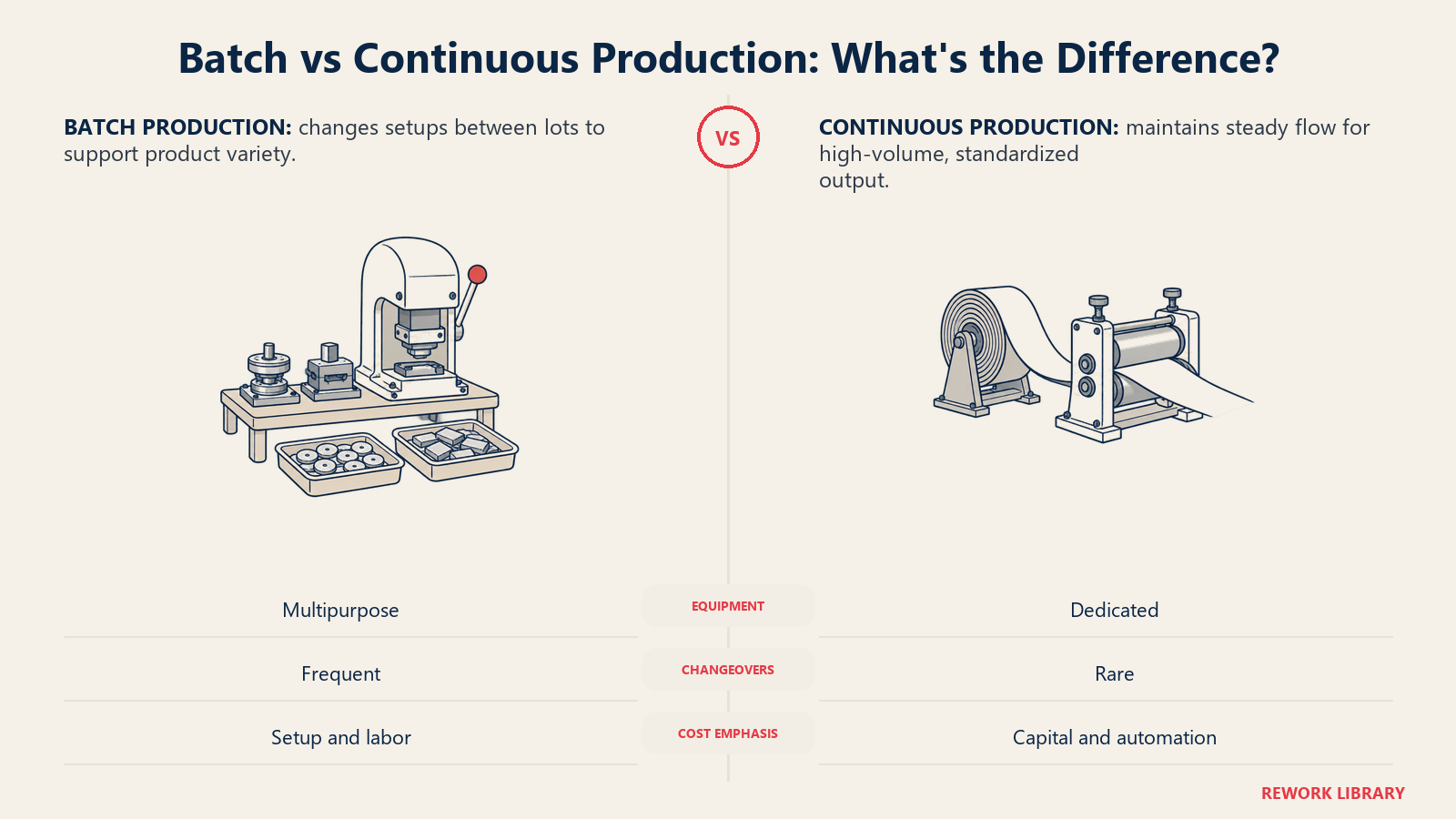
Batch production carries higher labor costs per unit because each batch requires setup, monitoring, and changeover labor. But equipment costs per unit can be lower because multipurpose equipment serves multiple products.
Variable costs dominate batch production economics. More volume means more batches, more setups, and roughly proportional cost increases. This creates predictable scaling but limits economies of scale.
Continuous production requires higher capital investment in dedicated, specialized equipment. But labor costs per unit are minimal because automation handles most operations. Fixed costs dominate continuous production economics.
Once continuous capacity exists, incremental production costs are low. This creates high operating leverage: volume increases generate dramatic margin improvements. But it also creates vulnerability: volume decreases concentrate fixed costs over fewer units, compressing margins quickly.
Flexibility and Variety
Batch production enables high product variety without excessive investment. The same equipment produces multiple products through different setups. This flexibility lets manufacturers serve diverse markets or customize for customers.
Changeovers enable variety but consume time. A 4-hour changeover after an 8-hour production run means 33% of time is non-productive. Reducing changeover time through SMED or increasing batch sizes improves efficiency but each has trade-offs.
Continuous production provides minimal flexibility. Equipment is optimized for specific products. Changes require shutdowns, reconfiguration, and restarts that might take days. Continuous processes can't economically produce multiple products unless volumes justify dedicated lines for each.
But continuous production excels at high-volume, standardized products. When you need millions of identical units, continuous processes deliver unmatched efficiency and consistency.
Quality Considerations
Batch production quality varies between batches. Different operators, materials, or environmental conditions create batch-to-batch variation. Statistical process control tracks variation and triggers investigation when batches fall outside specifications.
Batch isolation limits defect exposure. If one batch has problems, others are unaffected. You can quarantine or rework bad batches without impacting other production. But you might not discover problems until after producing entire batches.
Continuous production quality is consistent because processes run at steady state. Once optimized, continuous processes maintain specifications for extended periods. Process variation comes from input materials or equipment degradation rather than batch-to-batch setup differences.
But continuous defects affect all production until discovered and corrected. A process drift creating off-spec product might run for hours before detection, creating large quantities of waste. Real-time monitoring and automated controls mitigate this risk.
Capital Requirements
Batch production requires modest capital for multipurpose equipment. Equipment often costs less per unit of capacity than continuous lines because it's simpler and more standardized. Adding capacity happens incrementally through additional machines.
Working capital requirements are moderate. Batch production typically maintains higher inventory than continuous (to buffer between batches) but doesn't require the massive raw material inventories some continuous processes need.
Continuous production requires substantial capital for specialized equipment, automation, and control systems. Capital per unit of capacity is high because equipment is dedicated and optimized. Adding capacity often requires complete new lines rather than incremental additions.
Working capital requirements vary. Some continuous processes maintain minimal inventory because flow is steady. Others (like petrochemicals) require large raw material inventories because shutdowns are expensive and materials must flow continuously.
Skill Requirements
Batch production operators need broader skills because they set up equipment, monitor multiple products, and troubleshoot varied situations. Operators often handle complete processes rather than narrow tasks.
Training time is longer because operators must learn multiple products and procedures. But this creates workforce flexibility. Cross-trained batch operators can move between different products or equipment as needed.
Continuous production operators need deep skills in specific processes. They monitor systems, respond to alarms, and optimize parameters within narrow ranges. The work is more specialized but repetitive.
Training focuses on process understanding, control systems, and troubleshooting within specific contexts. Automation handles routine operation. Operators manage exceptions and optimize performance.
Selection Criteria: Choosing the Right Method
Product characteristics, market requirements, and strategic goals guide method selection.
Product Characteristics
Standardized products with minimal variation suit continuous production. If you make the same thing repeatedly at high volume, continuous excels. Commodities, bulk materials, and high-volume consumer goods fit this profile.
Variable products requiring customization or variety suit batch production. If customers want different specifications, sizes, colors, or configurations, batch provides needed flexibility. Custom products, seasonal items, and low-to-medium volume products fit here.
Product complexity matters. Simple products (one or two process steps) can be continuous. Complex products requiring multiple operations, assemblies, or treatments typically use batch to accommodate complexity.
Volume Considerations
Volume is the primary driver. Continuous production requires high, sustained volume to justify capital investment and cover fixed costs. Generally, consider continuous when:
- Annual volume exceeds 1 million units
- Production runs multiple shifts year-round
- Volume is predictable and stable
Batch production suits lower or variable volumes. Consider batch when:
- Annual volume is under 500,000 units
- Demand is seasonal or unpredictable
- Multiple products share equipment
Between these ranges, hybrid approaches often work best. Demand forecasting for manufacturing helps determine volume predictability.
Market Requirements
Markets demanding fast delivery, high responsiveness, or product customization favor batch production. The flexibility to change quickly and serve diverse needs creates competitive advantage.
Markets prioritizing low cost on standardized products favor continuous production. The efficiency advantages justify limited flexibility when products are standardized and volumes are high.
Time-to-market matters. Batch production enables faster introduction of new products because equipment already exists. Continuous production requires dedicated capacity, making new product launches slower and riskier.
Technology Factors
Process maturity influences method choice. Mature, well-understood processes suit continuous production. Automation and optimization are feasible when process knowledge is deep.
Evolving processes suit batch production. When you're still learning and improving, batch provides experimentation flexibility that continuous doesn't allow.
Technology availability matters. Some processes lack automation suitable for continuous operation. Others are inherently continuous (chemical reactions, heating/cooling cycles) and resist batch treatment.
Transition Strategy: Changing Production Methods
Methods can change as products mature and volumes grow.
From Batch to Continuous
Products often start as batch production during development and low-volume introduction. As volumes grow and products mature, transitioning to continuous production captures efficiency benefits.
Transition when volume consistently exceeds batch capacity, product specifications stabilize, and capital investment can be justified. Don't transition prematurely. Continuous production limits flexibility needed during product evolution.
Implement dedicated continuous lines rather than converting multipurpose batch equipment. This preserves batch capability for other products and prevents stranded assets if continuous transition fails.
From Continuous to Batch
Rarely do manufacturers move from continuous to batch. But it happens when products decline to volumes that no longer justify continuous operations or when market demands require variety that continuous can't provide.
If continuous capacity becomes excess, consider whether batch conversion enables better utilization across multiple products or whether equipment should be retired entirely.
Hybrid Implementation
Hybrid approaches often provide optimal solutions. Continuously produce high-volume components or base materials. Batch produce final assemblies or configurations where variety is needed.
This focuses continuous production where volumes justify it while maintaining flexibility where markets demand it. Process design determines feasibility. Some processes enable clean separation between continuous and batch stages. Others don't.
Learn More
Expand production method understanding:
- Manufacturing Business Models explains how production methods align with business models
- Production Planning Fundamentals covers planning for different methods
- Manufacturing Cost Structure details cost implications of each method
- Capacity Planning Strategy guides capacity decisions for different methods
- Lean Manufacturing Principles applies to both methods with different emphasis
- Value Stream Mapping visualizes flow for both production methods
Aligning Production Method with Strategy
Production method isn't just an operational choice. It's a strategic decision that enables or constrains your business model, determines cost structure, and shapes competitive positioning.
Choose methods deliberately based on product characteristics, volume realities, market requirements, and strategic direction. Don't default to batch because "it's how we've always done it" or pursue continuous because "it's more efficient."
And recognize that optimal methods evolve. What worked at startup volumes might not work at scale. What succeeds with mature products might not work with new ones. Review methods periodically and adjust as conditions change.
That flexibility (choosing the right method initially and evolving as circumstances change) creates manufacturing organizations that remain competitive across products lifecycle stages and market conditions.
