First Pass Yield Optimization: Reducing Defects and Rework to Maximize Manufacturing Efficiency
Turn this article into takeaways for your work.


Each assistant summarizes the article only for you and suggests best practices for your work.
A medical device manufacturer thought they had 95% yield because 95% of finished products passed final inspection. Then they measured First Pass Yield at each process step. The reality: only 73% of units made it through all operations without any rework or repair. The remaining 22% required touchup, adjustment, or component replacement at various stages.
This hidden rework was costing them $3.8 million annually in direct labor, plus unknown amounts in expediting, delayed shipments, and quality holds. Worse, they had no idea which operations caused the most problems because they only measured final outcomes.
First Pass Yield (FPY) reveals the real story. It tells you what percentage of your production is truly right the first time, not just eventually acceptable after rework. And that distinction matters enormously for cost, capacity, and customer satisfaction.
Understanding First Pass Yield: The True Quality Metric
First Pass Yield (FPY) measures the percentage of units that pass all quality checks the first time through a process, without rework, repair, or adjustment. According to Wikipedia, FPY is defined as the number of units coming out of a process divided by the number of units going into that process over a specified period of time. ASQ notes that First pass yield is the percentage of units that completes a process and meets quality guidelines without being scrapped, rerun, retested, returned or diverted into an offline repair area.
The calculation is simple:
FPY = (Units entering - Defects found) / Units entering
Or equivalently:
FPY = Units passing first time / Total units processed
If you process 1,000 parts and 92 have defects requiring rework, your FPY is 90.8%. The 92 defective parts may eventually get reworked to acceptable condition, but they didn't pass the first time.
FPY vs Final Yield: Why FPY Matters More
Final yield measures what percentage of units eventually meet specifications after rework and repair. It sounds similar to FPY but masks critical information.
Imagine two scenarios:
Scenario A: 95% FPY, 95% final yield. Most units pass first time; the few defects get scrapped.
Scenario B: 75% FPY, 95% final yield. Only three-quarters pass first time, but almost everything gets reworked to acceptable condition.
Final yield looks the same. But Scenario B has much higher costs: rework labor, delayed output, capacity consumed by rework, quality holds, and expediting. Plus, reworked products typically have higher field failure rates than right-first-time production.
FPY reveals process capability that final yield obscures. Low FPY with high final yield means you're good at rework but poor at prevention. That's expensive and risky.
Rolled Throughput Yield for Multi-Step Processes
Most products go through multiple operations. Rolled Throughput Yield (RTY) accounts for cumulative probability of passing all steps:
RTY = FPY₁ × FPY₂ × FPY₃ × ... × FPYₙ
If you have five operations, each with 95% FPY, your RTY is:
0.95 × 0.95 × 0.95 × 0.95 × 0.95 = 0.774 = 77.4%
Even though each step has 95% FPY: which sounds good: less than 80% of units make it through all five operations without any defects. The compounding effect is brutal.
This explains why improving FPY at any step has multiplicative benefits. Raising one operation from 95% to 98% FPY might not sound dramatic, but it improves RTY from 77.4% to 90.4% for the overall process.
That medical device manufacturer had eight major process steps with FPY ranging from 87% to 98%. Their RTY calculation revealed why only 73% of units were right-first-time: even the best individual step (98%) couldn't overcome the cumulative effect of seven other operations with lower FPY.
World-Class Benchmarks by Industry
FPY expectations vary by industry complexity and maturity:
Electronics assembly: World-class operations achieve 98-99% FPY for circuit board assembly through automated inspection and mistake-proofing.
Automotive assembly: Major OEMs target 95-98% FPY for final assembly with extensive process controls and operator training.
Precision machining: 92-96% FPY is typical for complex parts with tight tolerances, higher for simpler components.
Pharmaceuticals: Near 100% FPY is required due to validation requirements and cost of waste.
Aerospace components: 90-95% FPY depending on complexity, with extensive inspection to ensure defects are caught.
Don't just compare to industry averages. Compare to your own past performance and set ambitious targets based on economic analysis of improvement potential.
Impact on Cost, Capacity, and Lead Time
Low FPY hits you in multiple ways:
Direct rework costs: Labor and materials to repair defects.
Capacity consumption: Time spent on rework is capacity not available for new production.
Extended lead times: Products delayed while waiting for or undergoing rework.
Inventory carrying costs: Higher WIP levels to buffer against rework delays.
Quality holds and expediting: Administrative burden and expediting costs.
Hidden quality costs: Reworked products may have higher field failure rates.
A fabrication shop calculated that improving FPY from 89% to 95% would eliminate 40% of rework labor and increase effective capacity by 8%: equivalent to adding another shift without hiring anyone. The lead time reduction would let them reduce safety stock by 15%, freeing $800K in working capital.
That's why FPY optimization delivers such high returns. Every percentage point improvement compounds across multiple cost and capacity metrics.
Measuring FPY: Data Collection and Analysis
You can't improve what you don't measure accurately. Solid FPY measurement requires clear definitions and consistent data collection.
Defining Pass/Fail Criteria Clearly
Ambiguous acceptance criteria create measurement problems:
"Good finish" is subjective. "No scratches visible from 12 inches under normal lighting" is objective.
"Tight fit" varies by person. "Torque 25 ±2 Nm" is verifiable.
"Acceptable solder joints" invites interpretation. "IPC-A-610 Class 2 standards" provides clear reference.
Document acceptance criteria with visual standards, measurement specifications, and examples of acceptable vs unacceptable conditions. Train inspectors until agreement is consistent.
Use Gage R&R studies to verify that your measurement system is repeatable (same inspector gets same result repeatedly) and reproducible (different inspectors get same result). If measurement variation is large relative to specification width, you can't reliably separate good from bad.
Tracking Defects by Location and Type
Don't just count total defects: track where they occur and what types you find:
By operation: Which process steps generate most defects?
By defect type: What kinds of defects occur? Dimensional, cosmetic, functional?
By operator: Do certain operators have more defects, suggesting training needs?
By shift: Do defect rates vary by shift, indicating equipment, supervision, or environmental factors?
By time: When do defects spike: after maintenance, during setup, start of shift?
By material lot: Do defects correlate with particular supplier lots?
This granular tracking reveals patterns that guide improvement efforts. Total defect counts are interesting; defect distributions are actionable.
Pareto Analysis of Defect Categories
Pareto principle applies to defects: typically 20% of defect types cause 80% of quality problems.
Create a Pareto chart ranking defect types by frequency or cost. Focus improvement on the vital few that drive most losses, not the trivial many that are statistically insignificant.
An injection molding operation tracked 23 different defect types. Pareto analysis revealed that just four types: short shots, flash, sink marks, and contamination: accounted for 78% of defects. They focused improvement on those four and saw overall FPY improve from 91% to 96% in three months.
Establishing Baseline and Targets
Measure current FPY at each operation for sufficient time to understand normal variation. Don't set targets based on best-ever performance: that's not sustainable. Use typical performance as baseline.
Set improvement targets based on:
Economic analysis: What FPY improvement justifies the investment required?
Competitive benchmarks: What do best-in-class operations achieve?
Process capability: What could this process achieve with current technology?
Strategic goals: What FPY is required to meet customer service or cost targets?
Aggressive but achievable targets create urgency. Too easy, and you leave performance on the table. Too ambitious, and people give up.
Real-Time Monitoring Systems
Manual defect tracking creates delays. By the time you compile and analyze data, you've produced more defects.
Real-time monitoring systems capture defects as they occur:
Automated inspection equipment that logs results electronically
Andon systems where operators register defects immediately
Barcode or RFID tracking that captures unit history through production
Digital dashboards displaying current FPY by operation
Real-time visibility lets supervisors intervene quickly when FPY deteriorates. Instead of discovering problems in weekly reports, they see them within minutes or hours and can respond before producing hundreds of defects.
Root Cause Analysis: Understanding FPY Losses
Measuring FPY tells you where problems exist. Root cause analysis tells you why they exist and how to fix them.
Common Sources of Defects
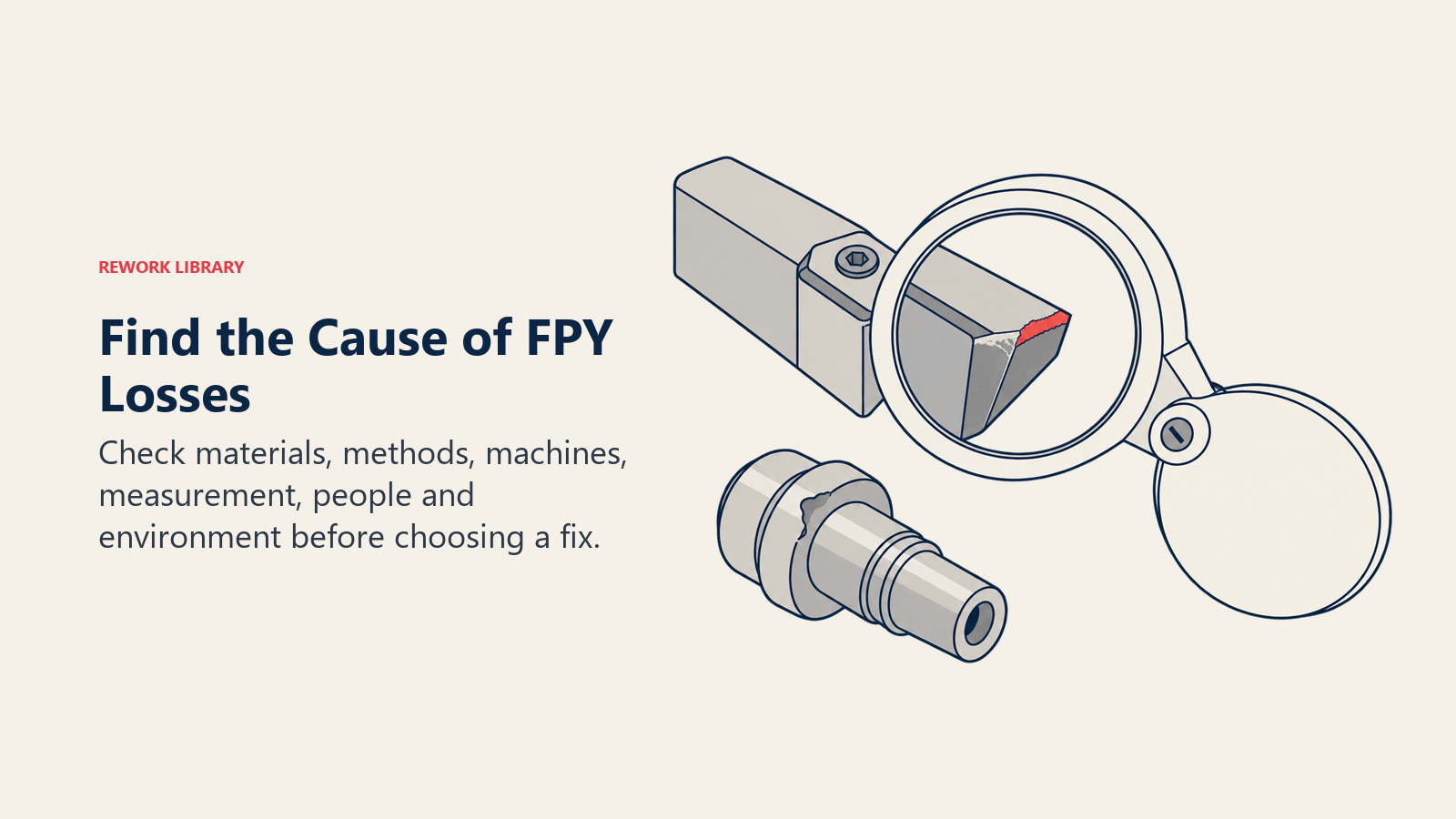
Most manufacturing defects trace to a handful of root causes:
Materials: Wrong material supplied, out-of-specification properties, contamination, damage, or inconsistent lot-to-lot variation.
Methods: Inadequate or unclear procedures, operators using different techniques, missing process steps, or incorrect process parameters.
Machines: Equipment not maintained, worn tooling, incorrect setup, machine capability insufficient for tolerances, or process drift.
Measurements: Inspection criteria unclear, measurement system incapable, calibration issues, or operator measurement error.
Manpower: Insufficient training, skill gaps, fatigue, communication breakdowns, or inadequate supervision.
Environment: Temperature, humidity, contamination, lighting, vibration, or other environmental factors affecting product or process.
The classic "6M" framework (adding Mother Nature to the 5Ms) helps ensure you consider all potential causes, not just the obvious ones.
Using Statistical Tools to Identify Patterns
Statistical analysis reveals patterns that casual observation misses:
Control charts: Distinguish between common cause variation (inherent to the process) and special causes (unusual events requiring investigation).
Scatter plots: Show relationships between variables: does defect rate correlate with temperature, line speed, or material supplier?
Hypothesis testing: Determine whether observed differences between groups (shifts, operators, suppliers) are statistically significant or just random variation.
Regression analysis: Quantify relationships between process parameters and quality outcomes.
These tools prevent jumping to conclusions based on limited data. Maybe night shift doesn't actually have more defects: you just remember night shift problems more vividly. Statistical analysis shows the truth.
Process Capability Analysis
Process capability studies compare process performance to specification requirements:
Cp (Capability index): Compares process spread to specification width. Cp > 1.33 is typically considered capable.
Cpk (Capability index accounting for centering): Considers both spread and whether the process is centered on target. Cpk > 1.33 is capable; > 1.67 is excellent.
Pp and Ppk: Long-term capability indices that include more sources of variation.
Low capability indices reveal that even a well-controlled process can't consistently meet specifications. You need fundamental process improvement: better equipment, different methods, or wider tolerances (if customer accepts).
High capability indices with low FPY suggest control problems. The process can meet specs, but something is causing frequent deviations.
Measurement System Assessment
Before you trust your FPY data, verify your measurement system is reliable:
Gage R&R studies determine what percentage of observed variation comes from the measurement system itself versus actual product variation.
A general rule: measurement system variation should be less than 10% of specification width for the system to adequately distinguish good from bad parts.
If measurement variation is large, you might reject good parts or accept bad ones. Fix measurement system problems before trying to improve the process: you need reliable data to guide improvement.
When is Variation Random vs Systematic?
Not all variation requires action:
Common cause variation is inherent randomness in the process. Trying to eliminate it through process adjustments often increases variation (overcontrol). Accept it or fundamentally change the process.
Special cause variation indicates something unusual happened: tool wear, material change, setup error. These require investigation and correction.
Control charts help distinguish the two. Points within control limits are common cause. Points outside limits or showing patterns (trends, runs, cycles) indicate special causes.
React to special causes immediately. Work on reducing common cause variation through systematic process improvement when you have time and resources.
Improvement Strategies: Tactical Approaches to Increase FPY
Once you understand root causes, implement targeted improvements.
Defect Prevention at the Source (Poka-Yoke)
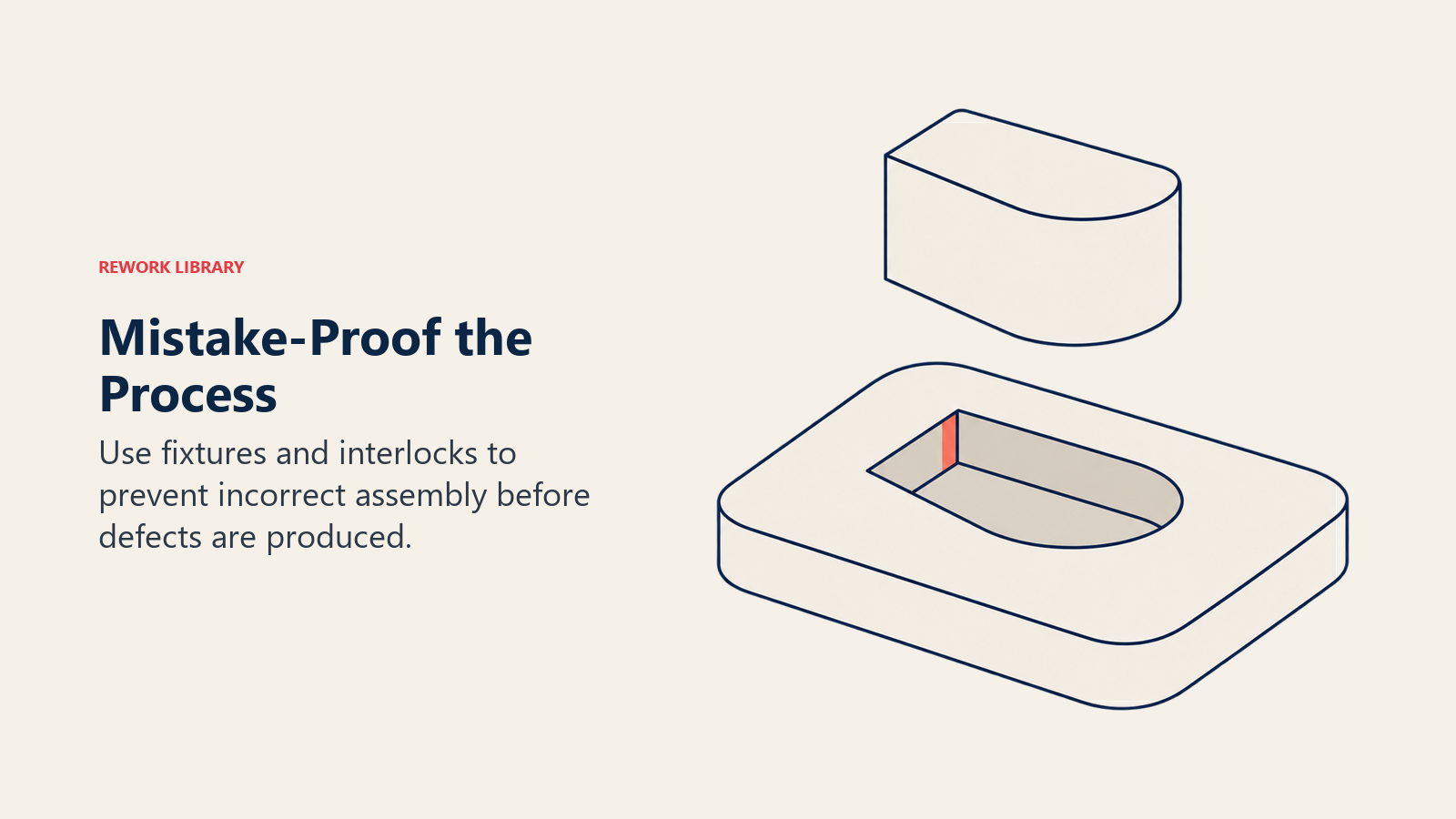
Mistake-proofing (Poka-Yoke) makes errors impossible or immediately obvious:
Physical design: Fixtures that only accept parts in correct orientation, sensors that verify all components present before allowing next operation.
Process interlocks: Equipment that won't cycle unless all conditions are correct: proper clamping pressure, correct tool installed, safety gates closed.
Error detection: Automated inspection that stops the line when defects occur, preventing accumulation of bad parts.
A packaging line had recurring issues with missing inserts. They added a weight check before sealing: packages below minimum weight were automatically rejected. FPY improved from 94% to 99.7%, and customer complaints about missing inserts dropped to zero.
Process Parameter Optimization
Many defects result from operating at suboptimal parameters:
Design of Experiments (DOE): Systematically vary process parameters to find optimal settings that maximize FPY while maintaining throughput and cost targets.
Narrow operating windows: Tighten process control limits around optimal settings to reduce variation.
Real-time parameter monitoring: Alert operators when parameters drift toward specification limits before defects occur.
A heat treatment operation used DOE to optimize furnace temperature profile, hold time, and quench rate. They found a combination that increased FPY from 88% to 96% while actually reducing cycle time by 12%.
Standard Work and Visual Work Instructions
Variation in how operators perform tasks creates variation in results:
Document best methods: Capture how your best operators perform tasks and make that the standard everyone follows.
Visual instructions: Photos, diagrams, and videos showing correct execution. Post them at workstations for easy reference.
Critical parameters highlighted: Make it obvious what matters most: key dimensions, torque values, sequence requirements.
Built-in checks: Incorporate verification steps within work instructions so operators confirm correctness before proceeding.
An assembly operation documented standard work with photos showing correct and incorrect assembly at each step. FPY improved from 89% to 95% within a month, even with the same workforce.
Operator Training and Certification
People can't execute what they don't understand:
Structured training programs: Formal training on procedures, quality requirements, equipment operation, and problem recognition.
Hands-on practice: Don't just explain: have operators demonstrate proficiency under supervision.
Certification requirements: Test knowledge and skills before allowing independent work on critical operations.
Refresher training: Periodic retraining to maintain proficiency and update on process changes.
An injection molding operation created a three-tier operator certification program. FPY data showed certified Level 2 and 3 operators achieved 95% FPY vs 87% for Level 1 or uncertified operators. They accelerated training programs and saw overall FPY improve as more operators achieved higher certification.
Fixture and Tooling Improvements
Poor fixturing and worn tooling cause many defects:
Eliminate setup errors: Design fixtures so parts can only be loaded correctly.
Improve repeatability: Better clamping, more precise locating features.
Prevent tool wear issues: Implement tool life tracking and preventive replacement before wear causes defects.
Quick-change tooling: Reduce setup time and setup variation.
A machining shop redesigned fixtures to include additional locating pins and error-proofing features. Setup-related defects dropped 80%, improving overall FPY from 91% to 96%.
Incoming Material Quality Controls
Supplier quality issues undermine internal improvement efforts:
Supplier quality agreements: Clear specifications and expectations.
Incoming inspection: Verify critical characteristics before releasing material to production. For certified suppliers, reduce to verification sampling.
Supplier scorecards: Track supplier quality performance and address chronic issues.
Early supplier involvement: Include suppliers in design reviews to ensure they understand requirements and can meet them.
Process audits: Periodically audit supplier processes, not just inspect their products.
A furniture manufacturer found that 40% of their defects traced to defective hardware from suppliers. They implemented supplier quality requirements, conducted audits, and replaced two chronic problem suppliers. Incoming defect rates dropped 85%, and internal FPY improved from 87% to 93%.
Process Control: Sustaining FPY Gains
Achieving high FPY is good. Sustaining it requires ongoing process control.
Statistical Process Control for Stability
SPC uses control charts to monitor process behavior and distinguish common cause from special cause variation:
X-bar and R charts: Monitor process average and range for measurement data.
P charts or NP charts: Monitor defect rates or counts.
C charts or U charts: Monitor defect counts per unit when multiple defects possible.
Plot data over time. As long as points stay within control limits and show no patterns, the process is stable. Points outside limits or showing trends indicate something changed that requires investigation.
SPC provides early warning when processes drift toward defect conditions. Intervene before FPY deteriorates rather than reacting after defects accumulate.
First Piece Inspection and Setup Verification
The highest-risk moment is after setup or changeover:
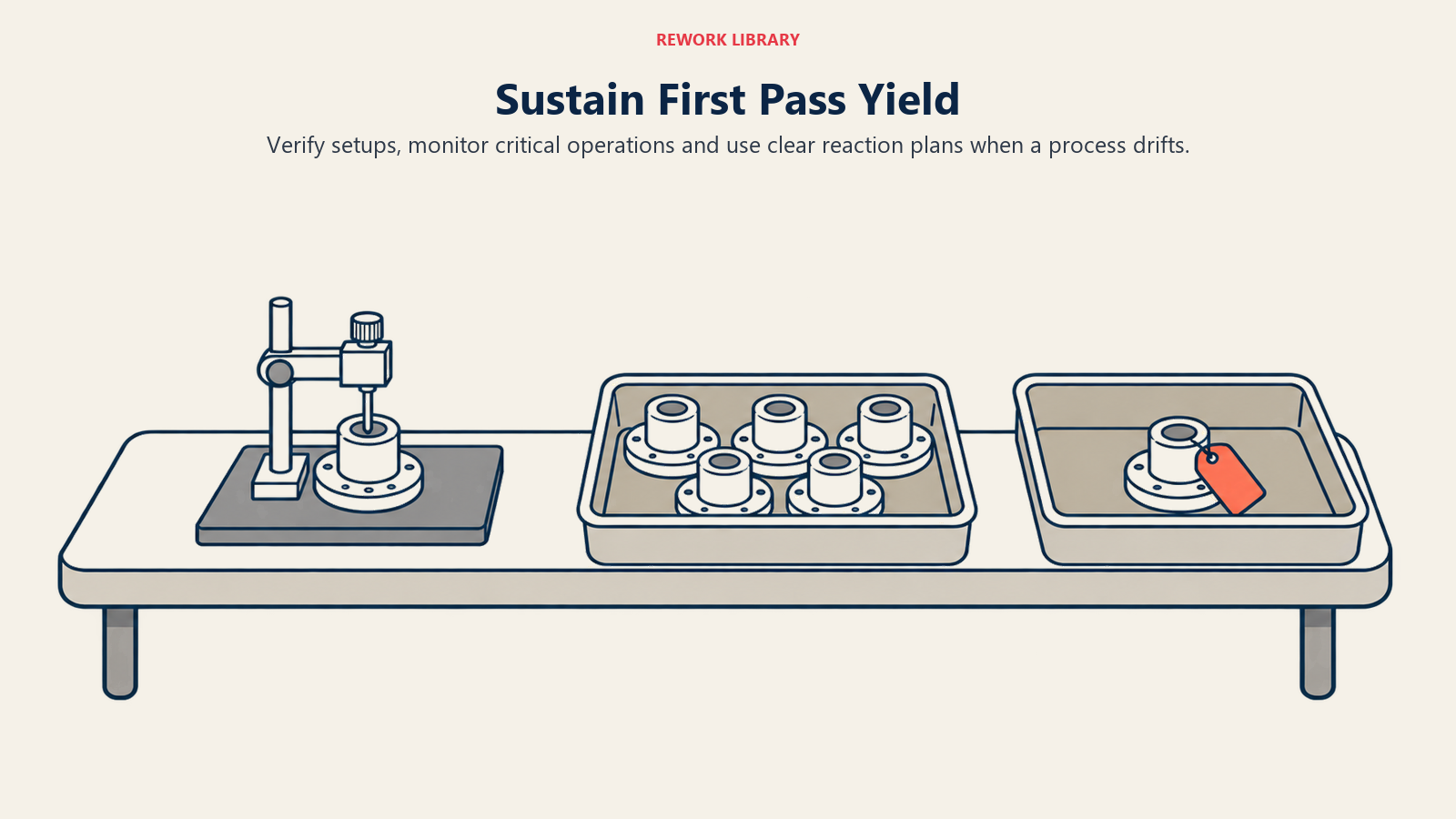
First piece inspection: Thoroughly inspect the first parts produced after setup before releasing the run for full production.
Setup verification checklist: Confirm all setup elements are correct: correct tooling, proper adjustments, right program loaded, material verified.
Process parameter verification: Confirm equipment is operating at specified parameters.
Documentation: Record what passed first piece inspection as evidence the setup was verified.
A precision machining operation mandated first piece inspection by supervisors before releasing jobs. Setup-related defects (which previously caused 30% of total defects) dropped to less than 5% of defects.
In-Process Verification Points
Don't wait until final inspection to catch problems:
Critical operations: Add inspection or automated verification at operations where defects would be costly or hard to detect later.
High-defect operations: Operations with historically low FPY need closer monitoring.
Irreversible operations: Check work before operations that can't be undone (welding, bonding, coating).
In-process verification catches problems closer to their source, enabling faster correction and preventing value-adding to defective work.
Quick Response to Process Deviations
FPY monitoring only helps if you respond when it deteriorates:
Clear escalation procedures: Operators know when to stop production and call for support.
Rapid response teams: Engineers and supervisors respond quickly to investigate and correct.
Temporary containment: Segregate suspect product while investigating rather than letting it proceed.
Root cause focus: Don't just adjust and continue: understand why deviation occurred and prevent recurrence.
An electronics assembly line implemented real-time FPY monitoring with alerts when any operation dropped below 98% in a 2-hour window. Supervisors responded within minutes instead of discovering problems in daily reports. Average time to detect and correct issues dropped from 6.5 hours to 45 minutes, reducing defects by 60%.
Control Plans and Reaction Plans
Control plans document:
What to control: Critical process parameters and quality characteristics.
How to control: Measurement methods, sampling plans, control limits.
When to control: Frequency of monitoring and inspection.
Reaction plans specify actions when parameters drift out of control:
Level 1: Parameter approaching limit: increase monitoring frequency, verify equipment function.
Level 2: Parameter at limit: stop production, investigate cause, adjust process.
Level 3: Parameter significantly out of control: quarantine product, initiate corrective action.
Clear reaction plans ensure consistent response regardless of who's on duty, preventing defects from accumulating while people debate what to do.
Advanced FPY Strategies: Continuous Improvement
Basic FPY optimization addresses current processes. Advanced strategies aim for step-change improvements.
Design for Manufacturability
The easiest defects to prevent are those designed out of the product:
Simplify design: Fewer parts mean fewer opportunities for errors.
Use appropriate tolerances: Don't specify unnecessarily tight tolerances that increase defect risk.
Design obvious assembly: Parts should fit together only one way.
Consider process capabilities: Design to what your processes can reliably achieve.
Design validation: Test prototypes under production conditions before committing to tooling.
A medical device company redesigned a product with eight small screws to use snap fits instead. Assembly FPY improved from 94% to 99.5%, and assembly time dropped 40%.
Predictive Analytics for Defect Prevention
Advanced analytics predict when defects are likely to occur:
Machine learning models: Analyze patterns in process data to predict when defects will spike.
Tool wear prediction: Predict tool replacement before wear causes defects.
Drift detection: Identify when processes are trending toward out-of-control conditions.
Prescriptive recommendations: Suggest process adjustments to maintain FPY.
These capabilities require significant data infrastructure and analytics expertise, but they enable prevention rather than just detection and reaction.
Automated Inspection and Defect Detection
Automated systems catch defects faster and more consistently than humans:
Vision systems: Inspect for cosmetic defects, dimensional compliance, component presence.
X-ray and CT scanning: Detect internal defects non-destructively.
Functional testers: Verify performance automatically.
Integrated into production: Inspection built into process flow, not separate operation.
Automation enables 100% inspection economically. Every part is verified, often at multiple stages, without slowing production or consuming inspection labor.
Zero-Defect Programs and Cultural Initiatives
Technical solutions must be supported by culture that prioritizes quality:
Management commitment: Leaders emphasize FPY improvement and allocate resources.
Operator empowerment: Authority to stop production when quality is at risk.
Problem-solving training: Capability to investigate root causes systematically.
Recognition and celebration: Acknowledge teams that achieve FPY milestones.
Transparency: Share FPY data openly and discuss improvement opportunities.
Organizations with strong quality cultures treat any defect as unacceptable, not just defects that reach customers. This mindset drives continuous reduction toward zero defects.
FPY as Leading Indicator of Operational Excellence
First Pass Yield isn't just a quality metric: it's a window into operational effectiveness:
High FPY indicates:
- Capable, stable processes
- Effective training and standard work
- Good supplier quality
- Adequate maintenance
- Process control discipline
Low FPY reveals:
- Process capability problems
- Training or supervision gaps
- Supplier issues
- Maintenance neglect
- Lack of process discipline
That's why world-class manufacturers track FPY religiously. It's an early warning system for operational problems that might not show up in final yield or customer complaints until much later.
Improving FPY improves everything: cost, capacity, lead time, customer satisfaction. It's the closest thing manufacturing has to a universal performance indicator.
That medical device manufacturer? After two years of systematic FPY improvement, they achieved 95% FPY overall (up from 73% RTY initially). The business impact:
- $3.8M annual rework cost eliminated
- 15% capacity increase without adding equipment
- Lead time reduced from 6 weeks to 4 weeks
- Customer complaints down 70%
- Employee satisfaction improved (less firefighting, more predictable operations)
All from focusing on right-first-time production instead of accepting rework as normal.
That's the power of First Pass Yield optimization: it transforms manufacturing operations from reactive firefighting to proactive excellence.
Learn More
- Defect Prevention Strategies: Building Quality at the Source
- Statistical Process Control: Monitoring and Preventing Variation
- Root Cause Analysis Methods: Getting to the Heart of Manufacturing Problems
- Overall Equipment Effectiveness: Maximizing Production Capacity
- Six Sigma in Manufacturing: Data-Driven Quality Improvement
- Manufacturing Quality Management Overview: Building Defect Prevention Systems

Co-Founder, Rework.com
On this page
- Understanding First Pass Yield: The True Quality Metric
- FPY vs Final Yield: Why FPY Matters More
- Rolled Throughput Yield for Multi-Step Processes
- World-Class Benchmarks by Industry
- Impact on Cost, Capacity, and Lead Time
- Measuring FPY: Data Collection and Analysis
- Defining Pass/Fail Criteria Clearly
- Tracking Defects by Location and Type
- Pareto Analysis of Defect Categories
- Establishing Baseline and Targets
- Real-Time Monitoring Systems
- Root Cause Analysis: Understanding FPY Losses
- Common Sources of Defects
- Using Statistical Tools to Identify Patterns
- Process Capability Analysis
- Measurement System Assessment
- When is Variation Random vs Systematic?
- Improvement Strategies: Tactical Approaches to Increase FPY
- Defect Prevention at the Source (Poka-Yoke)
- Process Parameter Optimization
- Standard Work and Visual Work Instructions
- Operator Training and Certification
- Fixture and Tooling Improvements
- Incoming Material Quality Controls
- Process Control: Sustaining FPY Gains
- Statistical Process Control for Stability
- First Piece Inspection and Setup Verification
- In-Process Verification Points
- Quick Response to Process Deviations
- Control Plans and Reaction Plans
- Advanced FPY Strategies: Continuous Improvement
- Design for Manufacturability
- Predictive Analytics for Defect Prevention
- Automated Inspection and Defect Detection
- Zero-Defect Programs and Cultural Initiatives
- FPY as Leading Indicator of Operational Excellence
- Learn More