Supply Chain Risk Management: Building Resilience in Manufacturing Operations
Turn this article into takeaways for your work.


Each assistant summarizes the article only for you and suggests best practices for your work.
In 2021, a single cargo ship blocking the Suez Canal disrupted global logistics and distribution networks for weeks, holding up approximately $9 billion in global trade each day. A fire at a Japanese chip factory caused automotive production shutdowns across three continents. The COVID-19 pandemic revealed how vulnerable just-in-time manufacturing becomes when suppliers shut down. Each event demonstrated what manufacturing executives always knew but often ignored: supply chains fail, and those failures cascade into production disruptions, lost revenue, and damaged customer relationships.
The traditional approach to supply chain optimization focused relentlessly on efficiency (lean inventory, single-source suppliers for volume leverage, global sourcing for cost advantage. This worked beautifully until something broke. And supply chains always break eventually. Geopolitical instability, natural disasters, financial failures, quality crises, or simple human error create disruptions that efficient-but-fragile supply chains can't absorb.
The solution isn't abandoning efficiency but balancing it with resilience. Supply chain risk management provides frameworks for identifying potential disruptions, assessing their likelihood and impact, implementing mitigation strategies, and preparing contingency plans. Companies with strong risk management maintain operations during disruptions that cripple competitors, turning supply chain resilience into competitive advantage rather than treating it as an unnecessary cost.
Understanding Supply Chain Risk
Supply chain risk encompasses any threat to the continuous flow of materials, components, or information needed for manufacturing operations. These risks arise from diverse sources with varying likelihood and impact.
Supplier risks represent the most direct category. A key supplier goes bankrupt, cutting off supply. They experience quality problems requiring production stoppages. Labor strikes shut down their operations. Their single factory burns down. Natural disasters hit their region. Each scenario disrupts your supply, cascading into your production problems.
Demand risks come from the market side. Unexpected demand spikes exceed supply capacity. New competitors or substitute products crater demand. Economic downturns reduce customer orders. Each creates challenges for supply chain planning and inventory management.
Process risks emerge from your internal operations. Equipment failures slow production. Quality problems cause rework or scrap. Information system outages disrupt planning and coordination. Workforce issues like high turnover or labor disputes affect execution.
Environmental risks originate from external forces. Natural disasters like earthquakes, floods, or hurricanes damage infrastructure. Geopolitical instability creates tariffs, trade restrictions, or border delays. Pandemics shut down economies. Cyberattacks compromise systems. These systemic risks can simultaneously affect multiple suppliers and transportation routes.
The business impact of supply chain disruptions extends beyond immediate production losses. Lost sales during stockouts disappoint customers and open doors for competitors. Expedited shipping and premium supplier charges inflate costs. Quality compromises when rushing replacement materials damage your reputation. Customer relationships suffer when you can't deliver reliably. The total cost of disruption typically exceeds obvious immediate losses.
Efficiency and resilience create inherent tension. Maximum efficiency means lean inventory, single suppliers for volume leverage, long-distance sourcing for cost advantage, and complex networks optimizing every dollar. Maximum resilience means extra inventory buffers, backup suppliers, local redundancy, and simple networks with fewer failure points. Neither extreme works. you need enough efficiency to compete on cost while maintaining sufficient resilience to survive disruptions.
Risk Identification and Mapping
You can't manage risks you don't know about. Risk identification reveals potential disruption sources before they materialize into actual problems.
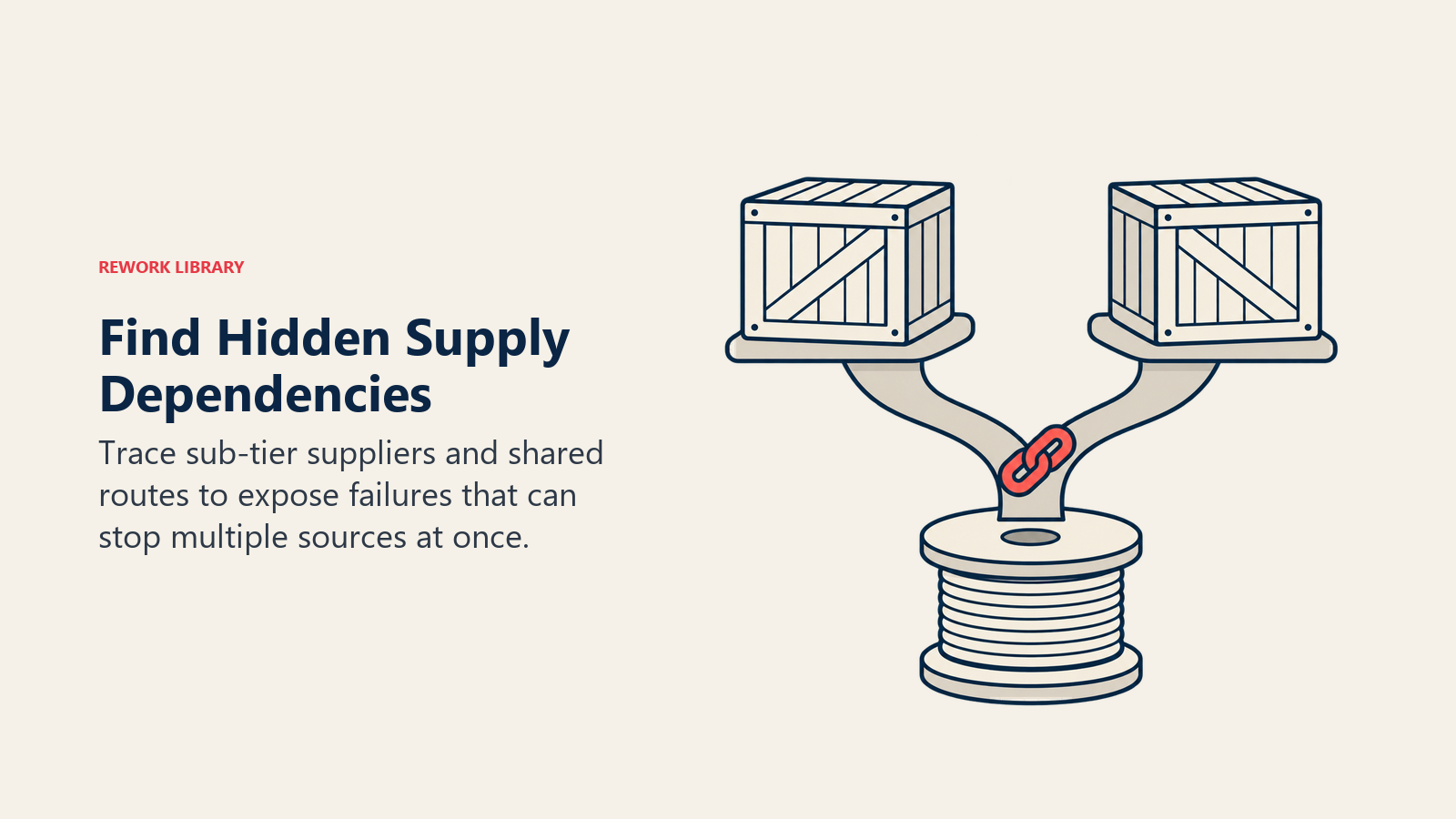
Supply chain mapping provides visibility into your extended network. Most manufacturers know their direct suppliers well but lack visibility to second and third-tier suppliers. Yet a disruption at a sub-tier supplier. say, a chemical company supplying the plastic resin your component supplier uses. stops your production just as surely as a direct supplier failure. Map your supply chain to understand these dependencies.
Single points of failure represent concentration risks where one entity's problems cascade widely. A single supplier providing 100% of a critical component is an obvious SPOF. But less obvious examples matter too. a single port handling all Asian imports, one trucking company managing distribution, or a single internal expert understanding critical processes. Document these concentration points for attention.
Supplier financial health monitoring provides early warning of potential failures. Request financial statements from critical suppliers, tracking metrics like debt levels, cash flow, and profitability. Engage credit monitoring services that alert you to deteriorating credit ratings or payment problems. Financial instability often precedes supply disruptions by months, giving you time to develop alternatives if you're paying attention.
Geopolitical and natural disaster risks require geographic awareness. Are suppliers concentrated in regions prone to earthquakes, hurricanes, or flooding? Do they operate in countries with political instability, trade tensions, or regulatory unpredictability? Map supplier locations against risk databases showing natural disaster zones and geopolitical risk indices.
Scenario analysis explores how different disruption types would affect operations. What happens if your largest supplier experiences a fire? If a port strike disrupts shipping? If trade restrictions block imports from a specific country? Walk through scenarios systematically, identifying vulnerabilities and dependencies you hadn't considered.
Supplier audits and assessments reveal capabilities and risks beyond what supplier sales teams share. Site visits show facility conditions, backup systems, and management quality. Quality audits expose process capabilities. Business continuity reviews reveal whether suppliers have disaster recovery plans. Regular assessments build understanding of supplier resilience before you need to rely on it.
Risk Assessment and Prioritization
Once you've identified potential risks, assessment determines which deserve immediate attention and resources.
Risk probability and severity matrices provide frameworks for evaluation. Plot each identified risk by likelihood (how probable is this disruption?) and impact (how much would it hurt if it happened?). Risks combining high probability and high impact demand urgent mitigation. High-impact but low-probability risks need contingency plans. Low-impact risks might not justify significant resources regardless of probability.
Supplier risk scoring quantifies supplier-specific risks for comparison. Score suppliers across dimensions like financial health, single-source exposure, location risks, quality track record, delivery reliability, and alternative availability. Composite scores identify your riskiest supplier relationships, focusing development and contingency planning efforts.
Critical supplier identification determines which relationships matter most for business continuity. Criticality combines factors like production dependency (can you operate without them?), availability of alternatives, revenue impact, and substitution difficulty. Critical suppliers warrant more intensive risk management regardless of current risk scores.
Business impact analysis quantifies disruption consequences. If supplier X fails, how many production lines stop? How much revenue gets lost daily? How long would recovery take? What would expedited alternatives cost? These calculations prioritize mitigation spending by comparing costs of prevention against potential disruption impacts.
Risk aggregation reveals concentration exposures that individual supplier analyses miss. You might assess each supplier separately as moderate risk, but discover six critical suppliers operate in the same industrial park. The individual risks compound into unacceptable concentration risk requiring action.
Mitigation Strategies
Assessment identifies risks; mitigation reduces them to acceptable levels through strategies that balance cost against resilience.
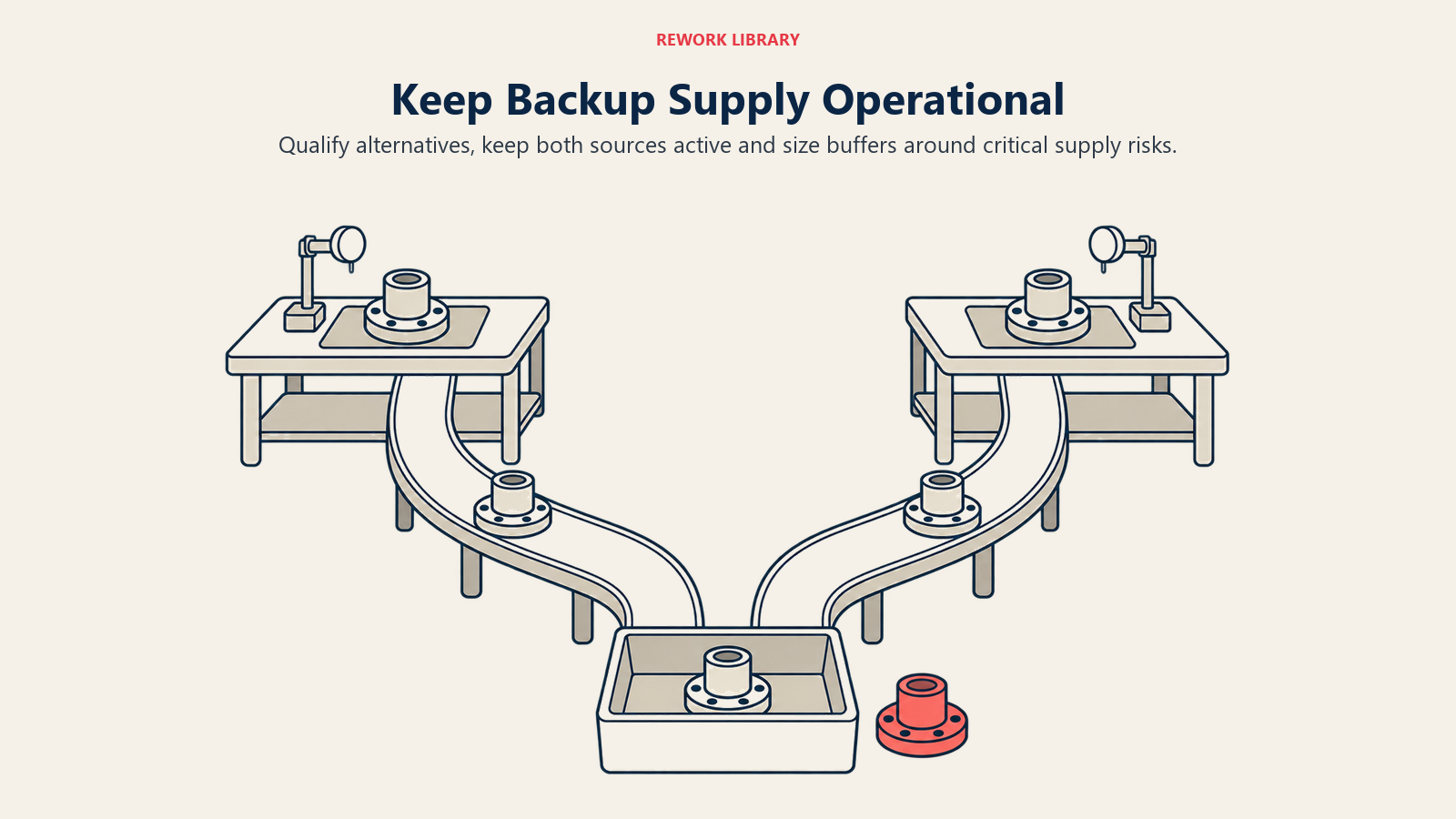
Supplier diversification is the primary mitigation for single-source risk. Dual sourcing splits volume between two suppliers, ensuring alternatives exist if one fails. Multi-sourcing spreads business across several suppliers for maximum redundancy, though at the cost of reduced volume leverage. Geographic diversification spreads suppliers across regions, preventing regional disasters from cutting off all supply.
Dual sourcing implementation requires careful execution. Qualify both suppliers to identical standards, ensuring either can serve all requirements. Maintain active production with both, not just qualified backups that might have capacity constraints or quality issues when suddenly activated. Split volume to give each sufficient business for engagement without fragmenting so much that neither gets meaningful leverage.
Strategic inventory buffers protect against supply disruptions by increasing stock of critical items from high-risk suppliers through safety stock calculations. This violates lean principles but provides insurance against disruptions. Size buffers based on risk probability, potential disruption duration, and criticality. Not every item warrants extra inventory, but critical components from risky suppliers do.
Alternative material specifications provide substitution options when preferred materials become unavailable. Design products to accommodate multiple suppliers' materials or components. Qualify alternative materials during normal times, not during crises when thorough qualification isn't possible. This design flexibility creates options when disruptions occur.
Supplier development through relationship management programs reduces risk at the source by improving supplier capabilities and resilience. Work with suppliers to improve their financial stability, quality systems, and business continuity planning. Help them diversify their sub-tier suppliers or develop alternative materials. Investment in supplier capability reduces risk more sustainably than merely planning to switch suppliers.
Contract terms through strategic sourcing negotiations can transfer or share risk. Force majeure clauses clarify responsibilities during extraordinary events. Penalty clauses incentivize reliable delivery. Alternative sourcing rights preserve your flexibility. Price adjustment mechanisms protect against cost volatility. Long-term contracts with suppliers might include requirements for business continuity plans or geographic diversification.
Contingency Planning
Mitigation reduces risk likelihood or impact, but contingency planning prepares for disruptions that occur despite preventive measures.
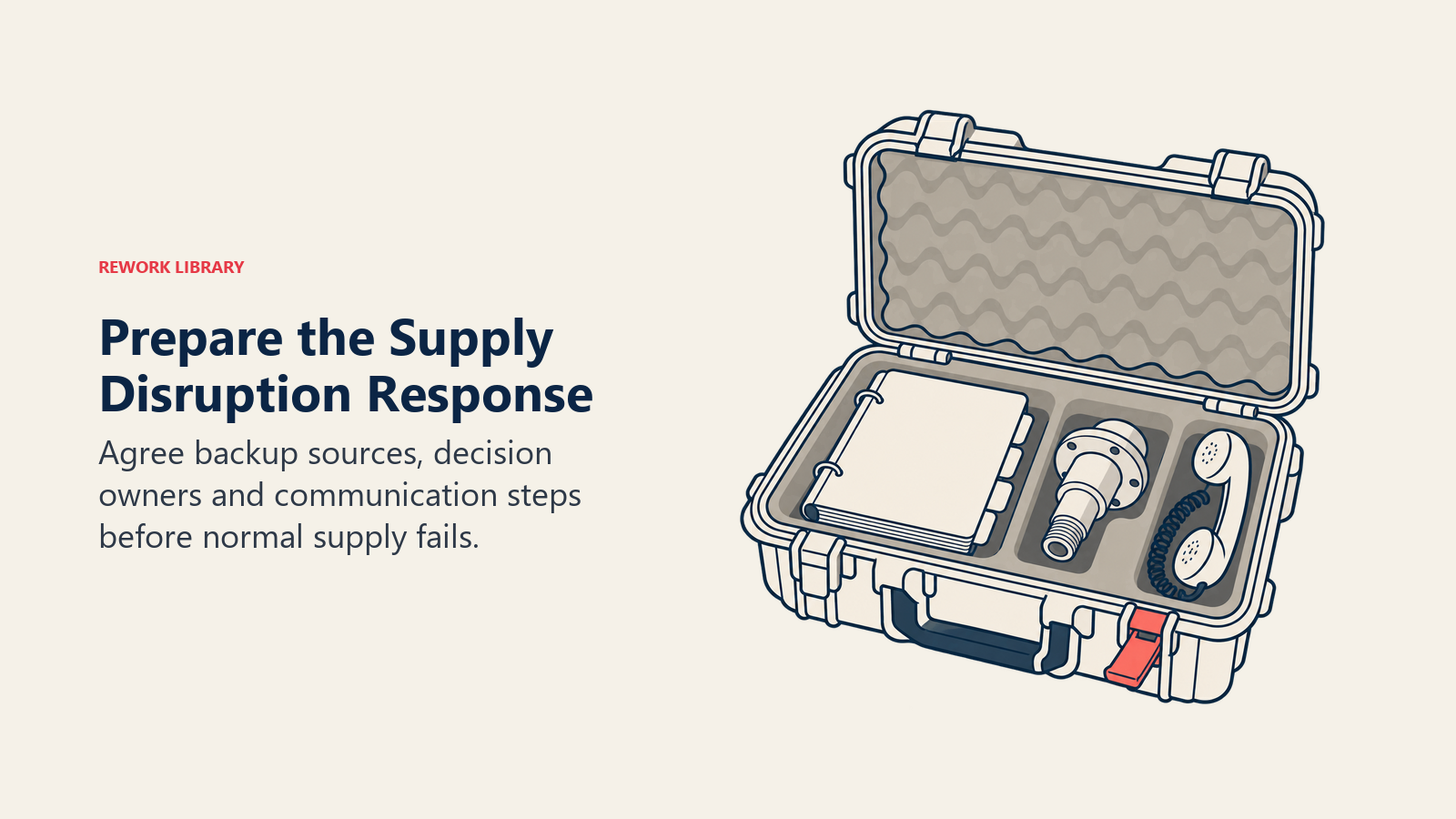
Business continuity plans document response procedures for specific disruption scenarios. If supplier X fails, who do you contact? What alternative suppliers can step in? What approvals are needed to expedite alternatives? How do you communicate with customers? Plans reduce chaos during crises by providing pre-established procedures everyone understands.
Scenario-based contingency plans address major risk categories. Develop plans for supplier bankruptcy, natural disasters affecting key regions, trade restrictions on critical imports, extended transportation disruptions, and supplier quality failures. Each scenario requires different responses. having plans prepared enables faster, more effective responses than improvising during emergencies.
Supply chain emergency response teams establish clear organizational accountability for crisis management. The team includes procurement, operations, quality, logistics, and executive sponsors. They meet regularly to review risks and update plans, then activate during actual disruptions to coordinate responses. Pre-defined teams prevent confusion about who's responsible during crises.
Communication protocols ensure stakeholders receive timely, accurate information during disruptions. When do you notify customers of potential delays? How do you communicate with alternative suppliers? What approval authorities exist for expedited decisions? Who speaks to media or regulators? Defined protocols prevent communication gaps or conflicting messages during chaotic situations.
Alternative supplier qualification during normal times prevents bottlenecks during crises. Maintain approved backup suppliers for critical items even if you don't currently buy from them. Periodic small orders keep relationships active and capabilities validated. When primary suppliers fail, backups can ramp quickly rather than requiring weeks for qualification.
Inventory management during disruptions requires different approaches than normal operations. Build inventory of critical items preemptively when disruptions appear likely. Allocate limited inventory to highest-priority customers or products. Expedite replenishment of safety stock after use. Switch to emergency procurement processes that accelerate approvals and expedite shipping.
Monitoring and Early Warning Systems
Proactive monitoring detects emerging risks before they become crises, enabling preventive action rather than reactive damage control.
Supplier financial monitoring provides early warning of potential failures. Credit rating changes, delayed payments to their suppliers, covenant violations, or declining profitability signal financial stress before bankruptcies occur. Quarterly reviews of financial data from critical suppliers should be standard practice.
Market intelligence and trend watching identifies supply market changes affecting risk. Industry news about capacity shortages, raw material price spikes, or regulatory changes helps you anticipate potential disruptions. Trade publications, supplier conferences, and industry associations provide information sources. Systematic intelligence gathering beats learning about problems from suppliers after alternatives have evaporated.
Performance metrics and red flags reveal deteriorating supplier reliability before complete failures. Declining on-time delivery, increasing quality defects, or communication delays often precede major problems. Track leading indicators and investigate negative trends early, when interventions can prevent escalation.
Geopolitical and weather monitoring alerts you to environmental risks. Subscribe to risk intelligence services tracking political instability, trade policy changes, and natural disaster threats. When hurricanes approach supplier regions or political tensions escalate, proactively communicate with affected suppliers and evaluate contingency plan activation.
Technology platforms enable risk visibility at scale through ERP integration. Supply chain risk management software aggregates data from multiple sources. supplier financial data, news monitoring, weather services, shipping data. providing integrated risk dashboards. Automated alerts notify relevant teams when risk indicators exceed thresholds. These platforms make comprehensive monitoring practical across large supplier bases.
Supplier collaboration on risk management shares information bidirectionally. Your suppliers know their challenges better than you can observe externally. Encourage open communication about capacity constraints, material shortages, or quality issues they're experiencing. Regular business reviews should include risk discussions. Collaborative relationships where suppliers feel comfortable raising concerns early prevent surprises.
Building Organizational Capability
Technology and processes enable risk management, but organizational capability determines whether these tools get used effectively.
Executive commitment signals that supply chain resilience matters strategically. When CEOs discuss supply chain risk in board meetings and business reviews, organizations respond accordingly. Procurement decisions that sacrifice slight cost advantages for reduced risk get approved. Investments in contingency capacity or backup suppliers receive funding. Without top-level commitment, short-term efficiency pressures overwhelm risk management efforts.
Cross-functional risk teams prevent risk management from becoming a procurement silo. Operations understands production impacts. Engineering knows product alternatives. Finance evaluates investment trade-offs. Quality assesses supplier capabilities. Supply chain risk affects multiple functions; managing it effectively requires their collective expertise.
Risk-aware culture makes risk consideration routine rather than exceptional. Procurement teams should evaluate supplier risk alongside cost and quality. New product designs should consider supply chain risk of specified components. Strategic decisions about plant locations or market expansions should evaluate supply chain implications. Risk thinking embedded in normal processes prevents the need for crisis management.
Skills development builds risk management competence. Train procurement teams in risk assessment methodologies, financial analysis, and contingency planning. Provide scenario planning training so teams can think through disruption implications systematically. Build analytical capabilities for risk quantification and modeling.
Metrics and accountability drive risk management behavior. Track key risk indicators. supplier concentration, dual-source coverage of critical items, supply chain risk scores, time-to-recover from disruptions. Include risk metrics in performance reviews alongside cost and quality measures. What gets measured and rewarded gets management attention.
Continuous improvement approaches treat risk management as an ongoing capability development rather than one-time project. Annual risk assessment reviews update for changing conditions. Post-disruption reviews capture lessons learned. Evolving best practices reflect new risks and improved methodologies. Maturity models show progress over time.
Balancing Cost and Resilience
The persistent challenge in supply chain risk management is justifying resilience investments against short-term cost pressures.
ROI calculation for risk mitigation compares investment costs against expected loss reduction. If dual sourcing costs $100,000 annually more than single sourcing but reduces expected disruption losses from $500,000 to $50,000, the investment returns 4.5x. Quantifying these trade-offs enables rational discussions rather than gut decisions.
Insurance thinking helps frame resilience investments. Companies accept insurance costs as protection against low-probability, high-impact events. Supply chain resilience investments work similarly. costs paid continuously to protect against occasional but catastrophic disruptions. The question isn't whether disruptions will occur but whether you'll survive them when they do.
Competitive advantage reframes risk management from cost center to strategic capability. During the semiconductor shortage, automakers with diversified chip suppliers maintained production while competitors shut down lines for months. That production continuity translated directly to market share gains competitors struggled to recapture. Resilience becomes advantage when disruptions occur.
Incremental approaches make resilience investments manageable. You don't need to dual-source everything immediately. Start with most critical items from riskiest suppliers. Add strategic inventory buffers for highest-priority components. Qualify one backup supplier per quarter. Incremental progress compounds into substantial resilience over time.
Learn More
