Scrap and Rework Reduction: Proven Methods to Cut Manufacturing's Hidden Costs
Turn this article into takeaways for your work.


Each assistant summarizes the article only for you and suggests best practices for your work.
Rework in manufacturing is the extra labor and material spent fixing defective parts so they meet specification, while scrap is product that fails and gets discarded. Both waste capacity and money. You cut them by tracking defects, running root cause analysis to find why parts fail, then preventing failures at the source with mistake-proofing and process standardization. True cost usually runs 3 to 5 times the visible scrap number.
An automotive supplier calculated that scrap and rework consumed 5% of revenue. Then they did the complete analysis. The 5% covered direct material and labor. When they added capacity loss from rework tying up equipment, engineering time investigating problems, customer service managing complaints, and expediting to replace scrapped parts, the true cost exceeded 12% of revenue. They'd been fighting quality problems for years while measuring only a fraction of the damage.
Scrap and rework represent the hidden factory within your factory. Resources consumed producing defects. Capacity wasted making products twice. Engineering attention diverted from improvement to firefighting. Customer relationships damaged by quality issues. The visible costs are bad enough. The invisible costs often exceed them.
The Economics of Quality Failure
Direct scrap costs are easy to calculate. Sum the material cost of scrapped parts. This shows up in cost accounting, gets measured in monthly reports, and concerns everyone. But direct costs are just the beginning of quality failure economics.
Rework consumes capacity that could produce saleable products. If your plant runs 80% capacity utilization and rework consumes 3% of capacity, that's not a problem. Excess capacity exists. But if you're running 95% utilization and rework consumes 3%, you can't meet demand. You're capacity-constrained because of quality failures. The cost isn't just rework labor and materials. It's lost revenue from products you can't make.
Engineering and quality resources spent on defect investigation and containment can't work on improvement projects. Every hour diagnosing why a batch failed is an hour not spent designing better processes or reducing costs. Quality failures consume innovation capacity.
Customer relationships suffer from quality issues even when problems get contained. Late shipments because you had to remake a batch. Special inspections on subsequent orders. Loss of preferred supplier status. These commercial consequences are real costs that never appear in scrap reports.
The complete picture looks like this: direct material and labor waste, capacity loss, overhead applied to scrapped production, engineering and quality resources, customer service time, expediting costs, potential lost sales, and commercial relationship damage. When you add it all up, scrap and rework typically cost 3-5 times their visible direct costs.
Root Cause Analysis Framework
Fixing quality problems starts with understanding causes. Most manufacturers treat symptoms. They inspect more carefully, add process steps, or retrain operators. These actions might reduce defects temporarily but don't prevent recurrence because they don't address root causes. Six Sigma emphasizes defect prevention over defect detection, driving customer satisfaction by reducing variation and waste.

Start with data. You can't solve quality problems you can't see or measure. Defect tracking systems should capture defect type, location, time, material lot, equipment, operator, and any other factors that might correlate with failures. Without detailed data, you're guessing about causes.
Pareto analysis prioritizes problems worth solving. Plot defect types by frequency or cost. Typically 20% of defect types account for 80% of quality costs. Research from ISM World shows that modern manufacturing has dramatically improved quality standards since the 1980s when 5% defect rates were acceptable. Focus root cause analysis on the vital few rather than the trivial many. Solving the top three defect types delivers more value than attacking twenty minor issues.
The 5 Whys methodology digs beneath surface causes to find true root causes. When a part fails, asking why once reveals the immediate cause: "Dimension out of tolerance." Asking why again reveals: "Tool wear." Asking why again: "Tool life monitoring not functioning." Asking why again: "Sensors need calibration." Asking why again: "No preventive maintenance schedule for sensors." Now you've reached root cause. The problem isn't operator error or material variation. It's lack of systematic tool management.
Fishbone diagrams organize potential causes into categories: material, machine, method, measurement, environment, and people. This structure prevents overlooking whole categories of causes. Material variation might contribute to defects, but so might inadequate fixtures, vague work instructions, or temperature fluctuations. Systematic exploration finds causes that narrow investigation misses.
Process capability studies compare process performance to specification requirements. If specifications require dimensions within ±0.005 inches and your process varies ±0.012 inches, you have a capability problem. The process can't reliably meet requirements even when centered perfectly. This signals the need for process improvement, not just better control.
Prevention Strategies
Once you understand root causes, prevention becomes systematic. Design for manufacturability addresses quality at the source by making products easier to make correctly. Simplifying part designs, reducing tolerances where they don't matter, eliminating difficult-to-control features, and designing in error-proofing all prevent defects before production starts.

Work with engineering during design phase. When manufacturing sees designs before they're frozen, they can identify features that will cause quality problems. A dimension toleranced to ±0.001 inches might be necessary for fit and function, or it might be a copied standard that's tighter than needed. Manufacturing input prevents unnecessarily difficult specifications.
Process standardization eliminates variation from operator decisions. When the best way to run a process is documented and trained, operators follow proven methods. This doesn't mean inflexible procedures that prevent improvement. It means capturing current best practices so new operators don't have to figure out everything from scratch and experienced operators don't drift into bad habits.
Visual work instructions with photos and diagrams beat text-heavy procedures. Operators can see what good looks like and spot deviations immediately. Critical steps get highlighted. Common mistakes get called out with examples of what to avoid. Visual standards make correct execution obvious.
Mistake-proofing (poka-yoke) designs processes so errors become impossible or immediately obvious. Fixtures that only accept parts in correct orientation prevent wrong assembly. Sensors that detect missing components stop processes before defects propagate. Color-coding that makes incorrect parts visually obvious prevents wrong-part errors. Good mistake-proofing feels like over-engineering until you calculate how much it saves.
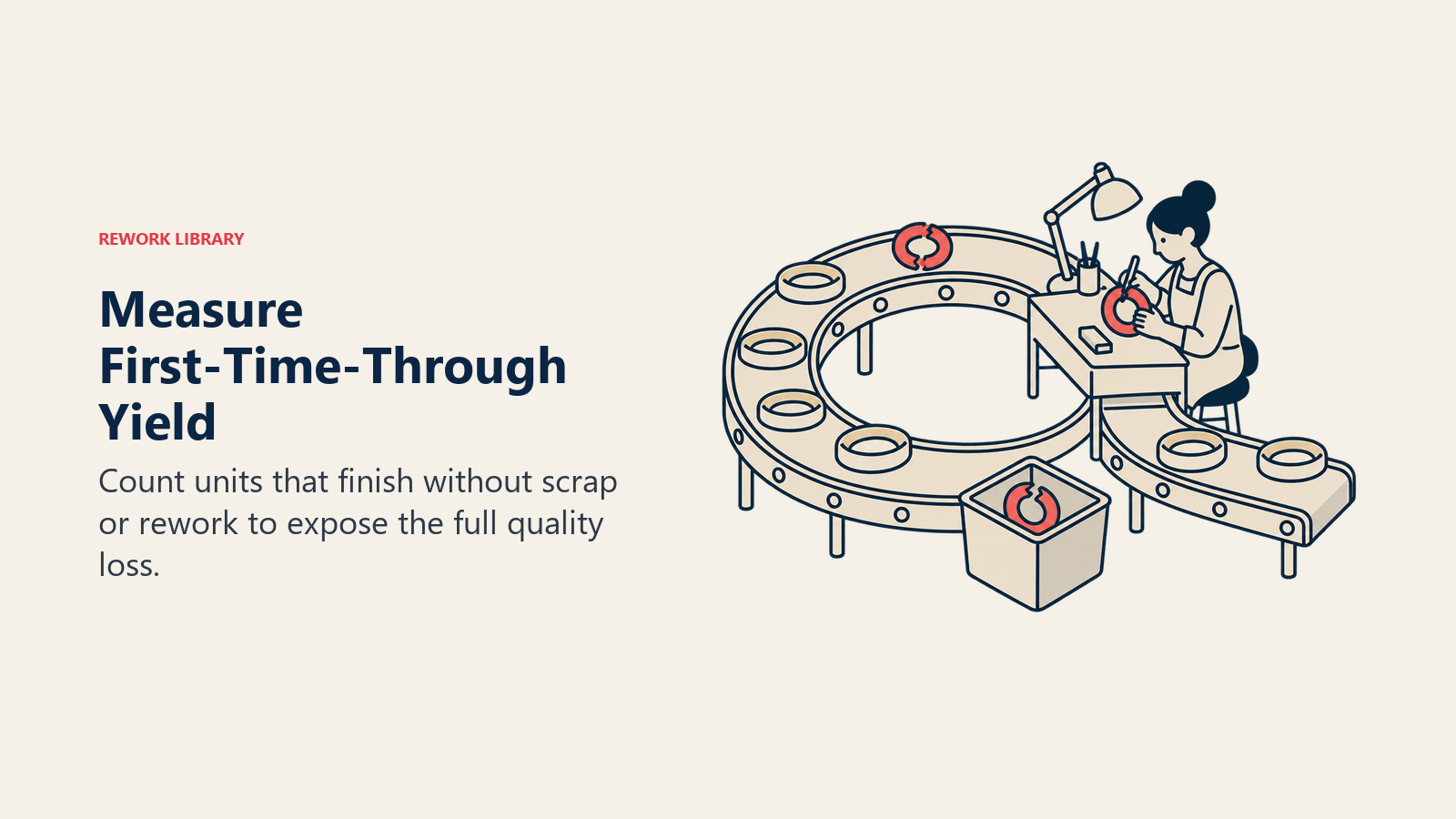
First-time-through (FTT) focus measures what percentage of products complete manufacturing without defects or rework. FTT illuminates quality in a way that scrap rates alone don't. A process might have 2% scrap but 15% rework, meaning only 83% FTT. Improving FTT means fewer products touch your facility twice and more capacity for new production.
Statistical process control monitors processes in real-time to detect problems before they produce significant scrap. Control charts show when processes start drifting out of specification. Operators can intervene immediately (adjusting settings, changing tools, investigating causes) rather than discovering problems hours later when hundreds of defective parts have been made.
Material and Supplier Quality
Incoming material variation causes quality problems that get blamed on your processes. If material dimensions, composition, or properties vary batch-to-batch, your process can't maintain consistent outputs. Supplier quality management prevents these problems at the source.
Supplier certification programs establish quality requirements and audit suppliers regularly. This includes capability studies showing suppliers can meet specifications, quality system audits verifying they have control processes, and ongoing monitoring proving they maintain standards. Certified suppliers earn reduced inspection while uncertified suppliers face 100% incoming inspection.
Incoming inspection detects supplier quality issues before they corrupt your process. The question is how much inspection. Full inspection is expensive and slow. No inspection risks contaminating production with bad material. Risk-based inspection balances these extremes by inspecting heavily when suppliers are unproven and reducing inspection as they demonstrate capability.
Supplier partnerships address quality problems collaboratively rather than adversarially. When defects occur, work with suppliers to understand causes and prevent recurrence. Share your quality data so they can see how their material performs in your process. Treat suppliers as extensions of your operations, not as vendors to be blamed.
Material traceability enables root cause analysis when defects cluster. If you can trace which material lot went into which products, you can correlate quality problems with material variations. This pinpoints supplier issues, identifies bad lots before they're all consumed, and supports effective corrective action.
Technology and Automation
Manual processes involve human variation. Automation delivers consistency. Where quality problems stem from process variation, automation often provides the best solution. But automation without process understanding just produces defects faster.
Vision inspection systems detect defects that human inspectors miss or can't check economically. Dimensional measurements, surface finish, color matching, and component presence can all be verified automatically at production speed. Vision systems don't get tired, distracted, or inconsistent. They catch problems immediately before defective products move downstream.
In-process inspection provides feedback loops that manual final inspection can't match. Measuring dimensions during processing rather than after completion lets you adjust before making a batch of bad parts. This requires instrumentation and control systems but pays for itself through scrap reduction.
Coordinate measuring machines (CMMs) provide precision dimensional data for root cause analysis and process validation. When you need to understand exactly how much dimensions vary and which features correlate with problems, CMM data reveals patterns human inspectors can't detect.
Manufacturing execution systems (MES) track production parameters and correlate them with quality outcomes. When defects appear, you can review what was different: who operated the equipment, which material lot was used, what settings were active, when maintenance last occurred. This detective work is impossible without automated data collection.
Cultural and Organizational Elements
Technology and methods enable quality improvement, but culture determines whether improvements get sustained. Organizations that treat quality as a program have quality improvement campaigns that fade. Organizations that embed quality in culture maintain continuous improvement indefinitely.
Accountability for quality belongs everywhere. Operators own quality of work they perform. Supervisors own systemic improvements to processes they manage. Engineers own designs that enable manufacturable products. Purchasing owns supplier quality. Everyone owns quality in their domain. When quality belongs to the quality department, everyone else treats it as someone else's problem.
No-blame root cause analysis seeks systemic causes rather than culprits. When defects occur, the question isn't "Who messed up?" but "What system weakness allowed this?" Blaming people drives problems underground. Understanding systems drives improvement. People make mistakes. Systems that depend on perfection from imperfect humans are broken systems.
Visible quality metrics create transparency and urgency. Display scrap rates, rework percentages, and FTT performance on shop floor boards. Update them daily. Make problems visible and make progress visible. When people can see performance, they care about improvement.
Recognition and rewards for quality improvement celebrate success and encourage continued effort. When teams eliminate a chronic defect, tell the story. Share savings. Give credit. Quality improvement isn't compliance duty. It's value creation that deserves acknowledgment.
Measurement and Tracking
Quality improvement requires metrics that reveal problems and validate solutions. Defect rates by type tell you what's failing. Defect rates over time show whether you're improving. Defect costs in dollars translate quality into business impact that executives understand.
Scrap rate is the classic quality metric: defective units divided by total units produced. This works for simple processes but misleads in complex environments. A 2% scrap rate sounds good until you realize products pass through 15 operations, each with 2% scrap, yielding 26% cumulative scrap. Track scrap by operation to see where problems concentrate.
Rework rate measures how often products need additional work to meet specifications. Some manufacturers hide rework by calling it "normal process" when it's actually fixing defects. Be honest about what's rework and what's legitimate processing. You can't improve what you don't acknowledge.
First-time-through rate combines scrap and rework into one metric: the percentage of products completing manufacturing without defects. This directly measures quality capability. If 92% FTT, then 8% of production requires scrap or rework. Improving FTT directly improves capacity and costs.
Cost of quality breaks down into prevention costs (training, mistake-proofing, quality planning), appraisal costs (inspection, testing, auditing), internal failure costs (scrap, rework, downtime), and external failure costs (returns, warranty, customer complaints). Tracking these categories reveals where to invest for best returns. Spending more on prevention typically reduces failure costs by multiples.
Defects per million opportunities (DPMO) normalizes quality across processes with different complexity. A process with 50 potential defect modes isn't comparable to one with 5 defect modes using simple defect rates. DPMO provides consistent comparison by accounting for opportunity differences.
Implementation Roadmap
Scrap and rework reduction follows a systematic path. Start with measurement to establish baseline performance and identify biggest opportunities. You can't improve what you don't measure, and you shouldn't improve what doesn't matter.
Pick high-impact problems to attack first. Use Pareto analysis to identify the defects costing most. These deliver the largest returns and build credibility for sustained improvement efforts. Success with major problems earns support for comprehensive programs.
Form cross-functional teams for root cause analysis. Include operators who run processes, engineers who designed them, quality specialists who measure them, and maintenance who support them. Single-function teams miss causes outside their perspective. Cross-functional teams see the whole system.
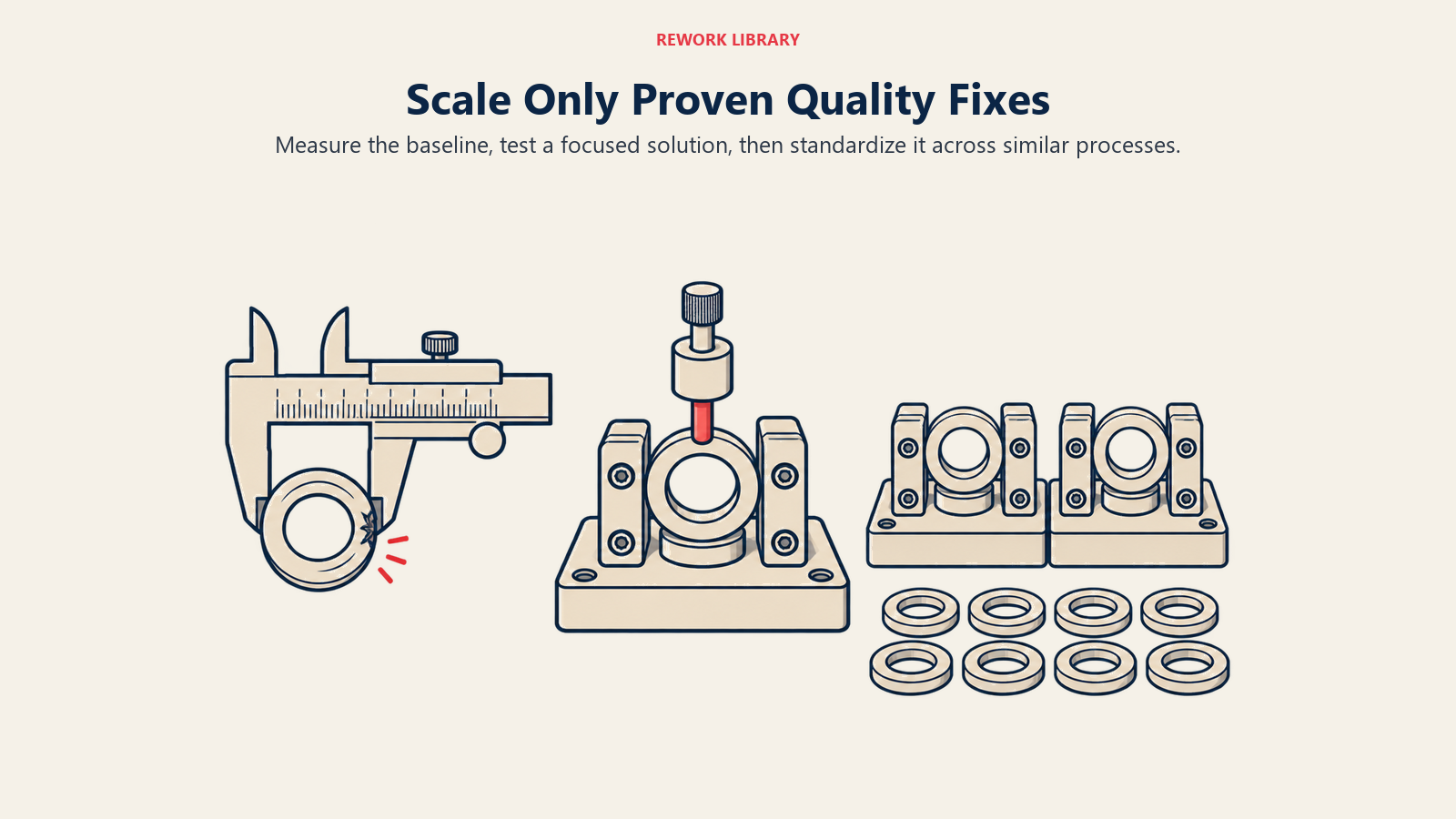
Implement solutions systematically with pilot testing before broad rollout. Try changes on one line, product, or shift. Validate that they work before implementing everywhere. This prevents scaling problems that don't work and enables learning before commitment.
Measure results and compare to baseline. Did the solution actually reduce defects? By how much? How much did it cost versus savings delivered? Disciplined measurement builds improvement capability and validates investment decisions.
Standardize successful solutions across all similar processes. When a fix works in one area, replicate it everywhere applicable. This multiplies the improvement effort and prevents some areas from lagging while others improve.
Sustaining Improvement
Initial quality improvements are easier than sustaining them. Processes drift. People forget training. New employees don't know why controls exist. Without sustained attention, quality gradually erodes and problems resurface.
Standard work maintains process discipline. Document the improved process completely. Train everyone who performs it. Audit periodically to verify standards are followed. When you find deviations, understand why and either fix the deviation or improve the standard. Standards aren't prison. They're current best practice that evolves as better methods emerge.
Management system audits verify that quality systems work as designed. Someone should regularly review defect tracking data, root cause analysis completion, corrective action implementation, and metric trends. This isn't blame-finding inspection. It's systemic health assessment.
Continuous improvement culture treats quality improvement as never finished. Every process can improve. Every defect is an opportunity to strengthen the system. Yesterday's achievement is today's baseline. This mindset prevents complacency and maintains improvement momentum.
Moving Forward
Scrap and rework reduction isn't a project you complete. It's a capability you build and maintain. The manufacturers who excel at quality don't have perfect processes or mistake-proof operations. They have systematic approaches to finding problems, understanding causes, implementing solutions, and sustaining improvements.
Start where you are. Measure current performance honestly. Pick one significant problem and solve it thoroughly. Use that success to build capability and support for broader improvement. Every quality problem you solve permanently improves profitability and capacity. The returns compound over time into substantial competitive advantage.
Quality failures destroy value silently. Prevention creates value perpetually. The difference between manufacturers bleeding profit through quality failures and those capturing it through quality excellence is systematic attention to understanding and preventing defects. That systematic attention is entirely within your control.
Frequently Asked Questions
What is the difference between scrap and rework in manufacturing?
Scrap is defective product that can't be salvaged and gets discarded, so you lose the full material and labor invested in it. Rework is defective product that can be fixed through extra processing to meet specification. Rework recovers the part but consumes added labor, capacity, and sometimes material on top of the original cost.
How do you calculate the true cost of rework?
Add the visible direct costs (rework labor and material) to the hidden costs: lost capacity that could make saleable product, engineering and quality time spent on investigation, expediting, and any lost sales when you're capacity-constrained. The full figure typically lands at 3 to 5 times the visible direct cost.
What is the most effective way to reduce rework?
Prevent defects at the source rather than inspecting them out. The highest-return moves are root cause analysis on your top defect types (use the 5 Whys and Pareto analysis), mistake-proofing (poka-yoke) so errors become impossible, process standardization, and statistical process control to catch drift before it produces bad parts.
What metric best tracks scrap and rework together?
First-time-through (FTT) rate, the percentage of units that complete manufacturing with no defects or rework. A line can show a low 2% scrap rate while still running 15% rework, so FTT exposes total quality loss that scrap rate alone hides.
Learn More

Co-Founder, Rework.com