Carbon Footprint Reduction in Manufacturing: Strategies for Net-Zero Operations
Turn this article into takeaways for your work.


Each assistant summarizes the article only for you and suggests best practices for your work.
A global automotive supplier faced a stark ultimatum from their largest customer: reduce carbon emissions by 50% within five years or risk losing $200M in annual contracts. Major automakers had set net-zero targets and were pushing requirements upstream to suppliers.
The company established a cross-functional carbon reduction team, conducted a comprehensive emissions inventory, and developed a science-based reduction roadmap. They invested in energy efficiency improvements that paid back within 18 months. They switched to renewable energy for their largest facilities. They worked with suppliers to reduce upstream emissions.
Three years in, they'd achieved 42% reduction and were on track to exceed the 50% target. But the bigger win wasn't just retaining existing business. Their demonstrated commitment to decarbonization became a competitive differentiator, winning new contracts from customers screening suppliers on sustainability.
This scenario is becoming universal. Carbon reduction has shifted from a corporate responsibility initiative to a market access requirement and competitive advantage.
Carbon Footprint Fundamentals
Scope 1, 2, and 3 emissions represent different sources of carbon impact. Scope 1 covers direct emissions from owned or controlled sources: fuel combustion in boilers, furnaces, and vehicles; process emissions from chemical reactions; fugitive emissions from refrigerants. These are emissions you directly control.
Scope 2 includes indirect emissions from purchased electricity, steam, heating, and cooling. You don't create these emissions directly, but your consumption drives their creation. Scope 2 is often the largest emissions source for manufacturers and the easiest to address through renewable energy procurement.
Scope 3 encompasses all other indirect emissions in your value chain: purchased goods and services, transportation and distribution, waste disposal, employee commuting, and use of sold products. Scope 3 typically represents 70-90% of total emissions but is hardest to measure and control because it involves third parties.
The GHG Protocol provides the international standard for carbon accounting. It defines what to measure, how to calculate emissions, and how to report results. Following the protocol ensures consistency, comparability, and credibility. Investors, customers, and regulators increasingly expect GHG Protocol-aligned reporting.
Carbon accounting and baseline establishment requires collecting activity data (kilowatt-hours consumed, gallons of fuel burned, materials purchased) and applying emission factors (kg CO2e per kWh, per gallon, per kg of material). The baseline (typically a specific year's emissions) provides the reference point for tracking reduction progress.
Reduction Strategy Framework
Carbon assessment and hotspot identification means understanding where emissions come from. Collect data across all facilities, processes, and activities. Calculate emissions by source. Most manufacturers find that 80% of emissions come from 20% of sources: electricity consumption in energy-intensive processes, natural gas for heat treating, transportation of materials and products. Focus reduction efforts where impact is greatest.
Reduction target setting should align with Science Based Targets initiative (SBTi) methodology. SBTi targets ensure your reductions align with what climate science says is necessary to limit warming to 1.5°C. This credibility matters. Customers and investors can distinguish between ambitious science-based targets and arbitrary reduction goals.
Targets typically follow one of two paths: absolute reduction (reduce total emissions by X% from baseline) or intensity-based reduction (reduce emissions per unit of production by X%). Absolute targets are more stringent and align with climate goals. Intensity targets make sense for growing businesses but must still deliver meaningful absolute reductions.
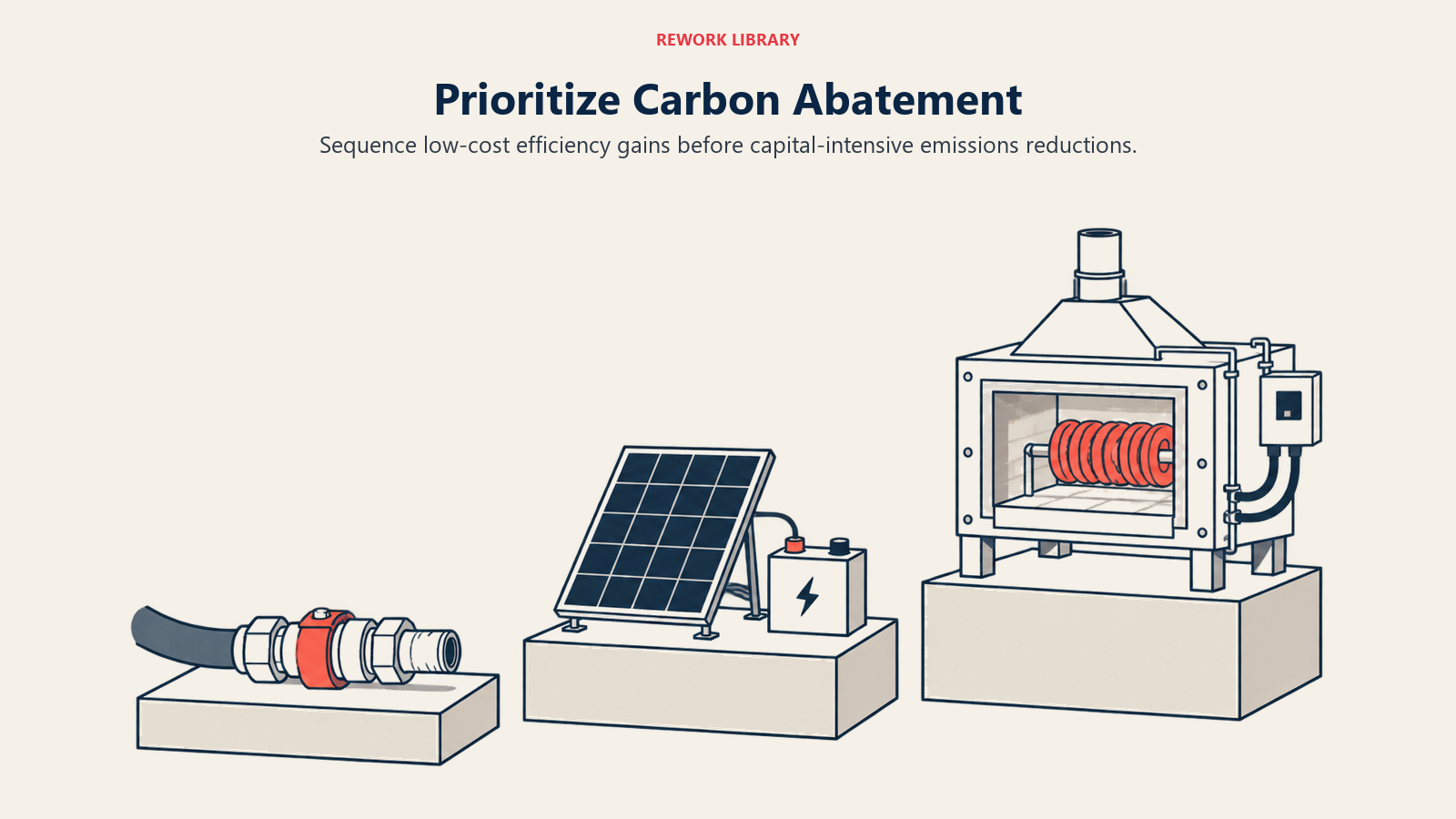
The abatement curve and prioritization tool plots potential reduction initiatives by cost per ton of CO2e reduced. Some initiatives have negative cost: energy efficiency improvements that pay for themselves through reduced energy bills. Others have modest positive cost. High-cost options like carbon capture typically come last. This prioritization ensures you start with initiatives that improve both sustainability and profitability.
Roadmap development and phasing sequences initiatives over time. Quick wins with immediate payback come first, building momentum and funding further investment. Medium-term initiatives requiring capital investment follow. Long-term transformational changes like fuel switching or process redesign complete the journey to net-zero.
Reduction Approaches
Energy efficiency improvements deliver the fastest payback. Upgrade to high-efficiency motors, lighting, and compressed air systems. Optimize HVAC operations. Reduce compressed air leaks. Install variable frequency drives. Add heat recovery systems. Improve insulation. These improvements reduce both emissions and operating costs.
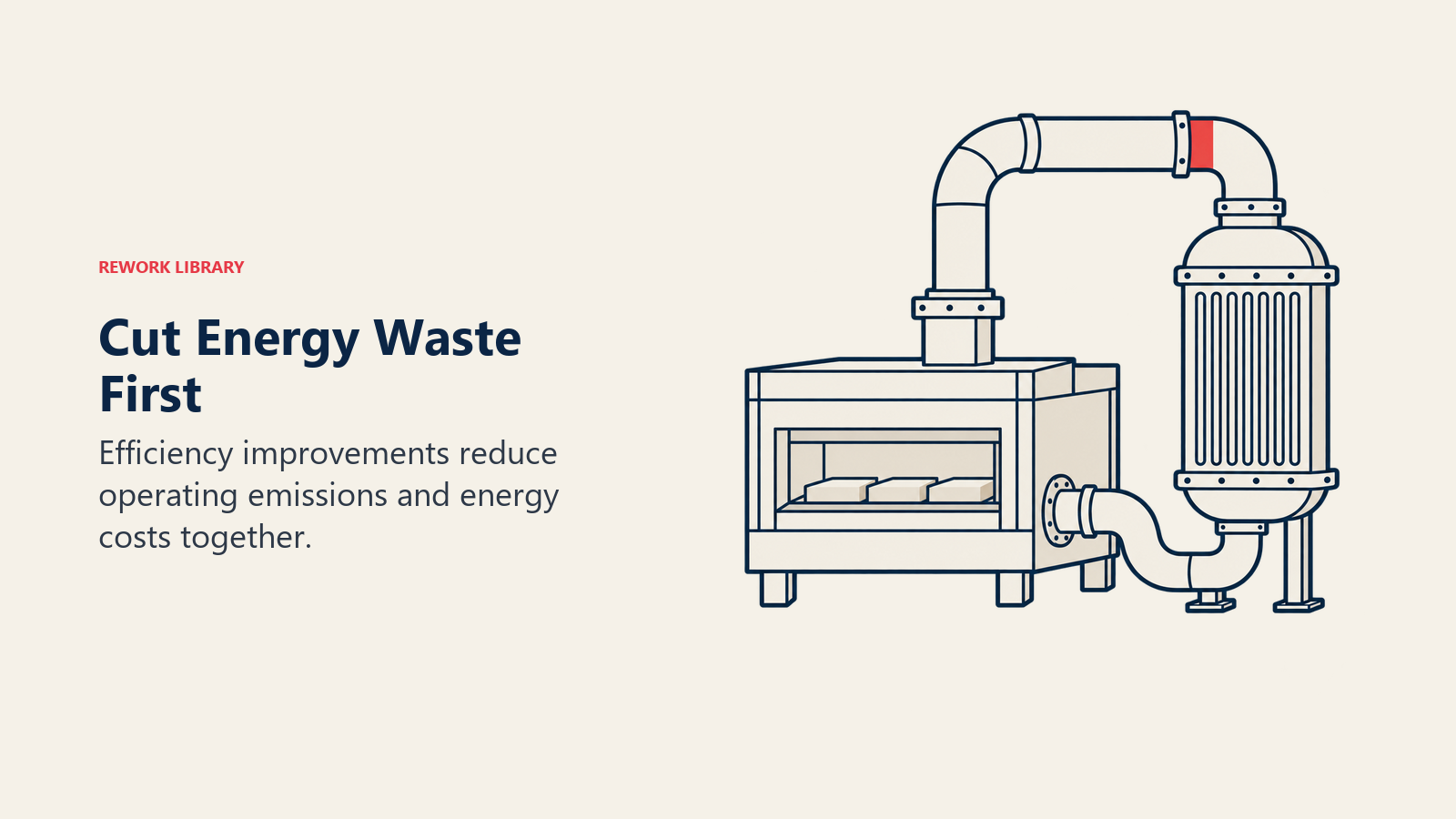
A food processing company conducted an energy audit identifying 23 efficiency opportunities. They implemented the 15 highest-ROI improvements over 18 months, reducing energy consumption by 22% with a 14-month payback. The emissions reduction and cost savings funded additional sustainability investments.
Renewable energy procurement and generation eliminates Scope 2 emissions. Options include purchasing renewable energy certificates (RECs) that support renewable generation, signing power purchase agreements (PPAs) with renewable generators, joining utility green power programs, or installing on-site solar or wind generation.
The economics have shifted dramatically. Renewable energy is now cost-competitive with fossil fuels in most markets. The question isn't whether renewable energy costs more but which procurement approach fits your facilities and financial model best.
Process optimization and fuel switching addresses emissions from manufacturing processes themselves. Can you reduce process temperatures? Switch from natural gas to electricity in heating applications? Modify chemical processes to generate less CO2? Electrify equipment currently running on fossil fuels? Some changes require significant process reengineering but eliminate emissions rather than offsetting them.
Supply chain decarbonization tackles Scope 3 emissions by engaging suppliers. Establish supplier emissions reporting requirements. Set supplier reduction targets. Provide resources and expertise to help suppliers decarbonize. Favor suppliers with lower emissions in sourcing decisions. This cascades climate action through the value chain.
Carbon capture and offsetting handle residual emissions that can't be eliminated economically. Carbon capture technology is developing rapidly but remains expensive. Carbon offsets (funding projects that reduce emissions elsewhere) provide a bridge solution but should complement, not replace, direct emissions reduction.
Technology Solutions
Clean technologies and electrification replace fossil fuel equipment with electric alternatives. Electric heat pumps instead of natural gas boilers. Electric forklifts replacing propane. Induction heating replacing gas furnaces. As electricity grids become cleaner, these transitions eliminate emissions at the point of use, aligning with sustainable manufacturing practices.
Hydrogen as an industrial fuel shows promise for high-temperature applications where electrification is difficult. Green hydrogen (produced using renewable electricity) can fire furnaces, reduce metal ores, and power heavy vehicles without carbon emissions. But hydrogen infrastructure is limited today, and costs remain high.
Carbon capture, utilization, and storage (CCUS) technologies capture CO2 from industrial processes before it reaches the atmosphere. The captured carbon can be used in products, sold for industrial applications, or stored permanently underground. CCUS is essential for industries like cement and chemicals where process emissions are inherent.
Reporting and Disclosure
CDP (formerly Carbon Disclosure Project) provides the leading platform for corporate environmental reporting. Over 14,000 companies disclose through CDP, responding to questionnaires covering emissions, climate risks, and reduction strategies. Many customers and investors require CDP disclosure.
TCFD (Task Force on Climate-related Financial Disclosures) framework structures reporting around governance, strategy, risk management, and metrics. TCFD emphasizes climate as a financial risk, requiring companies to disclose how climate change affects their business and how they're managing those risks.
Regulatory reporting requirements are expanding rapidly. The EU's Corporate Sustainability Reporting Directive (CSRD) mandates detailed sustainability disclosure. California requires climate risk reporting from large companies. The SEC has proposed climate disclosure rules. Manufacturers must track evolving requirements across jurisdictions where they operate or sell products.
Building a Credible Path to Net-Zero
Carbon reduction in manufacturing isn't about embracing arbitrary sustainability targets. It's about responding to market requirements, managing business risk, and positioning for a carbon-constrained future.
The most successful manufacturers treat carbon reduction as a strategic priority with executive ownership, clear targets and accountability, dedicated resources, and regular reporting. They start with comprehensive measurement because you can't manage what you don't measure. They prioritize initiatives based on both impact and economics. They engage suppliers early because supply chain emissions dwarf direct emissions for most manufacturers.
They avoid common pitfalls: relying solely on offsets rather than real reduction, setting unambitious targets that don't match business risk, treating carbon as a compliance exercise rather than strategic imperative, and failing to engage operations in solution development.
The carbon advantage goes to manufacturers who move early, building expertise and infrastructure before it becomes crisis-driven. Customers increasingly screen suppliers on carbon performance. Investors pressure companies on climate risk. Regulations tighten annually. The cost of delay is growing.
The question isn't whether to decarbonize but how fast and through what pathway. Start with measurement, set science-based targets, prioritize high-impact initiatives, and scale systematically. The goal is credible progress toward net-zero, not perfection from day one.
Learn More
