Manufacturing Value Chain: Optimizing Every Stage from Raw Materials to Customer
Turn this article into takeaways for your work.


Each assistant summarizes the article only for you and suggests best practices for your work.
Winning manufacturers don't just produce better products. They excel across the entire value chain from supplier relationships through customer service. A manufacturer might have world-class production but lose money because their inbound logistics are inefficient, or their distribution costs are excessive, or their service organization can't support products effectively.
Value chain mastery separates industry leaders from competitors. It's the difference between companies that generate 15% EBITDA and those struggling to reach 5%. Understanding where value is created, where costs accumulate, and where competitive advantage emerges transforms manufacturing profitability and operational performance.
Understanding the Manufacturing Value Chain
The manufacturing value chain encompasses all activities that create and deliver value to customers. It extends from supplier procurement through after-sales service. Each link in the chain either adds value that customers will pay for or adds cost that reduces profitability.
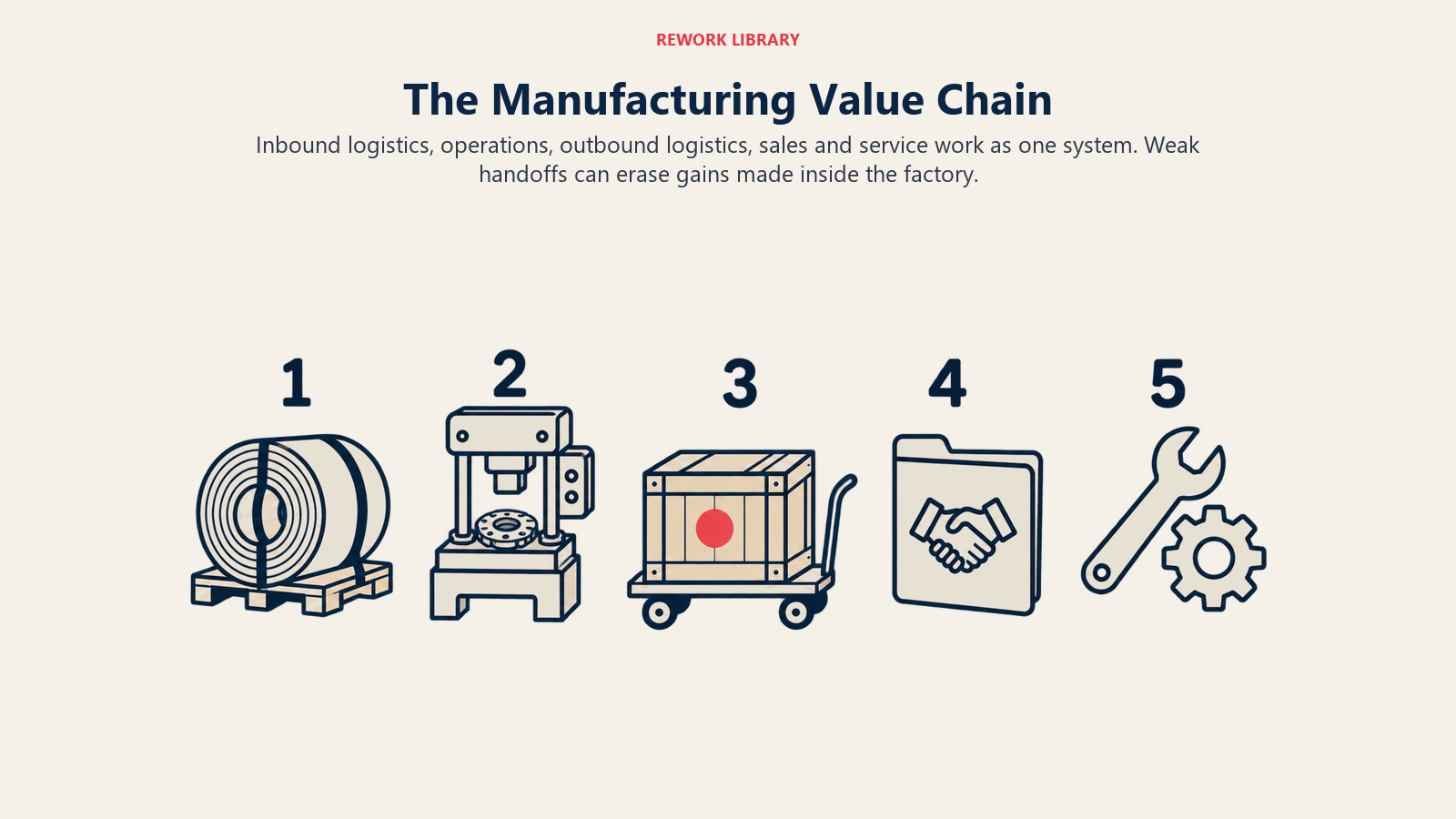
Michael Porter's value chain framework divides activities into primary activities (directly create value) and support activities (enable primary activities). For manufacturers, the primary activities are inbound logistics, production operations, outbound logistics, marketing and sales, and service. Support activities include procurement, technology development, human resources, and firm infrastructure.
Understanding this framework helps manufacturers see their business systematically. McKinsey research emphasizes that supply chain optimization significantly impacts profitability, with companies adopting digital tools seeing a 25% increase in efficiency. You're not just a production operation. You're an integrated system where each activity affects others. Optimizing one link while ignoring others creates imbalance that limits overall performance.
Inbound Logistics
Inbound logistics manages material flow from suppliers to production. It includes supplier selection, purchasing, receiving, inspection, inventory management, and material handling to production lines. Strong supplier relationship management and strategic sourcing are foundational.
This link often represents 40-60% of manufacturing costs. A 10% improvement in inbound logistics, through better supplier relationships, reduced freight costs, or improved inventory management, drops directly to profit. Yet many manufacturers focus almost exclusively on production while treating inbound logistics as administrative overhead.
Excellence in inbound logistics requires supplier partnerships, not just transactional purchasing. It demands visibility into supplier capacity and quality. It needs inventory optimization that balances carrying costs against stockout risks. And it requires smooth handoffs from receiving to production that minimize handling and delay.
Production Operations
Production operations transform raw materials into finished goods. According to research on the value chain, the operations activity is where manufacturing takes place, involving the transformation of raw materials into finished products. This is the core manufacturing activity where most manufacturers concentrate attention and investment. It encompasses machining, assembly, testing, and packaging. Production planning fundamentals and lean manufacturing principles drive production excellence.
Production excellence requires efficient processes, capable equipment, skilled operators, and effective quality control. Cycle times, yield rates, equipment uptime, and labor productivity determine production economics. Small improvements multiply across volume to generate significant profit impact.
But production optimization in isolation creates problems. Manufacturers who maximize production efficiency without considering downstream distribution or customer requirements often produce what they can make cheaply rather than what customers value. Balanced optimization across the value chain beats production-only optimization.
Outbound Logistics
Outbound logistics manages product flow from production to customers. It includes finished goods warehousing, order fulfillment, packaging, shipping, and delivery tracking. For manufacturers shipping direct to customers or through distribution networks, outbound logistics significantly impacts service levels and costs. Your on-time delivery performance depends on outbound logistics excellence.
Many manufacturers underinvest in outbound logistics because it happens after production. But customers judge you on delivery, not just product quality. Late deliveries, damaged shipments, and order errors destroy customer relationships regardless of product excellence.
Outbound logistics excellence requires efficient warehousing, accurate order fulfillment, optimized shipping, and proactive delivery communication. It means choosing whether to ship direct, use distributors, or employ 3PLs based on economics and service requirements. And it demands integration between production scheduling and customer delivery commitments.
Marketing and Sales
Marketing and sales activities generate demand and convert it to orders. For manufacturers, this includes market analysis, product positioning, pricing strategy, sales force management, channel relationships, and customer engagement. A strong manufacturing sales strategy integrates sales with operations.
Many manufacturers treat marketing and sales as separate from manufacturing. But sales effectiveness determines capacity utilization, which determines manufacturing economics. A sales team that can sell 20% more volume enables manufacturing to spread fixed costs and improve margins dramatically.
Marketing and sales must understand manufacturing capabilities and constraints. Selling products you can't profitably produce destroys value. Promising delivery you can't meet damages reputation. Integration between sales and operations planning prevents these disconnects.
Service and Support
Service and support activities maintain customer relationships after initial sale. This includes installation, training, maintenance, repairs, parts supply, technical support, and warranty administration.
For manufacturers selling equipment or durable products, service often generates more lifetime profit than initial product sales. Service margins typically exceed 40% while product margins run 20-30%. Service creates recurring revenue, builds customer loyalty, and provides competitive differentiation.
Service excellence requires field technicians, parts inventory, technical expertise, and customer relationship management. Manufacturers who treat service as afterthought leave money on the table and create customer dissatisfaction that affects future sales.
Value Analysis: Identifying Where Value Is Created and Captured
Not all activities create equal value. Some add significant value that customers willingly pay for. Others add cost without adding value. Systematic value analysis identifies opportunities for competitive advantage and profit improvement.
Value-Added vs. Non-Value-Added Activities
Value-added activities transform products in ways customers value. Machining, assembly, quality testing, and custom packaging are value-added if customers consider them important. Value-added activities justify their costs through customer willingness to pay.
Non-value-added activities consume resources without increasing customer value. Excessive material handling, rework, inspection to find defects, and redundant quality checks are non-value-added. They're necessary evils created by poor processes, not genuine value creation.
The goal isn't eliminating all non-value-added activities. Some are necessary for business operations or regulatory compliance. But minimizing non-value-added activities reduces costs while maintaining or improving customer value. This is the essence of lean manufacturing.
Cost Drivers at Each Stage
Each value chain stage has distinct cost drivers. Understanding these drivers guides optimization efforts:
Inbound logistics costs are driven by supplier locations, order frequencies, inventory levels, and material handling processes. Reducing supplier count, consolidating shipments, and optimizing inventory levels reduce inbound costs.
Production costs are driven by material usage, labor efficiency, equipment utilization, and quality yield. Process improvement, automation, and yield enhancement reduce production costs.
Outbound logistics costs are driven by shipment frequency, package size, destination distance, and delivery speed requirements. Consolidating shipments, optimizing packaging, and managing customer delivery expectations reduce outbound costs. Effective logistics optimization delivers significant savings.
Sales and marketing costs are driven by market fragmentation, channel complexity, and customer acquisition difficulty. Focusing on profitable customer segments and efficient channels reduces go-to-market costs.
Service costs are driven by product reliability, service complexity, geographic dispersion, and parts inventory requirements. Improving product design for serviceability and optimizing parts networks reduce service costs.
Margin Optimization Opportunities
Margin optimization happens at every value chain stage. Most manufacturers focus only on production margin, missing opportunities elsewhere.
Inbound logistics offers margin improvement through better supplier negotiations, reduced freight costs, and lower inventory carrying costs. A 10% reduction in material costs improves margins by 4-6 percentage points for typical manufacturers.
Production offers margin improvement through yield enhancement, cycle time reduction, and automation. A 5% yield improvement or 20% cycle time reduction generates 3-4 percentage points of margin.
Outbound logistics offers margin improvement through shipping optimization and reduced damage. Freight represents 3-8% of revenue for many manufacturers. Optimizing routing and carrier selection saves 15-25% of freight costs.
Service offers margin improvement through better pricing, parts margin optimization, and technician productivity. Service often runs at 50%+ gross margins when properly managed. Poor service management leaves 10-20 percentage points on the table.
Integration Strategy: Building Seamless Value Chain Operations
Optimized individual links don't guarantee optimized chains. Integration across links creates leverage that individual optimization can't achieve.
Supplier Relationships
Traditional supplier relationships are transactional: you specify requirements, multiple suppliers bid, you choose the lowest price. This approach optimizes purchase price but often increases total cost through quality problems, delivery issues, and limited supplier investment in your success.
Strategic supplier relationships treat key suppliers as partners. You share forecasts, involve them in design, invest in their capability development, and commit to longer-term relationships. In return, suppliers invest in understanding your requirements, improving quality, and reducing costs collaboratively.
This doesn't mean single-sourcing everything or accepting poor performance. It means segmenting suppliers into strategic partners (10-20% of suppliers, 60-80% of spend) and transactional vendors (80-90% of suppliers, 20-40% of spend). You manage each category differently based on strategic importance.
Internal Process Linkages
Value chain links must connect smoothly. Poor handoffs between inbound logistics and production, or between production and outbound logistics, create delays, errors, and costs.
Smooth handoffs require physical integration (materials flow easily), information integration (systems communicate automatically), and organizational integration (groups collaborate rather than just hand off).
Physical integration might mean locating receiving near production to minimize material handling. Information integration means production planning systems automatically trigger purchase orders and inform outbound logistics of upcoming shipments. Organizational integration means functions share metrics and collaborate on improvement.
Customer Connections
The final value chain link connects you to customers. Strong customer connections provide demand visibility that enables better planning, reduces forecast error, and identifies improvement opportunities.
Collaborative planning with major customers shares forecasts, coordinates delivery schedules, and aligns production with consumption. This reduces buffer inventory, improves service levels, and enables joint cost reduction.
Customer feedback loops inform product development, identify quality issues early, and guide service improvements. Manufacturers who stay close to customers understand changing requirements and adapt faster than those relying only on sales reports.
Optimization Framework: Tools for Value Chain Excellence
Several tools help manufacturers analyze and optimize value chains systematically.
Value Stream Mapping
Value stream mapping visualizes material and information flow from supplier through customer. It identifies cycle times, queue times, value-added time, and waste at each stage. The ratio of value-added time to total lead time reveals optimization opportunity.
A manufacturer might discover that a product requiring 4 hours of processing time takes 30 days from order to delivery. The 716 hours of waiting time offers enormous improvement opportunity. Value stream mapping makes this visible and guides improvement efforts.
Create current state maps showing how things work today. Analyze for waste, delays, and disconnects. Design future state maps showing how things should work. Then implement changes to close the gap systematically.
Total Cost of Ownership
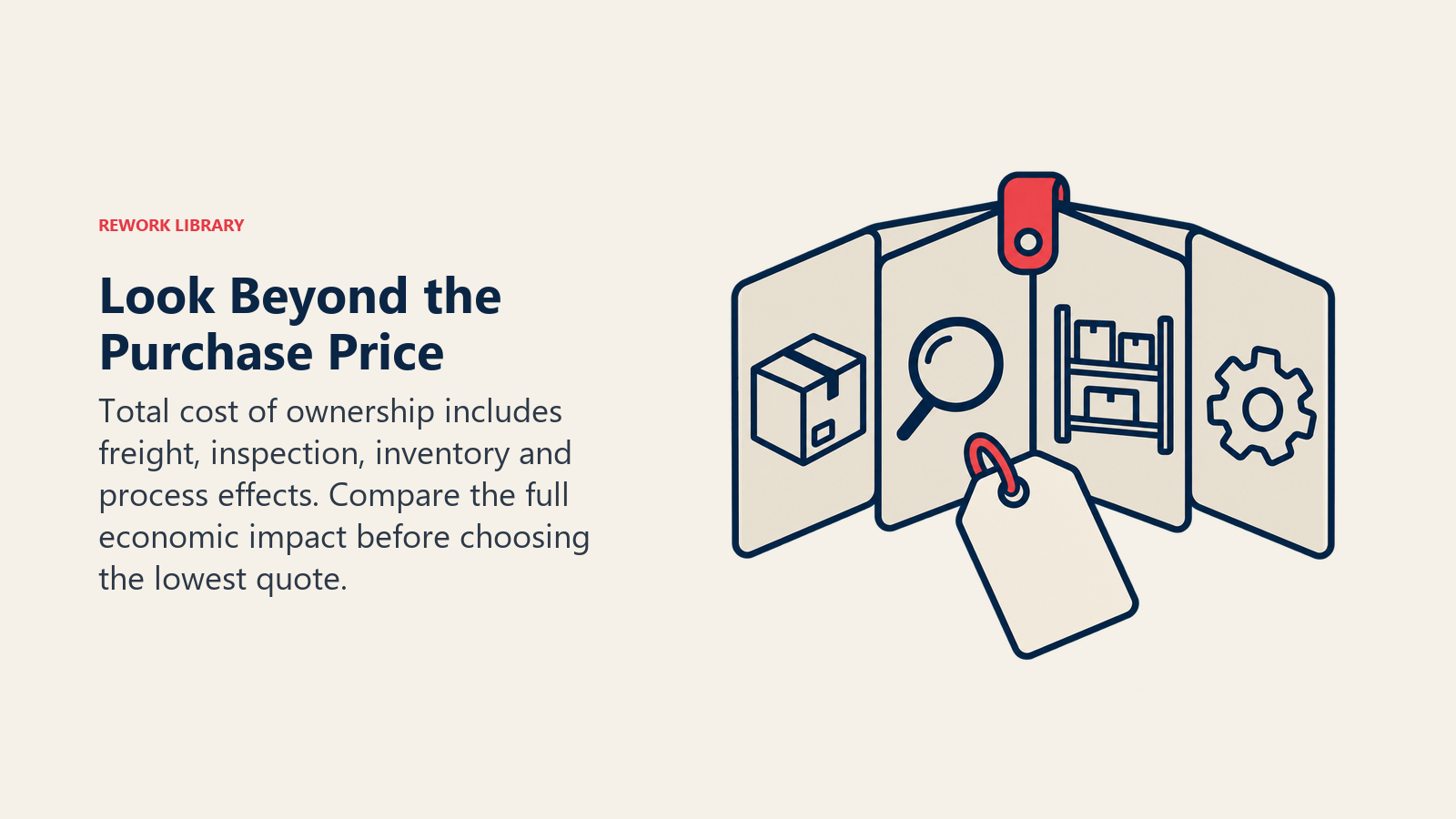
Total cost of ownership (TCO) analysis evaluates all costs across the value chain, not just visible purchase prices. A component with a $50 purchase price might carry $65 total cost when you include freight, receiving, quality inspection, carrying costs, and production inefficiencies.
TCO thinking prevents false economies. Choosing a supplier based on 10% lower purchase price while ignoring 30% longer lead times (higher inventory), 2x defect rates (higher rework), and poor delivery reliability (higher expedite costs) increases total cost despite lower purchase price.
Apply TCO analysis to supplier selection, make-vs-buy decisions, and distribution channel choices. Look beyond the invoice price to the complete economic impact.
Balanced Scorecards
Balanced scorecards prevent sub-optimization by measuring performance across multiple dimensions. A scorecard for inbound logistics might include material cost, inventory levels, supplier quality, and delivery reliability. Optimizing only cost while ignoring quality or delivery creates problems downstream.
Scorecards should cascade across value chain stages. Corporate scorecards drive functional scorecards, which drive process scorecards. This alignment ensures local optimization supports overall objectives rather than conflicting with them.
Lean Thinking
Lean principles apply across the value chain, not just production. Waste exists in purchasing (excess inventory, poor supplier relationships), logistics (excess transportation, material handling), and sales (complex quoting, lengthy order processing).
Apply the five lean principles everywhere: define value from customer perspective, identify the value stream, make value flow, let customers pull, and pursue perfection through continuous improvement. These principles guide optimization whether you're improving production, logistics, or service.
Learn More
Expand your understanding of value chain optimization:
- Manufacturing Growth Model explains how value chain complexity grows with business scale
- Manufacturing Cost Structure details cost components across the value chain
- Material Requirements Planning covers material flow through the chain
- Lean Manufacturing Principles provides tools for value chain optimization
- Value Stream Mapping offers detailed mapping methodology
- Manufacturing Business Models shows how business models shape value chains
- Supply Chain Risk Management addresses value chain vulnerabilities
Competing Through Value Chain Superiority
Value chain excellence creates competitive advantage that product features alone can't deliver. When you can deliver better quality, faster delivery, and lower costs than competitors by optimizing your entire value chain, you build sustainable differentiation.
This requires seeing your business as an integrated system, not just a collection of functions. It means optimizing the whole, not just the parts. It demands collaboration across organizational boundaries and with external partners.
The manufacturers who master their value chains don't necessarily have the best equipment or the smartest engineers. They have better integrated systems that perform reliably across every link from supplier to customer. That consistency and integration beats point optimization every time.

Co-Founder, Rework.com