Just-in-Time Production: Reducing Inventory Costs While Improving Manufacturing Flow
Turn this article into takeaways for your work.


Each assistant summarizes the article only for you and suggests best practices for your work.
A mid-sized electronics manufacturer once believed maintaining large raw material inventories protected them from supply disruptions. They kept 90 days of component stock, requiring a 15,000 square foot warehouse and tying up $4.2 million in working capital. Their CFO viewed this inventory as prudent business practice.
Then a quality issue emerged in a batch of microcontrollers buried six weeks deep in their inventory. By the time they discovered the defect, they'd built it into 1,200 finished products that required rework. The inventory they thought protected them had actually hidden a critical quality problem for weeks, costing far more than any supply disruption might have.
This experience isn't unique. Excess inventory creates the illusion of stability while masking quality issues, tying up capital, consuming space, and preventing the visibility that drives improvement. Just-in-Time (JIT) production takes the opposite approach: produce and receive materials only as needed, creating a lean system where problems surface immediately and flow improves continuously.
Understanding Just-in-Time Production
Just-in-Time (JIT) production synchronizes manufacturing operations with actual customer demand, producing items only when needed in the quantity needed. According to Britannica, JIT is a production-control system developed by Toyota Motor Corp. that has revolutionized manufacturing methods by eliminating waste due to overproduction and lowering warehousing costs. This contrasts sharply with traditional batch-and-queue manufacturing that produces in large lots based on forecasts and stockpiles inventory at each process step. JIT represents a core pillar of lean manufacturing principles that eliminate waste from operations.
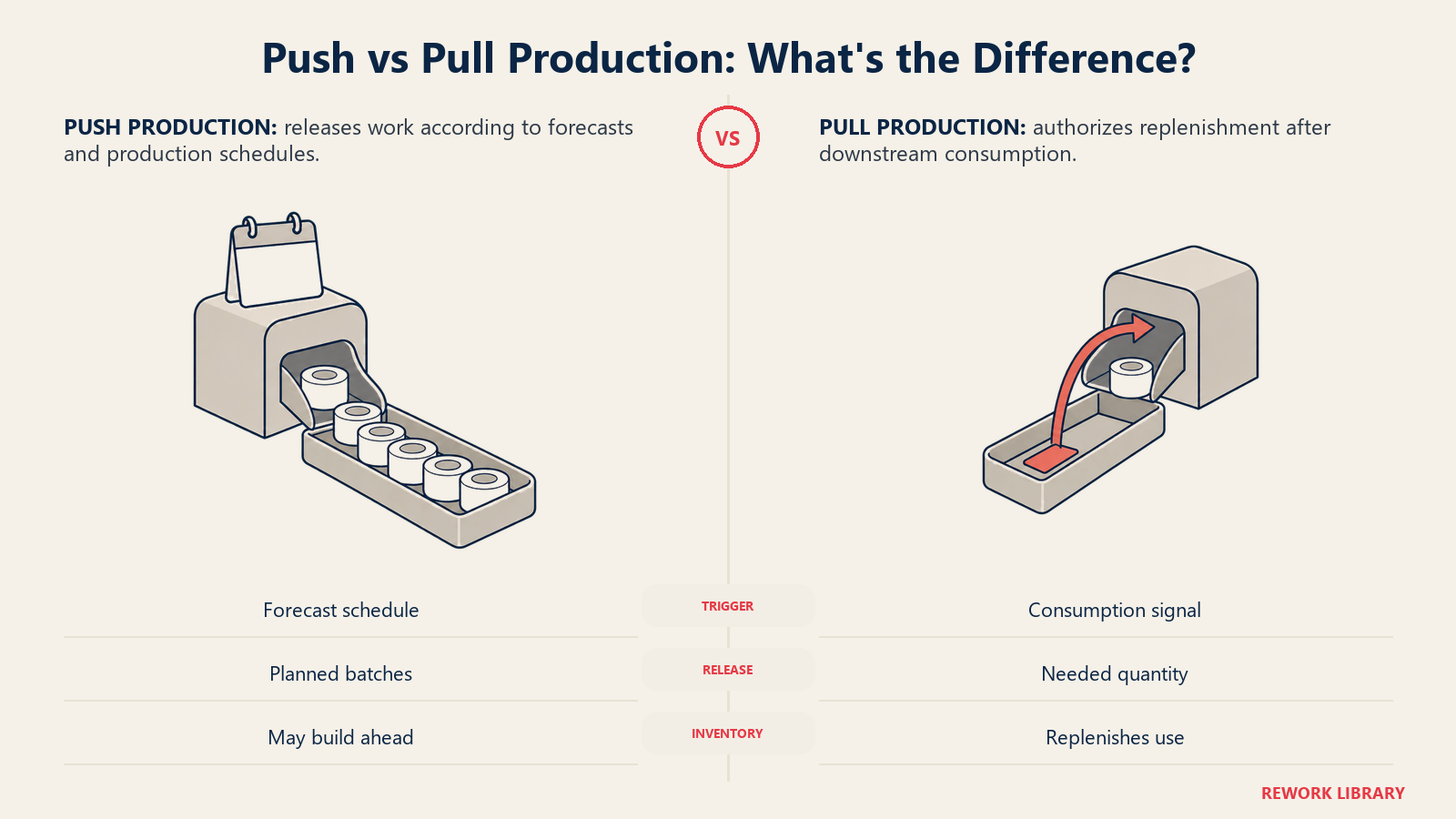
Pull versus push systems represent fundamentally different production control philosophies. Push systems use forecasts and production schedules to push work through each process step regardless of downstream demand. Work centers produce according to schedule, creating inventory that waits for the next operation.
Pull systems produce only when downstream processes signal they need more. Wikipedia notes that JIT is grounded on the concept of "Making only what is needed, only when it is needed, and only in the amount that is needed" as part of the Toyota Production System. Customer orders trigger final assembly, which pulls from subassembly, which pulls from fabrication, which pulls from suppliers. No work occurs until actual demand authorizes it.
This distinction matters because push systems inevitably create excess inventory. Forecasts are wrong. Production schedules don't account for real-time disruptions. Batch sizes optimize for cost rather than actual need. The result: warehouses full of materials that may or may not match actual demand.
Takt time provides the heartbeat of JIT production. It's the rate at which products must be completed to meet customer demand, calculated simply: available production time divided by customer demand. If customers order 240 units daily and production runs 480 minutes, takt time is 2 minutes per unit.
Production processes synchronized to takt time create smooth flow without overproduction. If a process can't meet takt time, it becomes a constraint requiring improvement. If a process produces faster than takt time, it risks overproducing parts the downstream process isn't ready to consume.
A furniture manufacturer restructured their entire operation around takt time. They calculated they needed to complete one dining table every 32 minutes to meet customer orders. They reorganized work cells, rebalanced tasks, and trained operators to switch between different models. Within six months, they'd reduced work-in-process inventory by 68% while improving on-time delivery from 79% to 96%.
Production leveling spreads production of different products evenly over time rather than building large batches of each model. Instead of running 500 units of Model A, then 300 of Model B, then 200 of Model C, a leveled schedule might alternate: A-B-A-C-A-B-A-C throughout the day. This connects closely with master production scheduling strategies.
Leveling enables JIT by creating predictable, steady demand on upstream processes and suppliers. It also prevents the workflow chaos that batch changeovers create, where material handlers scramble to stage new components and quality issues don't surface until hundreds of units are complete.
Building the Foundation for JIT Success
JIT isn't a standalone technique you simply implement. It requires solid supporting capabilities that many manufacturers must develop before JIT can work reliably.
Reliable supplier partnerships become critical when inventory buffers disappear. You need suppliers who consistently deliver quality materials on time in the exact quantities specified. This requires selecting suppliers based on quality and reliability, not just price. It means sharing production schedules so suppliers can plan effectively. It often involves helping suppliers improve their own processes. Effective supplier relationship management becomes a strategic capability.
An automotive components producer reduced their supplier base from 342 to 87, selecting partners willing to commit to JIT delivery standards. They invested in supplier development programs, sharing lean manufacturing techniques and quality methods. Three years later, supplier on-time delivery had improved from 82% to 98%, and incoming defect rates dropped 73%. They coupled this with strong supplier quality management processes.
Quality at the source becomes non-negotiable under JIT. When inventory buffers are minimal, defects immediately stop production. Every worker must be trained to inspect their own work, empowered to stop production when problems occur, and equipped with mistake-proofing devices that prevent defects. This aligns with comprehensive manufacturing quality management approaches.
This represents a significant culture shift for manufacturers accustomed to finding defects in final inspection. JIT requires building quality into processes rather than inspecting it in afterward. It means training operators in quality techniques, providing clear work standards, and creating error-proofing mechanisms.
A medical device manufacturer implemented comprehensive quality-at-source practices before attempting JIT. They trained every production employee in statistical process control, installed visual inspection aids at each workstation, and empowered operators to stop the line for quality concerns. Defect rates fell by 84%, creating the quality reliability JIT required.
Equipment reliability and quick changeover enable flexible production with minimal inventory. Machines that break down unpredictably require inventory buffers to protect downstream operations. Long changeovers force batch production that creates inventory.
Total productive maintenance improves equipment reliability through preventive maintenance, operator involvement in routine care, and systematic problem-solving to eliminate root causes of failures. Single-Minute Exchange of Die (SMED) techniques reduce changeover times from hours to minutes, enabling smaller batches and more frequent model changes. High overall equipment effectiveness becomes essential for JIT success.
A packaging company reduced major changeover times from 4 hours to 23 minutes through SMED methodology. This enabled them to run smaller batches more frequently, reducing finished goods inventory by 52% while improving customer service by offering shorter lead times.
Information systems and visibility coordinate JIT production across multiple processes and facilities. Everyone needs real-time information about what's needed where and when. Kanban system implementation provides visual signals that authorize production and simple manual coordination for local processes. More complex operations may require Manufacturing Execution Systems (MES) or ERP systems with advanced planning capabilities.
Visibility extends to suppliers who need to see upcoming demand to plan their own production and deliveries. Many JIT manufacturers provide suppliers with access to production schedules and consumption data, enabling them to anticipate needs and respond quickly to changes. This transparency strengthens manufacturing supply chain strategy.
Implementing Just-in-Time Production
JIT implementation follows a careful, phased approach that builds capabilities progressively rather than attempting immediate transformation.
Start with pilot production lines that offer favorable conditions for JIT: relatively stable demand, reliable equipment, capable suppliers, and supportive leadership. Prove the methodology works, learn lessons, and build organizational capability before expanding to more challenging environments.
A machinery manufacturer selected their highest-volume product line for JIT pilots. Demand was predictable, most components came from nearby suppliers willing to participate, and the production manager was enthusiastic about lean methods. After six months, this line achieved 40% inventory reduction and 15% productivity improvement, creating proof points that enabled expansion to other product lines.
Inventory reduction strategies must be systematic rather than arbitrary across-the-board cuts. Start by analyzing current inventory: What's the mix of raw materials, work-in-process, and finished goods? What are the stated reasons for holding each category? Which reasons represent genuine constraints versus protective habits?
Target low-hanging fruit first: obsolete inventory from discontinued products, excess safety stock held "just in case," duplicate inventory stored in multiple locations. Removing this dead inventory creates space and frees capital without touching production-essential stock.
Then methodically reduce safety stock levels based on supplier performance improvement. If a supplier historically delivered in 10-14 days with 92% on-time performance, you needed substantial safety stock. But if you work with them to achieve 6-8 day delivery with 98% on-time performance, safety stock requirements drop significantly. Strategic inventory optimization becomes possible.
Supplier integration and vendor-managed inventory (VMI) shift inventory ownership and management to suppliers in some cases. Under VMI, suppliers monitor your consumption and maintain agreed-upon inventory levels at your facility, owning the stock until you use it. This moves inventory investment off your balance sheet while ensuring material availability.
VMI works best with strategic suppliers of high-volume commodity items where the supplier has better visibility into overall market demand than individual customers do. It requires trust, transparency, and clear performance agreements.
An aerospace parts manufacturer implemented VMI with their fastener suppliers. These suppliers owned inventory stocked in automated dispensing systems on the production floor, monitored consumption electronically, and replenished automatically. The manufacturer eliminated $380,000 in fastener inventory investment while improving material availability.
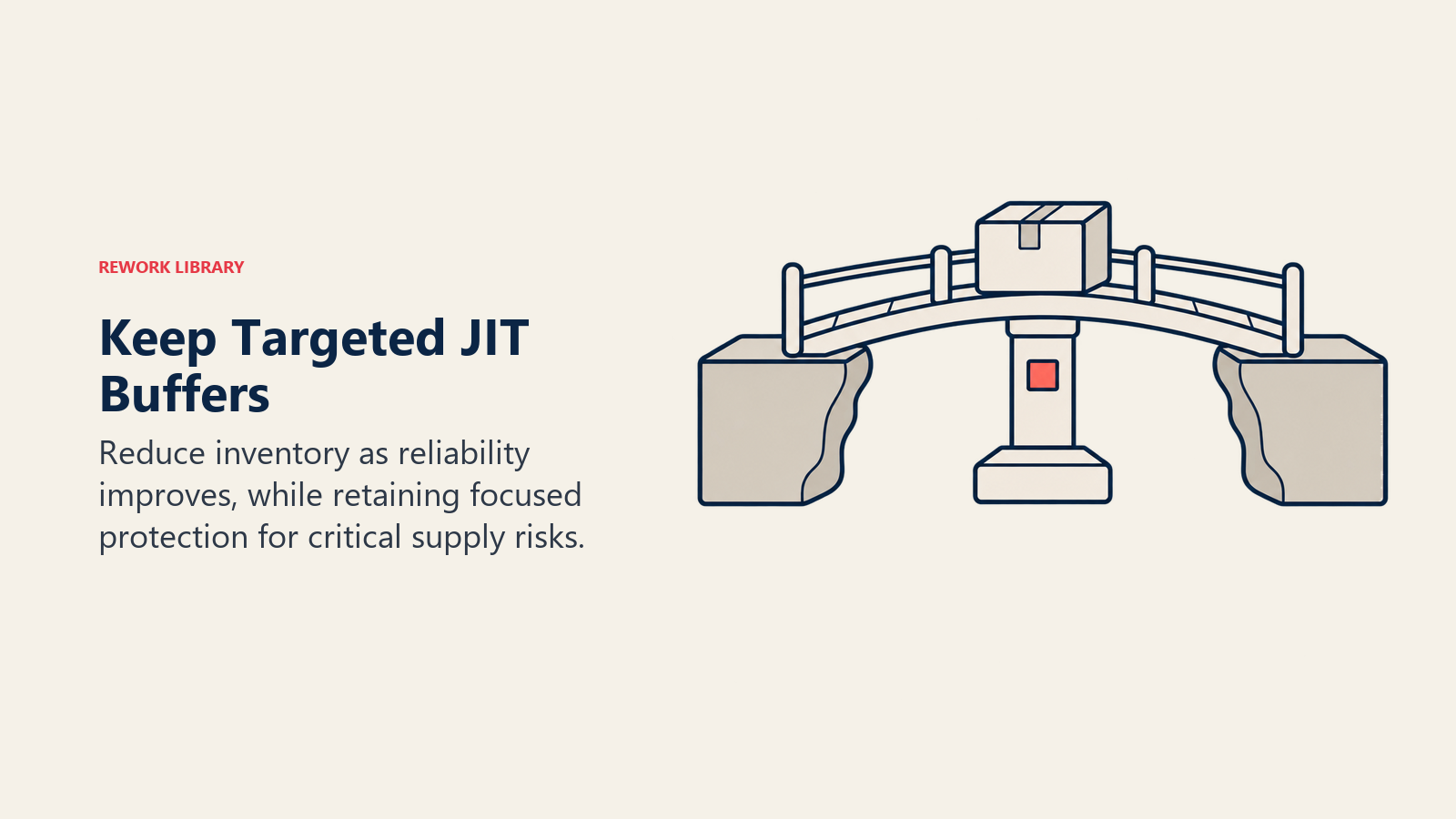
Risk mitigation and buffer strategies acknowledge that JIT increases exposure to supply disruptions. Don't eliminate all buffers indiscriminately. Strategic buffers protect against high-impact, difficult-to-predict risks.
Consider maintaining modest safety stock for sole-source components with long lead times, materials from geographically distant suppliers vulnerable to transportation disruptions, or items with unstable quality from developing suppliers. These targeted buffers cost far less than broad-based excess inventory while protecting against specific risks.
Develop backup suppliers for critical components even if it means accepting slightly higher cost. The insurance value of supply continuity often justifies dual sourcing for components that would stop production if unavailable.
Benefits, Challenges, and When JIT Doesn't Fit
Understanding JIT's advantages and limitations helps set realistic expectations and identify situations where alternative approaches make more sense.
Cost savings and working capital improvements provide the most visible JIT benefits. Reduced inventory directly improves cash flow and reduces carrying costs: warehouse space, material handling, insurance, obsolescence, and capital tied up. A typical successful JIT implementation reduces inventory 40-60%, freeing millions in working capital for mid-sized manufacturers. Understanding manufacturing cost structure helps quantify these benefits.
Operating costs often decline as well. Less material handling, smaller warehouse operations, reduced obsolescence write-offs, and elimination of expediting activities remove cost from operations. Labor productivity typically improves 15-25% as flow smooths and waste elimination strategies take effect.
Quality improvements and defect visibility emerge as JIT removes inventory buffers that hide problems. When defects stop production immediately, quality issues get addressed urgently. The pain of stopped production creates motivation to implement error-proofing and improve processes.
The electronics manufacturer from our opening discovered this benefit directly. After implementing JIT with minimal component inventory, quality problems surfaced within hours instead of weeks. This immediate feedback enabled faster problem-solving and prevented defects from compounding through production.
Supply chain vulnerabilities and disruption risks increase under JIT. Lean systems with minimal inventory buffers are efficient but fragile. Supplier disruptions, transportation problems, or quality issues that would have been absorbed by inventory under traditional systems now stop production.
Recent supply chain disruptions during the pandemic highlighted these vulnerabilities. Manufacturers running JIT systems faced immediate shutdowns when suppliers couldn't deliver. Some that had eliminated all safety stock and sole-sourced components struggled more than competitors with slightly higher inventory and backup suppliers.
When JIT doesn't fit, consider alternative approaches. High demand variability makes it difficult to stabilize production flow. Unreliable suppliers who can't commit to consistent quality and delivery undermine JIT prerequisites. Extremely long supplier lead times may justify carrying more inventory than pure JIT principles suggest.
Custom job shops with unique orders and minimal repeat business can't use JIT the same way repetitive manufacturers can. The nature of custom work means you can't level production or establish steady takt times. These environments may benefit more from focusing on lead time reduction and flexible capacity than on inventory minimization.
JIT as Part of Holistic Lean Strategy
JIT delivers maximum value when integrated with broader lean manufacturing principles rather than implemented in isolation.
Combine JIT with cellular manufacturing layouts that group equipment and processes to enable smooth flow. Support it with total productive maintenance that ensures equipment reliability. Enable it through quick changeover methods that allow flexible production. Protect it with quality-at-source practices that prevent defects from disrupting flow. Value stream mapping helps identify where JIT creates the most impact.
View JIT not as an end goal but as a tool for exposing waste and driving continuous improvement. As inventory reduces, problems surface that were previously hidden. Each exposed problem becomes an opportunity for problem-solving that makes operations more robust. This connects to kaizen continuous improvement mindset.
The most successful JIT implementations evolve over years as capabilities mature. Start conservatively, maintaining larger buffers than theoretical JIT requires. As reliability improves and confidence builds, gradually reduce inventory further. Continuous improvement of the underlying processes enables continuous advancement toward leaner operations.
Consider your industry dynamics, supply chain realities, and organizational capabilities when defining JIT goals. The right target isn't zero inventory regardless of circumstances. It's the minimum inventory level consistent with acceptable risk and reliable operations given your specific situation.
Learn More
