Manufacturing On-Time Delivery: Building Reliability into Operations

Turn this article into takeaways for your work.


Each assistant summarizes the article only for you and suggests best practices for your work.
You promised delivery on Friday. Monday rolls around and the customer calls asking where their order is. You scramble to check production. The order finished Wednesday but failed final inspection. Quality held it for rework. Nobody communicated this to anyone outside of production. The customer needed those parts for their assembly line that ran Friday afternoon:now stopped and costing them thousands per hour.
You lost that customer's trust and probably their future business over one missed delivery. Not because you couldn't make the parts, but because your systems didn't ensure delivery reliability.
On-time delivery isn't just a nice metric to track:it's fundamental to customer satisfaction, repeat business, and your reputation. Customers plan their operations around your delivery commitments. When you don't deliver on time, you disrupt their operations, cost them money, and erode trust.
Understanding On-Time Delivery Fundamentals
On-time delivery (OTD) measures how consistently you meet delivery commitments. But the definition requires precision.
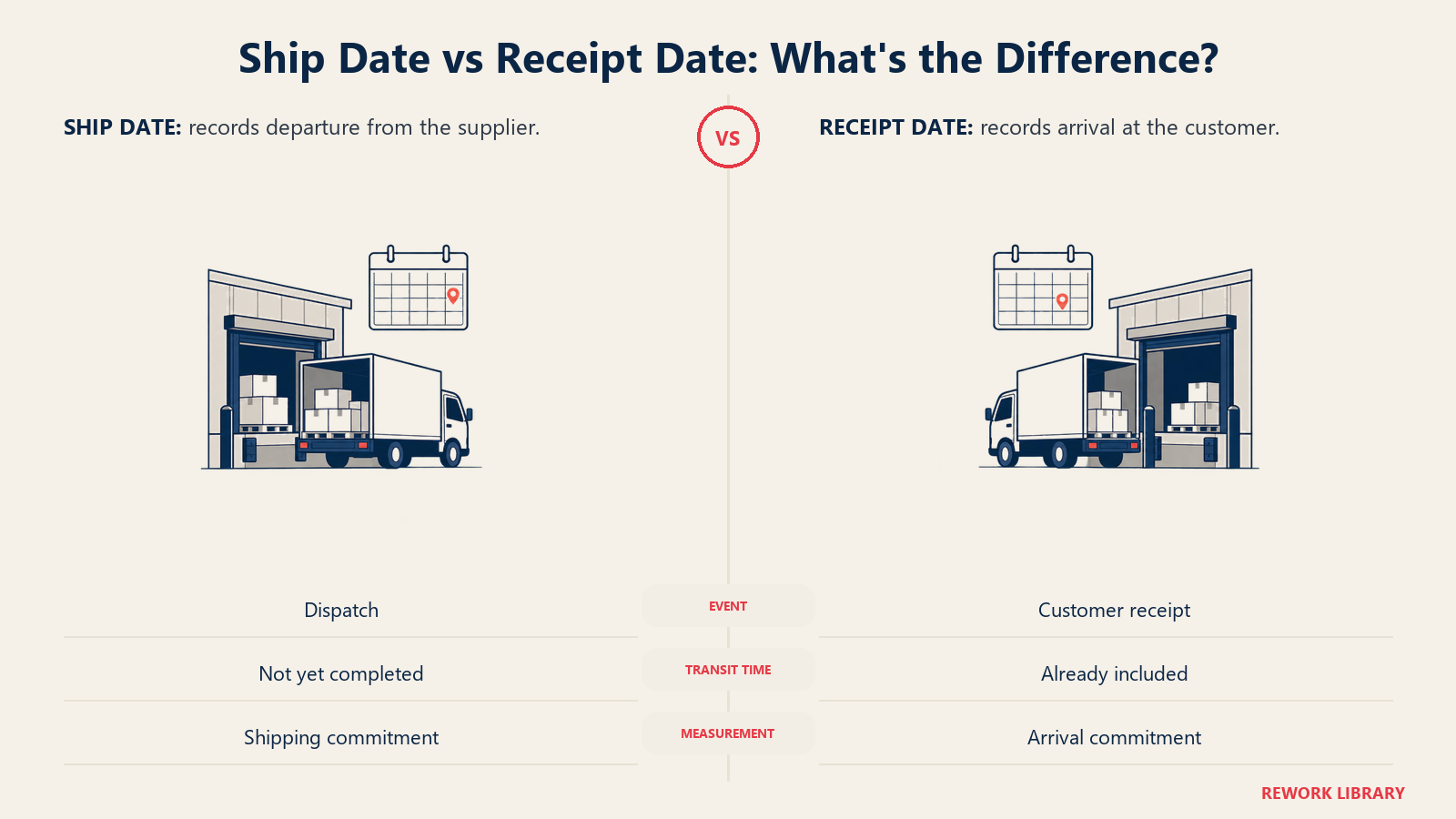
OTD definition and measurement methods vary. Some companies define on-time as shipping on the promised date. Others define it as the customer receiving on the promised date. Some allow a window (within one day early or late). Others require exact day performance.
Align your OTD definition with customer expectations. If customers care about receiving goods (not when you ship), measure to receipt. If they accept a window, define the window clearly.
Customer expectations and agreed metrics must be explicit. Don't assume you know how customers define on-time. Some customers measure to the day, some to the hour. Some penalize early delivery as harshly as late delivery because it creates inventory handling issues.
Document OTD definitions in contracts or quality agreements so everyone measures the same way. Gartner defines On-Time In Full (OTIF) as a key supply chain metric calculated by multiplying fill rate by on-time delivery.
Internal versus external causes of delays require different solutions. Internal causes include production schedule misses, quality failures requiring rework, equipment breakdowns, material shortages you control, and insufficient capacity planning.
External causes include supplier delays you can't control, customer changes or unclear specifications, carrier delays, and force majeure events.
Focus improvement efforts on internal causes you can control, while building contingency into planning for external risks.
Cost of poor delivery performance is substantial beyond just customer dissatisfaction. Costs include expedited shipping to recover late deliveries, overtime and premium labor to catch up, lost sales when customers switch suppliers, contract penalties for missed delivery dates, and opportunity cost of capacity consumed by crisis management.
Many manufacturers don't calculate these costs fully, underestimating the ROI of improving OTD performance.
Identifying Root Causes of Delivery Failures
You can't improve OTD without understanding why deliveries are late.
Production schedule adherence issues create most delivery problems. Common patterns include starting orders late due to material delays, longer-than-planned cycle times, unplanned equipment downtime, capacity bottlenecks, and priority changes disrupting schedules.
Strong production planning fundamentals and manufacturing KPIs help track these patterns. Track schedule adherence daily. Know which orders are on track versus behind schedule. This visibility enables proactive intervention.
Material shortages and supplier delays propagate through your operation. If materials arrive late, production starts late, and delivery slips. This is particularly damaging when shortages are discovered late:materials were expected on Tuesday, it's now Thursday, and they're not here.
Improve material visibility and supplier performance management to prevent these surprises.
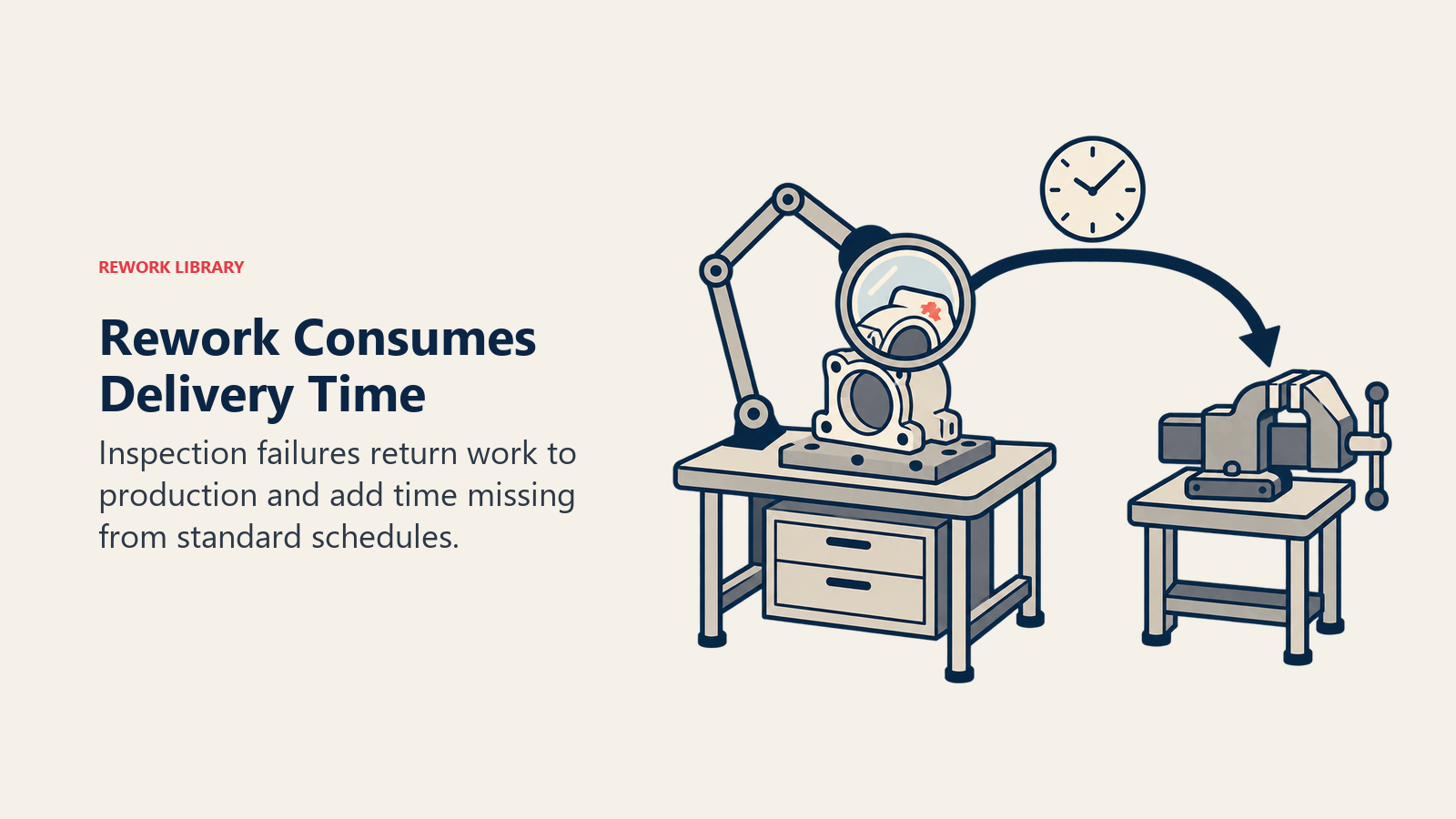
Quality problems and rework consume time not reflected in standard schedules. If 5% of production fails inspection requiring rework, that adds time not built into lead time commitments.
High first-pass yield improves delivery reliability. Lower quality creates unpredictable delays.
Capacity constraints and bottlenecks limit throughput. When demand exceeds capacity at constraint operations, orders queue up waiting. Lead times stretch, and delivery performance suffers.
Identify and address bottlenecks systematically. Temporary fixes (overtime, outsourcing) may be needed short-term, but permanent capacity increases or demand management are long-term solutions.
Inaccurate lead time commitments set you up for failure. If standard lead time is six weeks but actual average is seven weeks, you'll consistently deliver late. Promising lead times shorter than your capability guarantees OTD problems.
Validate that quoted lead times reflect reality, not wishful thinking.
Setting Realistic Delivery Promises
The foundation of good OTD is promising dates you can actually meet.
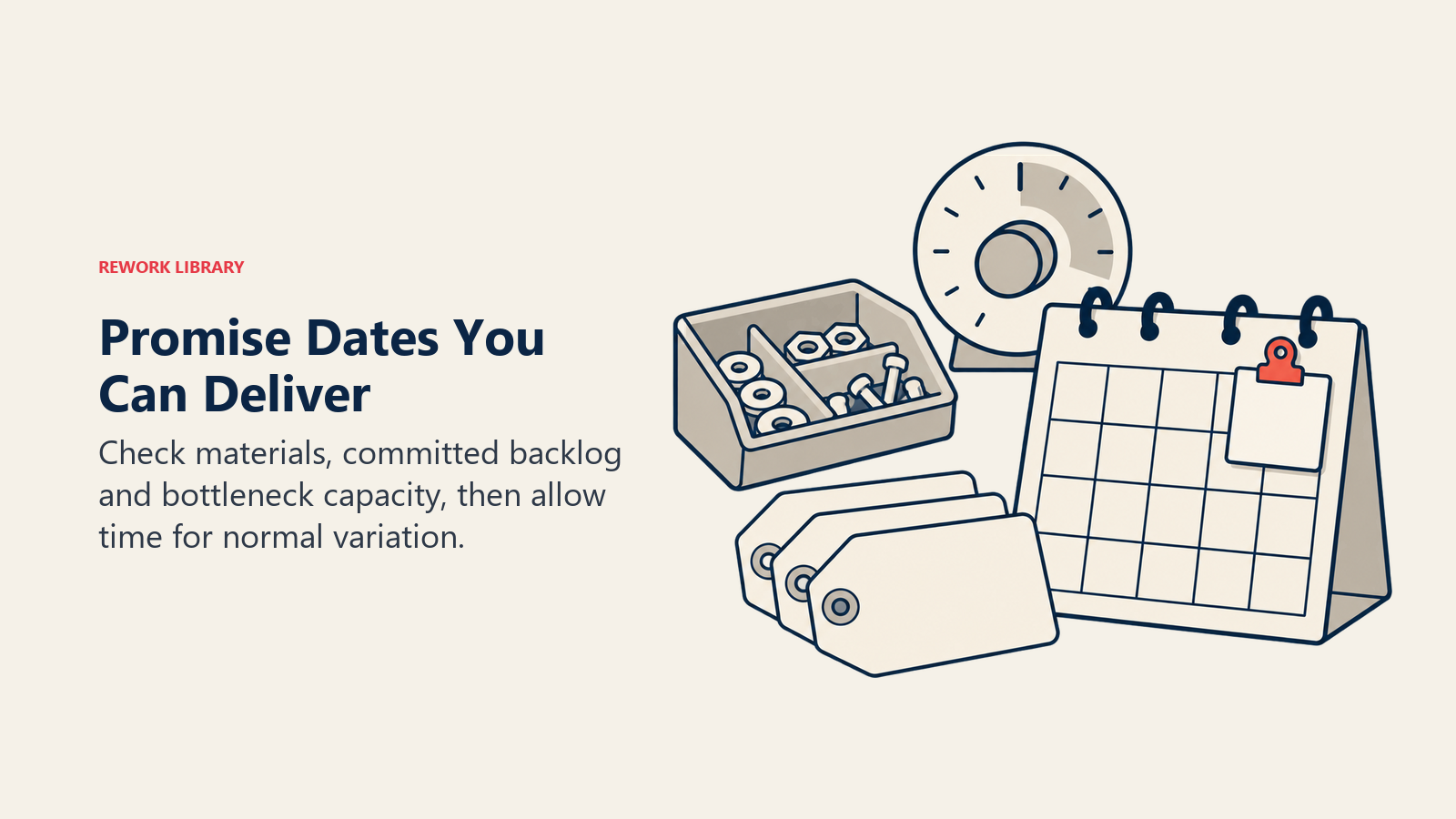
Lead time calculation and validation should consider standard production lead time, current backlog and capacity utilization, material procurement time if not in stock, queue time at bottleneck operations, buffer for normal variation, and any special requirements adding time.
Use data to set lead times, not assumptions. Track actual cycle times and use those to inform quotes.
Capacity-aware order promising prevents overcommitting. Before promising a delivery date, verify that you have capacity available, materials can be procured in time, no known constraints or issues exist, and the promise considers other orders already committed.
Many ERP systems can provide available-to-promise (ATP) calculations that consider capacity and materials.
Production scheduling discipline creates the execution plan. Master schedule should sequence orders by priority, optimize for efficiency within delivery constraints, identify orders at risk of delay, and communicate clearly to production.
Schedules that constantly change create chaos. Establish change control processes that balance responding to urgent needs with maintaining schedule stability.
Buffer management strategies protect against variation. Options include adding time buffers to lead times, maintaining capacity buffers at constraints, holding safety stock of critical materials, and building schedule slack for recovery.
Buffers cost money but buy reliability. Balance the cost of buffers against the cost of poor OTD.
Customer communication of realistic dates matters more than promising optimistic dates. If your lead time is eight weeks, don't promise six weeks to win the order. You'll miss delivery, disappoint the customer, and probably lose future business.
Customers prefer realistic dates they can count on over optimistic dates you miss.
Executing with Discipline
Even perfect plans fail without strong execution.
Daily schedule adherence tracking monitors whether production is following the plan. Track orders completed versus planned each day, orders behind schedule and by how much, bottleneck performance versus plan, and emerging issues that may impact future performance.
Daily review with production leadership addresses problems before they cause delays.
Hot list and expedite management focuses attention on critical orders. Maintain a hot list of orders at risk of missing delivery dates. But don't let every order become hot:that defeats the purpose. True hot lists identify the vital few that need special attention and resources.
Over-expediting everything creates chaos without improving performance.
Cross-functional coordination prevents handoff delays. OTD requires coordination of planning, production, quality, shipping, and customer service. Orders shouldn't wait between departments.
Establish clear handoff processes and communication protocols. Waiting for someone to check email before the next step happens adds unnecessary time.
Real-time issue escalation surfaces problems when they can still be addressed. Don't wait until the promised delivery date to discover an order won't ship. Flag issues immediately when production falls behind, quality problems emerge, materials aren't available, or equipment problems occur.
Early visibility enables early action or customer communication.
Alternative solutions and recovery plans address problems that threaten deliveries. Options include shifting capacity from other orders, authorizing overtime or weekend work, expediting materials or using alternates, outsourcing operations to subcontractors, and partial shipments to get customers some product.
Proactive recovery minimizes customer impact even when problems occur.
Measuring and Improving OTD
What gets measured gets managed. Track OTD rigorously.
On-time delivery metrics and reporting should include overall OTD percentage, OTD by customer, OTD by product line, early/on-time/late distribution, and average days early or late for missed deliveries.
Daily or weekly OTD reporting keeps performance visible. Don't wait for monthly reports to discover problems.
Trend analysis and root cause tracking identifies patterns. Are certain product types consistently late? Do certain customers experience worse OTD? Are specific root causes (quality issues, material shortages, equipment problems) recurring?
Systematic root cause analysis and corrective action prevents repeat failures.
Customer-specific performance matters because some customers are more important or demanding than others. Track OTD separately for key customers. If your overall OTD is 92% but your largest customer experiences 75% OTD, you have a problem.
Prioritize improvement efforts based on customer importance and relationship impact.
Visual management and accountability makes performance visible to everyone. Production boards showing scheduled versus actual completion, OTD scoreboards for teams or shifts, and charts tracking OTD trends create transparency and accountability.
Teams that see their performance daily are more likely to improve it.
Building a Culture of Delivery Reliability
Sustained OTD excellence requires cultural commitment, not just better processes.
This means leadership emphasis on delivery commitments as non-negotiable, clear accountability for schedule performance, celebration of OTD achievements, systematic root cause elimination, and investment in capacity and capability to support commitments.
The manufacturers with consistently excellent OTD don't achieve it through heroic efforts and constant expediting. They achieve it through disciplined planning, rigorous execution, proactive problem-solving, and cultural commitment to keeping promises.
Your customers plan their operations around your delivery commitments. Honor those commitments consistently, and you earn trust, loyalty, and growth. Miss them regularly, and you lose customers regardless of your quality or pricing.
Make delivery reliability a competitive strength. Your reputation depends on it.
Learn More
