Manufacturing Cost Analysis: Understanding and Managing Production Economics
Turn this article into takeaways for your work.


Each assistant summarizes the article only for you and suggests best practices for your work.
You're quoting a new product. Sales wants aggressive pricing to win the business. Your cost estimate comes in higher than the target price. Sales says competitors are quoting lower:your costs must be wrong. But are they?
Without rigorous cost analysis, you're guessing. You might underestimate and lose money on every unit produced. Or you might overestimate and lose the business to competitors who understand their costs better.
Manufacturing cost analysis provides the foundation for pricing decisions, make-versus-buy choices, process improvement priorities, product mix optimization, and capital investment justification. Get your cost analysis wrong, and every strategic decision built on it is flawed.
Manufacturing Cost Fundamentals
Understanding cost structure starts with proper categorization.
Cost components break into three main categories. Material costs include raw materials, purchased components, and consumables. Labor costs include direct production labor and indirect support labor analyzed through labor productivity metrics. Overhead includes all other manufacturing costs:facilities, equipment, utilities, supervision, quality, maintenance.
The relative proportion varies by industry. Material might be 60% of cost in assembly operations but 30% in machining-intensive processes.
Direct versus indirect costs distinguish between costs directly traceable to products versus costs allocated across products. Direct materials and direct labor go into specific products. Indirect costs like supervision, facilities, and equipment depreciation support production generally but aren't directly traceable to individual units.
The distinction matters for cost allocation and decision-making.
Fixed versus variable costs behave differently as volume changes. Fixed costs remain constant regardless of volume:facility costs, equipment depreciation, salaried labor. Variable costs change with volume:materials, direct labor, utilities.
Understanding cost behavior enables break-even analysis, pricing decisions under different volume scenarios, and outsourcing evaluations. Deloitte's research shows that many organizations lack sufficient transparency into their COGS, restricting cost optimization opportunities.
Standard costs versus actual costs represent planned versus real performance. Standard costs are predetermined estimates of what products should cost. Actual costs are what products really cost. Variance between standard and actual reveals efficiency gains or losses.
Cost drivers and cost behavior explain why costs occur and how they change. Material cost drivers include material prices, yield rates, and scrap. Labor cost drivers include wage rates, productivity, and setup efficiency. Understanding drivers enables targeted improvement.
Choosing Cost Analysis Methods
Different costing methodologies suit different situations.
Job costing versus process costing depends on production type. Job costing assigns costs to specific jobs or batches:suitable for custom manufacturing, project work, or distinct production runs. Process costing allocates costs across continuous production:suitable for high-volume, repetitive manufacturing.
Most manufacturers use hybrid approaches:process costing for standard operations with job costing for custom work.
Standard costing systems establish predetermined costs based on engineered standards, bill of materials, and overhead rates. Production performance is measured against standards. Variances reveal performance gaps.
Standard costing works well when processes are stable and volumes are predictable. It's less useful for highly variable operations or rapidly changing products.
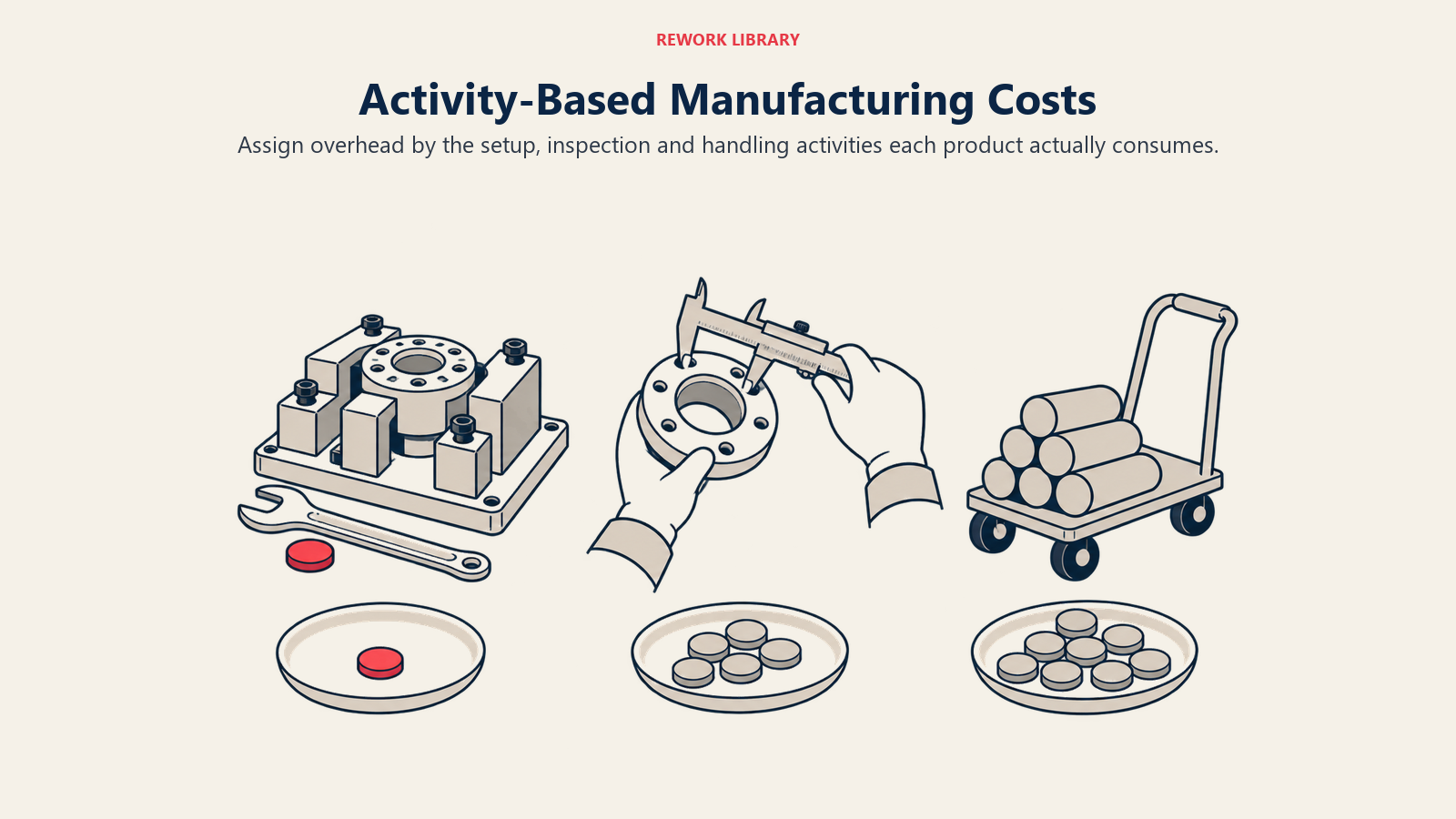
Activity-based costing (ABC) allocates overhead based on activities that drive costs rather than simple allocation bases like labor hours. ABC identifies cost pools for different activities (setup, inspection, material handling), determines cost drivers for each activity, and allocates costs based on product consumption of activities.
ABC provides more accurate product costs when overhead is large and products consume resources differently. But it's complex to maintain.
Throughput accounting focuses on contribution margin after truly variable costs:typically just materials. All other costs are treated as operating expenses. This approach aligns with theory of constraints thinking.
Throughput accounting works well for short-term decisions but can mislead on long-term pricing and strategic choices.
Building Detailed Cost Structures
Accurate cost build-up requires understanding all cost elements.
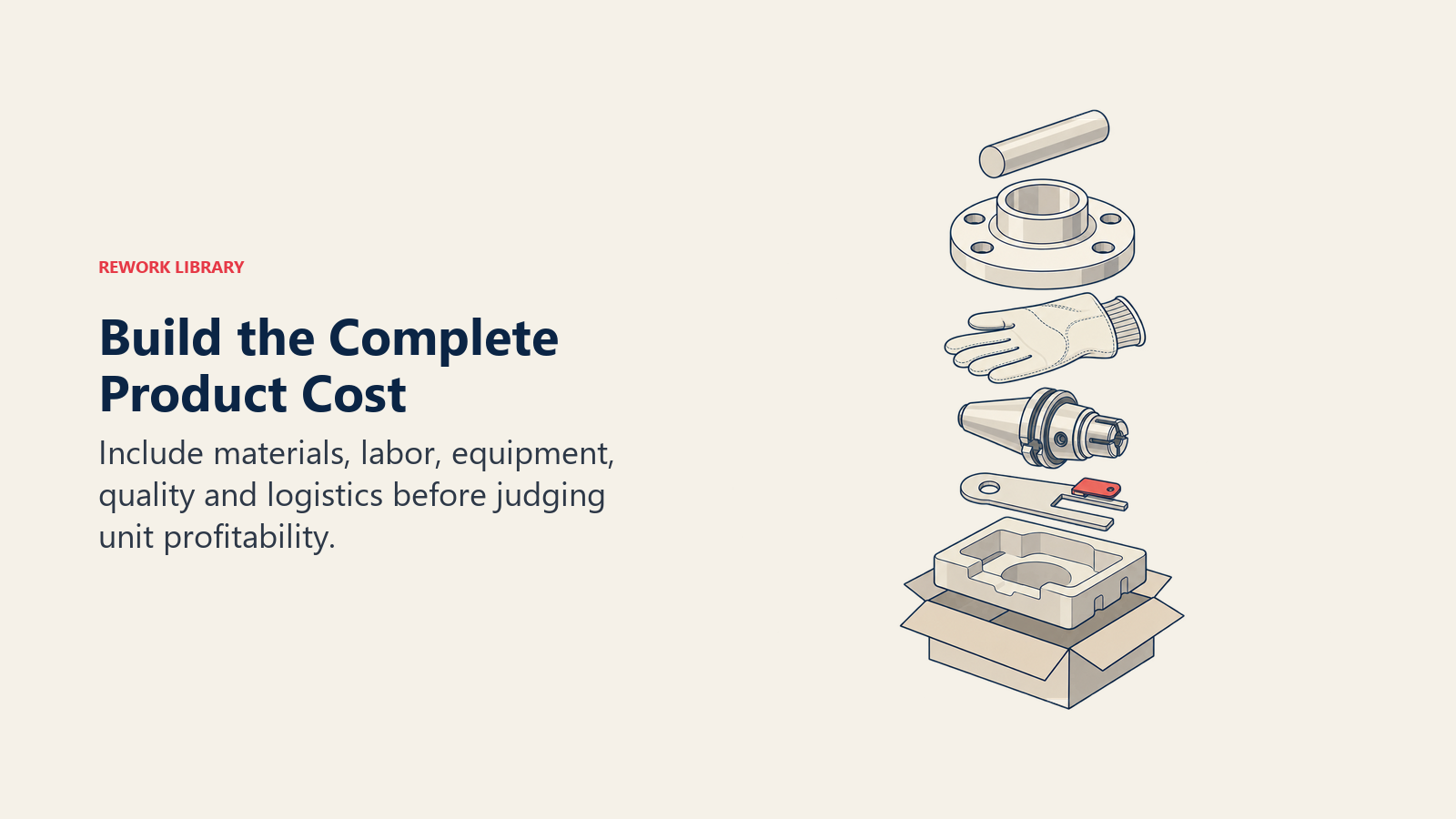
Material costs and bill of materials start with detailed BOM showing all materials, quantities, prices, and yields. Include raw materials, purchased components, packaging materials, consumables and supplies, and scrap allowances.
Update material costs regularly as prices change. Outdated material costs create inaccurate product costs.
Direct labor and labor standards calculate required labor hours per unit times labor rates. Develop labor standards through time studies, historical performance, or engineered estimates. Include setup time allocated per unit, run time per unit, and yield losses requiring rework.
Labor standards enable efficiency tracking and variance analysis.
Manufacturing overhead allocation distributes indirect costs. Common allocation bases include direct labor hours, machine hours, or units produced. More sophisticated approaches use multiple cost pools with different allocation bases.
Choose allocation methods that reflect how overhead costs are actually consumed.
Machine and equipment costs include depreciation, maintenance, tooling, and setup. Expensive equipment creates high overhead rates. Calculate machine hour rates including depreciation, maintenance and repairs, tooling and fixtures, and utilities for equipment operation.
Equipment-intensive operations may use machine hour rates instead of labor hour rates.
Quality and scrap costs often hide in overhead but should be tracked explicitly. Include inspection and testing labor, quality system costs, scrap and rework costs, and warranty and field failure costs.
Visibility into quality costs enables quality improvement ROI calculation.
Packaging and logistics complete the product cost. Include packaging materials and labor, warehousing and handling, and outbound freight if included in product cost.
For make-versus-buy decisions, ensure you compare complete costs including logistics.
Analyzing Costs for Improvement
Cost data becomes valuable when analyzed to drive decisions.
Variance analysis compares actual costs to standards. Material variance breaks into price variance (actual price versus standard price) and usage variance (actual quantity versus standard quantity). Labor variance breaks into rate variance (actual wage versus standard) and efficiency variance (actual hours versus standard hours). Overhead variance shows spending versus budget and volume impact.
Investigate significant variances to understand root causes and improvement opportunities.
Cost-volume-profit analysis examines how profit changes with volume at different cost structures. This reveals break-even points, margin contribution at different volumes, impact of price changes on profitability required volume to achieve profit targets, and effect of cost structure changes.
CVP analysis guides pricing and volume decisions.
Break-even analysis calculates the volume where revenue equals total costs. Fixed costs divided by contribution margin per unit gives break-even units. This helps evaluate new product launches, equipment investment payback, and make-versus-buy thresholds.
Pareto analysis of cost drivers identifies the vital few cost elements driving total costs. Typically 20% of cost elements represent 80% of total costs. Focus improvement efforts on high-impact elements.
Trend analysis and benchmarking track cost performance over time and compare to competitors or industry standards. Monitor material cost per unit trends, labor cost per unit trends, overhead rate trends, and total product cost trends.
Benchmarking reveals whether your costs are competitive.
Supporting Strategic Decisions
Cost analysis enables better decision-making across the business.
Make versus buy decisions require comparing total cost of internal production versus external sourcing. Internal costs should include direct materials and labor, allocated overhead, opportunity cost of capacity used, quality costs, and logistics and transaction costs.
External costs include purchase price, incoming inspection, vendor management, and supply risk. Don't just compare purchase price to direct costs:compare all costs.
Pricing and profitability analysis uses cost data to set prices that achieve target margins. Calculate required price as cost divided by (1 minus target margin percentage). Evaluate profitability by customer, product, and order size.
Some products or customers may be unprofitable at current pricing:requiring price increases, cost reduction, or discontinuation.
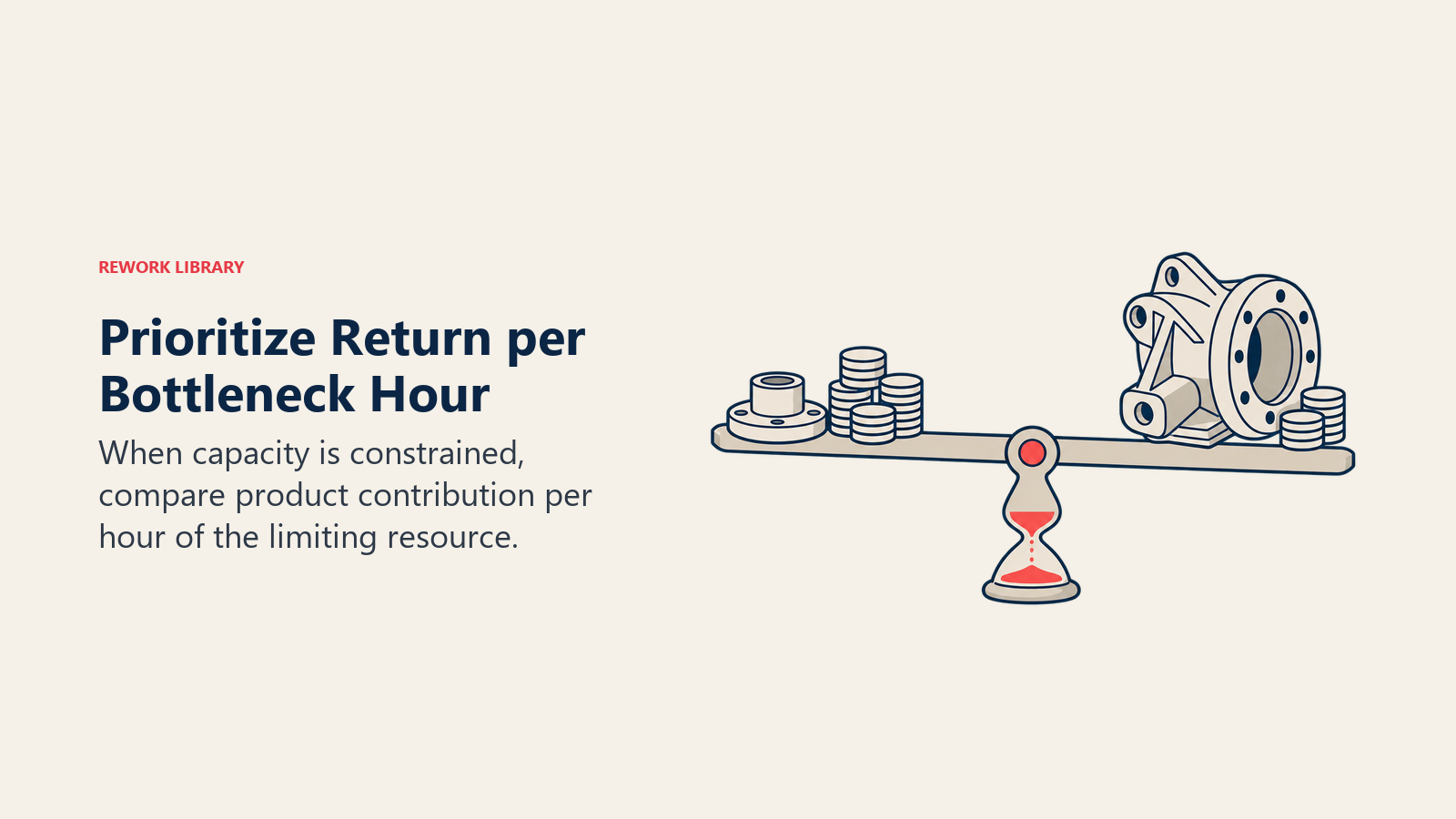
Product mix optimization determines which products to emphasize when capacity is constrained. Calculate contribution margin per constraint hour (bottleneck resource). Prioritize products with highest margin per constraint unit.
Simple margin analysis can mislead if it ignores capacity constraints.
Process improvement prioritization focuses resources on highest-impact opportunities. Compare cost reduction potential, implementation difficulty, and strategic importance to prioritize improvement projects.
Capital investment justification requires accurate cost data to calculate ROI. Quantify cost savings from reduced labor, material savings from improved yield, overhead reduction from automation, and quality cost reduction.
Compare total savings to investment cost to determine payback period and return.
Reducing Costs Systematically
Understanding costs is valuable only if it drives improvement.
Material cost reduction initiatives target your largest cost element for many manufacturers. Strategies include supplier negotiations and competitive bidding, alternative materials or substitute components, design changes reducing material content, yield improvement reducing scrap, and global sourcing when appropriate.
Even small percentage reductions in material costs create significant savings.
Labor productivity improvement reduces cost per unit through faster cycle times, reduced setup time, improved first-pass yield, better work methods, and skills development.
Productivity improvements compound over time:3% annual improvement becomes 30% over ten years.
Overhead cost management controls indirect costs. Strategies include capacity utilization improvement, energy efficiency initiatives, maintenance cost optimization, supplier consolidation, and facility rationalization.
Overhead often creeps up unnoticed without active management.
Waste elimination and lean methods remove non-value-added costs through motion and transportation waste reduction, waiting and delay elimination, overproduction and inventory reduction, and defect and rework prevention.
Lean thinking systematically attacks cost while improving flow and quality.
Design for manufacturability reduces costs through product design. Engineers can eliminate 70% of product cost through design decisions. Partner with engineering to specify appropriate tolerances, standardize components, simplify assembly, and design for efficient manufacturing.
Building Cost Consciousness
The most successful manufacturers build cost analysis into their culture.
This means transparency in sharing cost data, accountability for cost performance, celebration of cost reduction achievements, continuous questioning of "why does this cost what it does?", and willingness to make tough decisions about unprofitable products or customers.
Cost consciousness isn't about being cheap:it's about understanding value and eliminating waste. It's about competing through operational excellence and smart resource allocation.
Your cost structure determines your competitive position, pricing flexibility, and profitability. Understand it deeply, analyze it rigorously, and improve it continuously.
Learn More
