Root Cause Analysis Methods: Getting to the Heart of Manufacturing Problems and Preventing Recurrence
Turn this article into takeaways for your work.


Each assistant summarizes the article only for you and suggests best practices for your work.
A production line that ran smoothly for months suddenly produces 15% defects. Your team springs into action:operators adjust settings, inspectors sort good from bad, and everyone works overtime to meet shipments. But two weeks later, the same problem returns.
Sound familiar? You've treated the symptom instead of finding the root cause. And that's an expensive habit.
Root cause analysis transforms reactive firefighting into systematic problem-solving. When you identify and eliminate true underlying causes rather than addressing surface-level symptoms, problems don't come back. It's the difference between putting a bucket under a leaking roof and actually fixing the hole.
Understanding Root Cause Analysis: Beyond Quick Fixes
Root cause analysis is a structured methodology for investigating problems, failures, or undesirable events to identify what happened, why it happened, and what can prevent it from happening again. But it's not about finding someone to blame:it's about understanding system failures that allow problems to occur.
A root cause is the fundamental reason a problem exists. Remove it, and the problem goes away permanently. Contributing factors may increase the likelihood or severity of a problem, but eliminating them won't prevent recurrence entirely. That's why distinguishing between the two matters so much.
Think of a plant that ran into recurring quality issues with a critical component. After several months of rework and customer complaints, they finally conducted a thorough root cause analysis. The immediate cause was operator error during setup. But the root causes? Inadequate training, missing visual work instructions, and a fixture design that allowed parts to be loaded incorrectly. Once they addressed all three root causes with standardized training, clear visual aids, and mistake-proofing the fixture, defects dropped to near zero.
When to Conduct Formal RCA
Not every problem requires a full-scale investigation. Save your formal RCA efforts for issues that matter:
High-impact problems: Safety incidents, major quality failures, significant customer complaints, or costly production disruptions deserve thorough analysis.
Recurring issues: If you've "fixed" the same problem multiple times, you haven't found the root cause. That's your signal to dig deeper.
Chronic performance gaps: When key metrics like scrap rates, downtime, or first pass yield consistently underperform despite improvement efforts.
Near-misses: Incidents that could have caused serious harm or damage provide valuable learning opportunities to prevent actual disasters.
For minor, isolated issues, a quick response and documentation may suffice. But don't let that become an excuse to avoid necessary investigation. The cost of thorough RCA is always less than the cumulative cost of recurring problems.
The RCA Toolkit: Methodologies for Different Situations
Different problems call for different analytical approaches. Having multiple methods in your toolkit lets you match the technique to the situation.
5 Whys: The Simplest Starting Point
The 5 Whys technique uses iterative questioning to peel back layers of symptoms and get to underlying causes. According to ASQ, by repeatedly asking the question "Why" (five is a good rule of thumb), you can peel away the layers of symptoms that can lead to the root cause of a problem. iSixSigma notes that although this technique is called "5 Whys," you may need to ask the question fewer or more times than five before you find the issue. You start with the problem and ask "why" repeatedly until you reach a root cause you can act on.
Here's how it works in practice:
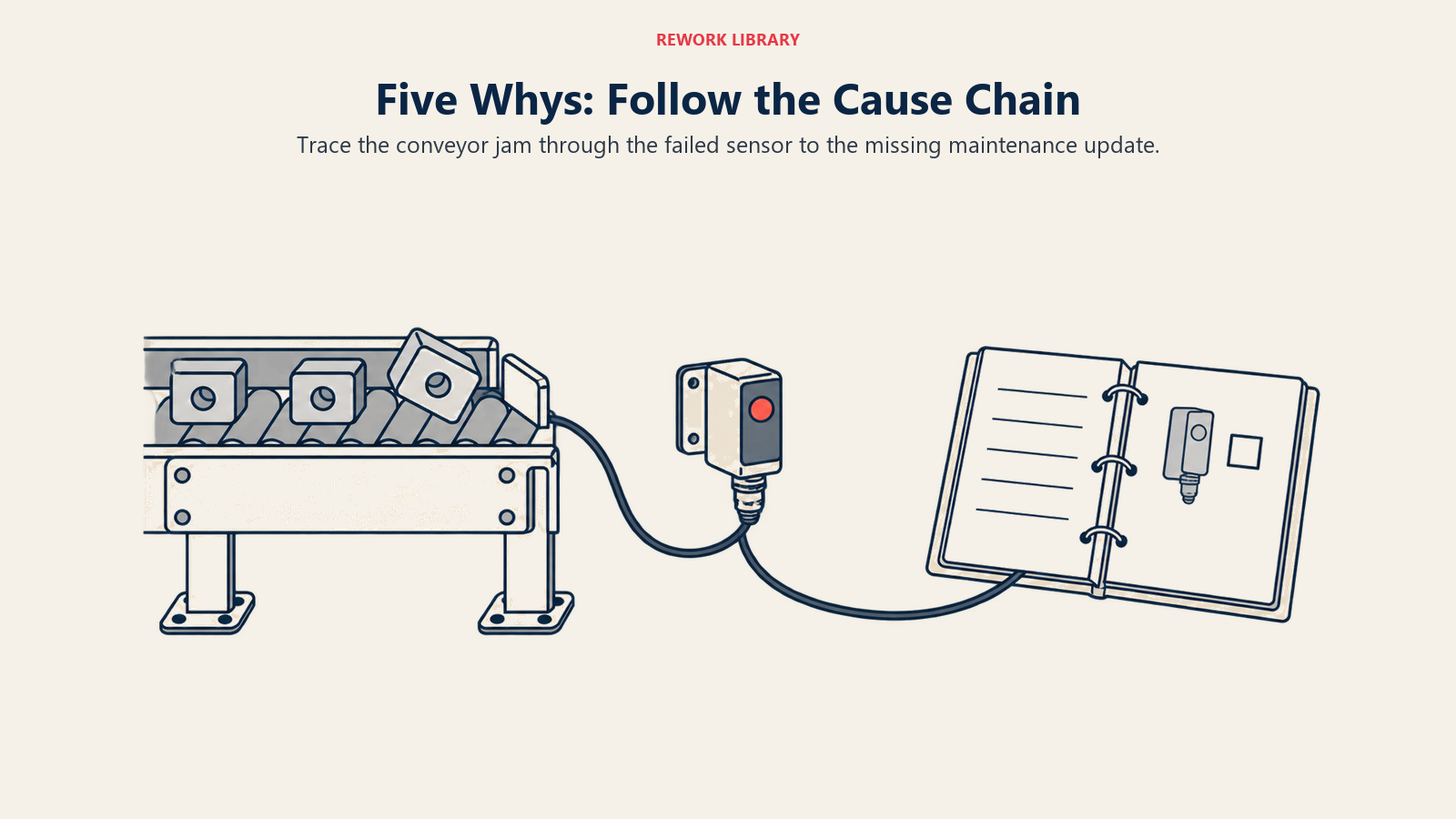
Problem: Production stopped for 45 minutes.
- Why? The conveyor belt jammed.
- Why? Material accumulated at the transfer point.
- Why? The sensor that triggers material flow failed.
- Why? The sensor wasn't included in the preventive maintenance schedule.
- Why? The PM program only covers equipment in the original installation, not later additions.
Root cause: Inadequate process for updating maintenance schedules when equipment is added.
The beauty of 5 Whys is its simplicity:you can use it in real-time discussions without special training. But it has limitations. It works best for relatively straightforward cause-and-effect relationships. For complex problems with multiple contributing factors, you need more sophisticated tools.
Fishbone Diagram: Mapping Multiple Contributors
The fishbone diagram (also called an Ishikawa diagram) helps identify and organize potential causes across different categories. According to ASQ, the fishbone diagram helps you explore all potential or real causes that result in a single defect or failure. iSixSigma explains that the 5 Whys can be used individually or as part of the fishbone diagram, and once all inputs are established on the fishbone, you can use the 5 Whys technique to drill down to the root causes. It's especially useful when multiple factors might contribute to a problem.
The diagram looks like a fish skeleton. The problem statement sits at the "head," and major cause categories form the "bones." Manufacturing typically uses the 6M categories:
Methods: Procedures, work instructions, processes Machines: Equipment, tools, fixtures Materials: Raw materials, components, consumables Measurement: Inspection methods, calibration, data collection Mother Nature (Environment): Temperature, humidity, contamination Manpower: Training, skills, fatigue, communication
For each category, teams brainstorm potential causes and sub-causes, creating branches off the main bones. This structured brainstorming ensures you consider all possible contributors rather than jumping to conclusions.
A food manufacturer investigating contamination issues used a fishbone to map out dozens of potential causes across all six categories. This comprehensive view revealed that while sanitation procedures (Methods) had gaps, the real breakthrough came from identifying inadequate air handling (Environment) and insufficient operator training on cross-contamination prevention (Manpower). Addressing all three together solved a problem that had persisted for months.
Fault Tree Analysis: Logic for Complex Failures
Fault tree analysis (FTA) uses Boolean logic to map how individual failures combine to create system-level problems. You start with the top-level failure and work backward, identifying the logical combinations of events that could cause it.
FTA is powerful for analyzing complex equipment failures, safety incidents, or situations where multiple simultaneous failures are required for a problem to occur. It's common in industries like automotive, aerospace, and process manufacturing where reliability is critical.
The method uses logic gates (AND, OR) to show relationships. An OR gate means any single event can cause the problem. An AND gate means multiple events must occur together.
For example, a hydraulic system failure might require both a pump malfunction AND a backup system failure (AND gate). But the pump could fail due to either bearing wear OR contaminated fluid OR electrical issues (OR gate). Mapping these relationships helps prioritize which failure modes need the most attention.
Failure Mode Effects Analysis: Proactive Risk Assessment
FMEA flips the reactive approach on its head. Instead of waiting for problems to occur, you systematically evaluate what could go wrong, how likely it is, how severe the consequences would be, and how well you'd detect it before it causes harm.
For each potential failure mode, teams assign scores for Severity (how bad is the impact?), Occurrence (how likely is it?), and Detection (how likely are we to catch it?). Multiply these together to get a Risk Priority Number (RPN) that guides which risks need immediate attention.
A medical device manufacturer used FMEA during new product introduction to identify 47 potential failure modes. The highest RPN went to a particular fastener that could loosen during operation, potentially causing device malfunction and patient harm. Even though the occurrence probability was low, the severity was catastrophic and detection was poor. They redesigned the assembly with a locking mechanism and added a verification step, dramatically reducing the RPN before production even started.
8D Problem Solving: The Structured Team Approach
The 8D (Eight Disciplines) methodology provides a complete problem-solving framework, particularly valuable for complex issues that require cross-functional teams and have significant customer or production impact.
The eight disciplines are:
D1: Form a team with the knowledge and authority to solve the problem. D2: Describe the problem clearly with specific data about what, where, when, and how much. D3: Implement containment actions to protect customers while you find permanent solutions. D4: Identify root causes using appropriate analytical tools. D5: Verify root causes with data to ensure you've found the real culprits. D6: Implement permanent corrective actions that eliminate root causes. D7: Prevent recurrence by updating systems, procedures, and training. D8: Congratulate the team and document lessons learned.
The automotive industry pioneered 8D, and it remains the gold standard for handling major quality issues with customers. What makes it powerful is the discipline to contain problems quickly while still taking time to find true root causes, plus the emphasis on prevention and documentation that builds organizational capability.
Conducting Effective RCA: Process and Best Practices
Having the right tools matters, but how you use them determines your success. Follow these principles for investigations that lead to real solutions.
Assemble the Right Team
Root cause analysis isn't a solo activity. You need diverse perspectives from people who understand different aspects of the problem:
Operators who see the day-to-day reality of what happens on the floor Engineers who understand the technical design and specifications Quality personnel who have data about when and how often problems occur Maintenance technicians who know equipment behavior and failure patterns Managers who can authorize changes and allocate resources
Keep teams small enough to be effective (typically 5-8 people), but make sure you have the knowledge and authority needed to implement solutions. And pick a facilitator who can keep discussions focused on facts rather than blame.
Gather Facts, Not Opinions
Effective RCA relies on data, not assumptions. Before you start theorizing about causes, collect solid information:
Examine physical evidence:the defective parts, the failed component, the scene of the incident. Take photos and preserve samples before things get cleaned up or put back into service.
Review process data, inspection records, maintenance logs, and production reports. Look for patterns in when problems occur, which products or lines are affected, and what conditions are present.
Interview people who were directly involved, but focus on what happened, not who was at fault. Ask open-ended questions and listen for details that might seem insignificant but could be important clues.
A plastics manufacturer investigating intermittent quality issues spent weeks theorizing about material problems before someone actually pulled the process data. Turns out the defects only occurred on second shift:not because of operator differences, but because that shift ran a different product mix that changed the thermal profile of the molding equipment. Facts pointed to a process parameter issue that opinions had missed entirely.
Use Multiple Methods for Validation
Don't rely on a single RCA technique. Use different approaches to validate your conclusions.
Start with 5 Whys to quickly narrow the focus, then use a fishbone diagram to ensure you haven't missed potential contributors. If the problem is complex, follow up with fault tree analysis or FMEA to understand failure combinations and prioritize risks.
The point is to test your conclusions from different angles. If multiple methods point to the same root cause, you've got solid ground for action. If they diverge, you need to dig deeper.
Distinguish Root Causes from Contributing Factors
Not everything in your investigation is a root cause. Some factors make problems more likely or more severe, but eliminating them won't prevent recurrence.
Ask yourself: If I eliminate this cause completely, would the problem never happen again? If the answer is yes, it's a root cause. If the answer is "it would happen less often" or "it wouldn't be as bad," it's a contributing factor.
Both matter. Fix the root causes to prevent recurrence, and address contributing factors to build in additional safety margins and make the process more robust.
Test Cause-and-Effect Relationships
Once you've identified potential root causes, validate them before implementing expensive solutions. Can you recreate the problem by reintroducing the suspected cause? Can you eliminate the problem by removing it?
Sometimes you can test hypotheses through controlled experiments or pilot trials. Other times you need to implement solutions in phases and measure results to confirm your analysis was correct.
An electronics manufacturer believed vibration during shipping caused component failures. Before redesigning packaging (expensive), they instrumented several shipments with data loggers. Turns out vibration was within acceptable limits, but temperature excursions during warehouse storage were the real culprit. Testing saved them from implementing the wrong solution.
From Analysis to Action: Implementing Lasting Solutions
Finding root causes is only half the battle. You still need to implement effective solutions and verify they work.
Develop Corrective and Preventive Actions
For each verified root cause, develop actions that eliminate it:
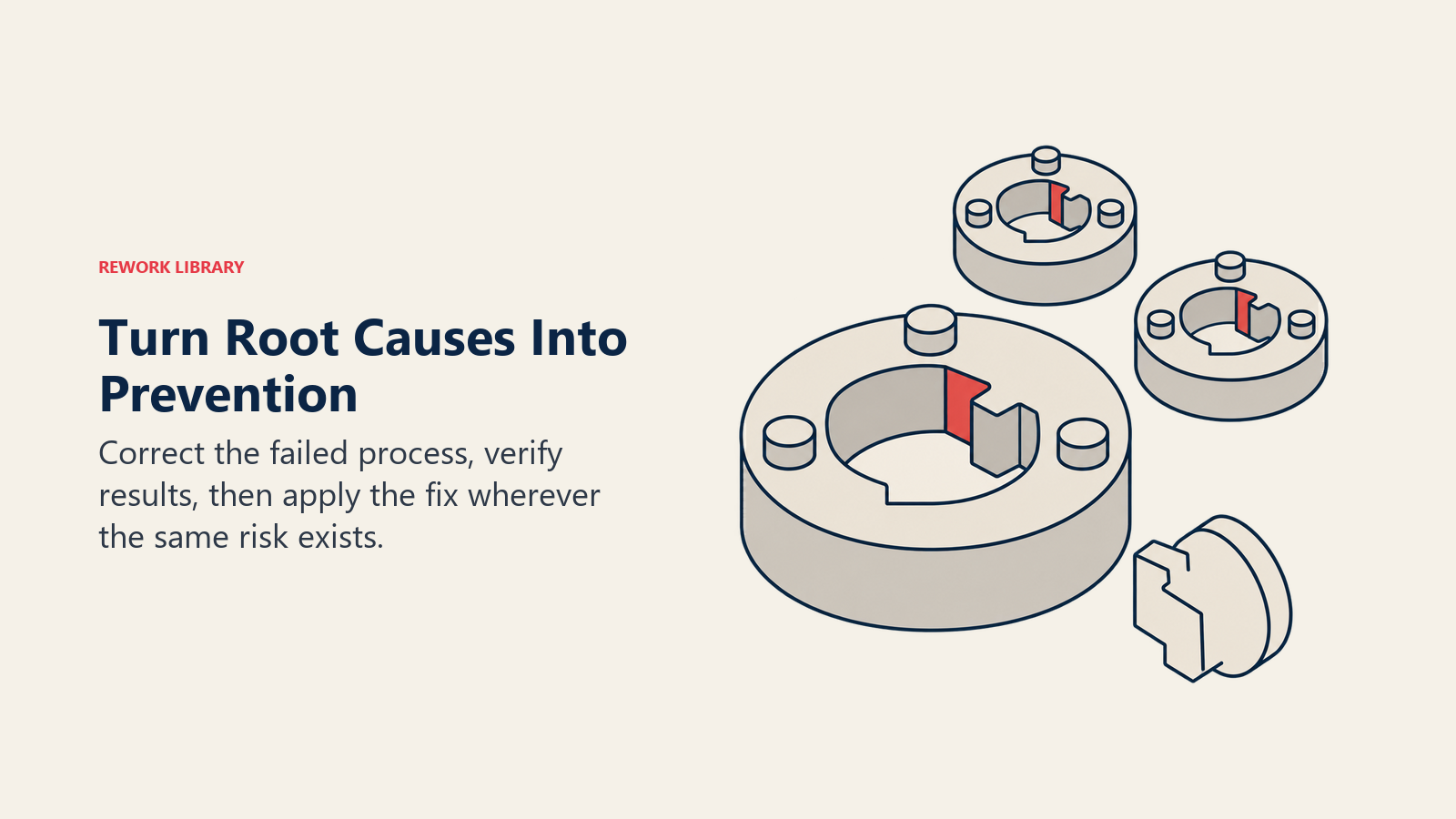
Corrective actions fix the immediate problem and prevent recurrence of this specific issue.
Preventive actions go further, identifying similar vulnerabilities elsewhere in your operation and addressing them before problems occur.
Think about the fixture design issue mentioned earlier. The corrective action was redesigning the specific fixture that allowed incorrect part loading. The preventive action was reviewing all fixtures across the plant for similar design weaknesses and establishing new standards for fixture design that incorporate mistake-proofing from the start.
Balance Short-Term Containment with Long-Term Prevention
Sometimes the right permanent solution takes time to implement. Don't let perfection delay protection.
Implement interim containment actions quickly to prevent further problems while you work on root cause elimination:
Add inspection points to catch defects before they reach customers. Develop workarounds or alternate processes to maintain production. Increase inventory buffers to reduce time pressure that might lead to shortcuts.
But make sure interim actions don't become permanent. Set specific deadlines for implementing permanent solutions, assign ownership, and track progress.
Prioritize Actions by Impact and Feasibility
When you've identified multiple root causes, you can't always fix everything at once. Prioritize based on:
Impact: Which solutions prevent the most serious problems or deliver the biggest performance improvements?
Feasibility: What's your capacity to implement? Consider cost, technical complexity, and resource requirements.
Time: How quickly can each solution be implemented? Sometimes quick wins build momentum for harder changes.
Dependencies: Do some solutions enable or require others?
Use a simple matrix to plot actions on impact versus feasibility axes. Focus first on high-impact, high-feasibility solutions. Then tackle high-impact, lower-feasibility ones. Save low-impact actions for later or drop them entirely if resources are limited.
Verify and Validate Effectiveness
After implementing solutions, confirm they actually work. That means:
Verification: Did we implement the solution as designed? Check that procedures were updated, training was completed, equipment was modified correctly, and people are following new methods.
Validation: Did the solution eliminate the problem? Monitor the metrics that indicated a problem existed and confirm they've improved to acceptable levels.
Set a specific timeframe for validation based on how often the problem occurred. If defects happened daily, a few weeks of clean performance might be enough. If they were monthly, you might need several months to be confident.
And document everything. Record what you learned, what you implemented, and the results achieved. This documentation becomes organizational knowledge that prevents repeating the same mistakes.
Deploy Solutions Horizontally
Once you've solved a problem in one area, look for similar situations elsewhere. This horizontal deployment multiplies the value of your RCA work.
If you found a root cause in one production line, could the same issue exist in similar lines? If you identified a design vulnerability in one product, could it affect other products? If a procedure gap caused problems in one department, might other departments have similar gaps?
Create a standard practice of reviewing significant RCA findings with broader teams to identify horizontal deployment opportunities. This proactive approach prevents problems before they occur and accelerates overall improvement.
Common Pitfalls: Avoiding RCA Mistakes
Even experienced teams fall into these traps. Watch out for them:
Stopping at Symptoms or Proximate Causes
The most common RCA failure is stopping too soon. You identify an immediate cause and declare victory without digging deeper.
"The problem was operator error" isn't a root cause:it's a symptom. Why did the operator make the error? Was training inadequate? Were instructions unclear? Was the task impossible to perform correctly under production conditions?
Keep asking why until you reach something you can fix that will prevent the error from occurring.
Blame Culture vs Systems Thinking
If your RCA process consistently identifies "people problems" as root causes, you're doing it wrong. Human error almost always reflects system failures:inadequate procedures, poor design, insufficient training, or conflicting priorities.
Systems thinking focuses on understanding why errors were possible rather than who made them. This shift from blame to learning encourages honest investigation and leads to more effective solutions.
Create an environment where people can report problems and participate in investigations without fear of punishment. Some of the best RCA insights come from the operators who made mistakes, because they understand exactly where the system failed them.
Analysis Paralysis and Over-Complication
RCA should be thorough, not infinite. Don't let perfect be the enemy of good enough.
Set time limits for investigations based on problem severity. Major safety incidents or critical customer issues might justify weeks of detailed analysis. More routine problems should be resolved in days, not months.
Use the simplest method that works. Not every problem requires fault tree analysis or elaborate FMEA. Sometimes 5 Whys and a fishbone diagram are sufficient.
And remember that 80% certainty is often enough to proceed with solutions you can validate through implementation. Don't wait for absolute proof when the cost of delay exceeds the risk of being slightly wrong.
Incomplete Follow-Through on Actions
The most frustrating RCA failure is finding root causes, developing good solutions, but never fully implementing them. Actions get documented, meetings end, and everyone goes back to firefighting the next crisis.
Prevent this by:
Assigning clear ownership for each action with specific deadlines. Tracking implementation in regular management reviews. Tying completion of corrective actions to performance metrics and accountability. Celebrating success when solutions work to reinforce the value of the process.
If you consistently fail to complete RCA actions, the problem isn't the methodology:it's organizational commitment to improvement. That's a leadership issue that requires attention at the top.
Building Problem-Solving Capability Across Your Organization
The goal isn't just to solve individual problems:it's to build organizational capability to systematically find and eliminate root causes.
Train people throughout your organization in basic RCA methods. Operators should understand 5 Whys. Supervisors and engineers should be proficient in multiple techniques. Create internal facilitators who can guide teams through complex investigations.
Make RCA part of your standard response to significant problems. Don't let teams implement quick fixes without understanding root causes. Build investigation and verification steps into your corrective action procedures.
Share lessons learned broadly. When a team solves a tough problem, publicize the story. Explain what they found, how they found it, and what changed as a result. This storytelling makes the methodology concrete and inspires others to dig deeper when they face problems.
And measure your RCA effectiveness. Track metrics like problem recurrence rates, time to resolution, and the percentage of actions that get fully implemented. These metrics tell you whether your RCA capability is improving and where you need to focus development efforts.
Learn More
- Six Sigma in Manufacturing: Data-Driven Quality Improvement
- Kaizen Continuous Improvement: Building a Culture of Excellence
- Defect Prevention Strategies: Building Quality at the Source
- Manufacturing Quality Management Overview: Building Defect Prevention Systems
- Statistical Process Control: Monitoring and Preventing Variation
- First Pass Yield Optimization: Reducing Defects at the Source

Co-Founder, Rework.com
On this page
- Understanding Root Cause Analysis: Beyond Quick Fixes
- When to Conduct Formal RCA
- The RCA Toolkit: Methodologies for Different Situations
- 5 Whys: The Simplest Starting Point
- Fishbone Diagram: Mapping Multiple Contributors
- Fault Tree Analysis: Logic for Complex Failures
- Failure Mode Effects Analysis: Proactive Risk Assessment
- 8D Problem Solving: The Structured Team Approach
- Conducting Effective RCA: Process and Best Practices
- Assemble the Right Team
- Gather Facts, Not Opinions
- Use Multiple Methods for Validation
- Distinguish Root Causes from Contributing Factors
- Test Cause-and-Effect Relationships
- From Analysis to Action: Implementing Lasting Solutions
- Develop Corrective and Preventive Actions
- Balance Short-Term Containment with Long-Term Prevention
- Prioritize Actions by Impact and Feasibility
- Verify and Validate Effectiveness
- Deploy Solutions Horizontally
- Common Pitfalls: Avoiding RCA Mistakes
- Stopping at Symptoms or Proximate Causes
- Blame Culture vs Systems Thinking
- Analysis Paralysis and Over-Complication
- Incomplete Follow-Through on Actions
- Building Problem-Solving Capability Across Your Organization
- Learn More