Master Production Scheduling: Creating Realistic Manufacturing Plans
Turn this article into takeaways for your work.


Each assistant summarizes the article only for you and suggests best practices for your work.
A good master production schedule turns production chaos into controlled execution. It creates realistic commitments that sales can promise customers and operations can actually deliver. Without MPS discipline, manufacturers oscillate between stockouts and excess inventory, miss delivery dates, and constantly expedite orders.
What Is a Master Production Schedule
The master production schedule is your commitment to produce specific quantities of specific products in specific time periods. According to APICS, the MPS represents what the company plans to produce expressed in specific configurations, quantities, and dates. It sits between aggregate planning (what families to produce) and detailed scheduling (which machine runs which job). MPS defines what you'll make and when, within capacity limits. Understanding production planning fundamentals provides the foundation for MPS.
The MPS drives everything downstream. Material requirements planning explodes MPS to calculate component needs. Capacity planning verifies whether resources can support the schedule. Production execution works from MPS to sequence and release jobs. If MPS is unrealistic, everything built on it fails.
Purpose and Scope
MPS purposes include matching production to demand, maintaining desired service levels, stabilizing production flow, and maintaining effective inventory levels. It creates the bridge between what customers want and what operations can deliver.
MPS typically covers 8-16 weeks, though horizons vary by lead time and business needs. Near-term periods are detailed and frozen. Future periods remain flexible as demand clarity improves. The schedule updates weekly or monthly as new information emerges.
Relationship to Other Planning Levels
Sales and Operations Planning (S&OP) sets aggregate production targets by product family. MPS disaggregates these into individual product schedules. Think of S&OP as "we'll produce 10,000 units of Product Family A" and MPS as "specifically, we'll produce 3,000 of Model A1, 4,500 of Model A2, and 2,500 of Model A3 in weeks 1-4."
Master scheduling feeds Material Requirements Planning. MRP takes MPS quantities and explodes bills of materials to calculate component requirements. It then generates purchase orders and manufacturing orders to supply those components. If MPS changes, MRP regenerates all dependent requirements.
Key Components and Structure
MPS displays as a time-phased schedule showing: beginning inventory, forecasted demand, customer orders, available inventory, and MPS quantity for each planning period. This structure enables visibility into when you'll build, how much inventory you'll carry, and what's available to promise customers.
Time buckets typically represent weeks, though some manufacturers use days or months. Weekly buckets balance planning detail with management burden. Daily buckets create too much schedule volatility. Monthly buckets lack visibility for execution.
MPS Development: Creating the Schedule
Developing MPS requires balancing multiple inputs and constraints. You can't just schedule whatever customers order. You must respect capacity limits, material availability, and inventory policies.
Demand Input Sources
MPS demand comes from three sources: firm customer orders, forecasts for uncommitted demand, and service inventory targets. Near-term periods rely heavily on firm orders. Future periods rely more on forecasts. The transition point between order-driven and forecast-driven planning is the demand time fence. Accurate demand forecasting is critical for effective MPS.
Combine these sources carefully. Don't double-count by including both an order and a forecast for the same demand. Use the "greater of orders or forecast" logic or consume forecast as orders arrive. Most ERP systems handle this automatically, but planners should verify the logic.
Account for demand patterns. Seasonal products need inventory buildup ahead of peak seasons. Products with erratic demand need safety stock. Stable products can run with minimal inventory. Understanding patterns guides MPS decisions.
Available-to-Promise (ATP) Calculations
ATP tells sales what they can commit to customers based on MPS and existing orders. According to manufacturing planning best practices, ATP helps avoid shortages, costly expediting, last-minute scheduling, and inefficient allocation of resources. It's calculated as: MPS quantity plus beginning inventory minus customer orders already committed. ATP answers "how much can we promise for delivery in period X?"
ATP prevents over commitment. Without ATP discipline, sales promises exceed production capability, guaranteeing late deliveries. ATP creates honesty in customer commitments by showing what's genuinely available.
Cumulative ATP looks across multiple periods to answer "how many total units can we deliver by date X?" This enables flexible customer promises when specific period timing matters less than total quantity or final delivery date.
Rough-Cut Capacity Planning
Before finalizing MPS, verify capacity can support it. Rough-cut capacity planning (RCCP) compares MPS requirements against available capacity for critical resources. It identifies when and where capacity problems will occur if you execute the schedule.
RCCP uses simplified routing and capacity data. It doesn't need the detail of finite scheduling. It just needs to confirm major resources can handle planned loads. If RCCP shows bottleneck overloads, you must revise MPS, add capacity, or accept late deliveries.
Run RCCP before releasing MPS. Finding capacity problems after releasing MPS is too late. You've already made commitments and triggered material orders based on an infeasible plan. Proactive RCCP prevents this trap.
Time Fence Management
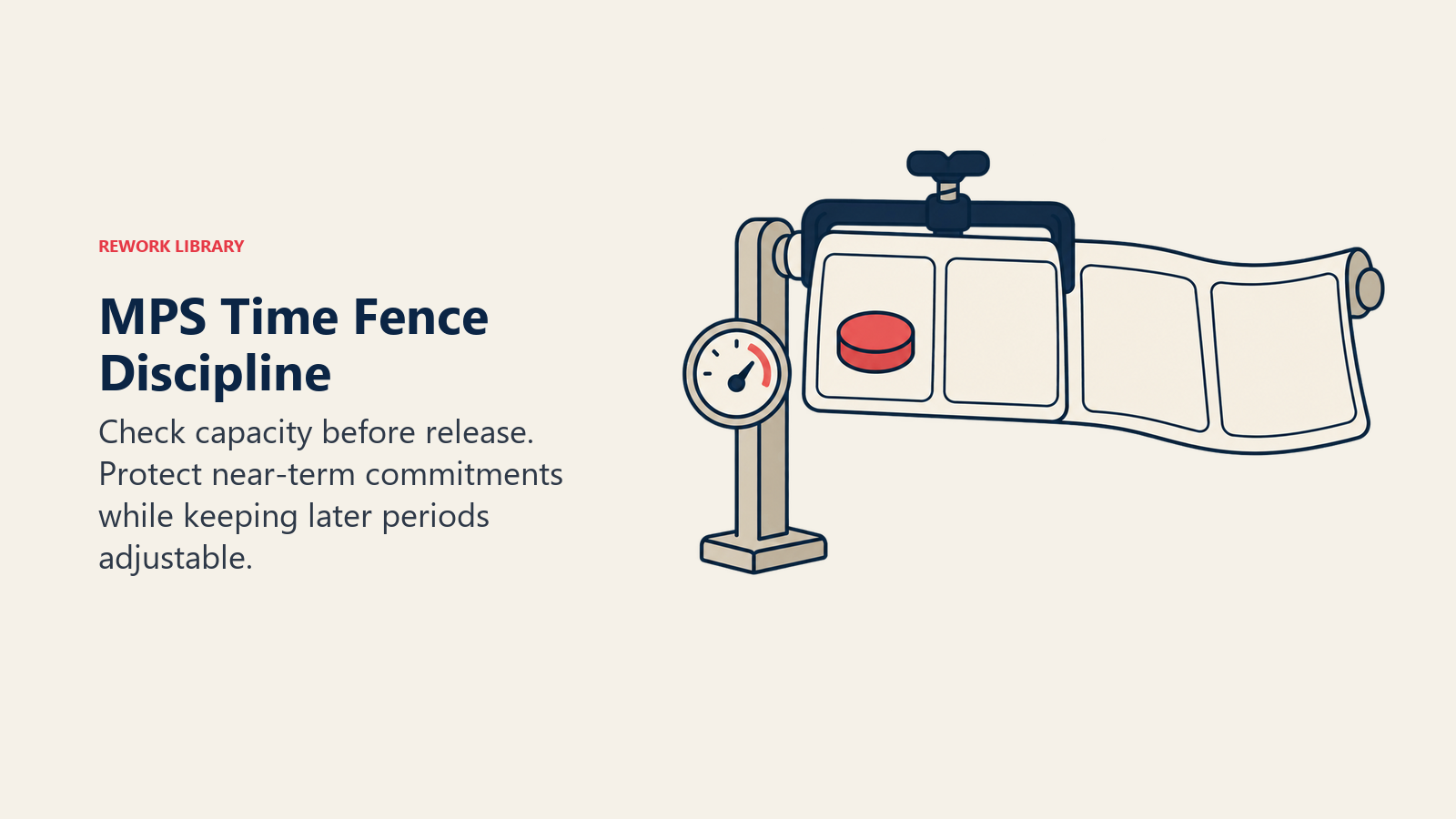
Time fences divide the planning horizon into zones with different change rules. The demand time fence (typically 4-8 weeks) separates order-driven from forecast-driven periods. The planning time fence (typically 2-4 weeks) separates flexible from frozen schedules.
Within the frozen zone, changes require senior approval and potentially customer negotiations. This stability enables reliable execution. Outside the frozen zone, planners adjust schedules as demand and supply conditions change.
Time fences prevent chaos from constant schedule changes. They force discipline: either make schedule changes early when they're easy and inexpensive, or don't make them at all. This discipline transforms planning from reactive firefighting to proactive management.
Schedule Maintenance: Keeping MPS Realistic
MPS isn't created once and forgotten. It requires continuous maintenance to remain realistic and actionable as conditions change.
Change Management Protocols
Changes fall into categories requiring different handling. Minor changes (quantities within 10%, timing within frozen zone) might flow through automatically. Major changes (product mix shifts, capacity impacts) require analysis and approval. Emergency changes (quality holds, equipment failures) trigger formal exception processes.
Document change reasons and impacts. This audit trail reveals whether changes stem from preventable problems (poor forecasting, inadequate communication) or genuine market volatility. You can improve preventable problems. You must buffer against volatility.
Measure schedule stability through metrics like: percentage of schedule changed within frozen zone, average magnitude of quantity changes, frequency of due date changes. Declining stability indicates planning problems requiring attention.
Exception Handling
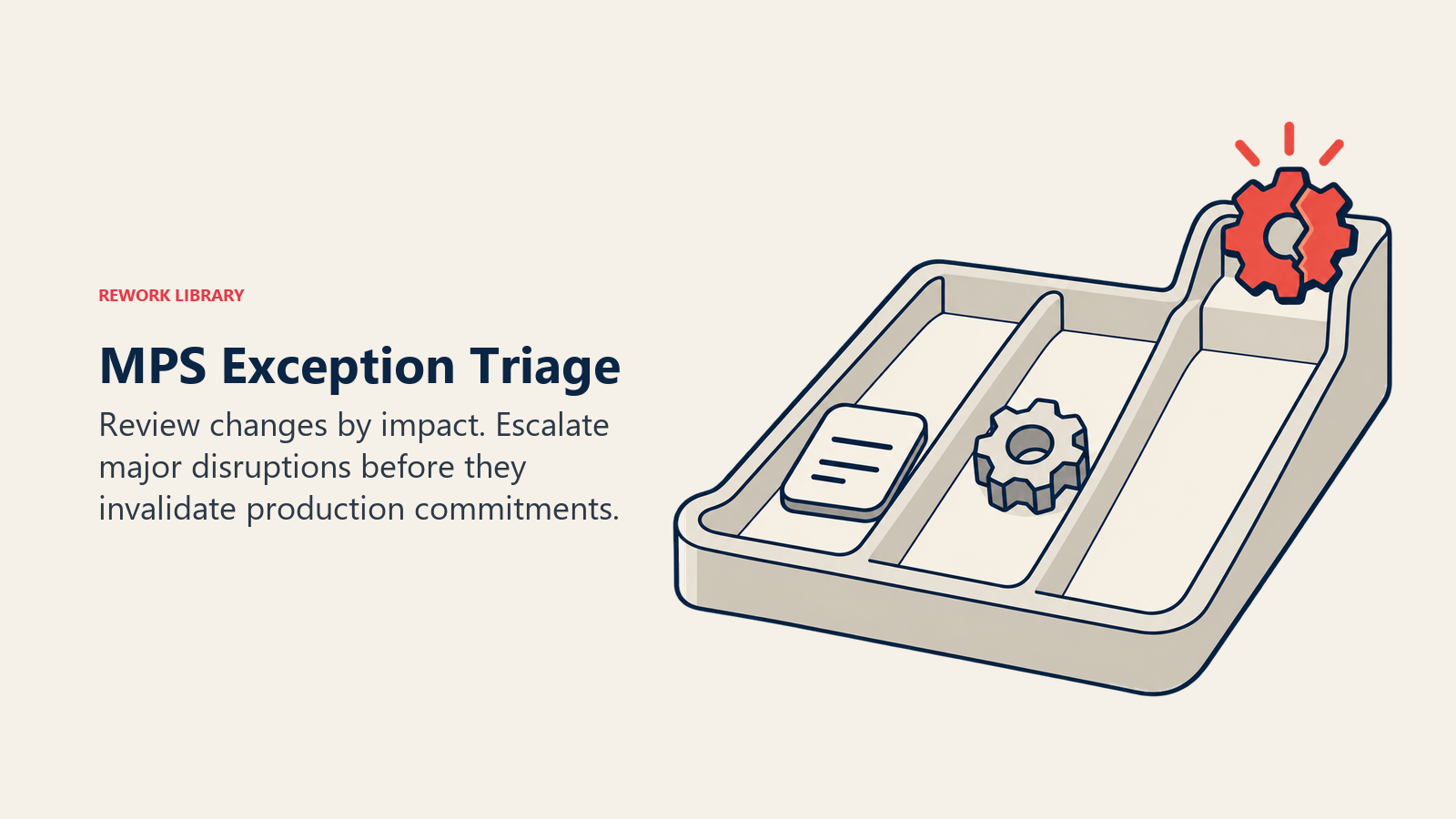
Exceptions occur when actual conditions deviate from planned: supplier delays material deliveries, equipment breaks down, quality issues scrap production, customers cancel or change orders. Each exception potentially invalidates MPS and requires replanning.
Create exception categories with standard responses. Minor exceptions (small quantity variations, single-day delays) might not require MPS changes. Moderate exceptions trigger planner review within 24 hours. Major exceptions escalate immediately with formal impact assessment.
Use exception management software to flag problems automatically rather than relying on planners to discover issues. Systems should alert when: inventory drops below safety stock, lead times exceed planned, capacity utilization exceeds thresholds, customer orders can't be met from ATP.
Performance Metrics
Track MPS performance to identify improvement opportunities. Key metrics include:
Schedule achievement: percentage of MPS quantities produced as planned. World-class is 95%+. Below 90% indicates either unrealistic scheduling or execution problems. Review manufacturing KPIs to measure planning effectiveness.
Forecast consumption: how accurately does actual demand match forecasted demand? High forecast errors force frequent MPS changes. Improving forecasts stabilizes schedules.
ATP accuracy: do ATP promises match actual delivery capability? If sales frequently can't deliver what ATP indicated was available, ATP calculations or inventory accuracy have problems.
Time fence violations: how often do changes occur within frozen zones? Frequent violations indicate inadequate planning horizons or unrealistic time fence policies.
Best Practices: MPS Excellence Factors
Achieving MPS excellence requires technical competence plus organizational discipline. The technical aspects are learnable. The discipline is harder.
Data Accuracy Requirements
MPS depends on accurate data. Bill of materials errors generate incorrect material requirements. Inventory record errors misstate what's available. Lead time errors create wrong timing. With 95%+ data accuracy, MPS works well. Below 90% accuracy, it fails. Strong inventory management systems maintain data accuracy.
Implement cycle counting to maintain inventory accuracy. Establish engineering change control to keep BOMs current. Update lead times quarterly based on actual performance. Audit data quality monthly and fix errors immediately.
Cross-Functional Collaboration
MPS requires inputs from multiple functions: sales provides demand, operations provides capacity status, purchasing confirms material availability, engineering provides BOMs and routings. Without collaboration, planners guess and create unrealistic schedules.
Establish weekly planning meetings bringing these functions together. Review upcoming schedules, identify issues, and resolve collaboratively. This prevents surprises and builds shared ownership of the plan.
Formal S&OP Process
Sales and Operations Planning provides the aggregate framework within which MPS operates. S&OP balances demand and supply monthly at family levels, resolves major disconnects, and sets direction for detailed planning.
MPS should never contradict S&OP decisions. If S&OP says produce 10,000 units of Family A, MPS shouldn't schedule 15,000 without S&OP approval. This discipline prevents planners from creating commitments that exceed agreed capacity.
System Configuration
Configure planning systems appropriately: realistic lead times, proper planning time fences, correct ATP logic, and appropriate lot sizing rules. Poor configuration creates schedules that look sensible in the system but fail in reality.
Review system parameters quarterly. Lead times change as processes improve. Lot sizes should adjust as volumes grow. Planning horizons might extend as business matures. Keep configuration current with operational reality.
Learn More
Deepen your MPS expertise with these resources:
- Production Planning Fundamentals provides the planning foundation for MPS
- Capacity Planning Strategy explains capacity analysis supporting MPS
- Demand Forecasting for Manufacturing improves demand inputs to MPS
- Material Requirements Planning shows how MRP uses MPS outputs
- Manufacturing Business Models explains how MPS varies by business model
- On-Time Delivery Performance measures MPS effectiveness
- Customer Order Management integrates with MPS processes
MPS as the Heart of Manufacturing Planning
Master production scheduling is where planning meets reality. It's where forecast probabilities become production commitments. It's where capacity constraints force prioritization. It's where material availability limits possibilities.
Great MPS creates credible plans that operations execute reliably and sales promises confidently. Poor MPS creates chaos, stress, and disappointment. The difference isn't complex math or sophisticated software. It's discipline: realistic schedules, accurate data, collaborative planning, and controlled changes.
Build that discipline systematically. Start with accurate data and simple processes. Add sophistication as you master fundamentals. Involve all stakeholders in creating and maintaining schedules. And enforce time fence discipline that prevents destabilizing changes.
That discipline transforms MPS from administrative burden into competitive advantage. It enables reliable delivery, efficient operations, and customer confidence. Those capabilities drive growth more effectively than any marketing campaign or price discount.
