Smart Factory Implementation: Building the Connected Manufacturing Operation
Turn this article into takeaways for your work.


Each assistant summarizes the article only for you and suggests best practices for your work.
Traditional factories operate largely blind. Machines run until they break. Quality problems surface during inspection, after producing scrap. Production schedules adjust manually when disruptions occur. Workers make decisions based on experience rather than real-time data. This reactive approach wastes resources, misses optimization opportunities, and struggles with complexity.
Smart factories transform operations through connectivity and intelligence. Equipment reports its own status and predicts maintenance needs. Quality systems inspect every unit in real-time, stopping production at the first defect. Scheduling systems adapt automatically to disruptions. Workers receive data-driven guidance for optimal actions through Industry 4.0 technologies. The factory monitors itself, optimizes continuously, and responds autonomously to changing conditions.
But the gap between vision and reality intimidates many manufacturers. How do you connect decades-old equipment? Where do you start when every system needs upgrading? How do you justify investments when benefits seem abstract? Smart factory implementation requires systematic approaches that deliver value incrementally while building toward comprehensive transformation. Understanding the architecture, implementation phases, and practical applications enables strategic progress rather than random technology experiments.
Smart Factory Architecture
Smart factory systems organize into layers, each providing specific capabilities while enabling higher-level intelligence.
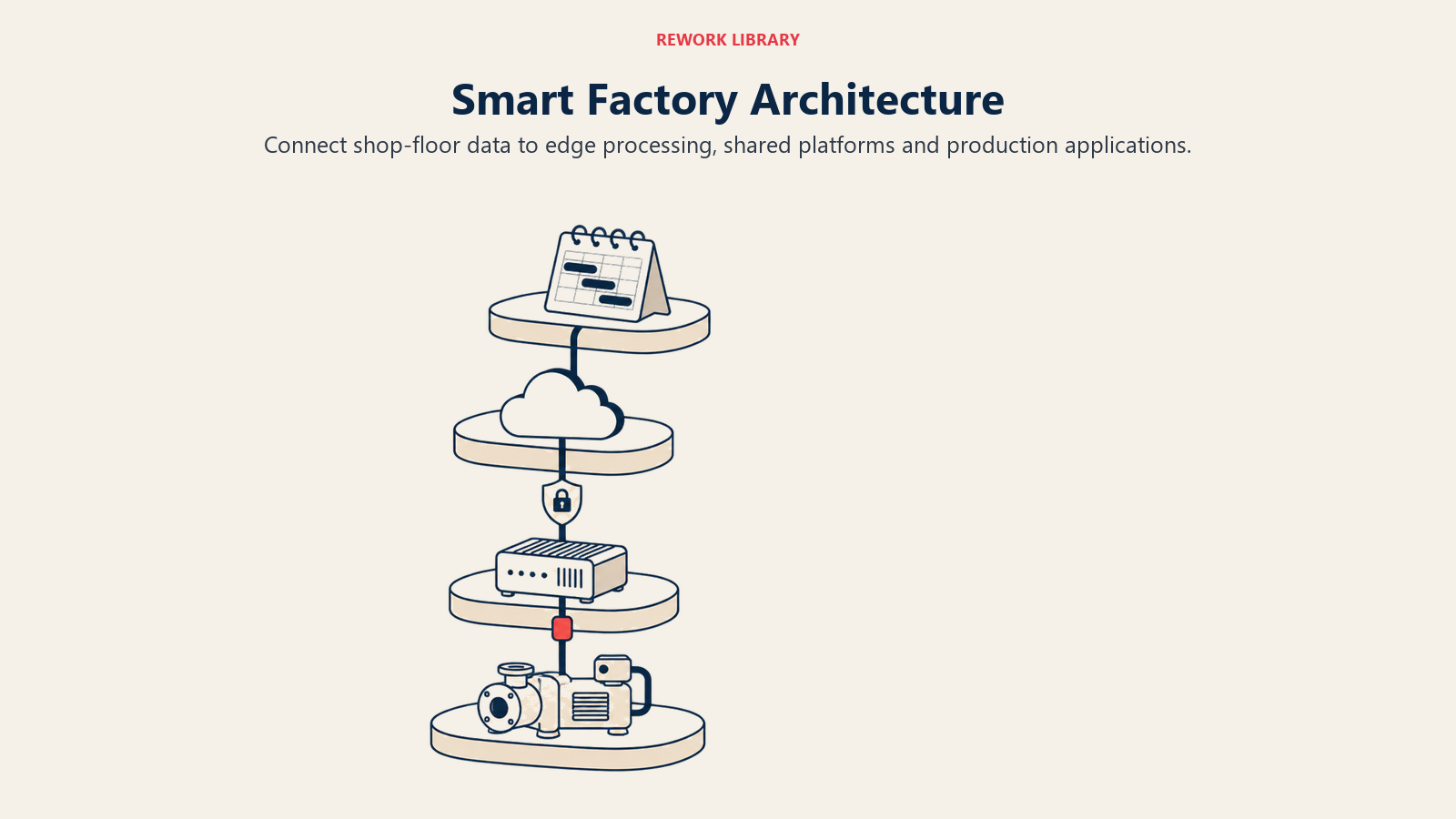
The shop floor connectivity layer instruments equipment with sensors and connects controllers generating continuous data streams. Sensors monitor temperature, vibration, pressure, position, and power consumption. Programmable Logic Controllers (PLCs) provide equipment control. Supervisory Control and Data Acquisition (SCADA) systems aggregate data from multiple controllers. This layer creates digital visibility into physical operations that were previously opaque.
Connectivity comes through various technologies depending on equipment age and requirements. Modern equipment often includes built-in connectivity using industrial Ethernet protocols like PROFINET or EtherNet/IP. Legacy equipment requires retrofitting with sensors and communication adapters. Wireless technologies like industrial WiFi or 5G suit applications where wiring is impractical. The goal is comprehensive connectivity. every relevant process variable captured digitally.
The edge computing layer processes data near generation points for low-latency applications requiring immediate response. Edge devices filter raw sensor data, extracting meaningful information before sending to cloud systems. They run analytics for real-time control. detecting quality issues requiring immediate production stops, or adjusting process parameters for optimal performance. Edge computing balances cloud analytics' power with control systems' speed requirements.
The cloud platform layer provides scalable data storage and processing power for enterprise-wide analytics. Historical data from all facilities accumulates in data lakes supporting cross-facility analysis. Machine learning models train on cloud infrastructure's massive compute resources. Enterprise dashboards aggregate information from multiple plants. Cloud enables capabilities impossible with on-premise systems alone while supporting remote access and collaboration.
The application layer delivers insights and actions through Manufacturing Execution Systems (MES), ERP for manufacturing, analytics platforms, and specialized applications. MES orchestrates production, tracks materials, and records quality data. ERP integrates manufacturing with business systems. Analytics applications provide predictive maintenance, quality analytics, and optimization recommendations. These applications turn raw connectivity into business value.
Security architecture protects connected systems from cyber threats. Network segmentation isolates control systems from enterprise networks and internet. Firewalls control traffic between zones. Access controls limit system access to authorized users. Intrusion detection monitors for suspicious activity. Security updates patch vulnerabilities. Industry 4.0 connectivity creates attack surfaces requiring proactive security measures.
Implementation Phases
Smart factory transformation happens through stages, each delivering value while enabling subsequent advances.
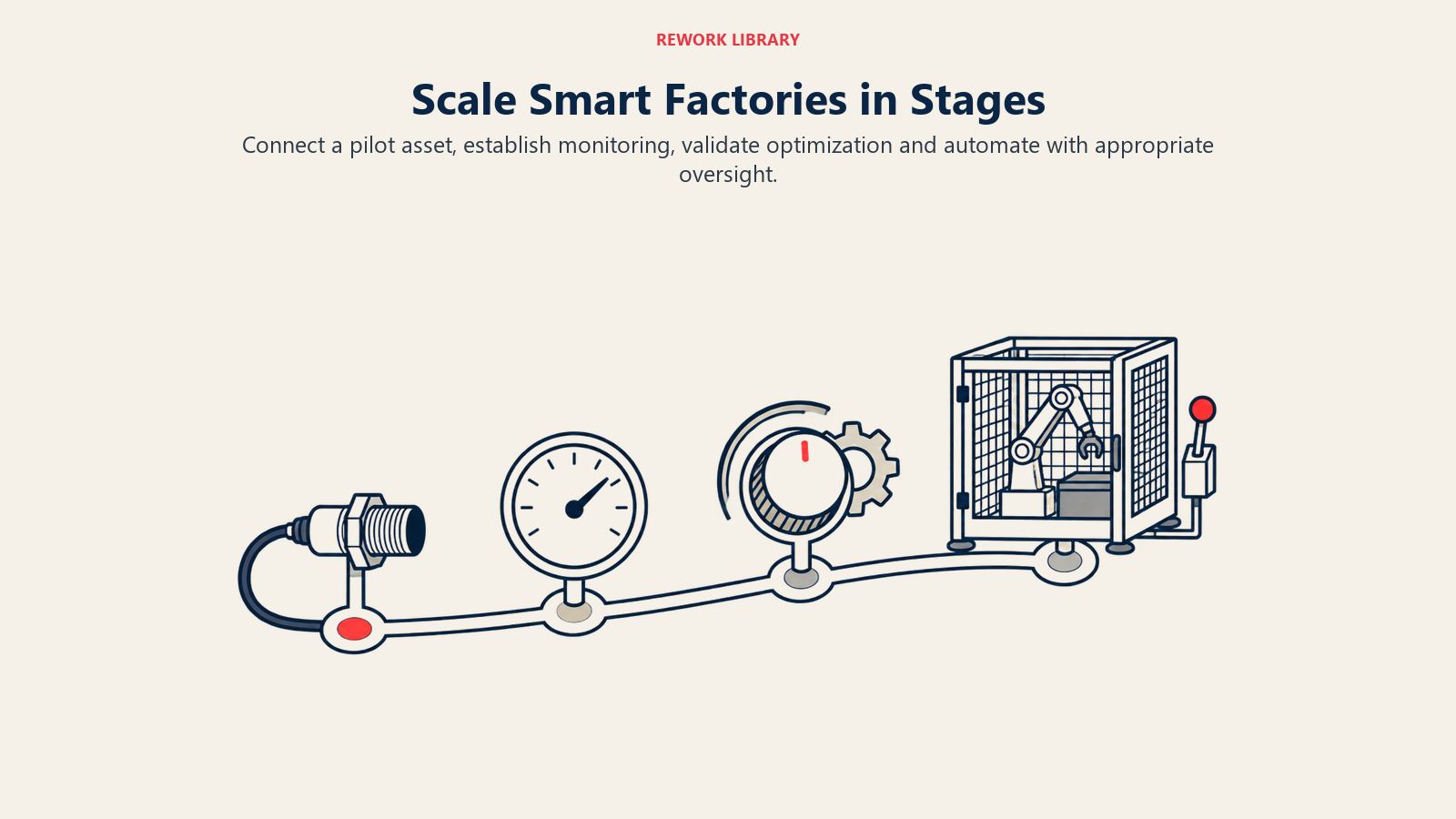
Phase 1 focuses on connecting equipment and establishing data collection. Install sensors on critical equipment lacking instrumentation. Connect machines' PLCs to data collection systems. Establish data infrastructure storing and organizing information. Implement basic visualization showing equipment status and production metrics. This foundation enables higher-level applications but delivers immediate value through visibility previously lacking.
Starting with pilot equipment reduces risk while proving concepts. Select high-value equipment where problems are most painful. bottleneck operations, quality-critical processes, or maintenance-intensive assets. Success on pilots builds confidence and organizational capability for broader deployment. Don't attempt to connect everything simultaneously.
Phase 2 implements monitoring delivering real-time visibility into operations. Production dashboards show current output, downtime reasons, quality metrics, and equipment status. Automated alerts notify personnel of abnormal conditions requiring intervention. Historical trending identifies patterns in performance, quality, and equipment health. Monitoring converts data into actionable information driving better decisions.
Dashboards should serve different audiences. Shop floor displays show operators their equipment's real-time status. Supervisor dashboards aggregate line or cell performance. Plant manager dashboards show facility-wide metrics. Executive dashboards provide high-level KPIs across enterprise. Right information to right people at right time drives appropriate actions.
Phase 3 applies optimization using analytics to improve performance. Statistical analysis identifies optimal process parameters. Predictive models forecast quality, yield, or energy consumption. Machine learning discovers patterns humans miss in complex data. Optimization recommendations guide decisions improving outcomes. Analytics turn monitoring data into improvement opportunities.
Start with specific use cases having clear business value. Predictive maintenance on critical equipment. Quality prediction preventing scrap. Energy optimization reducing costs. Schedule optimization improving throughput. Each use case proves analytics value while building organizational capability for more sophisticated applications.
Phase 4 enables automation where systems make decisions and take actions autonomously. Predictive maintenance automatically schedules interventions. Quality systems stop production at first defect. Adaptive scheduling adjusts to disruptions without human intervention. Autonomous material handling moves products based on real-time needs. This represents the smart factory vision. autonomous operations requiring minimal human oversight.
Automation progresses gradually as confidence builds. Start with supervised automation where systems recommend actions for human approval. Progress to automated actions for routine situations with human override capability. Eventually reach full autonomy for well-understood processes while maintaining human oversight of exceptions.
High-Value Use Cases
Specific applications demonstrate smart factory value through measurable business impact.
Real-time production monitoring provides visibility enabling faster problem response and better decision-making. Track Overall Equipment Effectiveness (OEE) in real-time by line, shift, or product. Identify downtime causes immediately rather than days later. Compare performance across shifts, lines, or facilities. This visibility alone improves performance 5-10% as issues get addressed faster and accountability increases.
Automated quality inspection using computer vision detects defects human inspectors miss while inspecting 100% of production at line speed. Vision systems identify scratches, dents, color variations, dimensional errors. They never fatigue or lose concentration. Integration with control systems stops production at first defect rather than after producing scrap batches. Quality improvements of 20-50% defect reduction are common.
Predictive maintenance shifts from reactive repair to scheduled interventions preventing failures. Vibration analysis predicts bearing wear. Thermal imaging shows electrical issues developing. Power consumption patterns indicate mechanical problems. Analytics combine these signals predicting failures weeks in advance. Maintenance happens during planned windows rather than emergency situations, reducing downtime 30-50%.
Adaptive scheduling and routing optimizes production planning dynamically rather than following static schedules. When equipment fails, systems automatically reroute to alternative resources. When rush orders arrive, systems reoptimize schedules balancing priorities. When quality issues surface, affected products get tracked and quarantined automatically. This flexibility improves delivery performance while reducing inventory.
Energy management monitors consumption at equipment level, identifying waste and optimizing usage. High-consumption equipment gets scheduled during off-peak rate periods when possible. Inefficient operations get flagged for investigation. Compressed air leaks get detected through pressure monitoring. Lighting and HVAC adjust based on occupancy and ambient conditions. Energy savings of 10-20% reduce both costs and environmental impact.
Technology Integration Challenges
Connecting diverse systems creates technical challenges requiring strategic solutions.
OT/IT convergence merges operational technology (shop floor systems) with information technology (enterprise systems) that historically operated independently with different priorities. OT prioritizes reliability and real-time performance. IT emphasizes security and standardization. Converging these worlds requires understanding both domains' requirements and finding architectures satisfying both.
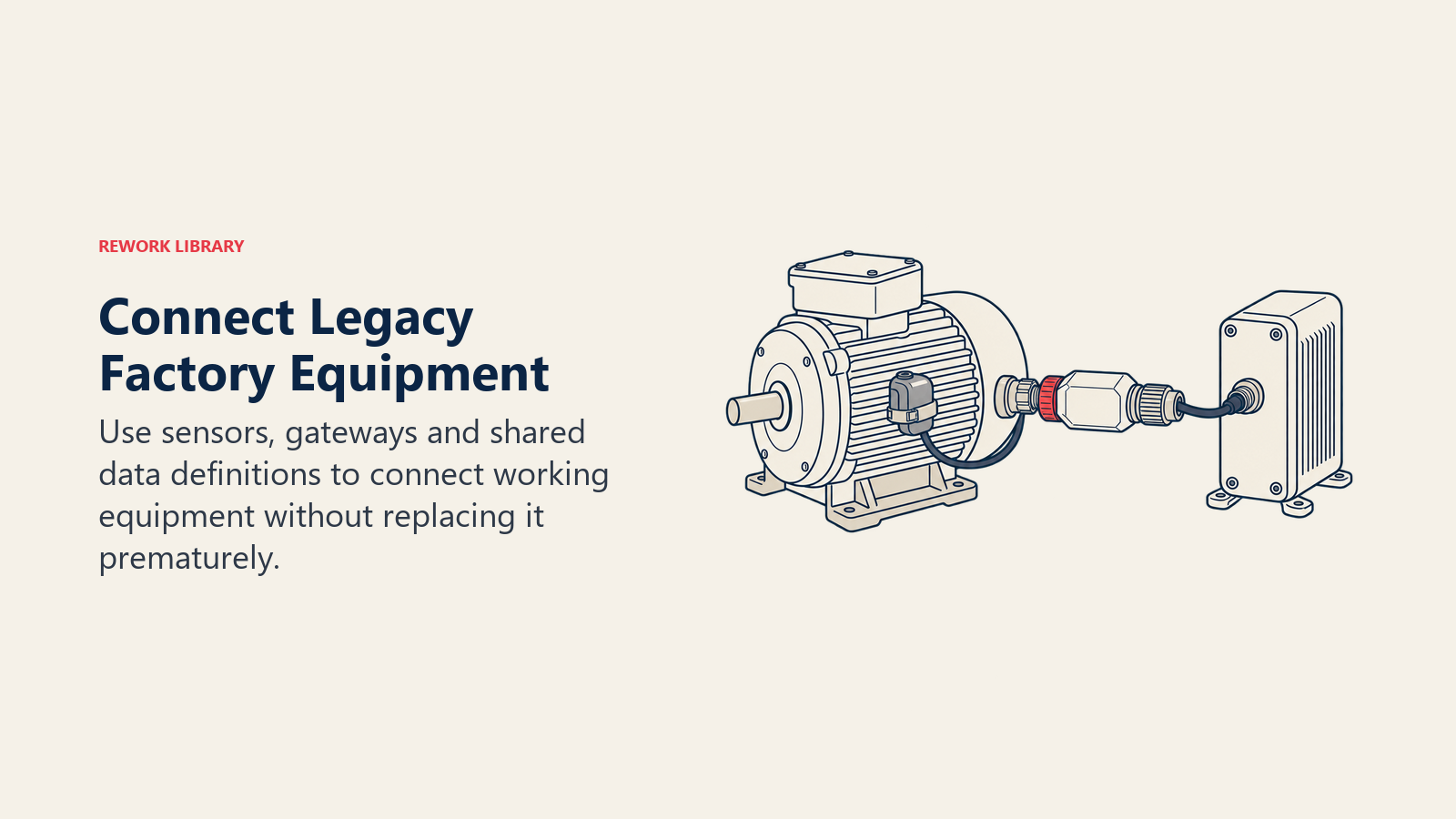
Legacy equipment integration presents specific challenges. Equipment decades old lacks modern connectivity. Proprietary protocols prevent communication with other systems. Documentation might not exist for programming and configuration. Retrofit strategies include installing sensors and edge devices that translate between old equipment and modern systems. Sometimes middleware provides protocol translation. The goal is practical connectivity without replacing functional equipment prematurely.
Data standardization enables meaningful analysis across diverse equipment. Different machines might use different units, naming conventions, and data structures for the same concept. ISA-95 and OPC UA provide industry standards for manufacturing data. Adopting standards simplifies integration and enables vendor-neutral solutions. Invest time in data modeling and standardization early. it's harder to fix later.
API and integration platforms connect applications without custom point-to-point integrations. APIs provide standard interfaces for accessing data and functions. Integration platforms orchestrate data flows between systems. These approaches reduce integration complexity and maintenance burden as system counts grow. Modern integration architectures are essential for sustainable smart factory ecosystems.
People and Change Management
Technology enables smart factories, but people determine whether implementations succeed or fail.
Skills development prepares workforce for new responsibilities. Operators need data literacy to interpret dashboards and respond to analytics insights. Maintenance technicians need digital troubleshooting skills complementing mechanical expertise. Engineers need capabilities in data analysis, simulation, and machine learning. Training programs, partnerships with educational institutions, and selective hiring build needed competencies.
New roles emerge in smart factories. Data analysts interpret production data and develop analytics models. Integration specialists connect diverse systems. Digital manufacturing engineers simulate and optimize processes. These roles didn't exist in traditional manufacturing but prove essential in digital operations. Workforce planning must account for these new requirements.
Adoption and training programs help personnel embrace new systems rather than resisting change. Hands-on training with actual systems beats classroom lectures. Mentoring pairs experienced workers with early adopters. Success stories showcase benefits to workers, not just management. Address concerns about job security openly. smart factories need people, just in different roles.
Cultural change from intuition-based to data-driven decision-making proves challenging. Experienced personnel might resist analytics contradicting their judgment. Management must reinforce that data complements rather than replaces experience while holding people accountable for using available information. Leading indicators include questions like "What does the data show?" becoming routine in discussions.
Building the Business Case
Smart factory investments require clear financial justification despite intangible benefits.
ROI calculation should include multiple benefit categories. Productivity improvements from reduced downtime and higher throughput. Quality improvements reducing scrap and rework. Energy savings lowering operating costs. Inventory reductions from better planning. Maintenance cost reductions through predictive approaches. Quantify each category separately, then aggregate for total return.
Quick wins demonstrate value quickly, building support for longer-term initiatives. OEE dashboards showing real-time performance. Predictive maintenance on single critical asset. Quality monitoring for high-scrap product. These focused pilots deliver ROI within months rather than years, proving smart factory value to skeptics.
Strategic benefits complement financial returns. Flexibility to handle product mix changes. Responsiveness to customer demands. Quality consistency building brand reputation. Competitive differentiation through capabilities competitors lack. These strategic advantages might justify investments even where pure financial returns are marginal.
Learn More
