New Product Introduction (NPI) in Manufacturing: From Prototype to Production Excellence
Turn this article into takeaways for your work.


Each assistant summarizes the article only for you and suggests best practices for your work.
An electronics manufacturer launched a promising new product six months late, 40% over cost target, and with a first-pass yield of 65%. By the time they fixed the issues, competitors had filled the gap and the market window had closed. The post-mortem revealed a familiar story: engineering designed in isolation, manufacturing got involved too late, suppliers couldn't meet specifications, and nobody validated the process before committing to production.
Most new product launches miss at least one target: timing, cost, or quality. According to research, as many as 95% of new products fail, highlighting the importance of systematic processes. The rare launches that hit all three targets don't happen by accident. They result from systematic NPI processes that engage manufacturing early, validate thoroughly, and ramp deliberately. The difference between successful launches and troubled ones isn't luck. It's process discipline and cross-functional collaboration.
The NPI Challenge
New product introduction sits at the intersection of speed and risk. Markets reward fast launches. Customers want innovation. Competitors move quickly. Pressure to launch fast is intense. But rushing through NPI creates problems that take months to fix and damage customer relationships permanently.
Engineering wants to optimize designs for performance and features. Manufacturing needs designs that can be made consistently at target cost. Quality requires stable processes that deliver reliable products. Supply chain needs lead time to qualify vendors and secure materials. Sales wants products now to hit revenue targets. These competing pressures collide during NPI.
Most NPI problems stem from poor handoffs and late involvement. Engineering completes designs and throws them to manufacturing. Manufacturing discovers the designs can't be made economically and requests changes. Engineering resists because changes delay launch. Quality identifies risks nobody addressed during design. Suppliers reveal they can't meet specifications. The project spirals while everyone points fingers.
Successful NPI integrates these perspectives early rather than sequentially. Manufacturing reviews designs during development, not after completion. Quality performs failure mode analysis before committing to production processes. Supply chain evaluates vendor capability during design, not after release. Early integration finds problems when they're cheap to fix. Late integration finds them when they're expensive disasters.
NPI Stage Framework
Effective NPI follows a stage-gate process that builds confidence through progressive validation. Each stage answers specific questions and achieves measurable milestones before advancing. This discipline prevents advancing unready designs to production.
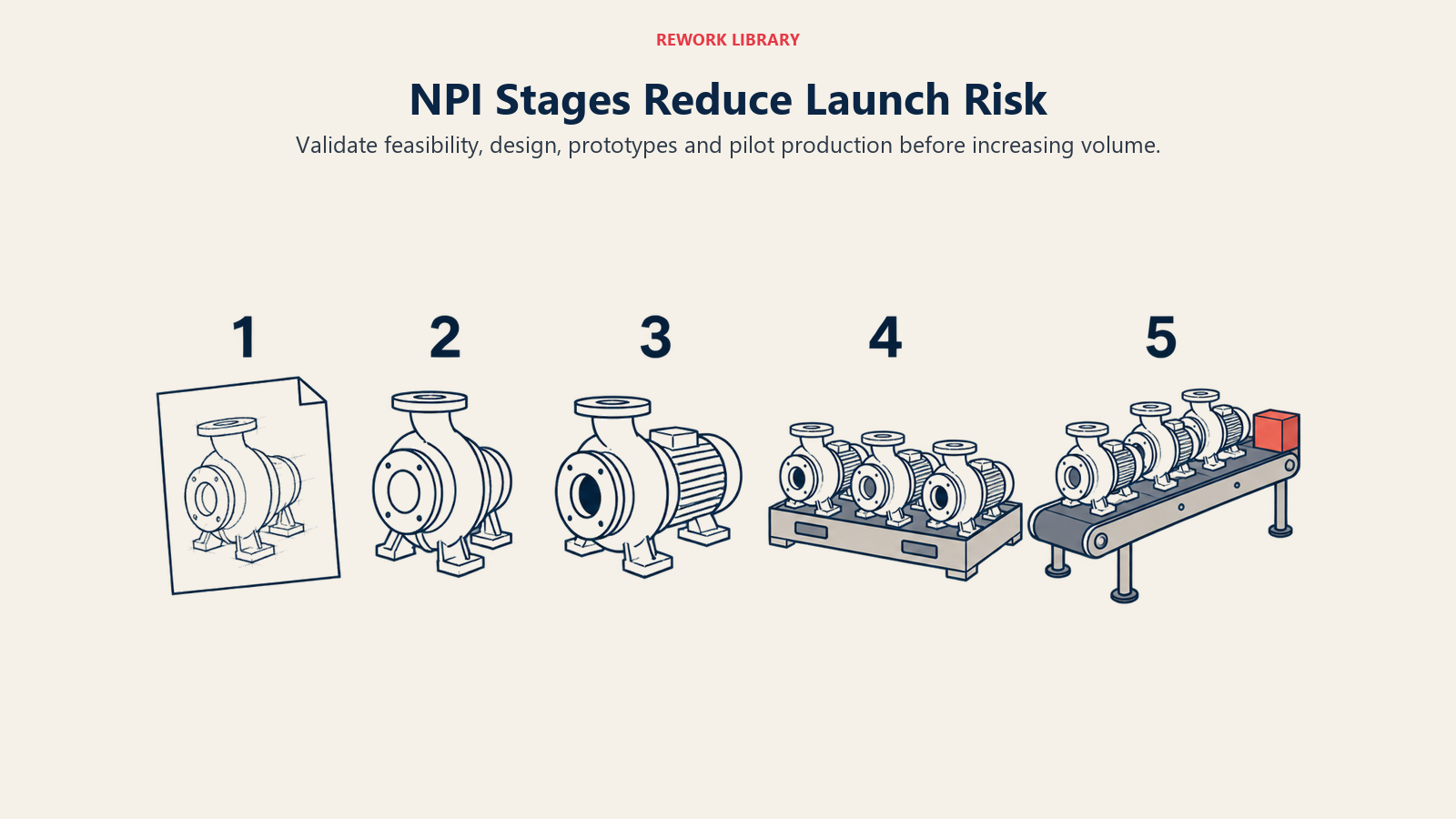
Concept phase establishes feasibility. Can this product be made at target cost? Do technologies exist to meet performance requirements? Are materials available? Can you source critical components? Early manufacturing involvement during concept prevents pursuing infeasible designs. Better to kill concepts early than discover fundamental problems during launch.
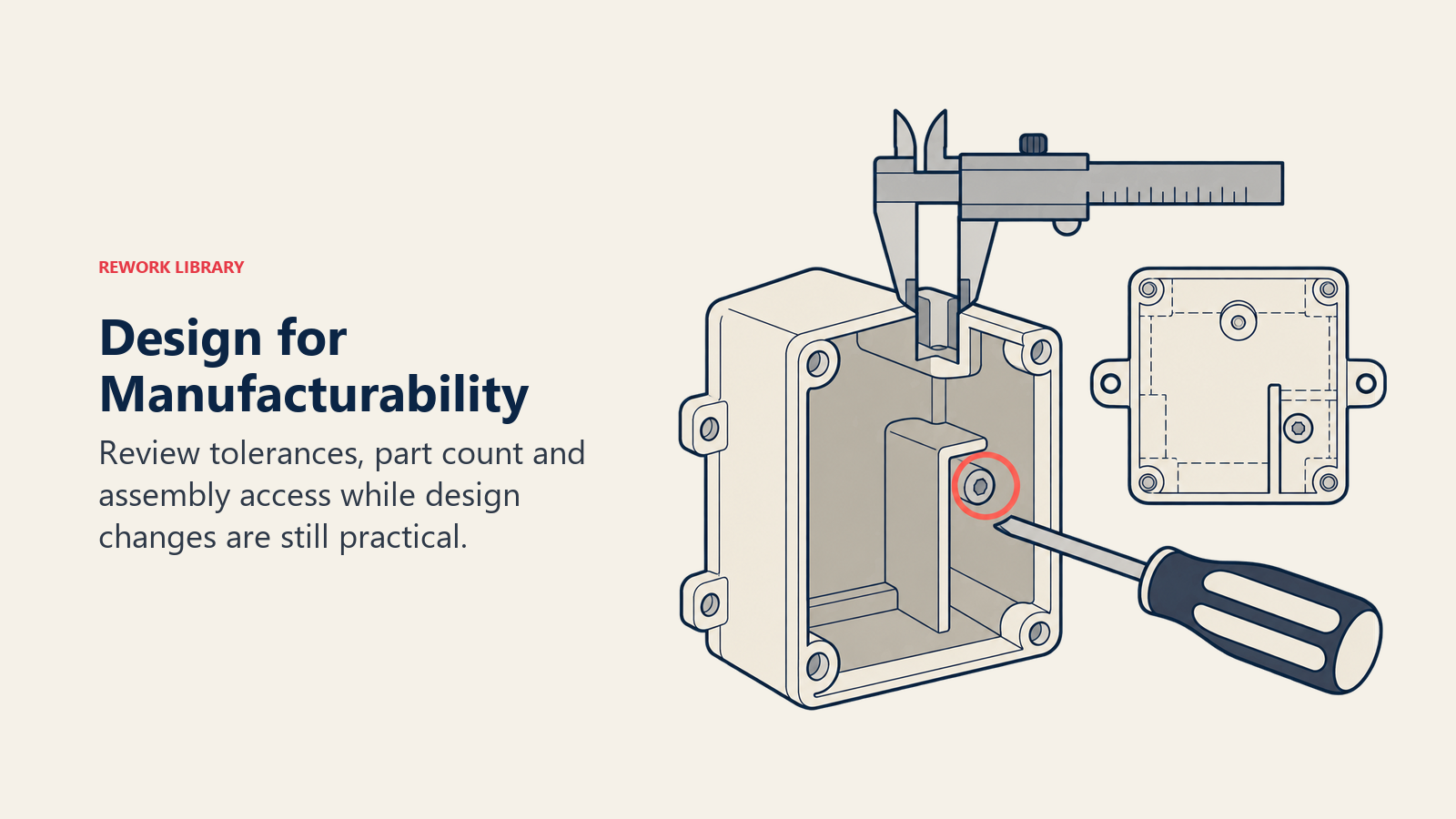
Design phase translates concepts into detailed specifications. Design for manufacturability (DFM) reviews identify features that complicate production, create quality risks, or drive costs. Simple design changes at this stage eliminate problems that would require expensive workarounds in production. Tolerances that can't be held economically get relaxed where function allows. Assembly sequences get simplified. Part counts get reduced.
Prototype phase validates that designs work as intended. But manufacturing shouldn't just build prototypes to engineering specifications. Prototypes should use intended production processes, materials, and suppliers as much as possible. Prototypes made with lab processes and hand-fitting don't predict production reality. Prototypes that approximate production reveal problems before they become production crises.
Pilot production bridges prototypes and full production. Make 50-500 units using production processes, equipment, and materials. This validates process capability, identifies quality risks, and trains operators. Pilot production should uncover problems. That's its purpose. Better to find issues making 100 units than discovering them at 10,000 units.
Production ramp increases volume gradually while monitoring quality and cost. Don't jump from pilot to full volume. Ramp 20% of capacity, then 50%, then 80%, then 100%. This staged ramp reveals problems that only appear at volume: material variation, operator consistency, equipment limitations. Problems found during ramp get fixed before they affect major production volumes.
Critical Success Factors
Certain practices separate successful NPIs from troubled ones. These aren't optional extras for sophisticated companies. They're fundamental practices that determine whether launches succeed or fail.
Early manufacturing involvement prevents designing products that can't be made efficiently. Manufacturing engineers should sit in design reviews, comment on drawings, and influence material selections. Research on NPI best practices emphasizes that early collaboration among cross-functional teams can streamline the process and accelerate time to market. This isn't interference. It's essential input that improves outcomes. Products designed with manufacturing input reach production faster and cheaper than products designed in isolation.
Design for manufacturability (DFM) analyzes designs specifically for production implications. How many operations does assembly require? Can critical dimensions be held with standard processes? Do parts have features that cause handling problems? Are tolerances tighter than necessary? DFM reviews find dozens of improvements that simplify production, reduce costs, and improve quality.
Supplier development happens in parallel with product development. Identify critical suppliers early. Share specifications while they're still draft. Get supplier feedback on feasibility. Qualify suppliers and validate their capability before launch. Waiting until design is frozen to engage suppliers creates delays and risks discovering they can't deliver.
Process validation proves that production processes can consistently meet requirements. This means capability studies on critical dimensions, validation of yields and cycle times, and confirmation that equipment can hold tolerances. Assumptions about process capability lead to surprises. Validation provides confidence based on data.
Production readiness assessment uses objective criteria to determine if manufacturing is ready for launch. Are operators trained? Is equipment validated? Are materials qualified? Are quality systems in place? Is capacity sufficient? A formal readiness scorecard prevents launching based on pressure and hope rather than preparation and evidence.
Managing the NPI Team
NPI requires coordinated effort across engineering, manufacturing, quality, supply chain, and operations. Without clear governance and communication, projects drift, decisions get delayed, and problems fester.
Project leadership should reside with one accountable person. Cross-functional teams provide essential input, but committees can't drive decisions. Someone needs authority and accountability for delivering the launch on time, at cost, with quality. This is often a program manager role that coordinates without directly controlling all resources.
Regular structured meetings maintain momentum and surface issues early. Weekly core team meetings review progress, resolve blocking issues, and adjust plans. Monthly executive reviews ensure leadership stays informed and provides resources when needed. Ad hoc communication isn't sufficient. Structured cadence creates accountability.
Issue escalation processes ensure problems get resolved quickly. When the team can't resolve something, escalation paths should be clear and fast. Unresolved issues shouldn't linger in meeting notes for weeks. Define what warrants escalation, who has authority to decide, and timelines for resolution.
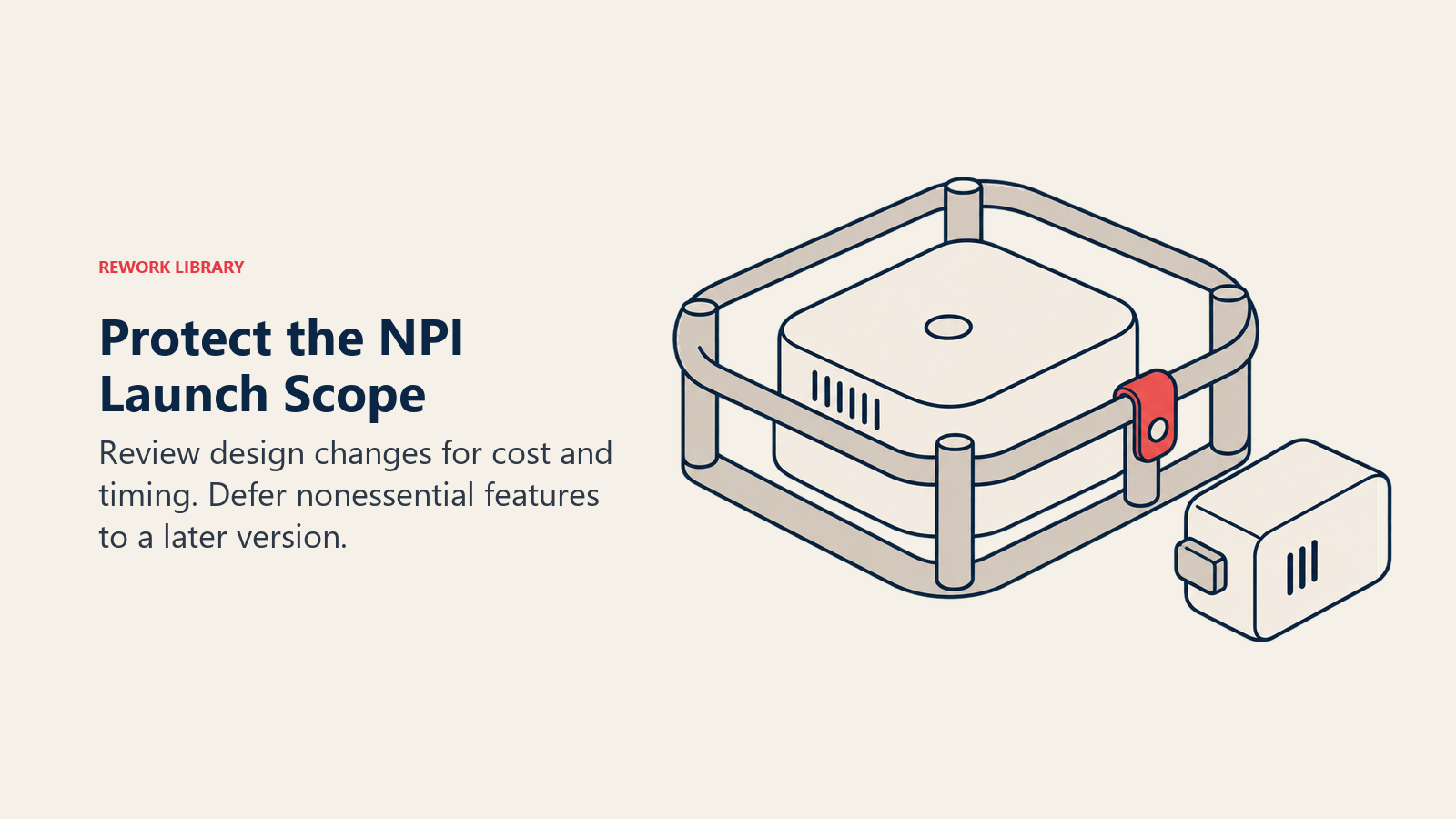
Change control balances flexibility with stability. Design changes during NPI are inevitable as learning occurs. But uncontrolled changes create chaos. Establish a change review process that evaluates impact, costs, and timing before approving modifications. Some changes are essential. Others can wait for next version. Distinguish between the two.
Technology and Tools
Modern NPI uses technology for simulation, collaboration, and knowledge capture. These tools don't replace good process, but they accelerate learning and reduce risks.
Product lifecycle management (PLM) systems provide single sources of truth for designs, specifications, and documentation. When everyone works from the current revision and can see change history, coordination improves. PLM prevents the confusion of multiple versions and conflicting information.
Digital twins simulate production before physical implementation. Virtual models of products and processes enable testing assembly sequences, identifying interferences, and optimizing workflows without building physical prototypes. This accelerates learning and reduces iteration costs.
Statistical tools support process validation and capability analysis. Control charts, capability studies, and designed experiments generate data showing whether processes can meet requirements. Gut feelings about capability get replaced by statistical confidence.
Collaboration platforms enable distributed teams to work together effectively. When engineering, manufacturing, and suppliers are in different locations, cloud-based collaboration tools provide shared visibility and communication. Video meetings, shared screens, and document collaboration reduce the coordination overhead of distributed teams.
Common Pitfalls
Certain mistakes appear repeatedly in troubled NPIs. Recognizing these patterns helps avoid them.
Optimistic scheduling assumes everything goes right. It never does. Build margin into timelines for equipment delays, startup issues, and unexpected problems. Aggressive schedules create pressure that leads to shortcuts. Realistic schedules with contingency enable thoughtful problem-solving.
Inadequate testing rushes products to market before validation is complete. The desire to launch fast tempts teams to skip testing or accept limited samples. This creates downstream quality problems that cost far more than thorough testing would have. Test adequately before launch. Fix problems found in testing. Don't ship hope.
Scope creep adds features or changes requirements during NPI. Each addition delays launch and increases risk. Protect scope aggressively. Features that can wait for version two should wait. Launching on time with committed features beats launching late with expanded scope.
Poor documentation creates confusion and prevents knowledge transfer. When only one person understands how something works, you're dependent on that person. Document processes, specifications, and decisions. Create work instructions and training materials. Transfer knowledge systematically.
Measuring NPI Performance
NPI effectiveness shows up in metrics. Track these to identify improvement opportunities and validate that process changes work.
Time to market measures how long products take from concept to full production. Industry benchmarks vary, but the trend matters most. Are you getting faster? Time to market determines how quickly you can respond to opportunities and competitive threats.
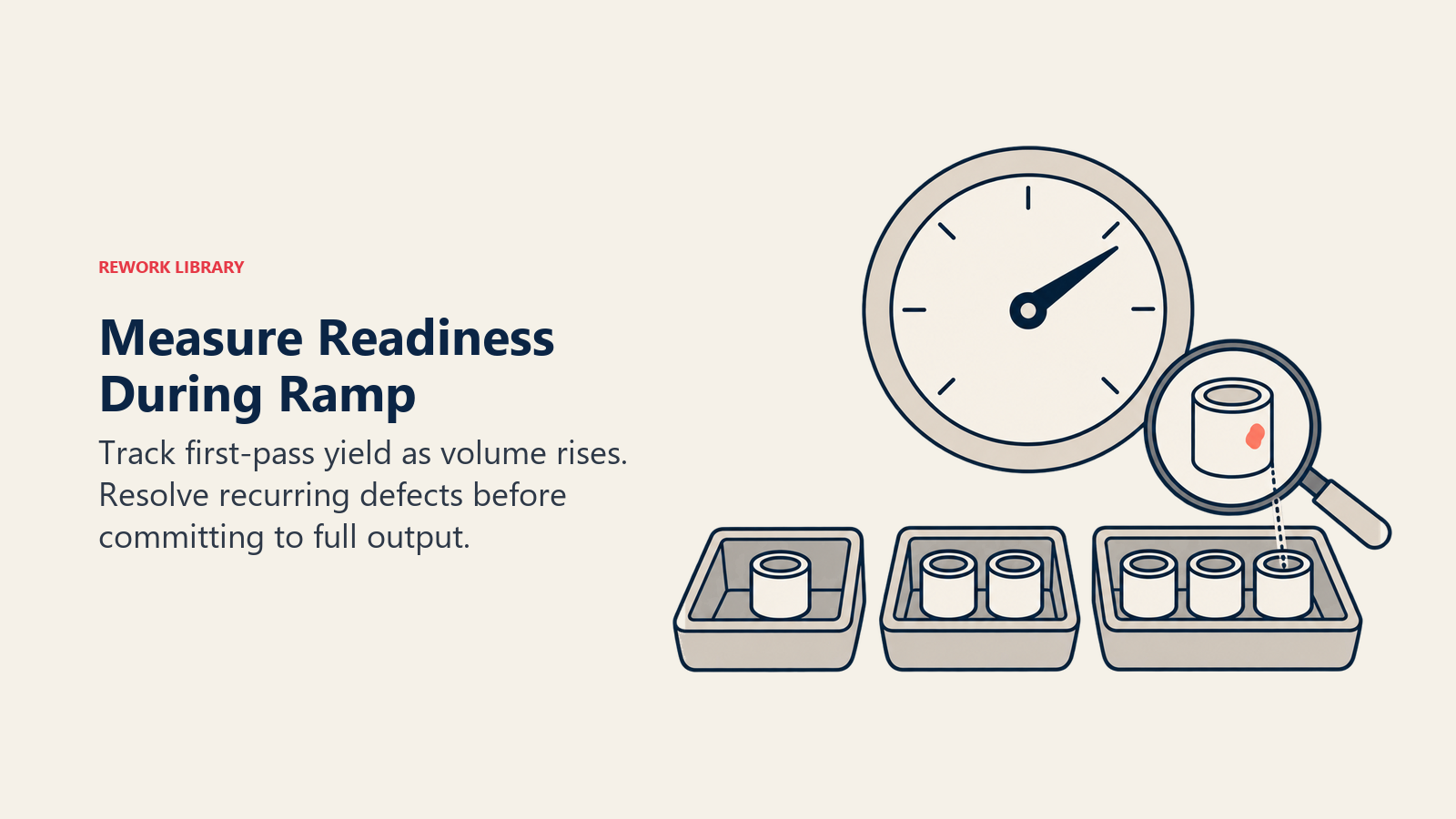
First-pass yield during pilot and ramp reveals process readiness. High yields indicate well-designed, validated processes. Low yields suggest rushing. Track yield progression through ramp. It should improve as learning occurs and issues get resolved.
Launch cost versus target shows financial discipline. Some overruns are justified by unforeseen requirements. Consistent overruns suggest poor estimation or inadequate cost management. Understanding variances improves future accuracy.
Design change rate after launch indicates design quality and NPI thoroughness. Some changes are inevitable as field experience accumulates. But frequent changes shortly after launch suggest inadequate validation. Products that reach production well-validated require fewer changes.
Customer quality metrics during launch reveal how products perform in use. Track defects, returns, and customer complaints for new products separately from mature products. Use this feedback to improve NPI processes for future launches.
Building NPI Capability
Companies that excel at NPI don't get lucky repeatedly. They build organizational capabilities through experience, learning, and continuous improvement.
Standardize NPI processes across products. Repeatable processes enable learning and improvement. Every launch shouldn't reinvent the wheel. Adapt standard processes to specific circumstances, but start with proven frameworks rather than blank sheets.
Conduct post-launch reviews for every NPI. What went well? What didn't? What would we do differently? Capture lessons learned while experiences are fresh. Share findings across the organization. Organizations that learn systematically get better. Those that don't repeat mistakes.
Develop cross-functional talent that understands both design and manufacturing. Engineers with production experience make better design decisions. Manufacturing engineers with design understanding contribute more effectively to DFM. Cross-train and rotate people to build these capabilities.
Invest in NPI infrastructure: simulation tools, prototyping equipment, pilot production facilities. Infrastructure enables thorough validation before committing to full production. The cost of infrastructure is modest compared to the cost of failed launches.
Moving Forward
New product introduction determines whether innovation creates value or destroys it. Fast launches with quality and cost problems hurt more than help. Slow launches that work perfectly miss market windows. The balance point (fast enough to capture opportunity, thorough enough to ensure success) comes from systematic NPI processes.
Don't treat NPI as project management with checklists. It's risk management through progressive validation. Each stage reduces uncertainty. Each gate confirms readiness before advancing. This discipline feels slow when you're eager to launch. But it's faster than fixing problems in production.
Engage manufacturing early and continuously. The later manufacturing gets involved, the more problems they'll find and the more expensive fixing them will be. Early involvement prevents problems. Late involvement discovers them. Prevention beats detection.
Invest in validation. Test thoroughly. Build pilots. Ramp gradually. Validate processes. These activities delay launch slightly but prevent disasters that delay it catastrophically. The manufacturers who skip validation don't launch faster. They just encounter problems later when they're harder to fix.
Excellence in NPI compounds over time. Each successful launch builds capability. Teams learn what works. Processes improve. The organization gets better at introducing products reliably. This capability becomes competitive advantage that competitors can't easily copy.
Learn More
