Total Productive Maintenance (TPM): Maximizing Equipment Reliability and Eliminating Unplanned Downtime
Turn this article into takeaways for your work.


Each assistant summarizes the article only for you and suggests best practices for your work.
A pharmaceutical manufacturer tracked their top three equipment failures over six months: bearing failures on agitator motors ($47,000 in lost production), pneumatic valve problems in filling lines ($38,000), and control system glitches ($29,000). Their maintenance team stayed busy responding to breakdowns, replacing failed components, and getting equipment back online as fast as possible.
But this reactive cycle never ended. The same equipment kept failing. Maintenance remained perpetually behind, lurching from crisis to crisis. Production blamed maintenance for poor reliability. Maintenance blamed production for running equipment too hard without proper care.
Then they implemented Total Productive Maintenance. Operators took ownership of daily equipment care and inspection. Maintenance focused on preventing failures rather than reacting to them. Teams attacked recurring problems systematically instead of patching symptoms. Within a year, unplanned downtime dropped 58%. The three chronic problems that had cost $114,000 in six months cost $21,000 in the next six. More importantly, the culture shifted from reactive firefighting to proactive equipment stewardship.
The Total Productive Maintenance Philosophy
TPM (Total Productive Maintenance) was developed by Seiichi Nakajima in Japan between 1950 and 1970, and expanded by Toyota and Nippondenso in the 1970s. According to Wikipedia, TPM started as a method of physical asset management focused on maintaining and improving manufacturing machinery to reduce operating costs. It transforms maintenance from a specialist function to an organization-wide responsibility focused on maximizing equipment effectiveness.
The eight pillars of TPM create a comprehensive framework addressing different aspects of equipment management. According to the Lean Enterprise Institute, after the PM award was created and awarded to Nippon Denso in 1971, the JIPM (Japanese Institute of Plant Maintenance) expanded TPM to include 8 activities that required participation from all areas of manufacturing and non-manufacturing. Unlike traditional maintenance that focuses narrowly on repair activities, TPM recognizes that equipment effectiveness depends on design decisions, operator behaviors, quality systems, and cultural factors as much as maintenance techniques. This comprehensive approach aligns closely with continuous improvement methodologies that emphasize systematic, organization-wide enhancement.
The pillars are: autonomous maintenance (operator ownership), planned maintenance (preventive and predictive), quality maintenance (defect prevention), focused improvement (eliminating losses), early equipment management (design for maintainability), training and education (skill development), safety/health/environment, and TPM in administration (office processes).
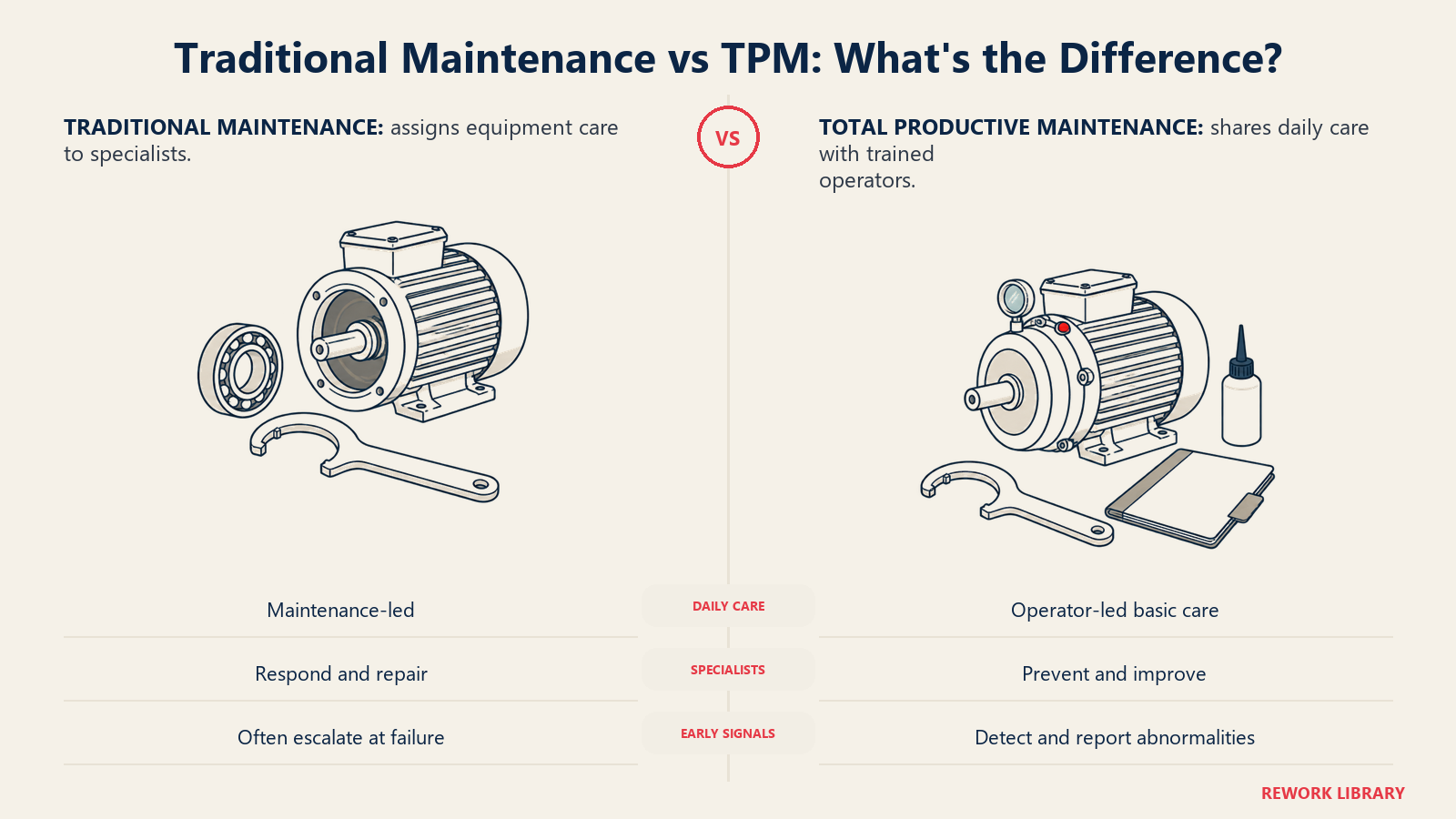
Operator-led maintenance versus traditional maintenance represents TPM's most fundamental shift. Traditional approaches assign maintenance exclusively to specialized technicians. Operators run equipment until it breaks, then call maintenance to fix it. This creates dependency, delays, and disconnection.
As the Lean Enterprise Institute notes, unlike traditional preventive maintenance which relies on maintenance personnel, TPM involves operators in routine maintenance, improvement projects, and simple repairs, with operators performing daily activities such as lubricating, cleaning, tightening, and inspecting equipment. TPM recognizes operators are with equipment every day. They hear unusual sounds, feel vibrations, notice leaks, and spot deterioration before catastrophic failures occur. But only if they're trained to recognize these signals and empowered to act on them.
Autonomous maintenance develops operators into equipment stewards who perform daily care, detect abnormalities, maintain basic conditions, and participate in improvement. This frees skilled maintenance technicians from routine tasks to focus on complex preventive maintenance, equipment improvements, and predictive monitoring.
Connection to OEE and lean manufacturing makes TPM a cornerstone of operational excellence. Equipment reliability enables just-in-time production by reducing buffer inventory needed to protect against breakdowns. Improved OEE captures additional capacity from existing assets. Reduced downtime improves flow and eliminates waste through lean principles.
Cultural shift from reactive to proactive proves challenging but essential. Reactive maintenance feels urgent and important:heroic technicians saving production from disaster. But it's expensive, stressful, and ineffective. Proactive maintenance prevents fires rather than fighting them, requiring discipline to invest time preventing problems that may never occur if prevention works.
This cultural shift requires leadership commitment, training, patience, and visible celebration of prevention successes.
The Eight Pillars of TPM
Each pillar addresses distinct aspects of equipment effectiveness.
Pillar 1: Autonomous Maintenance empowers operators to care for their equipment. This doesn't mean operators become expert technicians. It means they clean, inspect, lubricate, and tighten according to standardized procedures. They detect abnormalities through daily contact with equipment. They maintain basic conditions that prevent accelerated deterioration.
Implementation follows seven systematic steps: initial cleaning and inspection, eliminate sources of contamination and inaccessible areas, develop provisional standards, general inspection training, autonomous inspection, standardization, and full autonomous maintenance.
Pillar 2: Planned Maintenance shifts maintenance from reactive breakdown response to scheduled preventive and predictive activities. Preventive maintenance performs time-based or cycle-based interventions before failures occur: changing oil every 500 hours, replacing belts every 12 months, rebuilding components at specified intervals.
Predictive maintenance uses condition monitoring:vibration analysis, thermal imaging, oil analysis, ultrasonic testing:to detect developing problems before they cause failures. This enables condition-based maintenance that intervenes when data indicates deterioration, not on fixed schedules that may be premature or overdue.
An aerospace parts manufacturer implemented predictive maintenance on critical CNC machines. Vibration sensors detect bearing wear. Oil analysis identifies contamination and deterioration. Thermal cameras spot electrical problems. These techniques reduced unplanned downtime 67% while cutting planned maintenance costs by eliminating unnecessary preventive replacements of healthy components.
Pillar 3: Quality Maintenance connects equipment condition to product quality. Worn tooling creates dimensional variation. Misaligned guides cause defects. Contaminated systems introduce impurities. Quality maintenance identifies equipment conditions that affect quality characteristics, establishes standards for those conditions, and maintains equipment to prevent quality problems through systematic defect prevention.
Pillar 4: Focused Improvement attacks specific losses systematically using cross-functional teams and structured problem-solving. Unlike routine maintenance that maintains existing conditions, focused improvement eliminates chronic problems through root cause analysis methodologies and countermeasures.
Teams analyze equipment suffering chronic issues: frequent minor stops, excessive changeover time, recurring defects, or energy waste. They investigate root causes systematically. They develop and test countermeasures. They standardize effective solutions.
Pillar 5: Early Equipment Management incorporates maintainability into equipment design and installation. Work with equipment suppliers to design for easy maintenance access, quick changeover, simplified cleaning, and reliable operation. When installing equipment, involve maintenance personnel in setup, verification, and documentation of maintenance requirements.
Many maintenance problems originate in poor equipment design: inaccessible lubrication points, components that require disassembly for inspection, adjustment procedures requiring specialized tools. Early equipment management prevents these problems through better design specification and installation practices.
Pillar 6: Training and Education builds competencies required for TPM success. Operators need training in equipment operation, basic maintenance tasks, inspection techniques, and problem recognition. Maintenance technicians need skills in predictive technologies, systematic problem-solving, and training operators.
Create skills matrices showing required capabilities and current proficiency for each person. Develop training plans addressing gaps. Provide hands-on training using actual equipment.
Pillar 7: Safety, Health, and Environment integrates these critical concerns into TPM. Equipment failures create safety hazards. Deteriorated conditions cause accidents. TPM's focus on maintaining proper equipment conditions inherently improves safety while environmental compliance depends on properly functioning control systems.
Pillar 8: TPM in Administration extends TPM principles beyond production to office processes: order entry, scheduling, procurement, engineering. These support processes create bottlenecks and errors just as equipment does. Apply TPM concepts:prevention, standard procedures, systematic improvement:to administrative work.
TPM Implementation Roadmap
Successful TPM deployment follows a structured phased approach over 2-3 years.
Preparation phase establishes foundation for TPM success. Senior leadership must visibly commit to the journey. Communicate TPM philosophy and expected benefits throughout the organization. Establish steering committees and working teams with clear responsibilities. Set measurable goals for equipment effectiveness.
Select an executive TPM sponsor who provides resources and removes obstacles. Train leadership on TPM concepts so they can support implementation effectively. Address concerns about role changes and workload early.
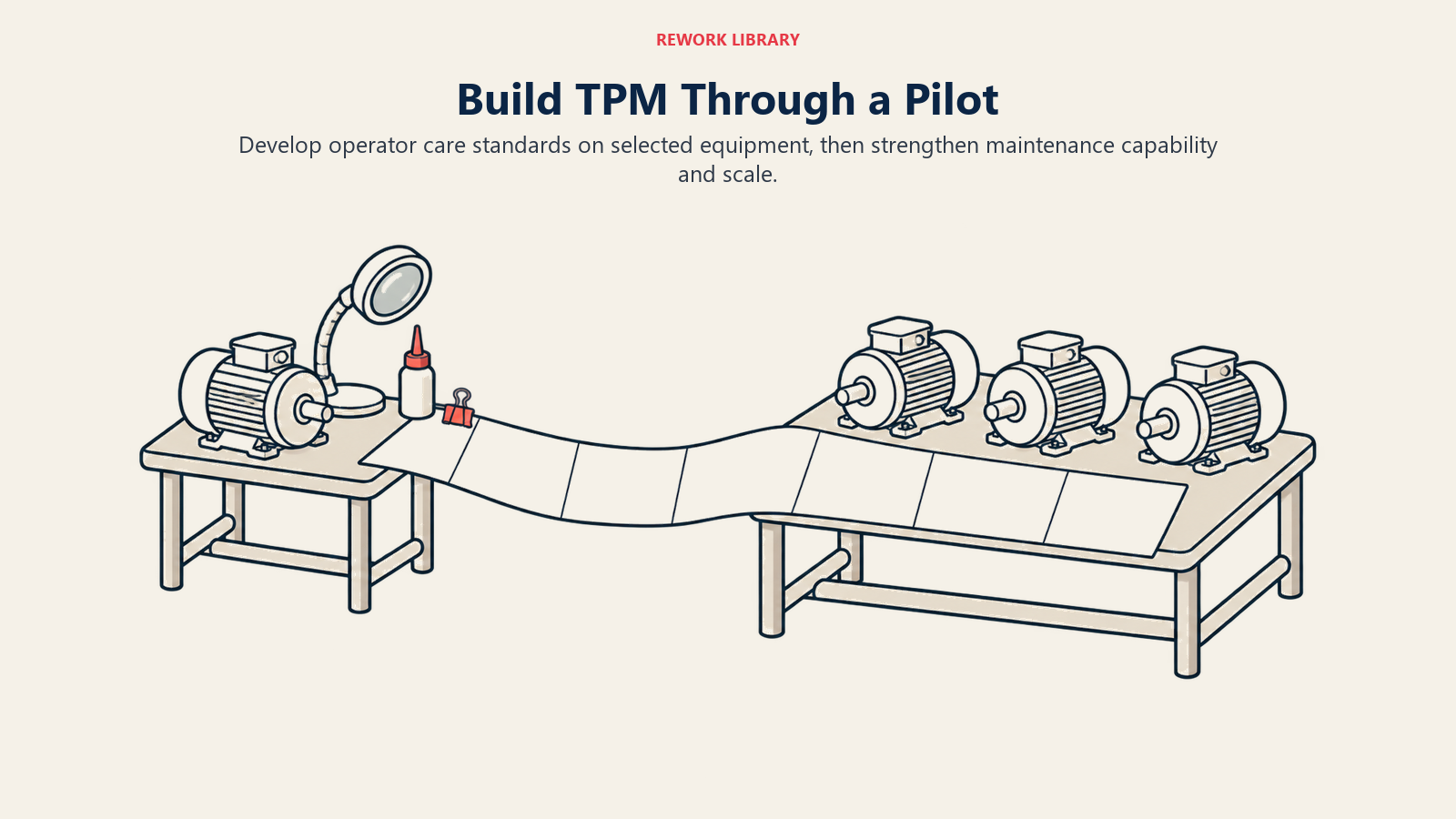
Kickoff and pilot area selection launches implementation with appropriate scope. Select pilot equipment that's important but not your most critical bottleneck. Choose areas with supportive supervision and operators receptive to new approaches. Success builds credibility for broader deployment.
A metal forming company piloted TPM on three press lines representing different product families. These lines were significant but not their absolute highest-volume operations. Supportive supervisors and experienced crews provided good learning environments. Six-month pilots demonstrated feasibility and refined their approach before scaling.
Autonomous maintenance rollout develops operator capabilities through seven sequential steps:
Step 1: Initial cleaning and inspection. Operators thoroughly clean equipment, discovering deterioration and defects hidden under grime and checking every component.
Step 2: Eliminate sources of contamination and inaccessible areas. Address root causes of contamination (leaks, spills, dust generation) and improve access for future cleaning and inspection.
Step 3: Develop provisional cleaning and lubrication standards. Document how often, what methods, what materials, expected times.
Step 4: General inspection training. Train operators to inspect equipment systematically: mechanical, electrical, pneumatic, hydraulic systems.
Step 5: Autonomous inspection. Operators begin regular inspections, detecting and reporting abnormalities before failures occur.
Step 6: Standardization. Refine and formalize standards for cleaning, lubrication, and inspection. Ensure consistency across shifts and operators.
Step 7: Full autonomous maintenance. Operators independently maintain equipment, continuously improve standards, and participate in focused improvement activities.
Don't rush through these steps. Most organizations need 12-18 months to progress from step 1 to step 7. Thorough development of autonomous maintenance capabilities provides TPM's foundation.
Building maintenance competencies modernizes maintenance team skills and practices. Implement equipment history tracking that records all maintenance activities, failures, and corrective actions. Establish preventive maintenance schedules based on OEM recommendations and failure history. Deploy predictive maintenance technologies for critical equipment.
Shift maintenance workload from reactive to preventive. Track the balance: world-class operations spend 70-80% of maintenance resources on planned preventive activities and only 20-30% on reactive breakdown response. This requires discipline to perform scheduled maintenance even when no apparent problems exist.
Scaling across the plant expands TPM from pilots to full deployment. Train additional work groups through the seven autonomous maintenance steps. Extend focused improvement activities to more equipment. Build maintenance planning and scheduling capabilities. Install predictive monitoring systems progressively.
Measure progress systematically: OEE improvements, downtime reduction, maintenance cost trends, ratio of planned to unplanned maintenance, operator and maintenance engagement scores.
Measuring TPM Success
Quantifying TPM benefits maintains momentum and justifies continued investment.
Mean Time Between Failures (MTBF) measures average operating time between breakdowns. Calculate by dividing total operating time by number of failures over a period. Improving MTBF indicates better equipment reliability. Track trends monthly, comparing current periods to baselines.
An automotive supplier tracked MTBF for 30 months through TPM implementation. Initial MTBF averaged 76 hours. After autonomous maintenance deployment, MTBF improved to 142 hours. After implementing predictive maintenance, MTBF reached 218 hours. These improvements translated directly to reduced unplanned downtime.
Mean Time To Repair (MTTR) measures how quickly equipment returns to service after failures. While TPM focuses primarily on preventing failures, efficient response when failures occur remains important. Lower MTTR indicates better maintenance preparedness: spare parts availability, technician skills, troubleshooting effectiveness.
OEE gains provide comprehensive equipment effectiveness measurement. TPM should improve all three OEE components: availability, performance, and quality. Availability increases through reduced downtime, performance improves through better equipment condition, and quality benefits from equipment maintained to precision standards.
Maintenance cost reduction demonstrates financial impact. Track maintenance spending: labor for reactive versus planned maintenance, spare parts consumption, outside contractor expenses. Well-executed TPM reduces total maintenance cost despite increased planned maintenance activities, because preventing failures costs less than reacting to them. This principle aligns with comprehensive manufacturing cost analysis showing prevention is more economical than correction.
Safety incident reduction often accompanies TPM implementation. Equipment in proper condition operates more safely. Autonomous maintenance training improves operator awareness of hazards. Systematic inspection detects safety issues before accidents occur.
TPM as Manufacturing Excellence Cornerstone
TPM represents more than a maintenance approach. It fundamentally changes how organizations view equipment, define roles, and pursue improvement.
When operators take ownership of equipment care, engagement and pride increase. They stop viewing machines as company property to be used hard and calling maintenance when problems occur. They develop stewardship mentality where equipment condition reflects directly on their work quality.
When maintenance shifts from reactive to planned, technicians become problem-solvers rather than breakdown firefighters. Job satisfaction increases as they apply expertise preventing failures rather than constantly responding to crises.
When cross-functional teams systematically eliminate chronic losses, organizational capability grows. The same disciplined problem-solving techniques work on equipment issues, quality problems, process improvements, and administrative challenges.
Manufacturers who fully embrace TPM over multi-year implementations create competitive advantages competitors can't easily replicate. Equipment reliability enables strategies others can't execute. Lower downtime and higher OEE create capacity without capital investment. These capabilities compound into market leadership.
Begin your TPM journey by securing leadership commitment, selecting appropriate pilot areas, and patiently developing autonomous maintenance capabilities. Success won't come from quick fixes but from systematic development of equipment care culture. That culture becomes a foundation for sustainable operational excellence.
Learn More
- Overall Equipment Effectiveness: Maximizing Production Capacity
- 5S Workplace Organization: Transform Efficiency Through Visual Management
- Kaizen Continuous Improvement: Building a Culture of Excellence
- Root Cause Analysis Methods: Getting to the Heart of Manufacturing Problems
- Defect Prevention Strategies: Building Quality at the Source
- Lean Manufacturing Principles: Building a Waste-Free Operation
