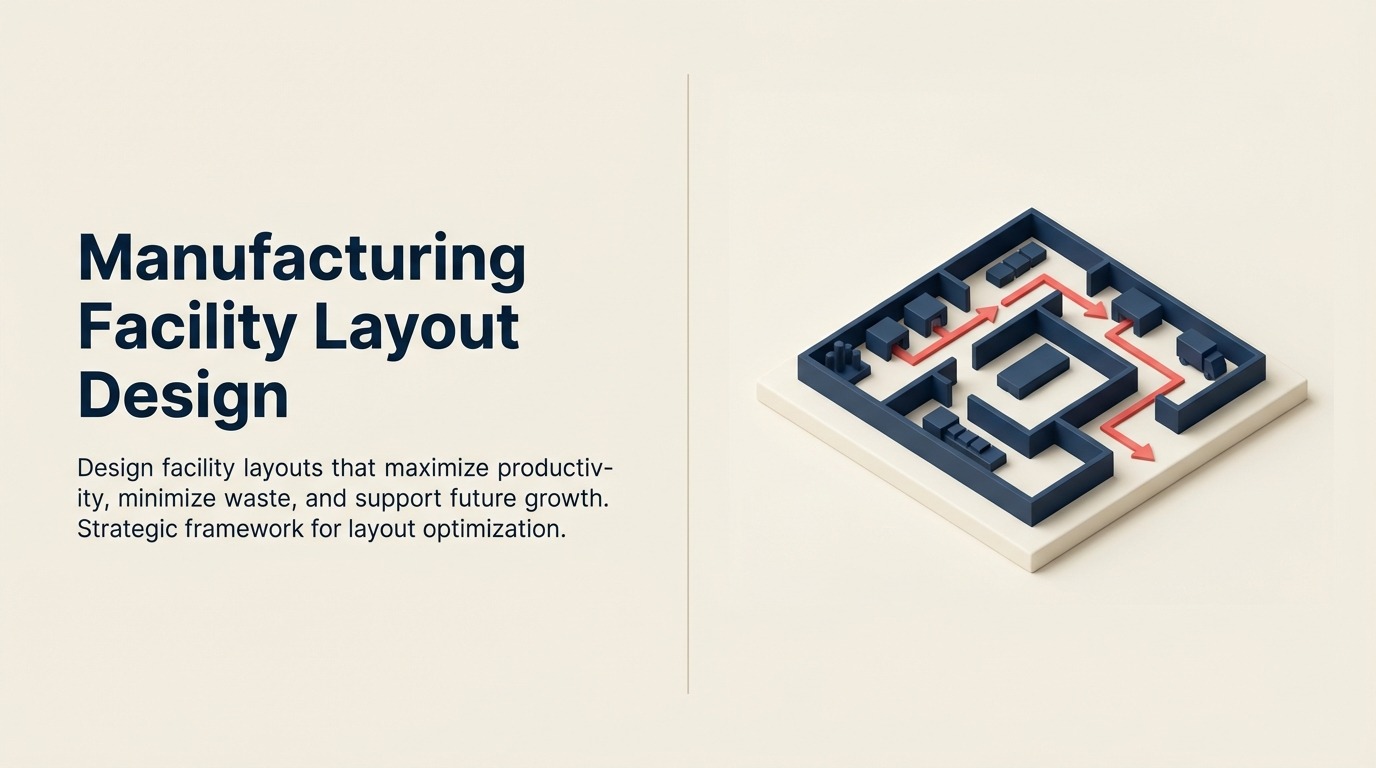
Manufacturing Facility Layout Design: Optimizing Flow, Efficiency, and Flexibility
Turn this article into takeaways for your work.


Each assistant summarizes the article only for you and suggests best practices for your work.
A furniture manufacturer redesigned their facility layout and cut production lead time by 35%. They didn't add equipment or hire more people. They just moved things around. The old layout had materials traveling 3 miles through the plant to become finished products. The new layout reduced travel to 800 feet. Operators spent their time adding value instead of walking. Work-in-process inventory dropped because products flowed instead of accumulating. The physical arrangement determined operational performance far more than anyone realized.
Layout isn't cosmetic. It's operational strategy made tangible. The physical arrangement of equipment, workstations, storage, and support areas determines how efficiently work flows, how much material handling waste exists, and how flexibly you can respond to changes. According to industrial engineering research, plant layout has been considered one of the most important classic operations management and industrial engineering problems since the second half of the twentieth century. Bad layouts create permanent operational handicaps that no amount of improvement effort can overcome. Good layouts create foundations for excellence.
Understanding Layout Types
Manufacturing facilities organize in different patterns depending on production characteristics and strategic priorities. Choosing the right layout type for your operations determines whether the facility supports or hinders performance.
Process layout groups similar equipment together. All lathes in one area, all mills in another, all assembly in a third. Products move between departments based on their specific process requirements. This flexibility accommodates diverse products with varying routings. Custom job shops and make-to-order manufacturers typically use process layouts. The downside is material handling. Products travel long distances through the facility. Work-in-process accumulates between departments. Flow is choppy rather than continuous.
Product layout arranges equipment in the sequence required to make specific products. A dedicated line makes one product or product family from start to finish. Material flows in one direction through consecutive operations. This enables efficient high-volume production with minimal material handling and short cycle times. But product layouts lack flexibility. Dedicated lines can't easily accommodate different products. When demand shifts, dedicated capacity becomes stranded.
Cellular layout combines advantages of both approaches. Group technology identifies product families with similar processing requirements. Create cells containing all equipment needed to complete those families. Each cell operates like a miniature product line with flexibility to handle family variations. Cellular manufacturing reduces material handling like product layouts while maintaining flexibility like process layouts. The trade-off is complexity. Designing effective cells requires careful analysis of product routing and volumes.
Fixed position layout keeps products stationary while resources move to them. This fits large, complex products like aircraft or ships that can't move economically through facilities. Workers, equipment, and materials come to the product rather than the reverse. Fixed position layouts solve mobility problems but create coordination challenges as multiple teams work in limited space.
Material Flow Analysis
Layout design starts with understanding how materials move. You can't optimize flow without knowing what flows, how much, and where it goes. Material flow analysis provides the data foundation for layout decisions.
From-to charts matrix all origin-destination pairs in the facility. How many loads move from receiving to raw material storage? From storage to work center 5? From work center 5 to work center 12? Mapping all movements reveals the major flow patterns that layout should accommodate. High-volume flows deserve short, direct paths. Low-volume flows can tolerate less convenient routing.
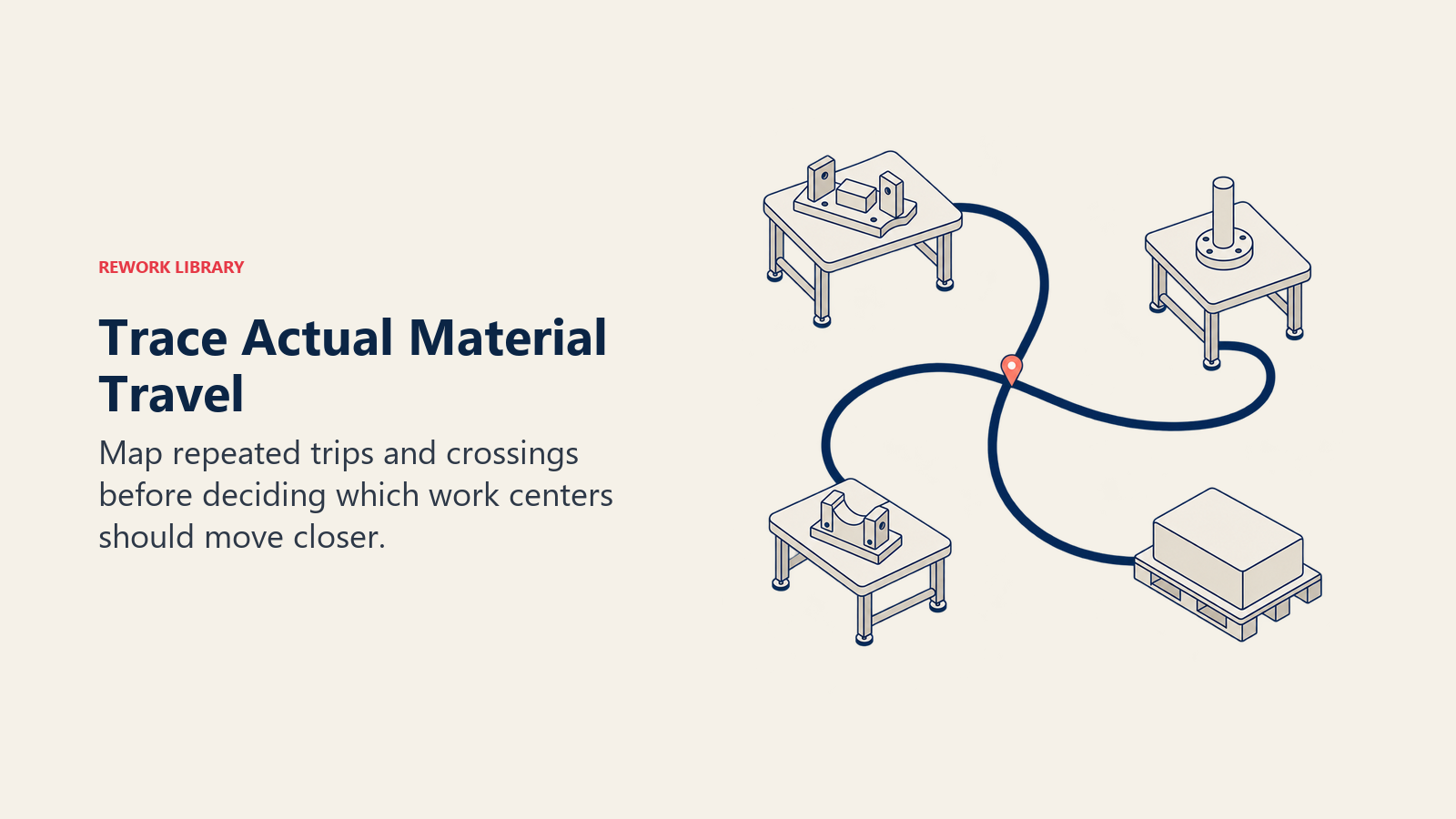
Flow diagrams overlay material movements on current layouts. Draw arrows showing how products travel through the facility. The resulting spaghetti diagram usually shocks people. Products zigzag back and forth crossing their own paths repeatedly. Materials travel absurd distances between operations only 50 feet apart because intervening space contains unrelated equipment. Seeing the chaos in visual form motivates change.
Value stream mapping traces materials and information through production processes. This identifies not just physical flow but also where materials wait, where information triggers movement, and where value actually gets added. VSM reveals that materials spend 95% of time waiting and only 5% being transformed. Layout improvements target this waiting time by reducing distances and enabling continuous flow.
Quantify material handling in cost terms. Calculate labor hours spent moving materials. Include forklift costs, conveyance equipment, and packaging. When executives see that material handling consumes 15% of direct labor or costs $500,000 annually, layout optimization becomes strategic priority rather than nice-to-have project.
Layout Design Process
Creating effective layouts follows systematic methodology that balances quantitative analysis with practical constraints and future needs.
Space requirements analysis determines how much room each function needs. Calculate floor space for equipment, work-in-process, aisle access, and operator movement. Include storage for materials, tools, and supplies. Don't forget support spaces like maintenance shops, quality labs, and offices. Total requirements usually exceed available space. This forces prioritization about what's essential versus what's preferred.
Relationship diagramming identifies which functions should be adjacent. Production steps with high material flow between them should be close. Quality inspection should be near production. Maintenance should be central to equipment it supports. Some relationships are mandatory: paint booths require spray booth specifications and exhaust systems. Others are preferential but not critical. Relationship diagrams balance ideal arrangements with spatial realities.
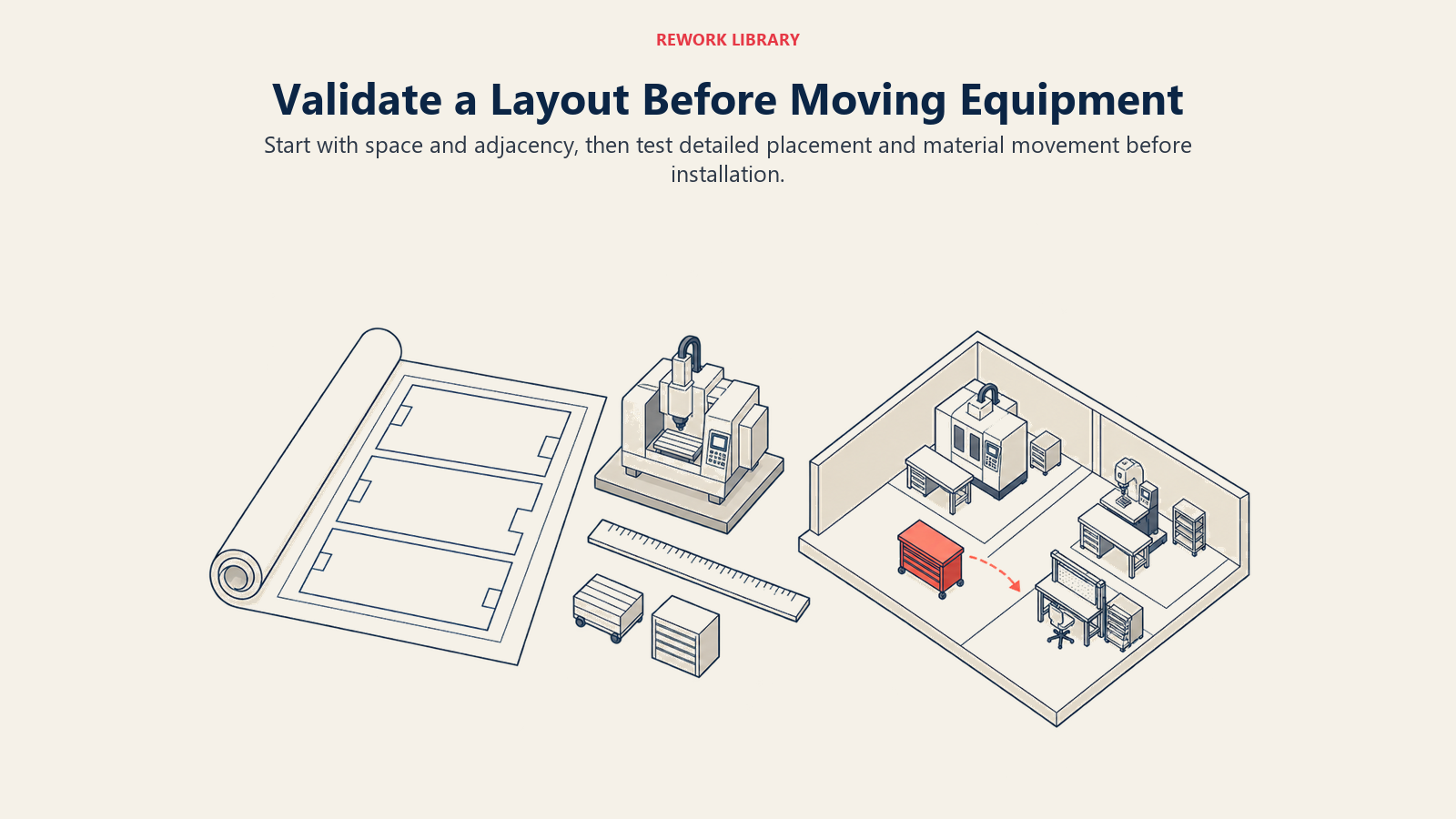
Block layouts allocate space to major functions without detailing exact equipment placement. Think of this as rough zoning. Receiving and raw materials in this zone. Primary processing here. Assembly there. Shipping on the opposite side from receiving. Block layouts establish the overall flow pattern and adjacencies before detailed placement creates complexity.
Detailed layouts place specific equipment, workstations, and storage. This is where theory meets reality. Equipment dimensions, aisle requirements, utility connections, and operational needs all constrain placement. Multiple iterations adjust equipment positions to optimize flow, minimize wasted space, and accommodate practical requirements. This is tedious work that determines whether the layout actually works.
Simulation and validation test layouts before implementation. Walk through workflows to identify problems. Simulate material movements to quantify handling requirements. Build mockups of critical areas to verify ergonomics and accessibility. Finding problems in simulation beats discovering them after moving 50 tons of equipment.
Minimizing Material Movement
Every foot materials travel is waste. Every lift onto a cart is handling cost. Every pallet staged between operations is inventory. Layout design should ruthlessly minimize all three.
Straight-line flow is ideal when products follow sequential processing. Arrange operations in order so materials enter one end of the line and exit the other without backtracking. This minimizes distance and prevents congestion from crossing paths. When products require twenty operations, arrange those operations in a line rather than scattered around the facility.
U-shaped cells work when operations are grouped. Materials enter and exit at the same location. Operators can cross-train on multiple operations within the cell. The compact arrangement minimizes space while supporting flexible staffing. U-cells particularly suit cellular manufacturing where product families require similar but not identical processing sequences.
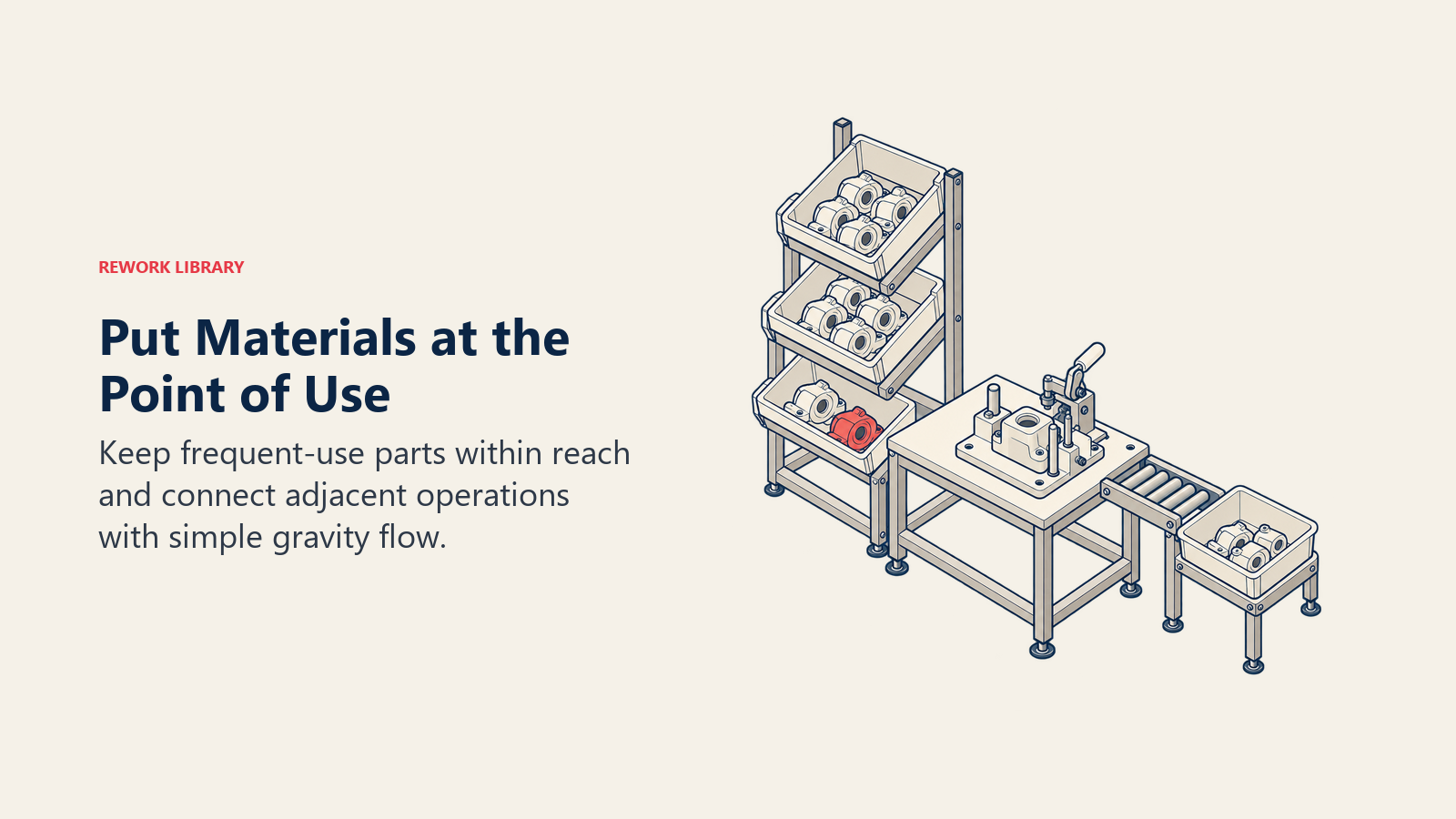
Point-of-use storage eliminates central warehouses for frequently used materials. Instead of storing materials in receiving and transporting them to production as needed, stage materials right at the point of use. Operators don't walk to storage to get materials. Everything they need is within arm's reach. This requires more sophisticated replenishment but eliminates huge material handling waste.
Gravity-assisted flow uses gravity instead of powered handling. Roller conveyors, chutes, and angled surfaces move materials without forklifts or carts. This is particularly effective between adjacent operations. A simple gravity roller between two workstations eliminates hundreds of individual part movements. Gravity is free, reliable, and doesn't require operators to stop working to move materials.
Flexibility for Future Needs
Today's optimal layout might be tomorrow's constraint. Products change. Volumes shift. Technologies advance. Layout should accommodate evolution without requiring complete redesigns.
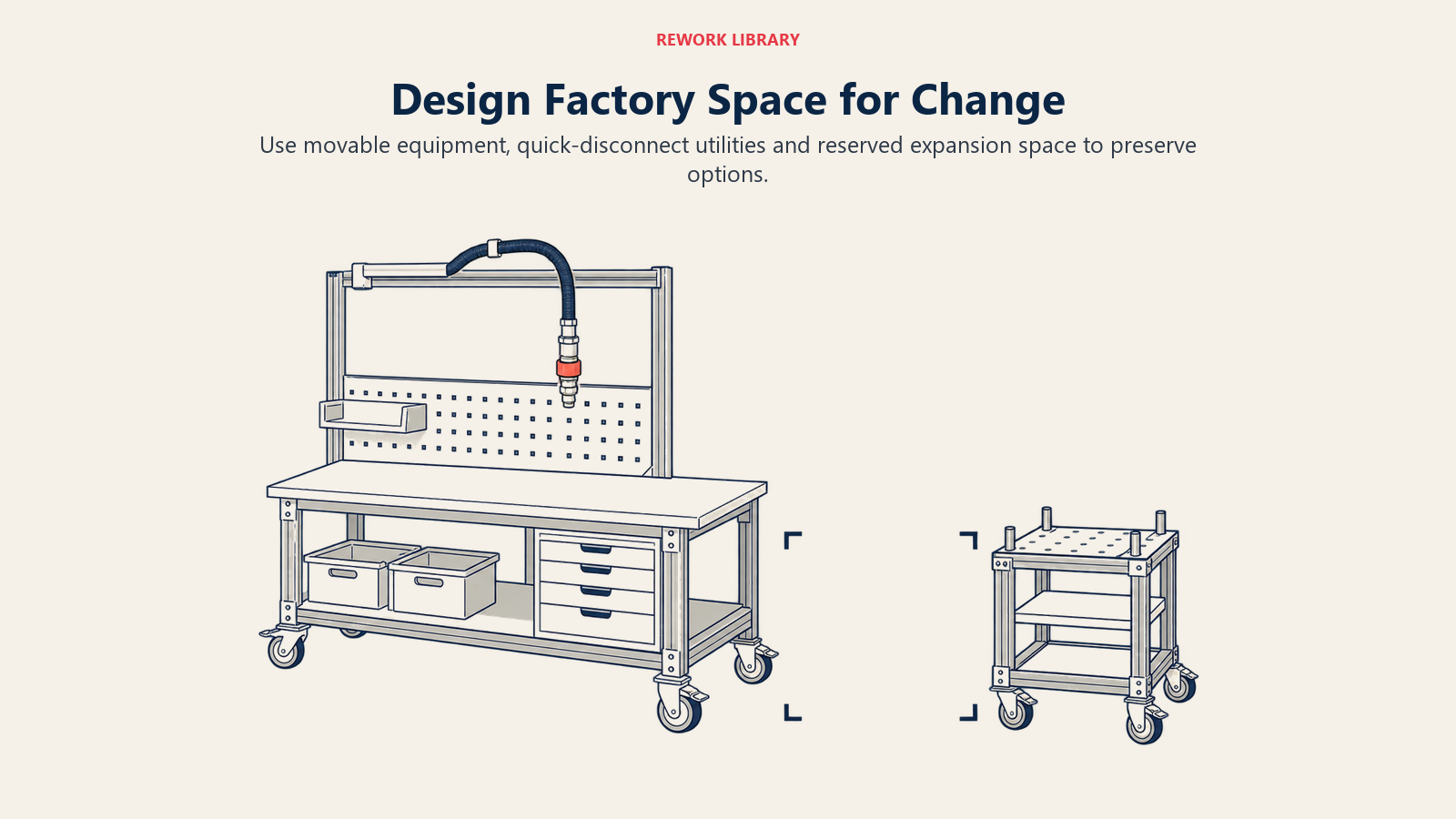
Modular equipment mounting enables reconfiguration. Equipment bolted to floors stays where it's placed forever. Equipment on wheeled bases or quick-disconnect utilities can move as needs change. Flexible utility distribution, wireless networks, and modular workstations reduce the cost and disruption of layout changes. This flexibility costs marginally more than fixed installations but prevents expensive future retrofits.
Design for expansion leaves space for growth. Don't fill every square foot initially. Leave room for additional equipment, higher inventories, and more workstations. This means accepting lower utilization initially to preserve growth capacity. The alternative is cramming new equipment wherever it fits, destroying the careful flow optimization you created.
Multi-purpose space accommodates various uses. Instead of dedicating space to single functions, create flexible areas that can serve different needs as priorities change. A quality inspection area might also serve as training space. A staging area can become assembly area. Flexibility prevents space from becoming single-purpose prison.
Document layout rationale for future reference. Why did you place work center 7 here? What material flow volume drove this arrangement? What future expansion did this accommodate? Years later when someone proposes changes, this documentation prevents ignorantly destroying carefully planned features. Layout decisions that seem arbitrary often reflect sophisticated analysis. Capture that analysis.
Supporting Technologies
Modern layout optimization uses technology for simulation, automation, and adaptation that manual methods can't match.
Computer-aided layout planning simulates material flow and quantifies handling costs for alternative arrangements. Software tests dozens of layout options, calculates handling distances, identifies congestion points, and recommends improvements. Research shows that well-designed facility layouts can significantly improve work efficiency and operational performance. This accelerates analysis that would take months manually and explores more alternatives than human planners could practically evaluate.
Automated guided vehicles (AGVs) and autonomous mobile robots (AMRs) provide flexible material handling without fixed conveyors. These systems adapt to layout changes because they follow software-defined paths rather than physical tracks. When you reconfigure work centers, you reprogram vehicle paths rather than rebuilding conveyors. This flexibility makes frequent layout optimization practical.
Warehouse management systems track materials in real-time enabling dynamic storage allocation. Instead of fixed locations for specific materials, WMS directs putaway to optimal locations based on current conditions. This improves space utilization and reduces travel distances. Storage becomes fluid rather than static.
Digital twin technology creates virtual facility replicas for testing changes before physical implementation. Model layout changes in software. Simulate throughput impacts. Identify bottlenecks. Validate improvements. When you're confident virtual changes work, implement them physically. Digital twins dramatically reduce the risk of layout changes.
Implementation Considerations
Even brilliant layouts fail if implementation isn't managed carefully. Moving operating facilities requires meticulous planning and execution to minimize disruption.
Phased implementation transitions gradually rather than attempting big-bang moves. Relocate one department or cell while others continue operating. Validate the move works before proceeding to the next phase. This limits risk and maintains production continuity. Complete facility shutdowns for layout changes cost enormous revenue and create intense pressure that leads to mistakes.
Temporary layouts bridge current and future states. During transition, you might need interim arrangements that aren't optimal but maintain operations while moving toward target layout. Accept temporary inefficiency to preserve continuity. The perfect target layout has zero value if getting there shuts down production for weeks.
Change management prepares people for new layouts. Operators need to learn new material flows. Material handlers need new routes. Supervisors need updated procedures. Train people before moving equipment. Walk through new arrangements. Address concerns. People resist change less when they understand reasons and feel prepared.
Performance monitoring after implementation validates that benefits materialize. Track material handling costs, travel distances, cycle times, and inventory levels. Compare actual to projected improvements. Some benefits appear immediately. Others take time as people adapt to new arrangements. Monitor long enough to see steady-state performance, not just startup confusion.
Learning from Results
Layout optimization is never finished. Products evolve. Volumes change. Technologies advance. Each layout change provides learning that improves future decisions.
Measure outcomes rigorously. Did material handling costs decline as projected? How much did cycle times improve? What unexpected benefits or problems emerged? Quantifying results builds organizational capability in layout design and creates realistic expectations for future projects.
Capture lessons learned while experience is fresh. What worked well? What would you do differently? What assumptions proved wrong? Which analysis methods were most valuable? Organizations that learn systematically from layout projects make better decisions on subsequent projects.
Build internal expertise through experience. Layout design is partly science and partly art. The science can be taught. The art comes from experience. People who've designed layouts understand subtleties that textbooks don't cover. Developing this expertise internally creates competitive advantage.
Stay current with industry practices through plant tours, conferences, and industry exchanges. Seeing how other manufacturers arrange facilities sparks ideas. Technologies and approaches that work elsewhere might adapt to your environment. External exposure prevents insularity and challenges assumptions.
Moving Forward
Facility layout determines the ceiling of operational performance. No amount of operator effort or management pressure overcomes fundamentally flawed physical arrangements. But good layouts create foundations where operational improvements compound into excellence.
Don't accept current layouts as permanent just because moving things is disruptive. The cost of poor layout (excess material handling, long cycle times, high inventory, wasted space) accumulates every day. The disruption of layout improvement is temporary. The benefits are permanent.
Start with data. Map current material flows. Calculate handling costs. Identify major waste. Quantify opportunity. This analysis builds the business case for layout projects and focuses effort on high-impact opportunities. Don't redesign everything. Focus on the parts of the layout creating the biggest problems.
Think beyond today's products and volumes. Layout decisions last years. Design for evolution. Include flexibility. Leave room for growth. The marginally higher initial cost of flexible design pays for itself many times over by reducing future reconfiguration costs.
Remember that layout is strategy made physical. How you arrange your facility reflects what you optimize for: flexibility versus efficiency, current volumes versus future growth, cost minimization versus quick changeovers. Make these strategy choices consciously, then align layout accordingly. The physical space should reinforce strategic priorities, not undermine them.
Learn More
