Statistical Process Control (SPC): Monitoring and Preventing Process Variation in Real Time
Turn this article into takeaways for your work.


Each assistant summarizes the article only for you and suggests best practices for your work.
A precision parts manufacturer inspected every finished part before shipment. Despite this 100% inspection, customers still received defective components. The problem? Inspection caught defects after full manufacturing costs were incurred. They were detecting problems, not preventing them.
They implemented Statistical Process Control on critical machining operations. Operators monitored control charts showing dimensional measurements in real time. When charts signaled process shifts, operators adjusted before defects occurred. Within months, in-process defect rates dropped 72%. More importantly, they'd shifted from expensive detection after the fact to prevention during production.
SPC transforms quality management from reactive inspection to proactive process control.
SPC Fundamentals
Statistical Process Control uses statistical methods to monitor processes, detect changes early, and maintain stability. According to ASQ, SPC is the application of statistical methods to monitor and control the quality of a production process.
Control charts and statistical limits plot process measurements over time with calculated control limits showing expected variation ranges. Wikipedia explains that control charts, also known as Shewhart charts (after Walter A. Shewhart), are used to determine if a manufacturing or business process is in a state of control. Points within limits indicate normal variation. Points outside limits or non-random patterns signal process changes requiring investigation.
Control limits differ from specification limits. Specifications define customer requirements:what parts must meet. Control limits describe what the process naturally produces:what to expect from stable operations. Capable processes have control limits comfortably within specifications.
Common cause versus special cause variation distinguishes random inherent variation from assignable changes. According to ASQ, control charts attempt to differentiate "assignable" ("special") sources of variation from "common" sources. Common cause variation comes from factors built into the process: slight material differences, minor temperature fluctuations, normal equipment variability. This creates predictable patterns within control limits.
Special cause variation stems from specific, identifiable events: tool wear, operator error, material defects, equipment malfunction. These create unpredictable patterns outside normal variation ranges.
The distinction matters for proper response. Common cause variation requires process improvement through systematic changes. Special cause variation requires identifying and correcting the specific problem. Treating special causes as common cause means ignoring problems. Treating common cause as special cause means unnecessary tampering that often makes things worse.
Process stability versus process capability are different concepts. Stable processes operate predictably within control limits, showing only common cause variation. Capable processes produce output meeting specifications. You can have stable incapable processes (consistently producing defects) or unstable capable processes (unpredictable but currently within specs).
Achieve stability first through SPC, then improve capability through Six Sigma methods if needed. Trying to improve capability in unstable processes wastes effort.
When SPC applies: Repetitive processes producing measurable output work best. High-volume manufacturing with consistent procedures provides ideal SPC environments. Custom job shops with unique orders struggle to gather sufficient data for meaningful control charts.
Selecting the Right Control Chart
Different data types and sampling strategies require different chart types.
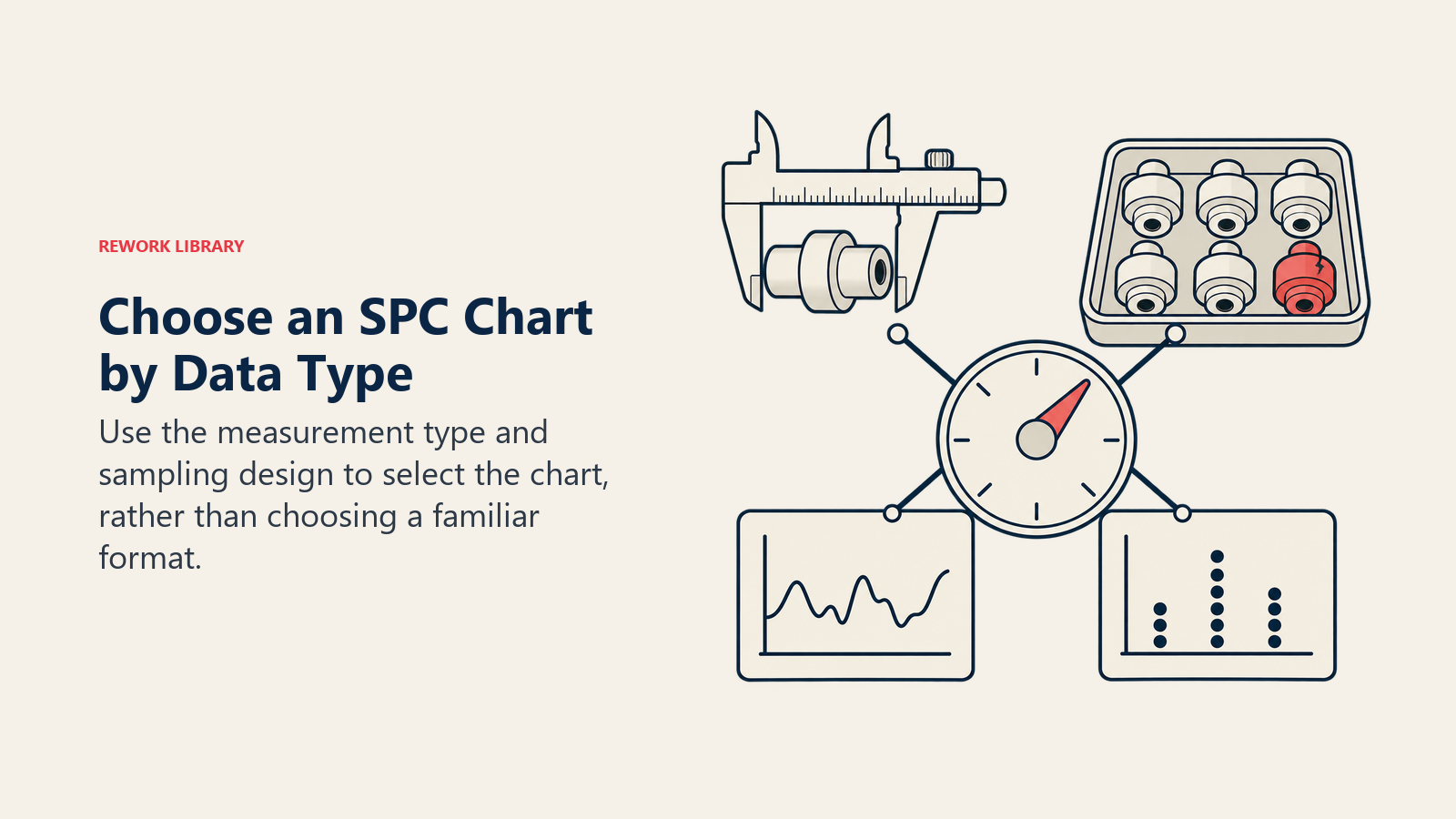
Variable data charts measure continuous characteristics like dimensions, weight, temperature, or time. X-bar and R charts plot average values and ranges from sample subgroups. X-bar and S charts use standard deviation instead of range for larger subgroups (typically 10+ pieces). Individuals and moving range (I-MR) charts work when subgroups don't make sense or sample size is one.
Use variable charts when measuring actual values provides useful information and measurement is economical.
Attribute data charts count discrete characteristics like defective units or defect counts. P-charts plot proportion defective with varying sample sizes. Np-charts plot number defective with constant sample size. C-charts count defects per unit with constant sample size. U-charts count defects per unit with varying sample size.
Use attribute charts when pass/fail inspection is more practical than precise measurement.
Selection criteria: Choose based on data type (variable or attribute), sample size (individual measurements or subgroups), and practical considerations (measurement cost, inspection complexity, data availability).
An injection molding operation uses X-bar and R charts for critical dimensions measured on 5-piece subgroups every hour. They use p-charts for visual defects inspected on 100% of production with varying hourly quantities.
Implementing SPC Practically
Effective SPC implementation requires systematic planning.
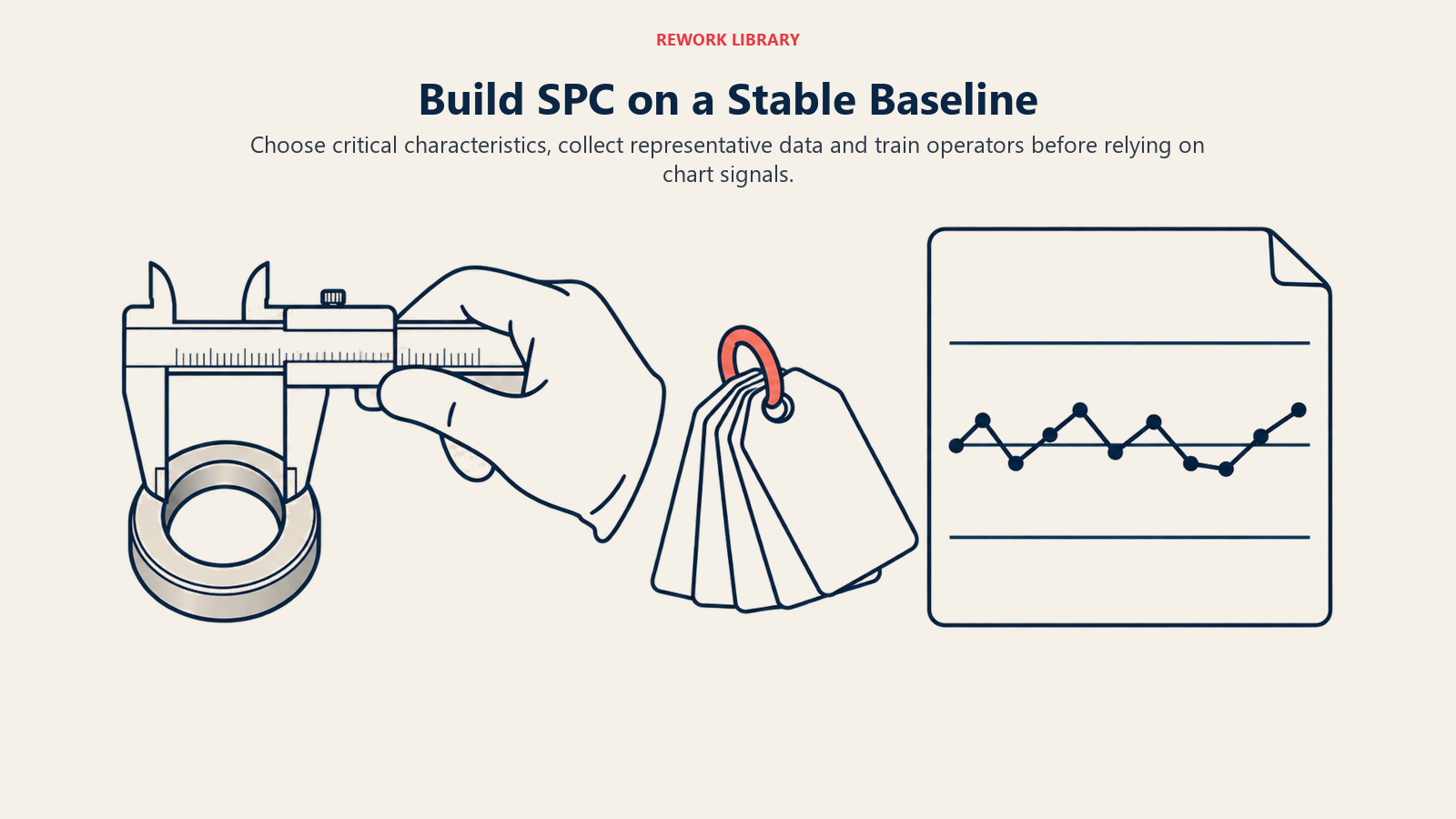
Identifying critical characteristics focuses monitoring on what matters most. Don't chart everything. Select characteristics that affect safety, function, customer satisfaction, or regulatory compliance. Use FMEA and risk analysis, customer complaints, or quality cost data to prioritize.
A medical device manufacturer identified 12 critical characteristics from 47 total product specifications. They implemented SPC on these 12, catching problems early while avoiding overwhelming operators with excessive monitoring.
Establishing control limits from baseline data requires collecting 20-25 subgroups from stable process operation. Calculate centerline (average) and control limits (typically three standard deviations from average). Verify baseline data comes from stable operations without known special causes affecting it.
Don't set control limits arbitrarily or equal to specifications. Limits must reflect actual process behavior to enable meaningful monitoring.
Setting up data collection systems determines SPC sustainability. Manual charting by operators works for moderate-volume operations but risks inconsistent collection. Automated systems using sensors and manufacturing execution software provide reliable data but require infrastructure investment.
Start simple: paper charts for critical processes. Automate selectively based on demonstrated value and available resources.
Training operators on chart interpretation enables frontline process control. Operators need to recognize signals requiring action, understand when to adjust versus when to leave processes alone, and know escalation procedures for significant problems.
An aerospace components supplier provides operators with pocket reference cards showing control chart patterns and appropriate responses. This enables confident decision-making without memorizing complex rules.
Real-time monitoring versus periodic review depends on process characteristics and risk. Critical high-speed operations may justify real-time monitoring with automated alerts. Slower processes or less critical characteristics might review charts daily or per shift.
Balance monitoring frequency against practical data collection capability and economic value of early detection.
Interpreting Control Charts and Recognizing Signals
Effective SPC requires recognizing various signals indicating process changes.
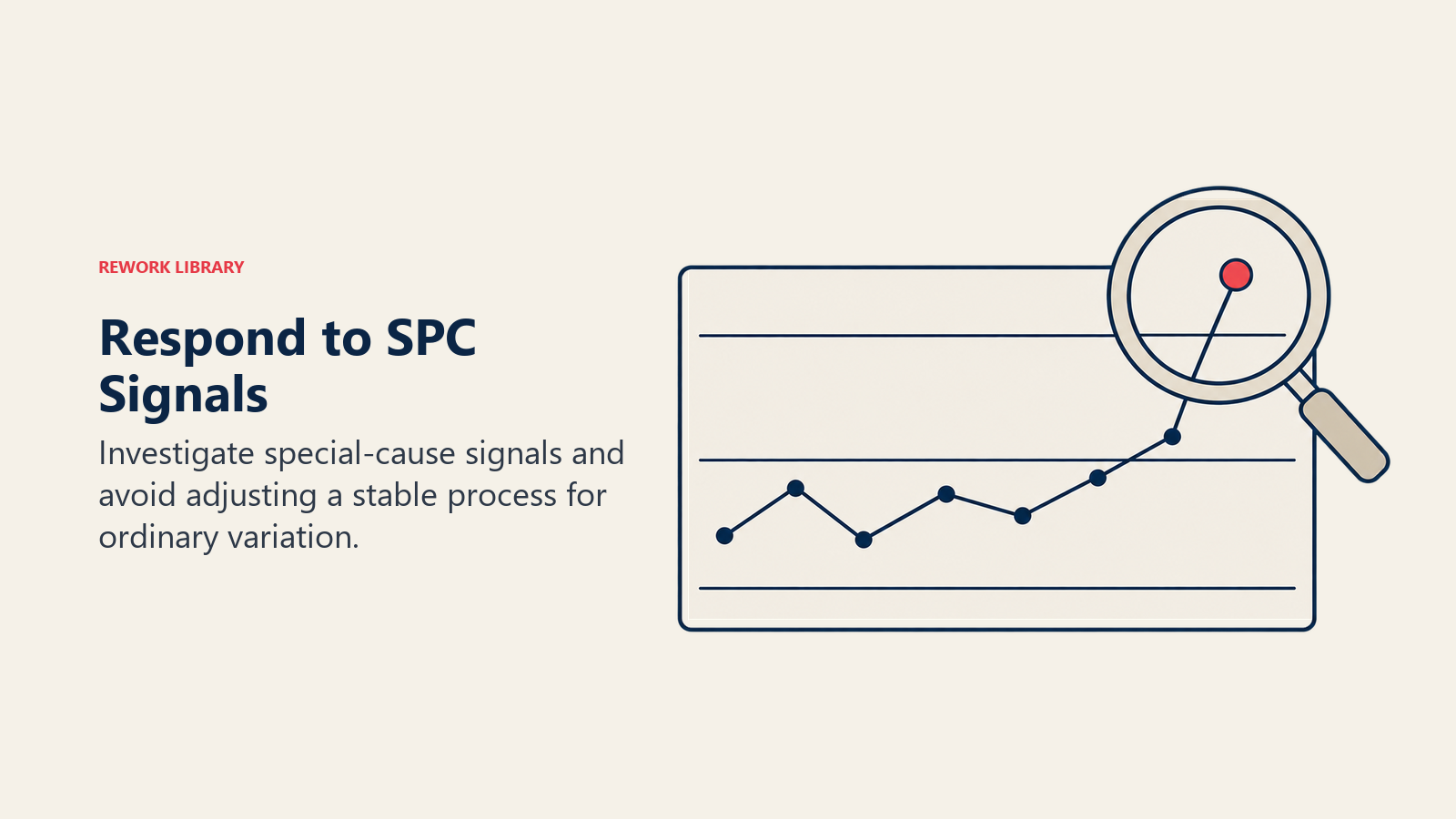
Points beyond control limits provide the most obvious signal. When any point falls outside three-sigma control limits, investigate for special causes. Probability of this occurring by chance in a stable process is less than 0.3%.
Don't just plot the outlier and move on. Find the special cause: What changed? What was different? Can we prevent recurrence?
Run tests and patterns detect shifts and trends before they produce out-of-control points. Common rules include: eight or more consecutive points on one side of centerline (process shift), six or more consecutive increasing or decreasing points (trend), 14 or more points alternating up and down (overcontrol or tampering), two out of three consecutive points beyond two-sigma limits.
These patterns signal process changes requiring investigation even when all points remain within control limits.
Overreaction risks and tampering create problems when people adjust stable processes showing normal variation. This introduces additional variability from unnecessary adjustments, degrading capability rather than improving it.
A packaging line operator noticed measurements varying around the target and "helped" by adjusting settings after each reading. This tampering doubled process variation. Training him to respond only to control chart signals rather than individual readings restored stability.
When to investigate versus when to leave alone: Investigate special cause signals indicated by out-of-control points or pattern rules. Don't adjust processes showing only common cause variation within control limits. This discipline prevents well-intentioned tampering.
Using SPC for Process Improvement
SPC enables both maintaining current capability and driving improvement.
Using SPC data to identify improvement opportunities reveals patterns pointing to specific problems. Shifts correlating with operators, shifts, or materials suggest training, procedure, or supplier issues. Trends might indicate progressive tool wear requiring preventive replacement.
An electronics assembly operation analyzing their SPC data discovered defect rates tripled during third shift. Investigation revealed inadequate lighting creating inspection errors. Adding task lighting eliminated the shift-to-shift difference.
Reducing common cause variation requires systematic process changes. After achieving stability, reduce inherent variation through better equipment, improved materials, enhanced procedures, or environmental controls.
This differs from adjusting for special causes. Common cause reduction means fundamentally improving process capability through Six Sigma or other rigorous improvement methodologies that implement permanent changes.
Improving process capability (Cp, Cpk) combines stability with capability assessment. Calculate capability indices from stable process data: Cp compares specification width to process spread. Cpk accounts for centering within specifications. Target Cpk of 1.33 or higher provides acceptable capability. Values below 1.0 indicate unacceptable capability requiring systematic improvement through defect prevention.
Continuous reduction of control limits demonstrates improving capability. As you reduce variation through improvement projects, control limits narrow. This progressive tightening signals real capability gains.
SPC in Modern Manufacturing
Technology extends SPC capabilities beyond traditional manual charting.
Real-time SPC with MES and sensors automatically collects data, calculates control limits, generates charts, and provides instant feedback. This enables monitoring high-volume operations that manual charting couldn't handle.
Automated alerts and notifications ensure problems get addressed quickly. Systems can send alerts to operators, supervisors, maintenance, or quality personnel when charts show out-of-control conditions.
SPC for high-mix low-volume environments challenges traditional approaches requiring extensive baseline data. Short-run SPC techniques using standardized parameters or target-based approaches enable monitoring even with limited historical data.
Predictive models beyond traditional SPC combine SPC with machine learning. These systems detect subtle patterns traditional control charts miss and predict problems before they occur.
But technology doesn't replace methodology understanding. Automated systems still require proper setup, interpretation, and response. Invest in training alongside technology.
SPC as Foundation for Process Excellence
SPC represents more than a quality tool. It's a management philosophy based on facts rather than opinions, prevention rather than detection, and continuous improvement rather than acceptance of variation.
Organizations mastering SPC develop cultures where data drives decisions, problems get addressed systematically, and process knowledge grows continuously. These capabilities extend beyond quality to operations, maintenance, and business processes.
Manufacturing leaders serious about quality make SPC core to how they operate. They train broadly, implement systematically, respond to signals consistently, and use data for continuous improvement through lean manufacturing and quality management approaches. This discipline builds competitive advantages through superior quality, lower costs, and reliable operations.
Begin your SPC journey by selecting critical characteristics on important processes. Establish baseline capability. Train operators on proper response. Start simple with manual charting. Demonstrate value. Expand methodically based on results and capability development.
Learn More
- Six Sigma in Manufacturing: Data-Driven Quality Improvement
- Overall Equipment Effectiveness: Maximizing Production Capacity
- Manufacturing Quality Management Overview: Building Defect Prevention Systems
- Root Cause Analysis Methods: Getting to the Heart of Manufacturing Problems
- Defect Prevention Strategies: Building Quality at the Source
- First Pass Yield Optimization: Reducing Defects at the Source
