Demand Forecasting for Manufacturing: Accurate Predictions for Better Planning
Turn this article into takeaways for your work.


Each assistant summarizes the article only for you and suggests best practices for your work.
Demand forecasting directly impacts inventory costs, service levels, and profitability. A manufacturer with 90% forecast accuracy carries appropriate inventory, meets delivery commitments, and operates efficiently. One with 60% accuracy oscillates between stockouts and excess inventory, disappoints customers, and runs inefficient production schedules.
Yet perfect forecasts are impossible. Demand varies due to market changes, competitive actions, economic shifts, and random variation. The goal isn't perfection. It's continuous improvement toward good-enough accuracy that enables effective planning and acceptable cost.
Demand Forecasting in Manufacturing Context
Manufacturing forecasting differs from retail or service forecasting. Manufacturers must forecast not just what customers will buy, but when they need it produced to meet lead times. They must balance forecast aggregation (families versus individual SKUs) with detail needed for material planning and capacity allocation. These forecasts feed directly into production planning fundamentals.
Dependent vs. Independent Demand
Independent demand comes directly from customers and market forces. Finished goods demand is independent. You must forecast it because it's not determined by any other factor you control.
Dependent demand derives from independent demand through bills of materials. Component demand depends on finished goods schedules. You don't forecast dependent demand; you calculate it through material requirements planning. Confusing dependent and independent demand creates double-forecasting that inflates inventory.
Focus forecasting effort on independent demand items. Let MRP calculate dependent demand. This concentrates forecasting where it adds value and prevents amplification errors.
Forecast Horizons and Purposes
Long-term forecasts (12-24 months) guide capacity planning strategy, facility investments, and supplier relationship development. Accuracy of ±20% is acceptable because you're making directional decisions, not precise commitments.
Medium-term forecasts (3-12 months) drive aggregate production planning, material procurement, and workforce planning. Target ±10-15% accuracy. Errors here create inventory or service problems but aren't catastrophic.
Short-term forecasts (0-3 months) support master production scheduling and material plans. Target ±5-10% accuracy. Errors directly impact customer service and expedite costs. Fortunately, short-term forecasts should be most accurate because you have better demand visibility.
Accuracy Expectations
Forecast accuracy varies by industry, product maturity, and demand pattern. Stable, mature products can achieve 85-95% accuracy. New products or erratic demand might achieve only 60-70% accuracy no matter how sophisticated your methods.
Set realistic accuracy targets based on product characteristics, not wishful thinking. Demanding 95% accuracy for inherently unpredictable products wastes effort and creates frustration. Instead, acknowledge uncertainty and plan accordingly through safety stock and flexible capacity.
Measure forecast accuracy consistently. Common metrics include Mean Absolute Percent Error (MAPE), tracking signal, and forecast bias. Track these monthly by product family and hold forecast owners accountable for continuous improvement.
Forecasting Methods: Techniques for Different Scenarios
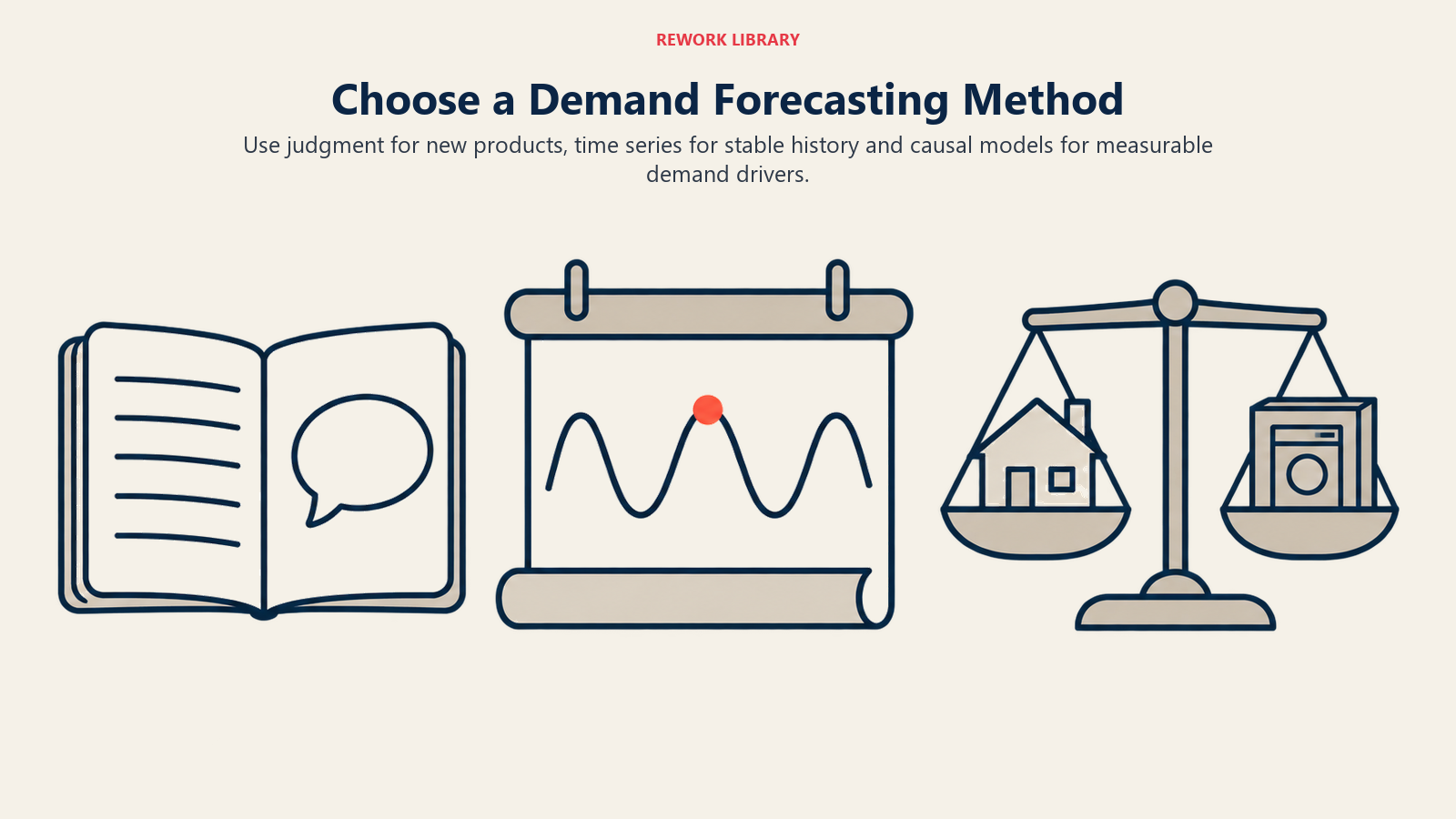
Multiple forecasting methods exist, each suited to different situations. Match method to product characteristics and data availability.
Qualitative Methods
Qualitative methods rely on judgment, experience, and expert opinion rather than historical data. Use these for new products without sales history, products facing significant changes, or situations where historical patterns won't continue.
Sales force estimates collect input from salespeople based on customer conversations and market knowledge. These people have the best demand visibility but tend toward optimism. Aggregate estimates across multiple reps to balance individual biases.
Executive judgment leverages senior leaders' experience and market insight. Use this for strategic products or major decisions. But don't rely solely on executive opinion. Executives are often disconnected from operational detail and subject to the same biases as salespeople.
Customer surveys directly ask customers about purchase intentions. This works for major customers in B2B markets. But customers often overestimate future purchases, especially when requests are speculative rather than commitments.
Market research analyzes market trends, competitor actions, and economic indicators to project demand. Professional market research firms provide this service. Use for strategic planning, not operational forecasting.
Time Series Analysis
Time series methods analyze historical demand patterns to project future demand. They work well for stable products with reliable data history. Most manufacturers use time series for established products representing 70-80% of volume.
Moving averages smooth demand by averaging recent periods. Simple moving averages weight all periods equally. Weighted moving averages emphasize recent data. Moving averages work for stable demand but lag trend changes.
Exponential smoothing weights recent data more heavily than older data through a smoothing constant (alpha). Higher alpha responds faster to changes but amplifies noise. Lower alpha dampens noise but responds slowly. Most manufacturers use alpha between 0.1 and 0.3.
Trend analysis identifies systematic increases or decreases in demand over time. Linear trends assume constant growth rates. Exponential trends assume accelerating growth. Don't extrapolate trends indefinitely. Markets saturate and trends reverse.
Seasonal adjustment accounts for predictable variations within years. Calculate seasonal indices for each period and apply to base forecasts. Many products show seasonality even if not obvious. Test for seasonal patterns before assuming none exist.
Causal Models
Causal models relate demand to variables that drive it: economic indicators, price levels, advertising spend, or competitor actions. They work when you understand demand drivers and can measure them.
Regression analysis quantifies relationships between demand (dependent variable) and drivers (independent variables). Simple regression uses one driver. Multiple regression uses several. Regression requires statistical sophistication and sufficient data (typically 30+ observations).
Leading indicators are variables that change before demand changes. Housing starts might lead appliance demand. Industrial production might lead packaging material demand. Identify relevant leading indicators through correlation analysis.
Price elasticity models predict demand response to price changes. Critical for manufacturers competing on price or considering price adjustments. Elasticity typically requires controlled pricing experiments or sophisticated analysis of historical price-demand data.
Hybrid Approaches
Most sophisticated manufacturers combine methods. They might use time series for most products, qualitative judgment for new products, and causal models for products with clear demand drivers. The combination balances accuracy, effort, and applicability.
Create forecasts collaboratively. Start with statistical forecasts from time series models. Overlay sales force insights about customer changes. Add marketing input about promotions or market conditions. Reconcile through monthly forecast meetings. This collaborative approach beats any single method.
Implementation Process: Building a Forecasting System
Effective forecasting requires process, not just techniques. The process determines who forecasts what, when, with what inputs, and how forecasts feed planning.
Data Collection and Cleansing
Forecasting accuracy depends on data quality. Historical demand distorted by stockouts, promotions, or data errors creates poor forecasts. Clean data before forecasting.
Remove outliers that aren't representative. A single 10,000-unit order from a one-time project shouldn't influence forecasts. Create separate forecasts for predictable outliers (annual orders, promotions) rather than averaging them into baseline.
Adjust for known changes. Historical data from periods with different prices, products, or market conditions isn't relevant for future forecasts. Either adjust historical data or weight recent periods more heavily.
Standardize demand in consistent units. Forecast in standard units (eaches, cases, tons) rather than dollars to avoid currency and price effects. Convert to currency only when needed for financial planning.
Model Selection
Select forecasting models based on product characteristics. Stable, high-volume products warrant sophisticated time series methods. Low-volume products might use simple averages. New products need qualitative approaches.
Create product segmentation: A items (high volume, stable) get sophisticated time series. B items (medium volume, moderate variability) get simpler exponential smoothing. C items (low volume, erratic) get qualitative forecasts or simple averages. This focuses effort where it generates the most value.
Test multiple methods and choose based on accuracy. Track forecast error by method and product category. The best method is the one that predicts most accurately for your specific situation, not the most sophisticated method.
Collaborative Planning
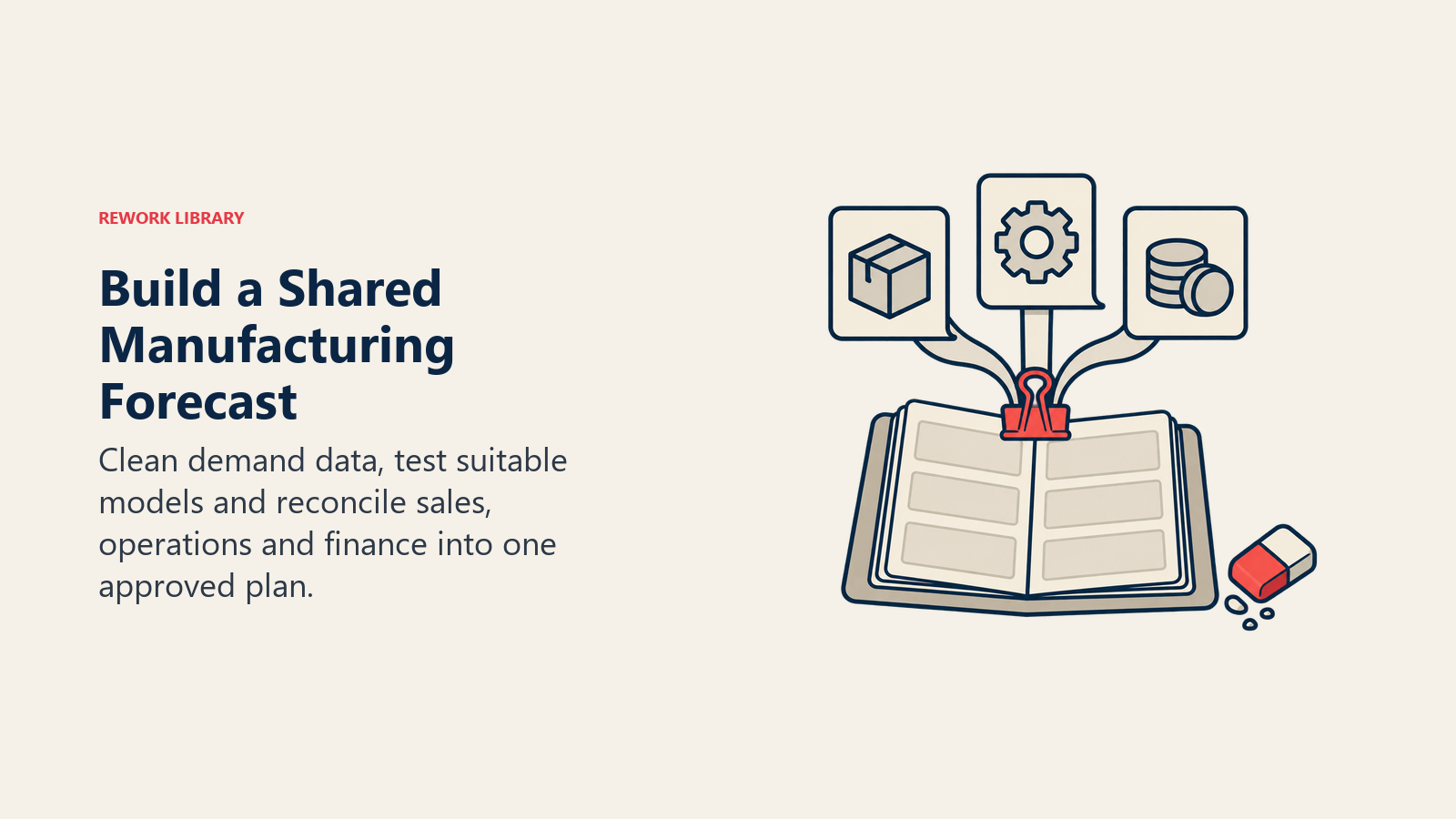
Sales and Operations Planning (S&OP) is the formal process for collaborative forecasting. Monthly S&OP meetings bring together sales, operations, finance, and leadership to create consensus forecasts. Understanding your manufacturing business models helps frame appropriate forecasting approaches.
The process typically follows: demand planning creates statistical forecasts, sales reviews and adjusts based on market intelligence, operations validates feasibility given capacity, finance translates to financial projections, and leadership approves or directs changes.
S&OP creates forecast ownership across functions. When sales, operations, and finance all contributed to forecasts, they share responsibility for execution. This prevents the common pattern where sales blames inaccurate forecasts for missed plans while operations blames sales for poor forecasting.
Accuracy Measurement
Track forecast accuracy religiously. You can't improve what you don't measure. Calculate accuracy metrics monthly and trend them over time.
Mean Absolute Percent Error (MAPE) is most common: MAPE = Σ|Actual - Forecast| / Σ Actual. Lower is better. MAPE of 20% means forecasts averaged 20% off actual demand. World-class is under 20% for most products.
Bias reveals whether forecasts are consistently high or low. Calculate as Σ(Forecast - Actual) / Σ Actual. Positive bias means systematic over-forecasting. Negative bias means under-forecasting. Zero bias is ideal.
Tracking signal combines error and bias to flag forecasts needing attention. It's calculated as running sum of forecast errors divided by mean absolute deviation. Values outside ±4 suggest forecast models need revision.
Managing Uncertainty: Dealing with Forecast Error
All forecasts are wrong. The question is how to plan effectively despite forecast error.
Safety Stock Strategies
Safety stock buffers against forecast error and supply variability. The amount needed depends on forecast error, desired service level, and replenishment lead time. Effective inventory optimization strategies balance forecast uncertainty with service levels.
Calculate safety stock using: Safety Stock = Z × σ × √LT, where Z is the service level factor (1.65 for 95%, 2.33 for 99%), σ is demand standard deviation, and LT is lead time. Higher service levels or longer lead times require more safety stock.
Don't apply the same service level to all products. A items might deserve 99% service levels. C items might accept 90%. Differentiated service levels reduce total inventory while maintaining service on critical products.
Flexible Capacity Approaches
Forecast uncertainty argues for flexible capacity that can respond to actual demand rather than rigid capacity tied to forecasts. Options include overtime capability, temporary labor pools, and contract manufacturing relationships.
Flexible capacity costs more per unit but reduces inventory costs and service failures. Calculate the trade-off. If flexibility costs 10% more per unit but reduces inventory 30% and improves service, it's probably worth it.
Continuous Improvement
Treat forecasting as a continuous improvement process. Review forecast errors monthly. Analyze why forecasts missed. Distinguish between forecast method problems (wrong model, poor parameters) and inherent uncertainty (random variation, unforecastable events).
Improve methods over time. As products mature, add historical data and improve model sophistication. As you learn demand drivers, incorporate them into causal models. As sales relationships strengthen, improve qualitative inputs.
Learn More
Enhance forecasting capabilities through:
- Production Planning Fundamentals explains how forecasts drive planning
- Master Production Scheduling uses forecasts to create schedules
- Material Requirements Planning explodes forecasts into component requirements
- Manufacturing Business Models discusses forecasting needs for different models
- Capacity Planning Strategy uses long-term forecasts for capacity decisions
- Manufacturing KPIs Overview covers forecast accuracy metrics
Forecasting as Continuous Improvement Process
Perfect forecasts are impossible, but continuous improvement toward good-enough accuracy is achievable. The path requires selecting appropriate methods, collecting clean data, engaging cross-functional input, measuring accuracy rigorously, and learning from errors.
Don't blame forecasting when plans fail. Poor forecasts are often symptoms of poor process, inadequate collaboration, or inappropriate methods for your situation. Fix the process and methods before blaming the inherent unpredictability of demand.
Build forecasting capability systematically. Start with simple methods and clean data. Add sophistication as you master fundamentals. Engage sales and customers in the process. Measure and improve continuously. That discipline transforms forecasting from necessary evil into competitive advantage that enables superior planning, service, and profitability.

Co-Founder, Rework.com