Manufacturing Sales Strategy: Aligning Production and Revenue Growth
Turn this article into takeaways for your work.


Each assistant summarizes the article only for you and suggests best practices for your work.
Your sales team just closed a major deal:$2 million over twelve months. Champagne all around. But when production reviews the order, problems emerge: the customer needs delivery in eight weeks, your capacity is booked twelve weeks out. They want customizations that require engineering resources you don't have available. And their quality requirements exceed your current capability without significant process investment.
You have a sale you can't profitably fulfill. This scenario repeats across manufacturing companies because sales and operations aren't strategically aligned. Sales pursues revenue without understanding production constraints. Operations optimizes for current products without considering strategic growth opportunities.
Effective manufacturing sales strategy bridges this gap: aligning what you sell with what you can profitably produce, and evolving production capabilities to support strategic growth.
Understanding Manufacturing Sales Dynamics
Selling manufacturing capabilities is fundamentally different from selling products or services because you're selling a constrained resource: your production capacity.
Product sales versus capability sales represents a critical distinction. When you sell products, customers care about the product itself. When you sell manufacturing capabilities, customers care about your ability to produce to their specifications with appropriate quality, delivery, and flexibility.
Contract manufacturers, custom fabricators, and OEM suppliers primarily sell capabilities. Even standard product manufacturers sell capabilities when customers need volume commitments, technical support, or customization. McKinsey research shows that building next-generation B2B sales capabilities is critical for manufacturing competitiveness.
This matters because capability selling requires different sales skills, different qualification criteria, and tighter operations integration than product selling.
Make-to-stock versus make-to-order versus engineer-to-order strategies determine your sales approach entirely. Make-to-stock means you produce based on forecast and sell from inventory. Sales cycles are short, but you carry inventory risk and have limited customization.
Make-to-order means you produce after receiving customer orders. Lead times are longer, but inventory is minimized and some customization is possible. Sales must forecast to enable capacity planning even though production awaits actual orders.
Engineer-to-order means each customer order requires significant design work. Lead times are longest, capital investment per order may be substantial, and operational complexity is high. Sales must heavily qualify opportunities to ensure you can deliver profitably.
Most manufacturers operate in hybrid modes: some standard products made to stock, some configured products made to order. Your sales strategy must align with your operational model or the disconnect creates chaos.
Sales and operations planning (S&OP) linkage provides the mechanism for aligning sales forecasts with production planning fundamentals and capacity, evaluating capacity implications of potential sales opportunities, balancing demand across product lines and time periods, and making strategic tradeoffs between volume, mix, margin, and capacity.
Companies with strong S&OP processes avoid crisis management driven by disconnected sales and operations activities. Companies without S&OP lurch between capacity constraints and underutilization.
Defining Your Manufacturing Value Proposition
Effective sales strategy starts with clarity about what makes your manufacturing capabilities valuable and differentiated.
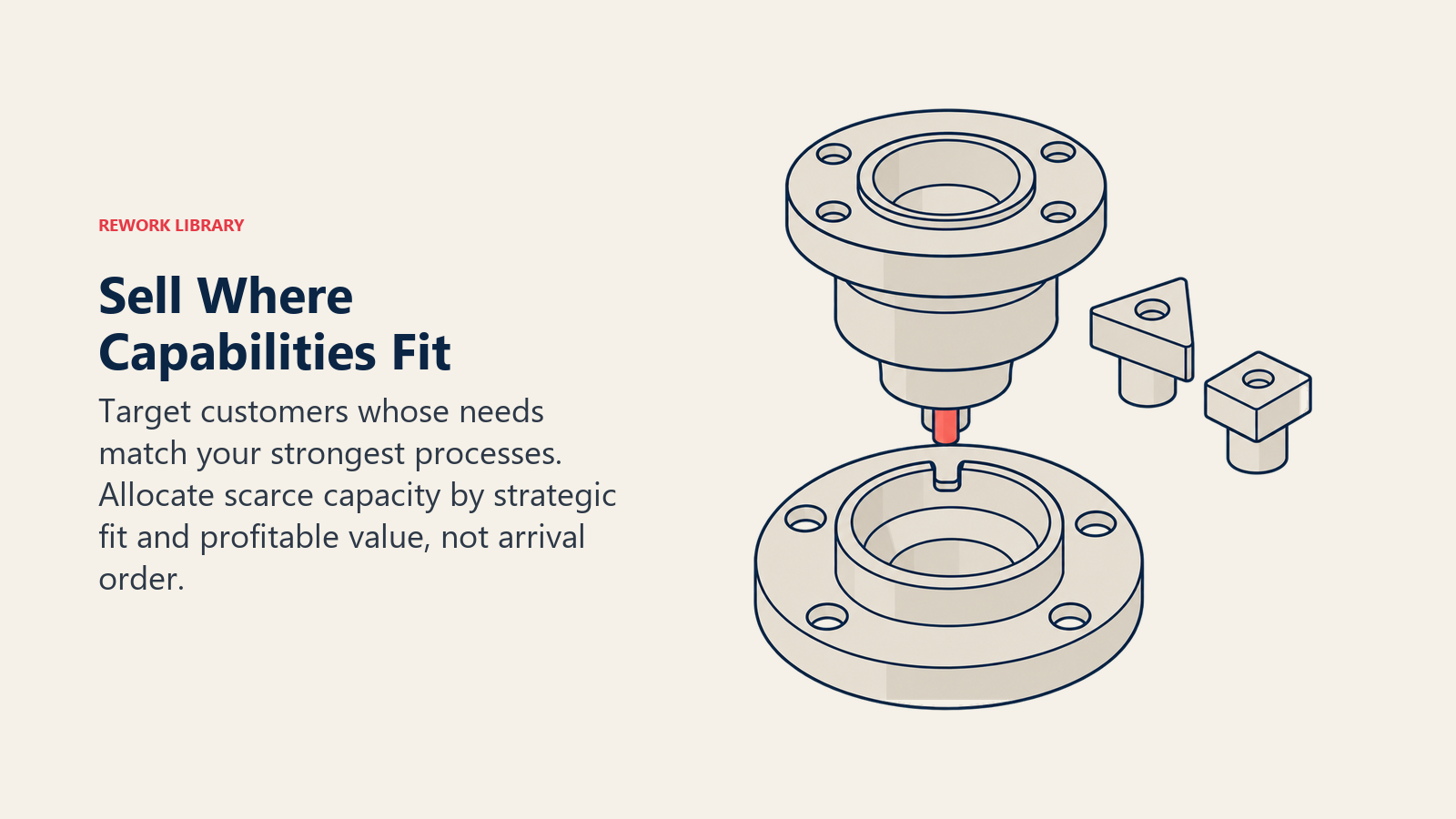
Core capabilities and differentiators describe what you do particularly well. Is it complex assemblies requiring tight tolerance control? High-mix, low-volume production with quick changeover? Large production runs with industry-leading efficiency? Vertically integrated capabilities from raw material to finished product?
Your capabilities determine which customer needs you can serve exceptionally versus adequately versus not at all. Strategic sales focus on opportunities that align with your strongest capabilities.
Many manufacturers try to be all things to all customers: taking any order that comes in. This creates operational chaos trying to serve customers whose needs don't fit your capabilities, and dilutes focus from customers where you could deliver exceptional value.
Target markets and customer segments should reflect where your capabilities create meaningful value. If your strength is high-volume, low-mix efficiency, target customers with stable, predictable demand for standard products. If your strength is flexibility and quick turnaround, target customers with variable demand and frequent product changes.
This segmentation guides sales prospecting and marketing, helps qualify opportunities faster, and improves win rates because you're pursuing opportunities where you have genuine advantages.
Pricing strategy and positioning flow from your capabilities and positioning. Are you the low-cost producer competing on price? The premium provider competing on quality, service, or technical capability? The flexible partner competing on responsiveness?
Each position requires different pricing approaches. Low-cost requires aggressive pricing with tight cost control. Premium requires value-based pricing with clear differentiation. Flexible requires pricing that reflects service level differences.
Trying to be premium priced while offering commodity capabilities, or low priced while providing high-touch service, creates customer confusion and margin pressure. Research from McKinsey shows that aftermarket and service are vital revenue opportunities for OEMs.
Capacity allocation decisions determine which customers and orders you prioritize when demand exceeds capacity. First-come-first-served is one approach, but probably not the best strategically.
Consider allocating capacity based on strategic value (customers aligned with your growth strategy), profitability (margin contribution per hour of capacity), relationship strength (long-term partners versus spot buyers), and total business potential (orders that could lead to larger future business).
These decisions directly impact revenue mix and profitability. Filling your capacity with low-margin work prevents you from serving high-margin customers. Capacity allocation is strategic, not just operational.
Structuring Sales Processes for Manufacturing Complexity
Manufacturing sales requires processes that address technical complexity and capacity constraints.
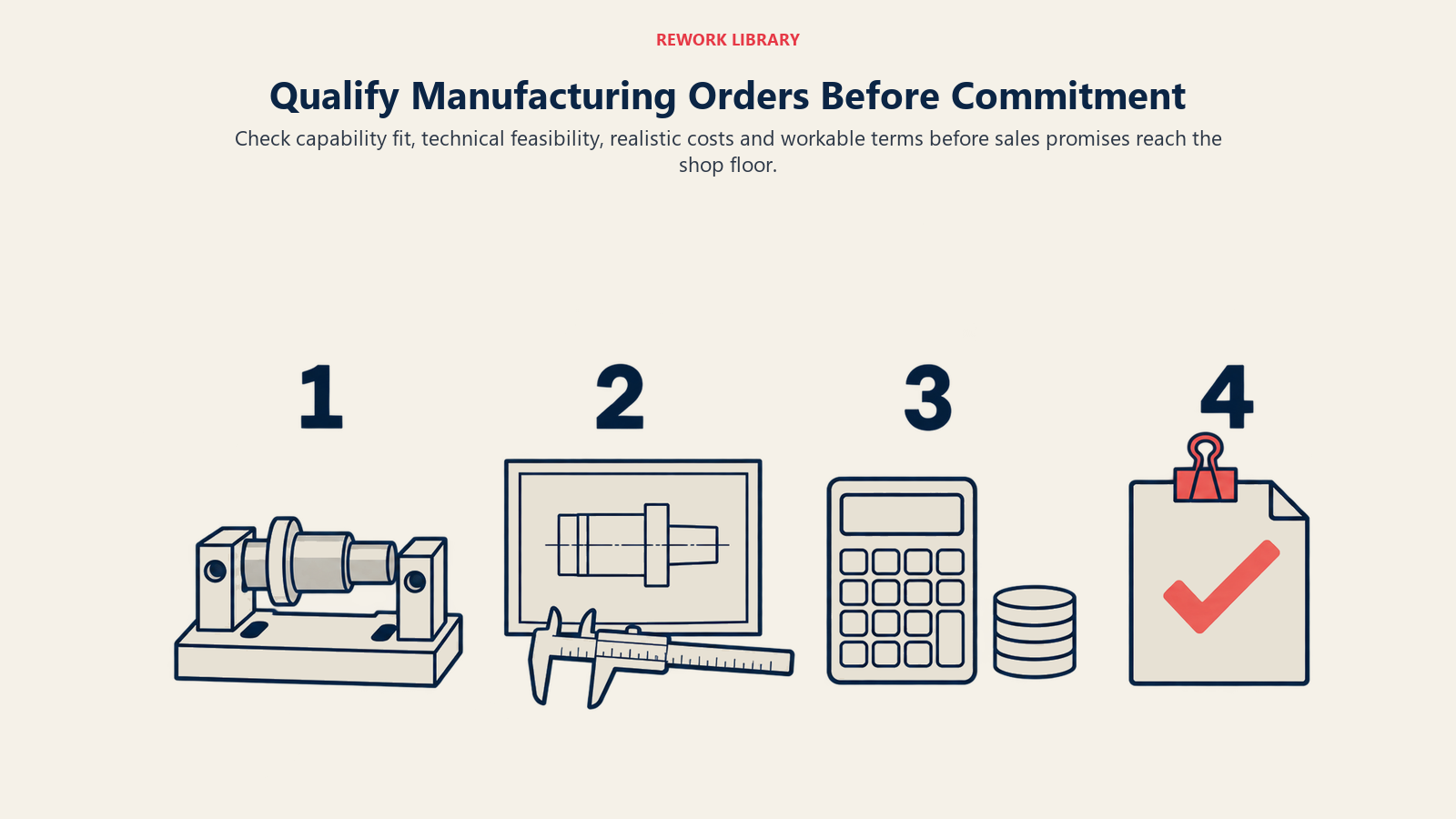
Lead qualification and capacity fit should happen early in the sales process. Before investing significant time in proposals and negotiations, determine if the opportunity aligns with your capabilities and capacity.
Key qualification questions: Does this opportunity fit our core capabilities? Can we meet the technical and quality requirements? Do we have or can we get the necessary capacity? Does the timing align with our production schedule? Is the business profitable at market pricing?
Disqualifying poor-fit opportunities quickly allows sales to focus effort on winnable, profitable business.
Technical sales support and engineering involvement is essential for complex manufacturing sales. Customers need confidence that you understand their requirements and can deliver. This requires technical expertise in sales conversations, engineering support for proposal development, manufacturing engineering input on feasibility and costing, and quality assurance involvement based on customer quality requirements for capability assessment.
Sales shouldn't promise capabilities or timelines without operations input. Operations shouldn't reject opportunities without understanding strategic value. Structured involvement of technical resources in the sales process balances these needs.
Proposal development and costing must accurately reflect production costs and capacity implications. Underestimating costs or lead times to win business creates financial losses and operational stress.
Rigorous costing includes materials at current market prices plus anticipated inflation, direct labor based on actual production standards, overhead allocation based on realistic rates, tooling and setup costs for new products, quality and testing requirements, and engineering support required.
Build in appropriate contingency for uncertainty, especially on engineer-to-order work where scope can expand.
Contract negotiation and terms protect you from customer requirements that create operational problems or financial risk. Key terms include delivery commitments realistic for your capacity, quality requirements achievable with your capabilities, payment terms that match your cash flow needs, change order processes for scope modifications, and liability limitations appropriate for your insurance coverage.
Sales teams under pressure to close deals sometimes accept terms that operations can't support or finance rejects as too risky. Clear guidelines and approval processes prevent this.
Integrating Sales and Operations for Sustainable Growth
The most successful manufacturers have destroyed the wall between sales and operations.
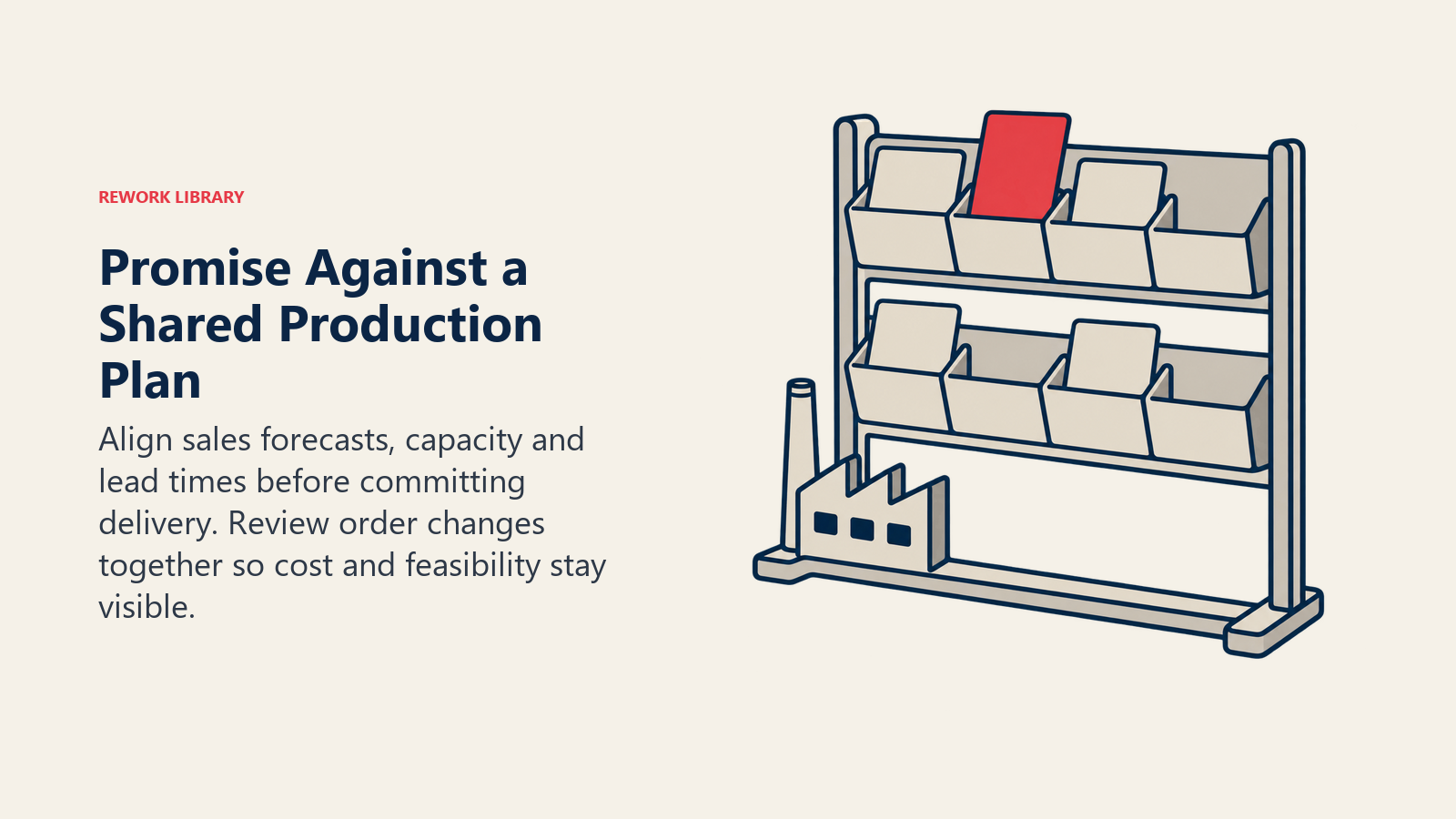
Sales forecasting and production planning work together continuously. Sales provides rolling forecasts of expected orders by product and time period. Operations provides capacity constraints and lead time requirements. Together they identify where demand exceeds capacity (requiring capacity expansion, allocation decisions, or sales pacing) or capacity exceeds demand (requiring sales focus, cost reduction, or capacity reduction).
This ongoing dialogue prevents surprises and enables proactive decisions.
Lead time commitments and scheduling must be realistic for current capacity and backlog. Nothing damages customer relationships faster than missed delivery commitments. Strong on-time delivery performance starts with realistic commitments.
If your current lead time is ten weeks based on backlog and capacity, don't let sales quote six weeks to win business. Either increase capacity, allocate existing capacity differently, or quote realistic lead times.
Some manufacturers provide sales with real-time visibility into production schedules and capacity utilization so they can quote accurate lead times. Others establish standard lead times by product with escalation processes for rush orders.
New customer onboarding process manages the transition from sales to production. This includes technical review of requirements and specifications, production planning and capacity allocation, tooling and setup requirements, quality planning and first article inspection, and documentation and training for production staff.
Structured onboarding prevents the chaos of unplanned new products hitting the shop floor without proper preparation.
Change order management handles modifications to existing orders. Customers frequently request changes: different quantities, altered specifications, accelerated timing.
Each change has operational and cost implications. Structured change order processes ensure changes are evaluated for feasibility and cost, quoted appropriately if they add cost, and properly communicated to operations if approved.
Without change control, "small" changes accumulate into major disruptions and cost overruns.
Measuring Manufacturing Sales Performance
Sales metrics for manufacturing must reflect both revenue generation and operational compatibility.
Revenue and margin by customer and product reveal profitability patterns. Which customers generate healthy margins versus minimal margins or losses? Which products are profitable versus unprofitable?
This analysis guides account management (invest in profitable relationships, fix or exit unprofitable ones) and product strategy (emphasize profitable products, improve or discontinue unprofitable ones).
Many manufacturers carry unprofitable customers or products for years because they track revenue but not true profitability including capacity costs.
Order backlog and booking trends provide forward visibility. Growing backlog indicates strong demand or insufficient capacity. Shrinking backlog may signal market weakness or need for sales focus.
Track backlog by customer type, product line, and expected production period. This shows not just total backlog but its composition and timing.
Capacity utilization and sales efficiency connect sales success to operational performance. Are you selling enough to maintain target utilization? Are you selling the right mix to optimize utilization?
High utilization with poor margins suggests selling to fill capacity rather than selling strategically. Low utilization with good margins suggests insufficient sales volume.
Customer profitability analysis evaluates total customer value including revenue and margin, cost to serve (engineering support, quality issues, rush orders), payment performance and terms, relationship stability and future potential, and strategic fit with your capabilities.
This comprehensive view often reveals that your largest customers aren't your most profitable, and some mid-size customers deliver exceptional value.
Common Sales-Operations Disconnects
Even with good intentions, predictable gaps emerge between sales and operations.
Overselling capacity creates schedule chaos and delivery failures. Sales, under pressure to make numbers, books more business than operations can deliver. Short-term revenue looks great but on-time delivery collapses, customer satisfaction drops, and operational costs spike through expediting and overtime.
Prevent this through real-time capacity visibility for sales, approval requirements for orders that stress capacity, and sales compensation tied partly to delivery performance not just revenue.
Underselling capabilities leaves money on the table. Operations has capacity and capability to serve additional customers or larger orders, but sales doesn't understand or communicate these capabilities.
Regular communication of capacity availability and capability evolution helps sales identify opportunities to grow volume or enter new markets.
Pricing below cost is surprisingly common, especially for custom manufacturing where costing is complex. Sales quotes a price to win business without accurate cost estimates. Operations produces at a loss.
Rigorous costing processes and pricing approval thresholds prevent this. Every quote should reflect actual cost plus appropriate margin.
Accepting technically unfeasible work creates quality problems and cost overruns. Sales commits to specifications or tolerances that push or exceed your capability. Operations struggles to deliver, quality suffers, and the customer relationship deteriorates.
Technical review before proposal commitment prevents this. If you can't reliably meet requirements, don't accept the work.
Building Sales Strategy Around Manufacturing Excellence
The most successful manufacturing companies make operational excellence a sales differentiator.
This means investing in capabilities that create competitive advantage, not just meeting customer minimums but delivering exceptional quality, lead times, flexibility, or technical support that competitors can't match.
It requires sales teams who understand your operational capabilities deeply and can articulate them clearly to customers. Technical fluency in sales isn't optional for complex manufacturing. It's essential for credible customer conversations.
It demands discipline to pursue business that fits your strategic direction and operational strengths. Not every opportunity is good business. Selective focus on the right opportunities drives both growth and profitability.
Your production capabilities determine what you can sell successfully. Your sales strategy determines whether those capabilities translate into profitable growth. Align them tightly, and you build sustainable competitive advantage. Allow them to drift apart, and you create operational stress and financial underperformance.
Manufacturing sales strategy isn't about sales alone. It's about the integrated system of capability development, capacity management, customer selection, and value delivery that drives profitable growth.
Learn More

Co-Founder, Rework.com
On this page
- Understanding Manufacturing Sales Dynamics
- Defining Your Manufacturing Value Proposition
- Structuring Sales Processes for Manufacturing Complexity
- Integrating Sales and Operations for Sustainable Growth
- Measuring Manufacturing Sales Performance
- Common Sales-Operations Disconnects
- Building Sales Strategy Around Manufacturing Excellence
- Learn More