Robotics and Automation: Strategic Deployment for Manufacturing Productivity
Turn this article into takeaways for your work.


Each assistant summarizes the article only for you and suggests best practices for your work.
A furniture manufacturer faced a chronic problem: their finishing operation required skilled workers to sand complex curved surfaces. Training took six months. Turnover was 40% annually. Quality varied based on worker fatigue and experience. The bottleneck prevented them from accepting larger orders.
Traditional industrial robots couldn't handle the irregular surfaces and required extensive custom programming. Then collaborative robots (cobots) with force-sensing capability became viable. The company deployed cobots that learned the contours through initial manual guidance, then replicated the motion with consistent pressure and coverage.
The result wasn't replacing workers entirely. it was augmenting them. Operators now guide cobots through the initial teaching phase and handle complex geometries. The cobots handle repetitive, physically demanding sanding. Throughput increased 85%, quality consistency improved, and the workforce pain points around difficult working conditions and training disappeared.
Robotics and Automation as Productivity Enablers
Robotics and automation encompasses technologies that reduce or eliminate human involvement in manufacturing tasks. This ranges from simple mechanization (a conveyor moving parts) to sophisticated robots that sense, adapt, and collaborate with human workers.
Fixed automation performs a single task repeatedly with minimal flexibility. Think of a transfer line in automotive manufacturing or a bottling line. extremely efficient for high-volume, standardized production but costly to change when products change. Flexible automation can be reprogrammed for different tasks, providing versatility at the expense of some speed and efficiency.
Industrial robots are programmable, multi-axis machines capable of complex movements. Traditional industrial robots operate in caged cells for safety, working independently of human workers. Collaborative robots (cobots) include safety features enabling them to work alongside humans without guarding. This collaboration combines robot precision and endurance with human problem-solving and adaptability.
The levels of automation range from manual operations (human performs all work) through mechanized assistance (tools that reduce physical effort), semi-automated systems (machines perform tasks with human oversight), automated systems (machines perform tasks autonomously), to fully autonomous operations (systems that sense, decide, and act without human intervention). Most manufacturers operate across this spectrum rather than at one extreme.
Understanding Automation Technologies
Traditional industrial robots come in several configurations. Articulated robots have multiple rotary joints (like a human arm), offering maximum flexibility for complex assembly, welding, and material handling. SCARA robots have rigid vertical arms with rotational motion, ideal for pick-and-place operations. Delta robots use parallel linkages for extremely fast operations like packaging and sorting. Cartesian robots move along three linear axes, providing precision for applications like 3D printing and CNC machine tending.
Collaborative robots represent a different philosophy. robots designed from the ground up to work safely alongside humans. They include force-limiting safety features, rounded edges to prevent pinch points, and intuitive programming interfaces. Cobots trade some speed and payload capacity for safety and flexibility. They shine in applications requiring frequent changeover, limited space, or close human-robot collaboration.
Automated guided vehicles (AGVs) and autonomous mobile robots (AMRs) handle material movement. AGVs follow fixed paths using magnetic tape, wires, or beacons. AMRs use sensors and mapping to navigate dynamically, routing around obstacles and adapting to changing layouts. AMRs offer greater flexibility at higher cost, while AGVs provide reliable performance in stable environments.
Pick-and-place and assembly automation ranges from simple pneumatic systems to vision-guided robots. Modern systems use cameras and AI to identify parts in random orientations, select the correct part, and place it precisely. This flexibility eliminates the need for complex parts feeding systems.
Automated inspection systems use cameras, lasers, and sensors to check dimensions, detect defects, and verify assembly. These systems inspect 100% of production at speeds impossible for human inspectors, providing consistent quality control without fatigue or distraction.
Machine tending automation loads raw materials into machines and removes finished parts, eliminating the need for operators to stand at machines during processing cycles. This frees workers for higher-value activities while keeping machines running during breaks and shift changes.
Assessing Automation Opportunities
Volume-variety-variation analysis determines whether automation makes economic sense. High volume, low variety, minimal variation. this is automation's sweet spot. Custom products in quantities of one? Automation struggles and human flexibility wins. The challenge comes in the middle ground where both approaches have merit.
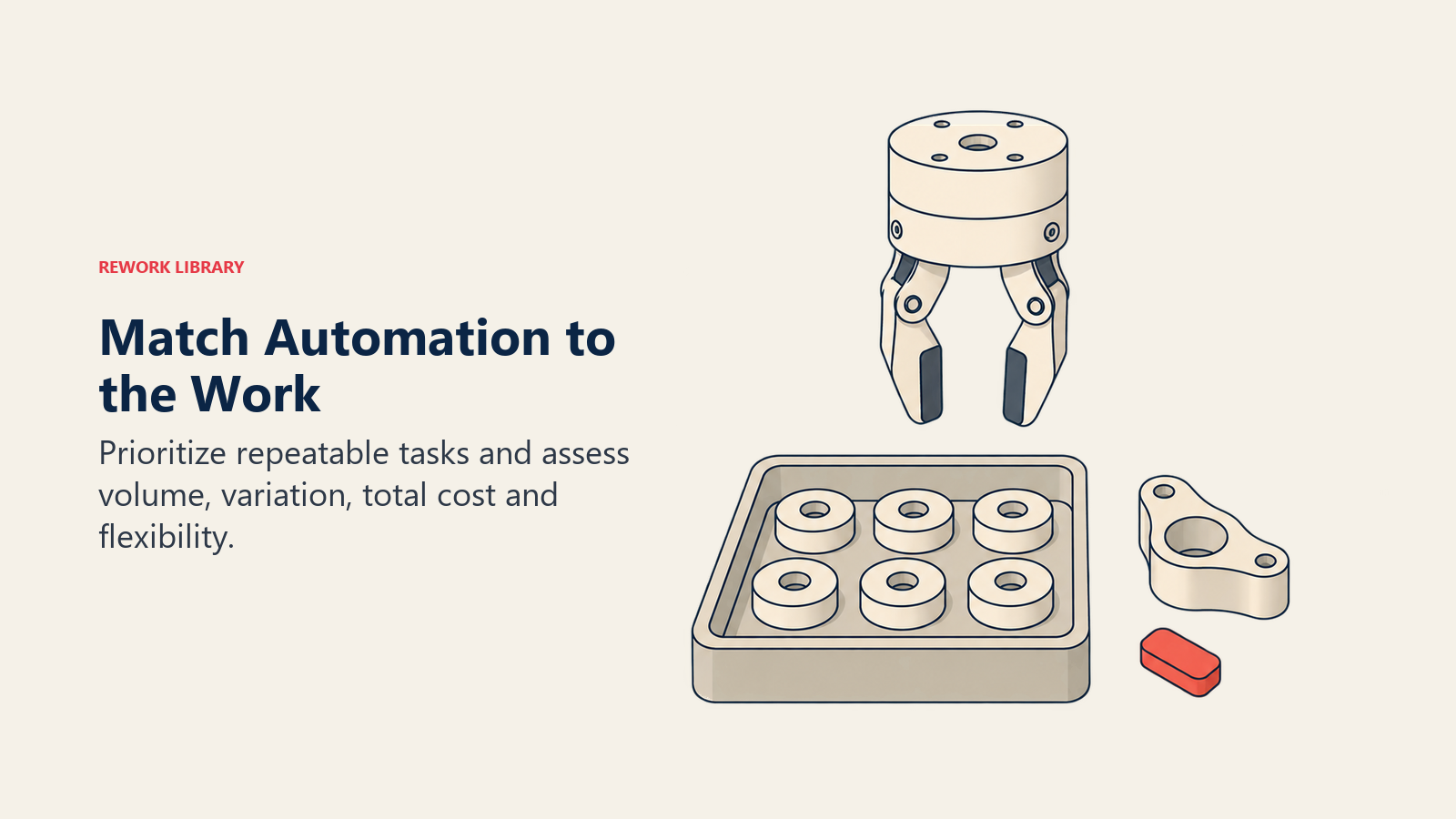
A fabrication shop analyzed their production mix: 40% high-runners that repeated weekly, 30% medium-volume jobs that ran monthly, and 30% low-volume custom work. They automated the high-runners, used flexible work cells for medium-volume work, and kept manual processes for custom jobs. This hybrid approach matched automation to the right applications.
Manual process assessment criteria identify good automation candidates. Repetitive tasks are automation's strength. humans get bored and inconsistent, robots don't. Hazardous operations involving heat, chemicals, or heavy loads protect workers when automated. Precision-critical processes benefit from robot repeatability. Tasks requiring consistent force or speed see quality improvements from automation.
ROI calculation methodology must account for total costs and benefits. Initial capital includes equipment, installation, safety systems, and integration. Ongoing costs include maintenance, programming, and energy. Benefits include direct labor savings, quality improvements (reduced scrap and rework), throughput increases, and reduced workers' compensation claims. Don't forget to factor in the opportunity cost of production capacity freed up for growth.
Flexibility requirements and future-proofing matter for long-term value. Is this product likely to change? Will you need to automate similar processes? Equipment that can be reprogrammed and redeployed has higher value than dedicated automation locked to a single task. The fastest payback isn't always the best choice if it creates inflexibility.
Make versus buy versus integrate decisions affect both cost and capability. Turn-key cells from automation vendors cost more but reduce implementation risk. Buying individual robots and integrating them in-house offers flexibility and lower cost if you have the expertise. Contract integrators split the difference, providing expertise without building permanent internal teams.
Implementation Planning
Process standardization before automation is essential. You don't want to automate a bad process. you'll just make mistakes faster. Document current methods, eliminate unnecessary steps, standardize part presentation, and reduce variation. The time invested in process improvement makes automation implementation smoother and results better.
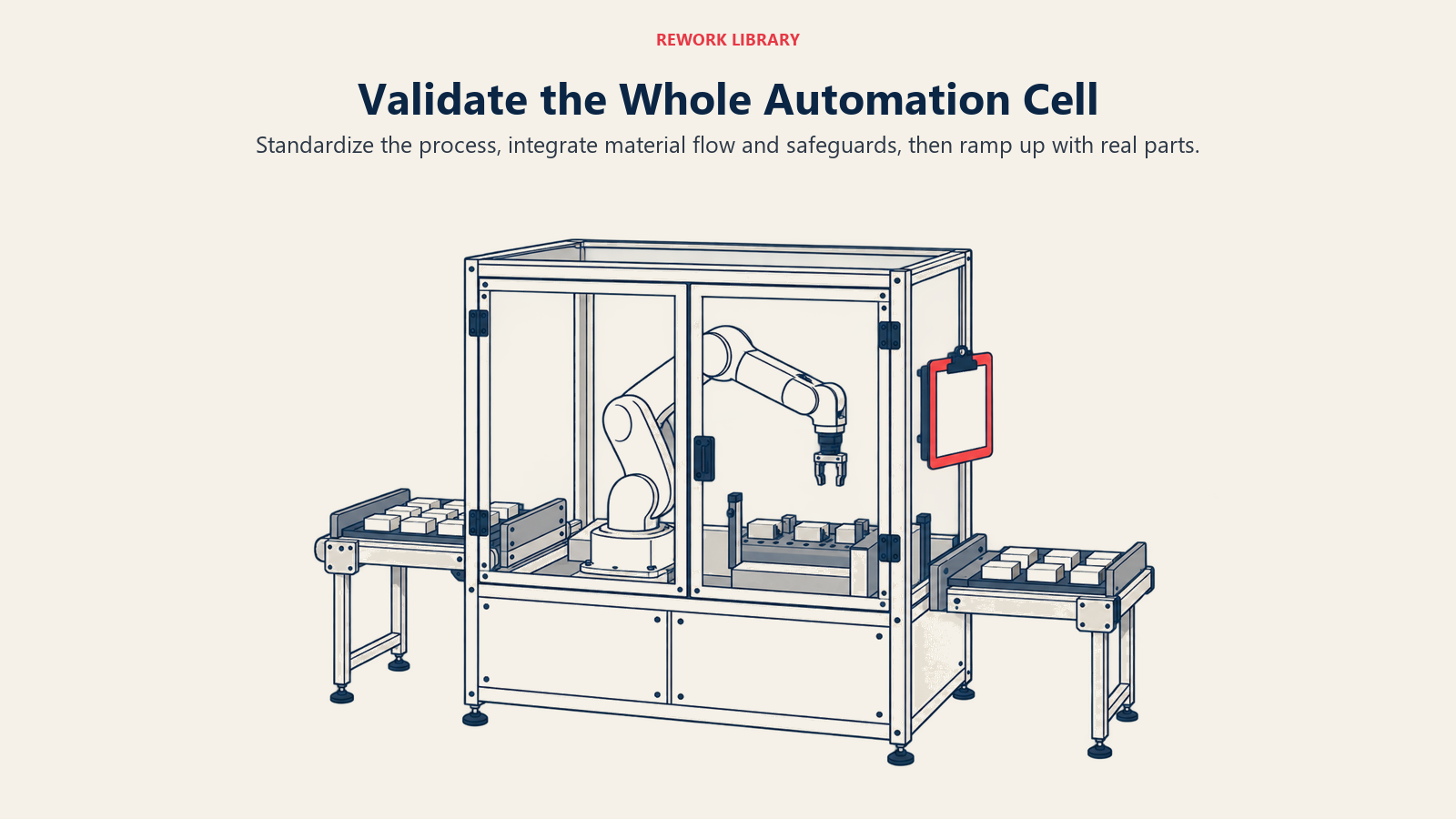
Workcell design and integration requires thinking beyond just the robot. How do parts feed into the cell? How do finished parts exit? What sensors detect part presence and quality? How does the cell communicate with upstream and downstream processes? A well-designed workcell integrates seamlessly into material flow and information systems.
Safety system requirements depend on automation type. Traditional robots require physical guarding, light curtains, or presence sensors that stop motion when humans enter danger zones. Collaborative robots might operate with reduced speed when humans are present and normal speed when alone. Safety systems must comply with standards (ANSI/RIA, ISO) and protect workers while minimizing false stops that hurt productivity.
Integration with existing equipment and systems extends automation value. The robot needs to communicate with machines it tends, conveyor systems that feed it, quality systems that collect its data, and manufacturing execution systems that assign its work. Standard industrial protocols (OPC-UA, Ethernet/IP) enable this integration, but plan for it from the start.
Validation and ramp-up approach reduces go-live risk. Run the cell in simulation before installation. Test with actual parts in parallel with existing processes. Gradually increase speed and throughput as confidence builds. Keep the old process available as backup during the first weeks of production.
Managing the Human Side
Skills transformation and retraining acknowledges that automation changes jobs rather than simply eliminating them. Operators become robot supervisors and troubleshooters. New roles emerge: robot programmers who configure cells for new products, technicians who maintain increasingly sophisticated equipment, engineers who integrate automation into processes. Invest in training existing workers for these roles rather than assuming you need entirely new staff.
Job redesign and human-robot collaboration optimizes the combination of human and robot capabilities. Let robots handle repetitive, physically demanding, or precision-critical tasks. Let humans handle problem-solving, quality judgment, and adaptation to variation. A electronics assembly line redesign put robots on precise component placement while humans handled inspection, testing, and exception handling. Both robots and workers operated more effectively in their optimal roles.
Change management and communication addresses the fear and resistance that automation triggers. Workers worry about job security. Supervisors fear loss of control. Engineers resist changes to familiar processes. Address these concerns directly: communicate the business case for automation, involve workers in implementation planning, demonstrate how automation makes their jobs better, and share success stories.
An industrial equipment manufacturer brought operators to visit successful automation installations at other companies before implementing their own. Seeing that automation created better jobs (less heavy lifting, more problem-solving) rather than eliminating jobs reduced resistance and generated ideas for implementation.
New roles created by automation expand employment in unexpected ways. Robot programmers configure cells for new products. Vision system specialists develop inspection applications. Maintenance teams grow to support more sophisticated equipment. Data analysts mine automation data for process improvements. Some companies find they employ more people after automation, just in different roles.
Advanced Automation Capabilities
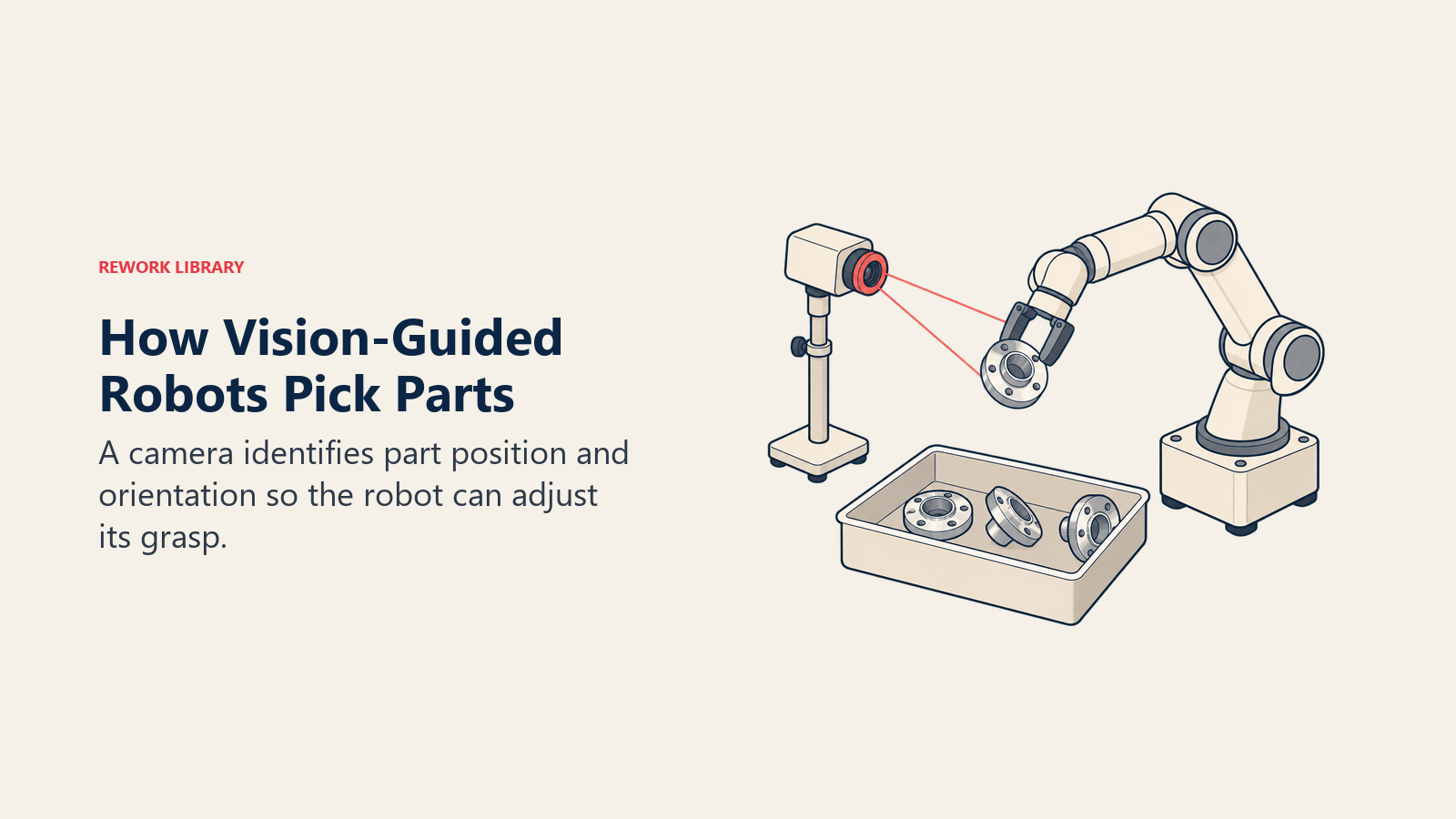
Vision-guided robotics eliminates the need for precise part positioning. Cameras identify parts in random orientations on conveyors or bins. The vision system calculates part location and orientation and guides the robot to pick the part correctly. This flexibility reduces expensive fixturing and parts feeding systems, similar to AI-powered quality inspection.
Force-sensing and adaptive automation enables robots to handle variation that would confuse traditional robots. A cobot assembling components can detect when parts don't fit properly, apply appropriate force without damage, and adapt its motion to component variation. This flexibility approaches human-like adaptability while maintaining robot consistency.
AI-enabled robots that learn and adapt represent the next evolution. These systems use machine learning to optimize their own motion, adapt to changing conditions, and improve performance over time. A robot learning to weld might initially follow programmed paths, then use vision and AI to recognize seam variations and automatically adjust technique. The robot improves with experience like a human welder does.
Lights-out manufacturing feasibility depends on process stability, product complexity, and quality control capability. Truly unmanned operations require reliable equipment maintenance, comprehensive sensing to detect problems, and automation sophisticated enough to handle normal variation without human intervention. Few manufacturers achieve full lights-out production, but many run unattended during shifts or weekends for stable processes.
Strategic Automation for Competitive Manufacturing
Successful automation isn't about replacing people with robots wherever possible. It's about strategic deployment based on clear business cases, matching the right technology to the right application, and managing workforce transition thoughtfully.
The manufacturers seeing greatest automation success started with clear objectives. specific productivity, quality, or capacity problems to solve. They assessed processes rigorously to identify where automation delivered value. They standardized before automating. They involved workers in planning and implementation. They treated automation as a long-term capability to build rather than one-time projects.
The competitive advantage comes not from automation technology itself. competitors can buy the same robots. but from the expertise to deploy it effectively, integrate it seamlessly, and continuously optimize it. That expertise develops through systematic implementation and learning.
Start with focused applications where ROI is clear. Build internal capability. Scale what works. The goal isn't maximum automation. it's optimal automation that combines robot and human capabilities to create manufacturing operations that competitors can't match.
Learn More
