Material Requirements Planning: Ensuring Right Materials at Right Time

Turn this article into takeaways for your work.


Each assistant summarizes the article only for you and suggests best practices for your work.
Before MRP, manufacturers managed materials reactively. They stockpiled inventory to prevent shortages, expedited constantly, and struggled with cash tied up in materials. MRP transformed this chaos into coordinated planning that calculates precisely what materials are needed, when, and in what quantities.
MRP isn't magic, though. It's systematic logic that depends on accurate data and disciplined execution. With 95%+ data accuracy and proper implementation, MRP delivers excellent results. With poor data and undisciplined use, it creates more problems than it solves.
What Is Material Requirements Planning
Material Requirements Planning (MRP) is a production planning and inventory control system that calculates material and component requirements based on master production schedules, bills of materials, and inventory status. Developed by Joseph Orlicky in 1964 in response to the Toyota Manufacturing Program, MRP revolutionized manufacturing planning. It answers three questions: What do we need? How much do we need? When do we need it?
Purpose and Benefits
MRP purposes include coordinating material availability with production schedules, minimizing inventory investment, improving customer service through better material availability, and reducing expediting costs. It shifts materials management from reactive to proactive.
The benefits are substantial when implemented properly: 20-30% inventory reductions, 10-15% customer service improvements, 40-60% reductions in expedite costs, and 15-20% improvements in planner productivity. Harvard Business Review documented MRP's explosive growth from 700 companies in 1975 to 8,000 by 1981. These aren't theoretical. They're what well-implemented MRP delivers consistently.
But MRP requires investment: accurate data, proper system configuration, trained planners, and organizational discipline. Manufacturers who skip these investments wonder why their MRP doesn't work. It's not the logic. It's the implementation.
MRP vs. MRP II vs. ERP
MRP calculates material requirements. MRP II (Manufacturing Resource Planning) extends this to capacity planning, shop floor control, and financial integration. ERP (Enterprise Resource Planning) extends further to encompass sales, purchasing, accounting, and business-wide integration.
Most modern systems are MRP II or ERP. They include MRP logic plus additional capabilities. When people say "MRP," they often mean the materials planning module within broader systems. Understand what your system includes to use it appropriately.
Key Inputs and Outputs
MRP inputs are master production schedule (what to build and when), bill of materials (what components each product requires), inventory records (what's on hand and on order), and lead times (how long procurement takes). Without accurate inputs, outputs will be wrong.
MRP outputs are planned orders (recommendations to produce or buy materials), order reschedule messages (recommendations to expedite or delay existing orders), and exception messages (warnings about problems requiring planner attention). Planners act on these outputs to execute material plans.
MRP Logic: How the System Works
Understanding MRP logic helps planners troubleshoot problems and make better decisions. The logic isn't complex, but it's precise and unforgiving of data errors.
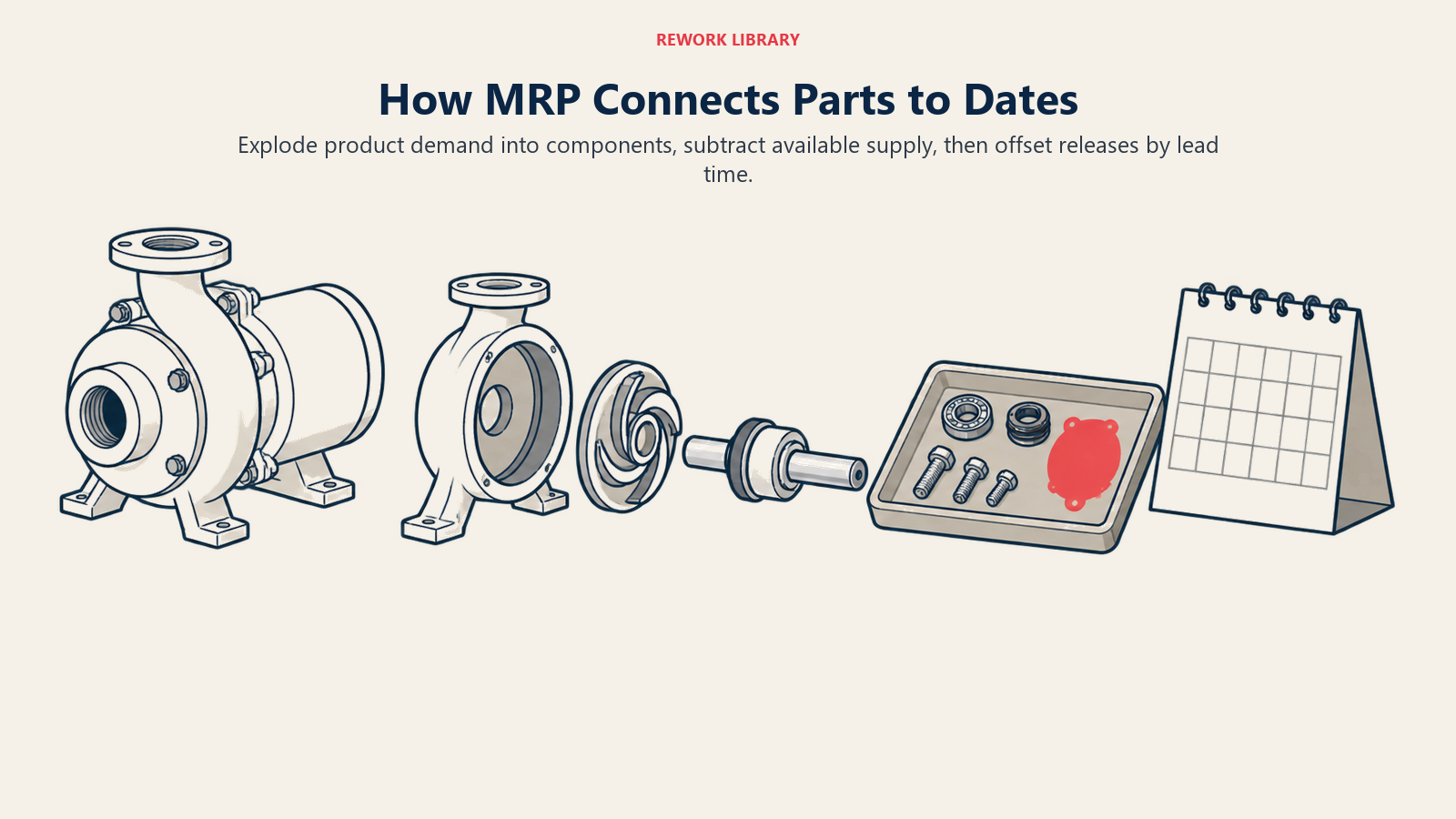
Bill of Materials Explosion
BOM explosion multiplies MPS quantities by component requirements at each product level. If the MPS says produce 100 units of Product A, and each Product A requires 2 units of Component B, MRP explodes this to 200 units of Component B demand. Understanding your manufacturing value chain helps structure accurate BOMs.
Multi-level BOMs explode through multiple levels. Product A requires Component B, which requires Part C. MRP calculates requirements at each level working from top (finished goods) to bottom (raw materials). This is where MRP provides value that manual methods can't match.
Low-level coding ensures components are calculated at their lowest BOM level before processing. If Component B appears in both Product A and Product D, MRP calculates total B requirements from all sources before determining net requirements. This prevents processing the same component multiple times with wrong timing.
Netting and Lot Sizing
Netting calculates net requirements by subtracting on-hand inventory and on-order quantities from gross requirements. If you need 200 units, have 50 on hand, and have 100 on order, net requirement is 50 units. MRP only plans to acquire the net requirement.
Lot sizing determines order quantities. Several rules exist:
Lot-for-lot orders exactly what's needed each period. It minimizes inventory but creates many small orders. Use for expensive items or highly variable demand.
Fixed order quantity orders the same amount every time, regardless of period requirements. Simple but creates excess inventory when requirements vary.
Economic order quantity (EOQ) balances ordering costs and carrying costs mathematically. It works well for stable demand but poorly for erratic demand.
Period order quantity aggregates requirements across multiple periods. It reduces order frequency while maintaining some demand responsiveness.
Lead Time Offsetting
Lead time offsetting calculates order release dates by working backward from need dates. If you need materials in week 10 and lead time is 3 weeks, MRP schedules the order for release in week 7.
This timing calculation cascades through BOM levels. Finished goods need dates drive component need dates, which drive raw material need dates. MRP coordinates this timing automatically, which is impossible to do manually for complex products.
But lead time offsetting only works if lead times are accurate. Overstated lead times create early orders and excess inventory. Understated lead times create late orders and shortages. Review actual lead times quarterly and update system parameters.
Action Messages
Action messages alert planners to conditions requiring decisions. Common messages include:
Order release: time to place this planned order. Schedule shortage: demand exceeds supply, investigate. Expedite: existing order needed earlier than scheduled. De-expedite: existing order not needed as soon as scheduled, delay to reduce inventory. Cancel: order no longer needed.
Planners should review action messages daily and respond promptly. Ignoring messages defeats MRP's purpose. The system can only guide; planners must act.
Implementation Requirements: Getting MRP Right
MRP's success depends more on implementation quality than software selection. The most expensive system fails with poor implementation. Adequate software succeeds with excellent implementation.

Data Accuracy Needs
MRP requires 95%+ accuracy in three data categories: BOM accuracy, inventory record accuracy, and master data accuracy (lead times, lot sizes, safety stocks). Below 95% accuracy, MRP generates so many errors that planners stop trusting it.
Bill of materials accuracy means every component, quantity, and relationship is correct. One error cascades through all downstream calculations. Implement engineering change control to keep BOMs current. Audit BOM accuracy quarterly through physical verification.
Inventory record accuracy means system records match physical reality. Implement cycle counting to maintain accuracy without annual physical inventories. Investigate and fix discrepancies within 24 hours. Track accuracy by location and item category.
Master data accuracy means lead times reflect reality, safety stocks are appropriate, and lot sizing rules make sense. Review these parameters quarterly as conditions change. Wrong parameters create systematic planning errors that planners work around, undermining the system.
System Configuration
Configure MRP systems to match your business. Key configuration choices include:
Planning horizon: how far forward MRP calculates. Set at least as long as longest cumulative lead time plus planning buffer. Too short creates artificial shortages.
Planning frequency: how often MRP regenerates. Daily regenerative MRP reflects current status. Weekly is adequate for stable environments. Match frequency to planning needs without creating excess system churn.
Safety stock: buffer inventory against uncertainty. Set based on demand variability and service level targets. Too much wastes cash. Too little creates stockouts.
Time fences: periods where changes are restricted. Frozen zones (1-4 weeks) lock plans for execution stability. Flexible zones allow changes as conditions evolve.
Planner Roles and Responsibilities
MRP doesn't eliminate planners; it changes their role from calculating requirements (system does this) to exception management and decision-making. Effective planners:
Review and act on MRP action messages daily, prioritizing based on impact and urgency.
Resolve exceptions collaboratively with purchasing, production, and engineering rather than forcing unilateral decisions.
Validate MRP outputs for reasonableness. Systems occasionally generate nonsensical recommendations. Planners must catch these before releasing orders.
Maintain planning parameters. Update lead times, review safety stocks, adjust lot sizing rules based on performance analysis.
Improve data accuracy. Planners are best positioned to spot BOM errors, inventory discrepancies, and parameter problems.
Optimization Strategies: Making MRP Work Better
Once MRP basics work, optimize to improve performance further.
Advanced Planning Parameters
Scrap allowances account for expected yield losses. If 5% typically scraps, plan 105% to ensure net requirements are met. Don't ignore expected scrap; it creates systematic shortages.
Safety lead time adds buffer time instead of buffer stock. Order materials X days earlier than needed to buffer against supplier delays. Use safety lead time for unreliable suppliers or critical components.
Phantom parts simplify BOMs for sub-assemblies that never stock. They appear in BOM for planning but orders flow through to components. Use for transient assemblies to reduce BOM levels without losing planning visibility.
Integrating with Capacity Planning
MRP assumes infinite capacity. It schedules whatever master schedule requires without checking whether work centers can handle the load. This creates infeasible plans when capacity is tight.
Integrate MRP with Capacity Requirements Planning (CRP) to verify capacity can support material plans. CRP calculates work center loads from MRP planned orders. If capacity is insufficient, adjust MPS before releasing MRP plans. Capacity planning strategy guides these decisions.
Handling Planning Nervousness
Planning nervousness occurs when small changes cause large plan fluctuations. Demand changes slightly and MRP reschedules hundreds of orders. This creates chaos and costs as suppliers and production constantly adjust.
Reduce nervousness through firm planned orders that system can't automatically reschedule, time fences that limit when changes are allowed, damping parameters that require significant changes before replanning, and lot sizing that aggregates small changes.
Supplier Collaboration
Share MRP outputs with key suppliers. Instead of just sending purchase orders, provide visibility to planned orders 3-6 months out. Suppliers can plan their materials and capacity to better support you. Strong manufacturing supply chain strategy includes supplier integration.
Some manufacturers give suppliers direct MRP system access. Suppliers log in to see requirements, accept orders, and update delivery status. This transparency reduces communication delays and improves coordination.
Learn More
Expand MRP knowledge through:
- Production Planning Fundamentals provides planning context for MRP
- Master Production Scheduling creates MPS that drives MRP
- Manufacturing Value Chain shows MRP's role in material flow
- Manufacturing KPIs Overview covers metrics for MRP performance
- Demand Forecasting for Manufacturing improves demand inputs to MRP
- Just-in-Time Production provides alternative to traditional MRP approaches
MRP as Foundation for Materials Excellence
MRP transformed manufacturing from reactive firefighting to proactive planning. But transformation only happens when manufacturers commit to data accuracy, proper configuration, trained planners, and execution discipline.
Too many manufacturers implement MRP, find it doesn't work magically, and revert to manual planning. The problem isn't MRP. It's inadequate implementation. Fix the implementation before abandoning the tool.
Start with data accuracy. Without 95%+ accuracy in BOMs, inventory, and master data, don't bother with sophisticated planning. Fix data first. Then implement MRP in phases: start with A items and expand as you prove the basics work.
Train planners properly. They need to understand MRP logic, interpret messages, handle exceptions, and maintain parameters. Invest in training. Untrained planners can't leverage MRP capabilities.
Execute recommendations faithfully. When MRP says release orders, release them. When it says expedite, expedite. When it says delay, delay. Selective execution undermines system integrity. If recommendations seem wrong, fix parameters or data, don't just ignore them.
That discipline:accurate data, proper configuration, trained planners, faithful execution:transforms MRP from software feature to competitive advantage through superior material availability, lower inventory, and reduced expedite costs.
