Manufacturing Execution Systems: Bridging Planning and Shop Floor Execution
Turn this article into takeaways for your work.


Each assistant summarizes the article only for you and suggests best practices for your work.
A pharmaceutical manufacturer had a sophisticated ERP system that managed planning, inventory, and financials. They had state-of-the-art production equipment with PLCs and SCADA systems. But between the two? A gap filled with paper travelers, manual data entry, and spreadsheets.
When regulators asked for complete production history of a specific batch, it took three weeks to compile data from paper records scattered across the plant. When customers called about order status, production had to physically walk the floor to find products. When quality issues occurred, root cause analysis was guesswork because detailed process data didn't exist.
They implemented a Manufacturing Execution System to bridge the gap between planning (ERP) and execution (shop floor). Eighteen months later:
- Batch genealogy and traceability queries answered in minutes, not weeks
- Real-time production status visible on dashboards
- Complete process data captured automatically for every unit
- Overall Equipment Effectiveness improved from 67% to 84%
- Quality issues investigated and resolved 70% faster
That's what MES does. it connects strategic planning with operational execution, providing the visibility, control, and documentation that modern manufacturing demands.
MES as the Bridge Between Planning and Execution
Enterprise Resource Planning (ERP) systems are excellent at managing what and when to produce. They handle planning, inventory management, purchasing, financials, and order management. But ERP operates at a relatively high level with daily or weekly time horizons.
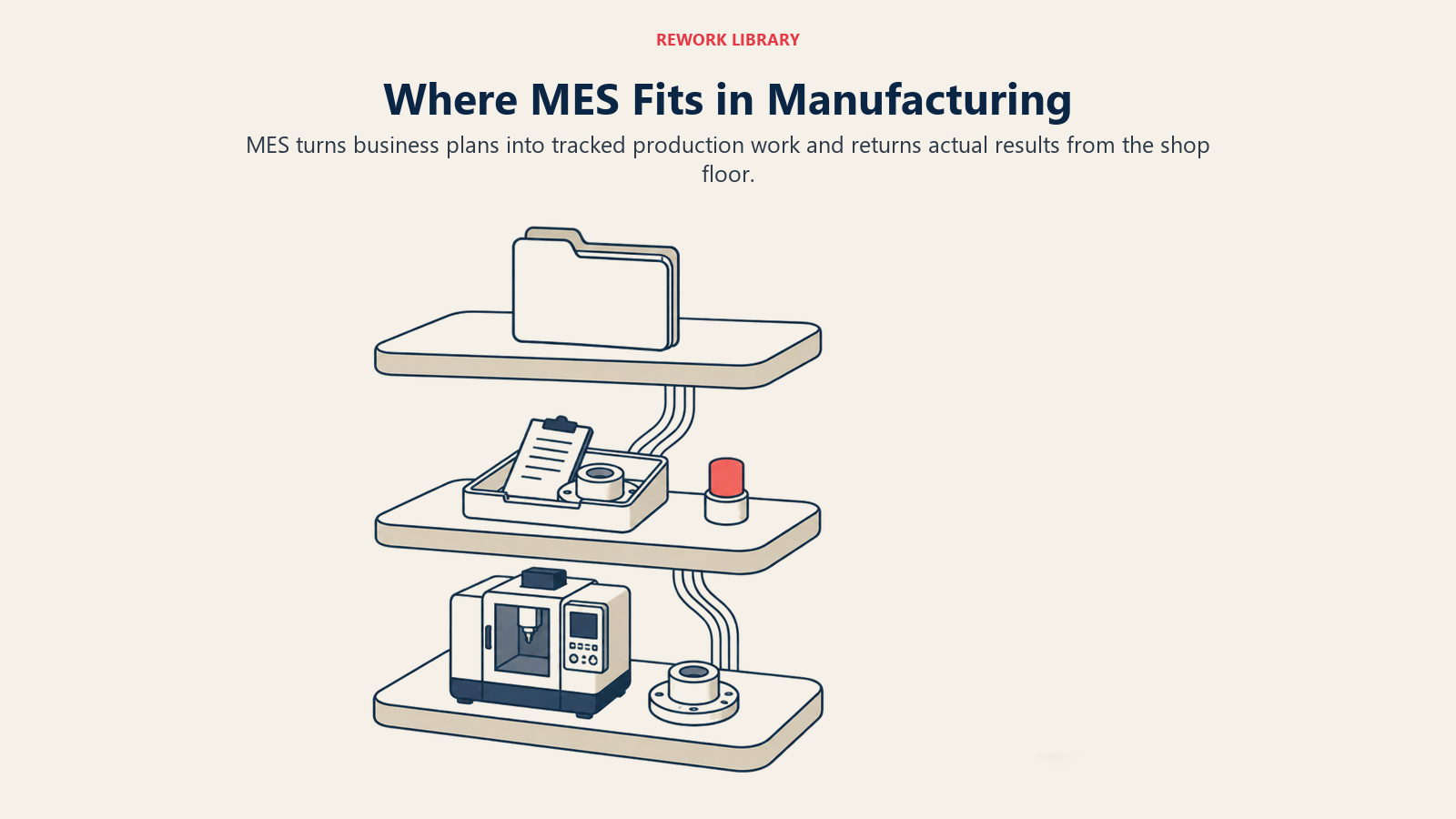
Production equipment and control systems (SCADA, PLCs, DCS) are excellent at controlling physical processes. They manage machines, respond to sensor inputs, and execute control logic in milliseconds.
Between these two layers is a gap:
The gap ERP can't fill: ERP doesn't track work-in-process through individual operations, doesn't capture real-time quality data, doesn't manage detailed work instructions, and doesn't monitor equipment performance minute-by-minute.
The gap SCADA can't fill: Control systems execute processes but don't understand business context. which order a product belongs to, customer specifications, quality requirements, or how performance compares to plans.
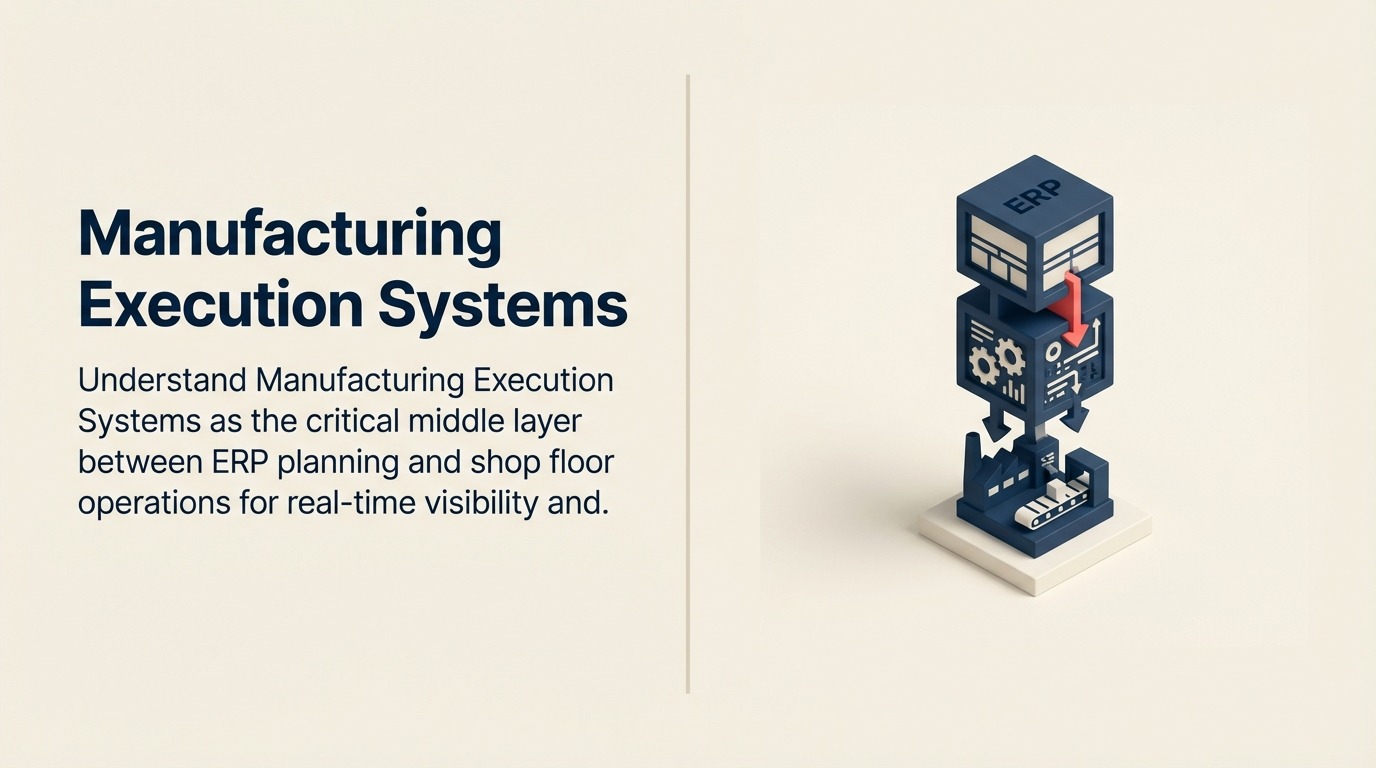
Manufacturing Execution Systems fill this gap. MES is the middle layer that manages production activities from order release through finished goods, providing real-time visibility and control that neither ERP nor SCADA can deliver alone.
The ISA-95 Model and MES Positioning
The ISA-95 standard defines five levels of manufacturing systems:
Level 4: Business Planning and Logistics (ERP)
- Order management, material planning, financial management
- Time horizon: weeks to months
Level 3: Manufacturing Operations Management (MES)
- Production execution, quality management, performance tracking
- Time horizon: shifts to days
Level 2: Supervisory Control (SCADA)
- Process monitoring and control, batch management
- Time horizon: minutes to hours
Level 1: Basic Control (PLCs, Controllers)
- Real-time control loops, sensor reading, valve actuation
- Time horizon: seconds to minutes
Level 0: Physical Process (Equipment)
- Actual production equipment and processes
MES sits at Level 3, receiving production plans from ERP (Level 4) and sending execution commands to control systems (Level 2), while providing feedback up to ERP about what actually happened.
ERP vs MES vs SCADA Distinction
Understanding what each system does prevents overlap and gaps:
ERP strengths:
- Financial and inventory management
- Supply chain and procurement
- Order promising and planning
- Business analytics and reporting
ERP limitations:
- Batch-oriented, not real-time
- Limited shop floor functionality
- No equipment integration
- Poor production visibility
MES strengths:
- Real-time production status
- Detailed work instructions
- Quality data collection
- Equipment performance monitoring
- Labor and material tracking
- Complete traceability
MES limitations:
- Doesn't handle financial or supply chain planning
- Not designed for equipment control
SCADA/PLC strengths:
- Real-time equipment control
- Fast response to process conditions
- Reliable operation in harsh environments
SCADA/PLC limitations:
- No business context
- Limited data storage and analysis
- No understanding of orders, customers, specifications
Effective manufacturing technology architecture uses each system for its strengths while integrating them to share information seamlessly.
Real-Time vs Transactional Systems
This distinction is crucial:
ERP is transactional: It records completed events. production order completed, inventory received, material issued. Updates are batched, often end-of-shift or end-of-day.
MES is real-time: It tracks current state. what's happening right now, what machine is running, what operation is in progress, what parameters are being recorded.
This real-time capability enables:
- Supervisors to see production status without walking the floor
- Quality issues detected and addressed immediately
- Equipment problems identified as they occur
- Customer service to provide accurate delivery commitments
An electronics manufacturer runs 24/7 operations across three shifts. Before MES, incoming shift supervisors spent 45 minutes getting status updates from outgoing supervisors. With MES dashboards showing real-time status, handoffs take 10 minutes, and incoming supervisors start their shifts already informed about what needs attention.
Core MES Functions: The ISA-95 Framework
ISA-95 defines eleven core MES functions. Not every manufacturer needs all eleven, but understanding them helps evaluate what capabilities you need.
Operations and Detailed Scheduling
Sequence and schedule work orders through production operations:
- Release work orders from ERP to shop floor
- Sequence operations based on priorities, due dates, and resource availability
- Reschedule dynamically as conditions change
- Consider equipment status, material availability, labor skills
MES scheduling is more detailed and dynamic than ERP planning. It works at operation level (hours) rather than order level (days), adjusting in real-time as equipment goes down, rush orders arrive, or quality issues occur.
Resource Allocation and Status
Manage and track resources. equipment, labor, materials, tooling:
- Track equipment status (running, down, idle, setup)
- Manage labor assignment to operations
- Verify material availability before starting operations
- Track tool usage and life
- Monitor resource utilization and capacity
Real-time resource visibility prevents starting work only to discover critical resources are unavailable. And resource utilization data reveals capacity constraints and improvement opportunities.
Dispatching Production Units
Send work instructions to operators and equipment:
- Display work orders ready to start
- Provide detailed work instructions (procedures, parameters, quality checks)
- Send recipes and parameters to equipment
- Manage operator workflow (what to do next)
Modern MES provides work instructions on tablets or workstation displays, often with videos, photos, and interactive guidance. This replaces paper travelers that get lost, damaged, or outdated.
Document Control
Manage and deliver documents and specifications:
- Standard operating procedures (SOPs)
- Work instructions
- Quality specifications
- Equipment operating manuals
- Safety procedures
Document control ensures operators access current, approved versions, not outdated copies. Electronic distribution is faster than printing and distributing paper, and changes take effect immediately across all workstations.
Data Collection and Acquisition
Capture production data automatically and manually:
Automated collection:
- Machine operating parameters (temperatures, pressures, speeds)
- Cycle times and counts
- Energy consumption
- Quality measurements from inline inspection
Manual collection:
- Operator entries (defects, adjustments, observations)
- Quality inspection results
- Material lot numbers
- Downtimes and reasons
Automated collection is more accurate and less burdensome than manual data entry. But some information. like reason codes for downtime or operator observations. still requires manual input.
A precision machining shop automated collection of critical parameters from CNC machines. Data that operators previously recorded manually (and often inaccurately) is now captured automatically with timestamps, ensuring complete and reliable quality records while eliminating 20 hours per week of manual data entry.
Labor Management
Track labor activity and productivity:
- Clock in/out at work centers
- Track labor hours by order and operation
- Monitor productivity and efficiency
- Manage overtime and schedule compliance
- Track certifications and qualifications
Labor management provides data for costing, payroll, and performance management. It also ensures qualified operators perform critical operations. the system can prevent uncertified operators from starting work requiring specific qualifications.
Quality Management
Manage quality activities throughout production:
- Enforce quality checks at specified operations
- Collect quality measurements and inspection results
- Track nonconformances and dispositions
- Trigger alerts for out-of-specification conditions
- Implement statistical process control (SPC)
- Support root cause analysis with complete data
Quality management ensures checks occur as planned, not skipped under schedule pressure. Automated data collection enables real-time quality monitoring and faster response to issues.
Process Management
Monitor and control production processes:
- Track process parameters against specifications
- Alert when parameters drift out of control
- Guide operators through process steps
- Enforce sequence and timing requirements
- Capture process deviations and adjustments
Process management is especially critical in regulated industries (pharma, food, medical devices) where documenting that processes followed approved procedures is essential for compliance.
Maintenance Management
Coordinate production with equipment maintenance:
- Track equipment run time and cycles
- Trigger preventive maintenance based on usage
- Record maintenance activities and parts used
- Integrate with CMMS (Computerized Maintenance Management Systems)
- Schedule maintenance during planned downtime
Integration between MES and maintenance prevents starting jobs on equipment due for maintenance and ensures maintenance history is available during troubleshooting.
Product Tracking and Genealogy
Track work-in-process and finished goods:
- Assign unique serial numbers or lot numbers
- Track location throughout production
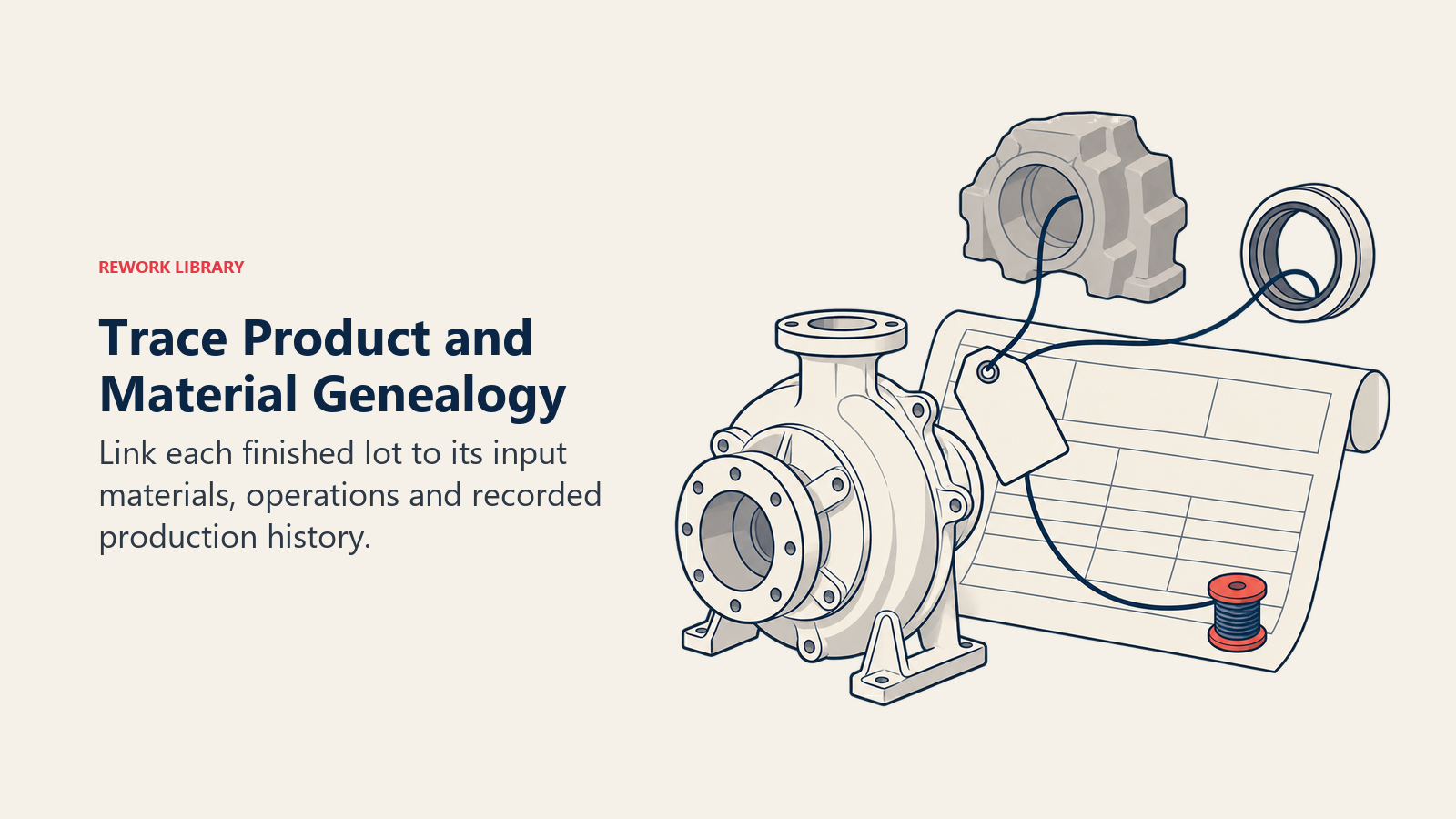
- Record which materials and components went into each unit
- Maintain complete genealogy (forward and backward traceability)
- Support recalls and lot tracking
Traceability requirements vary by industry. Medical devices and pharmaceuticals need complete genealogy down to individual components. Other products may only need lot-level tracking. MES provides the infrastructure for whatever traceability level you need.
Performance Analysis
Analyze and report production performance:
- Overall Equipment Effectiveness (OEE)
- Throughput and cycle times
- Quality metrics (first pass yield, defect rates, scrap)
- Resource utilization (equipment, labor, materials)
- Order completion and on-time performance
Performance analysis transforms raw operational data into actionable insights. Dashboards and reports show trends, identify problems, and track improvement initiatives.
MES Benefits and Value: Why Manufacturers Invest
MES implementations represent significant investment. software, integration, change management, training. What justifies this investment?
Real-Time Visibility Into Production Status
Perhaps the most immediate benefit: anyone can see what's happening without walking the floor.
Production supervisors see which orders are in progress, where delays exist, which equipment is down, and what's behind schedule. all on a dashboard.
Plant managers monitor performance metrics in real-time across shifts and departments.
Customer service checks order status and provides accurate delivery commitments without calling production.
Quality teams monitor reject rates and quality metrics continuously, intervening before problems escalate.
Maintenance sees equipment utilization and can plan preventive maintenance optimally.
One manufacturer calculated that supervisors and managers previously spent 3 hours per shift collecting status information through phone calls and floor walks. MES reduced this to 30 minutes of dashboard review, freeing 2.5 hours per supervisor per shift for value-adding activities like problem-solving and operator coaching.
Paperless Operations and Work Instructions
Paper-based systems have serious limitations:
- Information gets lost, damaged, or filled out incorrectly
- Updates require reprinting and redistributing
- Finding historical records is difficult
- Data entry from paper to computer systems is error-prone and time-consuming
MES enables paperless production:
- Work instructions delivered electronically to workstations
- Data collected digitally (automatically or through operator input)
- Complete electronic records searchable instantly
- Updates deployed immediately across all locations
A medical device manufacturer eliminated 60,000 pages of printed batch records annually after implementing MES. More importantly, incomplete or incorrect batch records. which previously caused compliance issues. dropped to nearly zero because MES enforces required entries before allowing operators to proceed.
Quality Traceability and Compliance
Regulated industries face stringent documentation requirements:
FDA (pharmaceuticals and medical devices) requires complete batch records proving processes followed validated procedures.
Aerospace and defense require traceability showing which materials and operators were involved in every production step.
Automotive (IATF 16949) requires comprehensive quality systems with full traceability.
MES creates complete, time-stamped electronic records automatically:
- All process parameters recorded
- All quality checks documented
- All material lots tracked
- All operator actions logged
- Complete audit trail of any changes
When regulatory audits occur or product recalls are necessary, data that would take weeks to compile from paper records is available in minutes from MES databases.
Performance Measurement: OEE, Cycle Time, and More
You can't improve what you don't measure accurately:
Overall Equipment Effectiveness (OEE) breaks down into availability, performance, and quality components. MES calculates OEE automatically from equipment status, production counts, and quality data.
Cycle times from raw materials to finished goods reveal bottlenecks and throughput opportunities.
First pass yield by operation pinpoints where quality problems originate.
Downtime analysis by reason codes identifies whether equipment reliability, material shortages, or other factors limit production.
An automotive supplier used MES data to identify that 35% of downtime was caused by minor stoppages (under 5 minutes each) that operators previously didn't report. These micro-stops were invisible in manual reporting but accumulated to significant losses. Root cause analysis of micro-stops led to improvements that increased OEE from 72% to 81%.
Reduced Work-in-Process Inventory
Better visibility and control reduce WIP:
Knowing exactly where every order is prevents starting duplicates when orders seem "lost."
Automated material tracking prevents excess material release "just in case."
Faster throughput from better scheduling and coordination reduces WIP levels.
Immediate visibility into delays enables proactive management instead of building WIP buffers.
A discrete manufacturer reduced WIP inventory 40% within a year of MES implementation. Better visibility eliminated the safety WIP they previously maintained because they couldn't reliably track order status.
Faster Response to Issues
Problems detected quickly cost less to fix:
Quality issues caught in-process cost less than defects discovered at final inspection after all value is added.
Equipment problems identified immediately can be addressed before they cause extensive downtime.
Material shortages detected when orders release (not when operators discover materials aren't available) allow time to expedite.
Customer priority changes communicated instantly enable dynamic rescheduling rather than producing wrong items.
Response time improvements from minutes to seconds might not sound dramatic, but multiply across hundreds of daily decisions, and the cumulative impact is substantial.
Implementation Approach: Successful MES Deployment
MES implementations have high failure rates. projects that run over budget, miss schedules, or deliver limited value. Success requires thoughtful approach.
Requirements Definition and Scope
Start by understanding what problems you're solving:
Current pain points:
- Where do we lack visibility?
- What manual processes are error-prone or time-consuming?
- What compliance or traceability challenges exist?
- What performance metrics can't we measure reliably?
Critical success factors:
- What capabilities are must-have vs nice-to-have?
- What integration with existing systems is required?
- What business results will justify the investment?
Resist the temptation to boil the ocean. Initial scope should address highest-priority needs. Additional capabilities can be added in later phases once core functionality is proven.
Best-of-Breed vs Integrated Suite Decision
Two architecture approaches:
Best-of-breed: Select specialized MES modules or vendors for different functions. one for quality management, another for production tracking, another for maintenance integration.
Advantages:
- Best functionality in each area
- Avoid lock-in to single vendor
- Can implement modules independently
Disadvantages:
- Integration complexity and cost
- Multiple vendor relationships
- Potential data inconsistencies
Integrated suite: Single MES platform providing all functions from one vendor.
Advantages:
- Consistent user interface
- Native integration between modules
- Single vendor relationship
- Usually lower total cost
Disadvantages:
- May compromise functionality in some areas
- Vendor lock-in
- Must implement vendor's approach even if not optimal
Most manufacturers choose integrated suites for simplicity, but best-of-breed makes sense when unique requirements or specialized processes demand specialized capabilities.
Phased Rollout by Area or Function
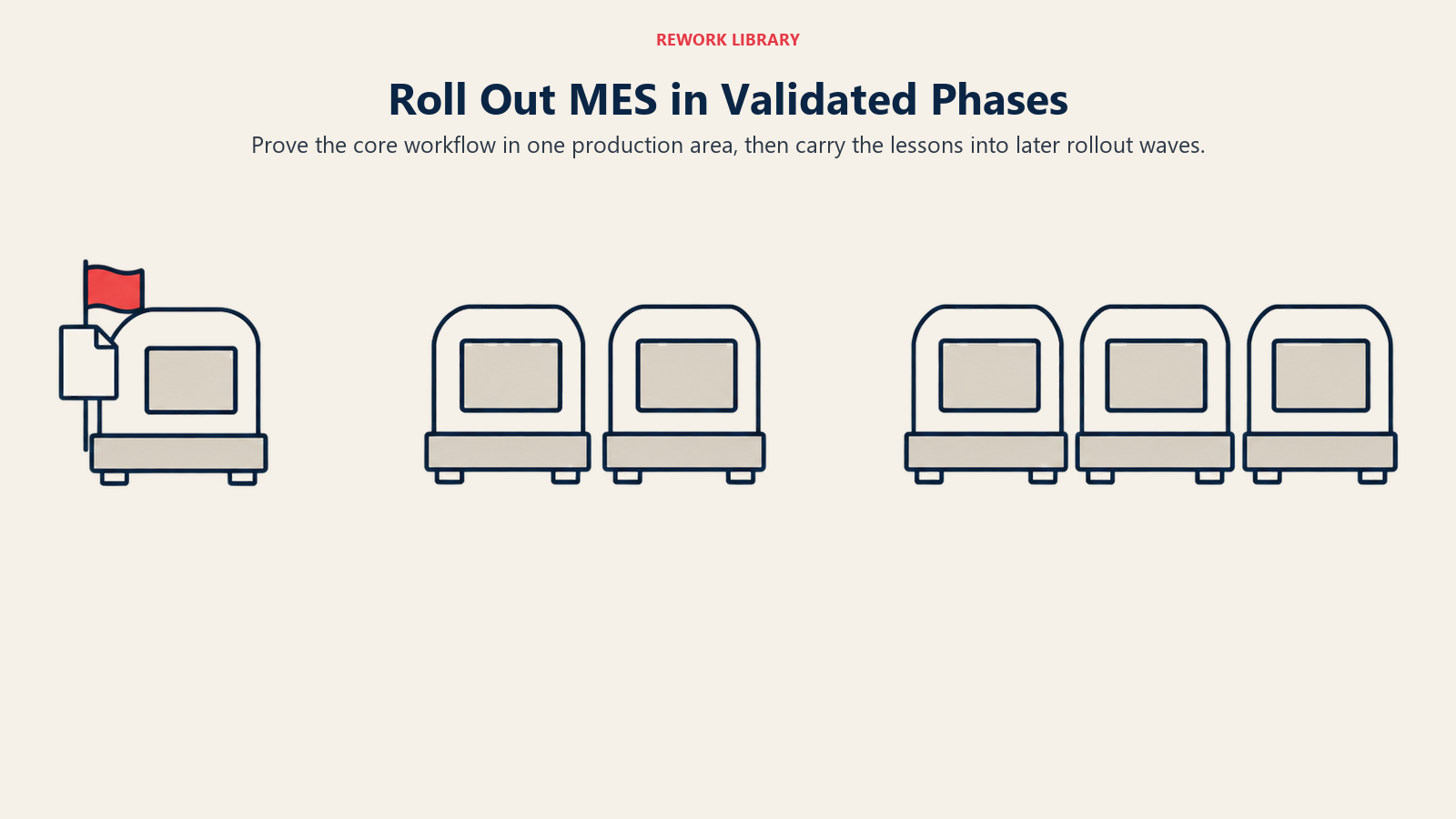
Big-bang implementations (everything, everywhere, all at once) rarely succeed. Phased approaches manage risk and learning:
By production area: Implement in pilot area (single production line or cell) to prove functionality and refine processes before broader rollout.
By function: Start with production tracking and performance monitoring, then add quality management, then labor management, etc.
By site: For multi-site organizations, implement at one location before rolling to others.
Phasing allows:
- Learning from early phases to improve later ones
- Demonstrating value before asking for additional investment
- Managing resource constraints (internal IT, vendor support, user capacity to absorb change)
- Adjusting approach based on experience
A food processor implemented MES across eight production lines over 18 months. two lines per quarter. Each wave benefited from lessons learned in previous phases. They averaged 5 months from implementation to steady-state operation for later lines vs 8 months for the first line.
Integration with ERP and Equipment
MES value depends on integration:
ERP integration:
- Receive production orders from ERP
- Update ERP with production completions and inventory transactions
- Pull material master data and bill of materials from ERP
- Send labor and resource actuals to ERP for costing
Equipment integration:
- Receive real-time data from PLCs, SCADA, and machines
- Send recipes and parameters to equipment
- Monitor equipment status and alarms
- Collect quality measurements from inline inspection equipment
Integration complexity varies:
- Modern systems with standard interfaces (OPC-UA, REST APIs) integrate relatively easily
- Legacy equipment may require custom interface development
- Some equipment may not be economically feasible to integrate and must be handled manually
Budget 30-50% of MES implementation effort for integration. Don't underestimate this. it's where many projects encounter surprises.
Change Management and Training
Technology is usually the easy part. People and processes are harder:
Executive sponsorship: Visible leadership support signals importance and overcomes resistance.
Operator involvement: Engage operators in design and testing. They'll identify practical issues designers miss.
Comprehensive training: Multiple sessions, hands-on practice, support during go-live.
Process redesign: Don't just automate existing processes. Redesign workflows to leverage MES capabilities.
Ongoing support: Dedicated support team during initial months to answer questions and resolve issues quickly.
Performance feedback: Show people how MES data is used to improve operations, not just monitor them.
Change management isn't an afterthought. it's central to success. Plan for it from project start, budget for it adequately, and measure adoption as rigorously as you measure technical milestones.
Technology Trends: Evolution of MES Capabilities
MES continues evolving with broader technology trends:
Cloud-Based MES Solutions
Traditional MES runs on servers in manufacturing facilities. Cloud MES runs on provider infrastructure:
Advantages:
- Lower upfront capital investment (subscription pricing)
- Automatic updates and patches
- Accessible from anywhere (mobile, remote offices)
- Easier multi-site deployment
- Scales easily as needs grow
Challenges:
- Requires reliable internet connectivity
- May have latency issues for real-time control
- Data security and compliance concerns
- Dependency on provider viability
Cloud MES is increasingly viable, especially for smaller manufacturers or those with limited IT resources. But facilities with unreliable connectivity or highly sensitive data may still prefer on-premises deployment.
Mobile and Tablet Interfaces
Operators and supervisors aren't tied to desktop workstations:
Tablets at workstations provide work instructions, data entry, and process guidance.
Mobile apps allow supervisors to monitor and respond from anywhere in the plant.
Wearables (smart glasses, smartwatches) provide hands-free access to instructions and data.
Mobile interfaces make information accessible where and when people need it, rather than requiring them to return to fixed terminals.
Analytics and Machine Learning
MES generates massive data volumes. Advanced analytics extract insights:
Predictive quality: Identify process parameter patterns that predict defects before they occur.
Predictive maintenance: Detect equipment degradation patterns that forecast failures.
Optimization: Recommend process parameters that maximize yield or throughput.
Anomaly detection: Automatically identify unusual patterns that warrant investigation.
These capabilities require data science expertise and may be bundled with MES platforms or implemented through separate analytics tools that consume MES data.
Integration with IoT and Smart Factory
MES is central to Industry 4.0 and smart factory initiatives:
IoT sensors provide richer data about equipment condition, environmental factors, and material properties.
Digital twins virtual models that simulate production. use MES data to keep twins synchronized with physical operations.
Autonomous systems that make decisions based on MES data. automatic quality adjustments, dynamic scheduling, predictive maintenance.
Supply chain integration connecting MES with supplier and customer systems for end-to-end visibility.
The vision: highly connected, data-driven manufacturing operations that continuously optimize themselves with minimal human intervention. MES provides the execution management and data infrastructure that makes this possible.
MES as Foundational System for Manufacturing Excellence
Manufacturing Execution Systems aren't just about digitizing paper or collecting data. They're foundational infrastructure that enables operational excellence:
Visibility that reveals where problems exist and where opportunities lie.
Control that ensures processes execute as designed, not as operators interpret.
Traceability that provides confidence in product quality and enables rapid response to issues.
Agility that allows quick response to changing priorities, quality issues, or equipment problems.
Continuous improvement based on accurate data about actual performance.
Organizations that view MES as compliance requirement or data collection exercise miss most of the value. Those that use MES as platform for operational transformation. redesigning workflows, empowering frontline decision-making, and systematically eliminating waste. achieve step-change performance improvements.
That pharmaceutical manufacturer from the opening? Five years after implementing MES, they've achieved:
- 99.8% traceability accuracy (vs 94% manually)
- 84% OEE (vs 67% before MES)
- 45% reduction in quality investigation time
- 30% reduction in work-in-process inventory
- Audit preparation time down from 3 weeks to 2 days
But the biggest impact wasn't measurable metrics. It was cultural shift from reactive firefighting to proactive management. With real-time visibility and reliable data, their team shifted from spending time gathering information to analyzing it and taking action. That's the transformative power of Manufacturing Execution Systems done right.
Learn More
- ERP for Manufacturing: Integrating Business Operations
- Smart Factory Implementation: Building Connected Manufacturing Operations
- IoT in Manufacturing: Leveraging Connected Devices and Sensors
- Overall Equipment Effectiveness: Maximizing Production Capacity
- Lean Manufacturing Principles
- Manufacturing KPIs Overview

Co-Founder, Rework.com
On this page
- MES as the Bridge Between Planning and Execution
- The ISA-95 Model and MES Positioning
- ERP vs MES vs SCADA Distinction
- Real-Time vs Transactional Systems
- Core MES Functions: The ISA-95 Framework
- Operations and Detailed Scheduling
- Resource Allocation and Status
- Dispatching Production Units
- Document Control
- Data Collection and Acquisition
- Labor Management
- Quality Management
- Process Management
- Maintenance Management
- Product Tracking and Genealogy
- Performance Analysis
- MES Benefits and Value: Why Manufacturers Invest
- Real-Time Visibility Into Production Status
- Paperless Operations and Work Instructions
- Quality Traceability and Compliance
- Performance Measurement: OEE, Cycle Time, and More
- Reduced Work-in-Process Inventory
- Faster Response to Issues
- Implementation Approach: Successful MES Deployment
- Requirements Definition and Scope
- Best-of-Breed vs Integrated Suite Decision
- Phased Rollout by Area or Function
- Integration with ERP and Equipment
- Change Management and Training
- Technology Trends: Evolution of MES Capabilities
- Cloud-Based MES Solutions
- Mobile and Tablet Interfaces
- Analytics and Machine Learning
- Integration with IoT and Smart Factory
- MES as Foundational System for Manufacturing Excellence
- Learn More