Manufacturing Customer Order Management: From Order Entry to Delivery Excellence
Turn this article into takeaways for your work.


Each assistant summarizes the article only for you and suggests best practices for your work.
Customer places an order Tuesday for delivery in four weeks. You enter it in the system, production schedules it, and everything looks fine. Three weeks later, the customer calls asking for order status. Nobody's quite sure. Production says the order is scheduled for next week. But materials aren't fully available. And quality inspection might add two days. You're about to miss the commitment, and the customer's learning about it when they called to check, not from proactive communication from you.
This scenario repeats daily in manufacturing operations without rigorous order management discipline. Orders enter the system but visibility disappears. Commitments are made but tracking is weak. Problems emerge but communication lags. Customers get frustrated because they don't know what's happening with their orders.
Effective order management provides the control systems and communication processes that ensure you know order status at all times, deliver on commitments consistently, and communicate proactively when problems arise.
Understanding Order Management
Order management encompasses all activities from order receipt through delivery confirmation and customer satisfaction.
Order types vary significantly in complexity. Standard orders involve catalog products with established specs, pricing, and lead times. Custom orders require unique specifications or configurations. Rush orders compress normal lead times requiring expediting. Blanket orders establish agreements for multiple releases over time.
Each order type requires different handling procedures and decision-making.
Order lifecycle stages flow from entry through fulfillment: order receipt and validation, planning and scheduling, production and progress tracking, quality verification, shipping and logistics, delivery confirmation, and customer satisfaction verification.
Each stage has specific inputs, outputs, decisions, and handoffs. Gaps or delays at any stage impact overall performance.
Cross-functional coordination requirements make order management complex. Sales enters orders and manages customer relationships. Production planning schedules orders against capacity. Manufacturing executes production. Quality ensures specifications are met. Shipping coordinates logistics. Accounting invoices and collects payment. Effective manufacturing execution systems help coordinate these functions seamlessly.
Order management systems and processes must coordinate these functions seamlessly.
Order Entry: Accuracy at the Start
Accurate order entry prevents downstream problems and rework.
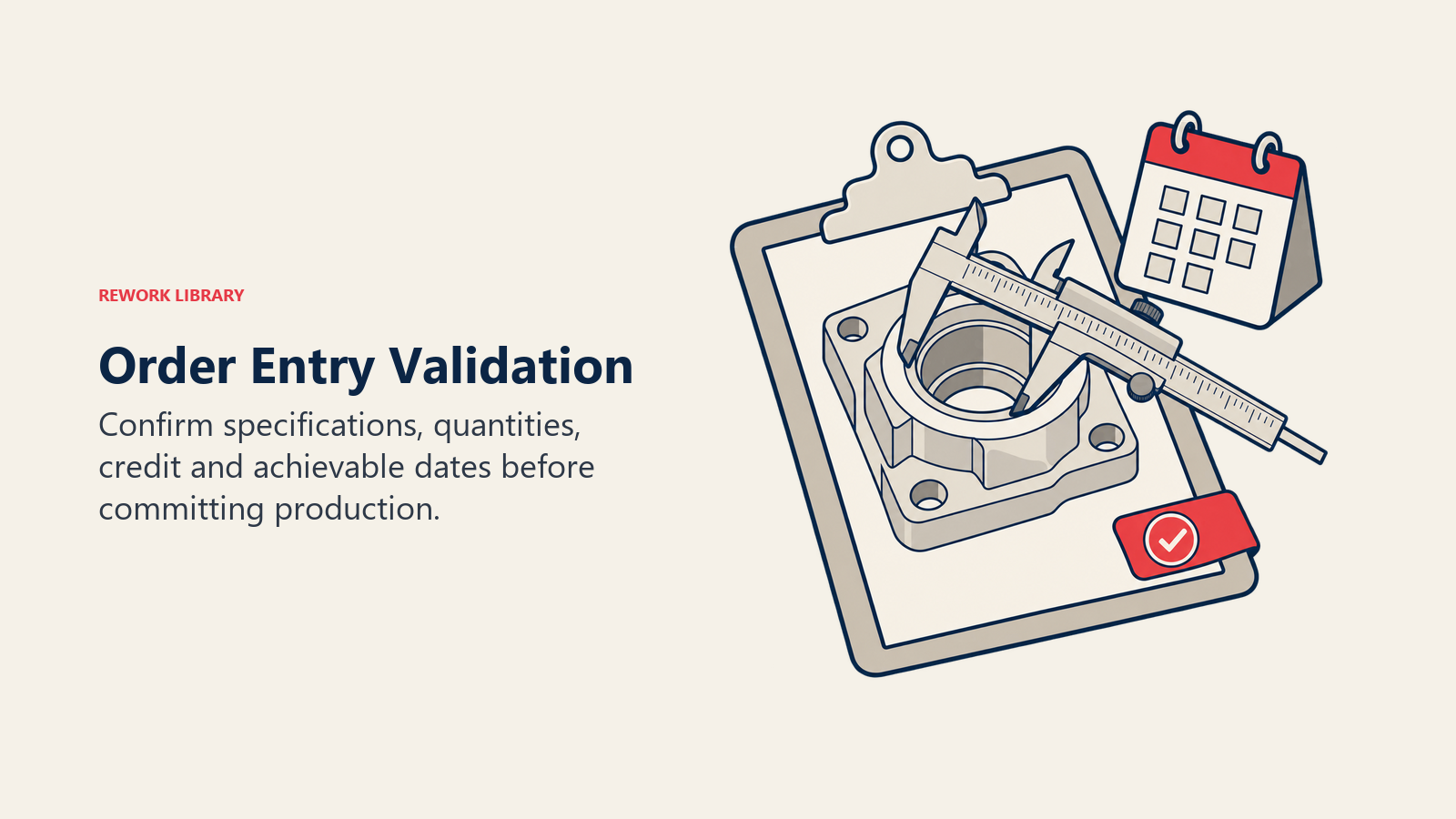
Order review and validation confirms that orders are complete, clear, and actionable. Check that customer information and ship-to address are correct, product specifications are clear and complete, quantities and units are specified properly, and delivery dates are realistic and achievable.
Catch and resolve ambiguities during order entry, not during production when they cause delays.
Technical specification confirmation ensures you understand requirements. For custom or complex orders, verify dimensions and tolerances, material specifications, finish requirements, quality standards and inspection criteria, and packaging or marking requirements.
Miscommunication about specs creates quality issues and customer disputes. Clear confirmation prevents this.
Credit approval and payment terms protect against payment risk. Check customer credit status before accepting large orders, verify payment terms are acceptable, and consider requiring deposits for new customers or large custom orders.
Don't invest in production you might not get paid for.
Promised delivery date calculation must consider current backlog and capacity, normal production lead time for the product, material lead times if procurement needed, and any special requirements adding time.
Provide realistic dates customers can rely on, not aspirational dates that look good but aren't achievable.
Order acknowledgment and communication closes the loop with customers. Send order confirmation promptly including order details for verification, confirmed delivery date, payment terms, and contact information for questions.
This creates written record of mutual understanding and surfaces any mismatches early.
Order Planning: Converting to Production
Orders must flow smoothly from entry to production scheduling.
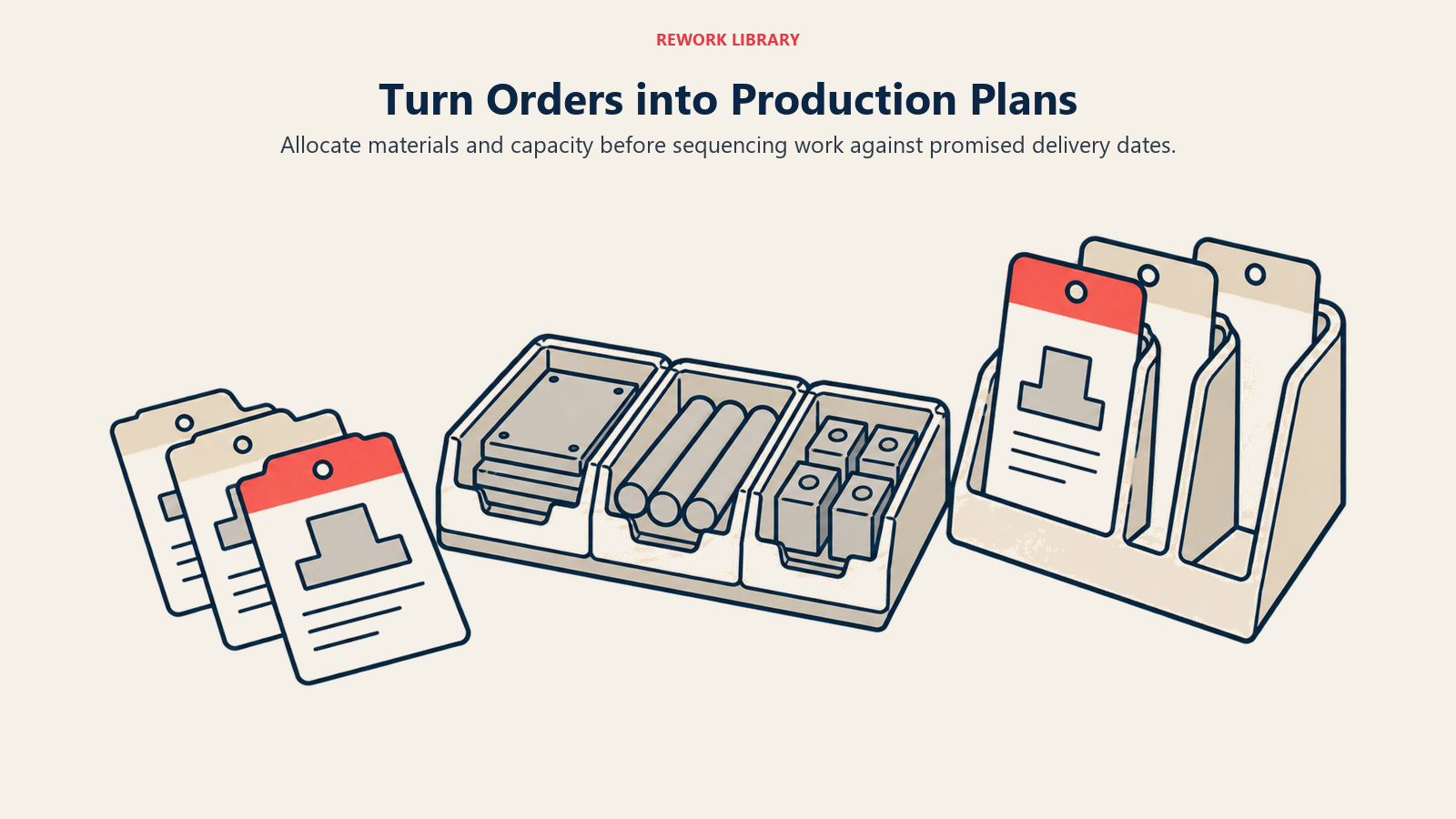
Master production scheduling integration places orders into production sequence. Effective master production scheduling coordinates all these elements. Consider order priority and delivery dates, capacity availability and constraints, material availability, setup and changeover optimization, and batch sizing for efficiency.
MPS converts customer demand into production plans that optimize delivery and efficiency.
Material requirements planning trigger ensures materials are available when needed. Orders should automatically trigger MRP for items not in inventory, verify material availability for in-stock items, flag shortages requiring purchasing action, and allocate inventory to specific orders.
Material shortages discovered during production cause delays and scrambling. Identify them during planning.
Capacity allocation and sequencing determines when orders will be produced. Balance keeping promises to customers, maximizing equipment utilization, minimizing changeovers and setup time, and maintaining work flow smoothness.
This balancing act requires both system logic and human judgment about priorities.
Lead time management tracks time from order entry to planned completion. Monitor orders approaching due dates, identify at-risk orders early, and trigger expediting or customer communication as needed.
Manage lead time actively. Don't just hope orders complete on time.
Change order handling processes modifications to existing orders. Customers frequently request changes to quantities, delivery dates, or specifications. Each change has implications for scheduling, materials, costs, and other orders.
Evaluate change impact before accepting, communicate cost or timing implications to customers, and update all affected systems and stakeholders when changes are approved.
Order Tracking: Visibility and Communication
Knowing order status at all times enables proactive management.
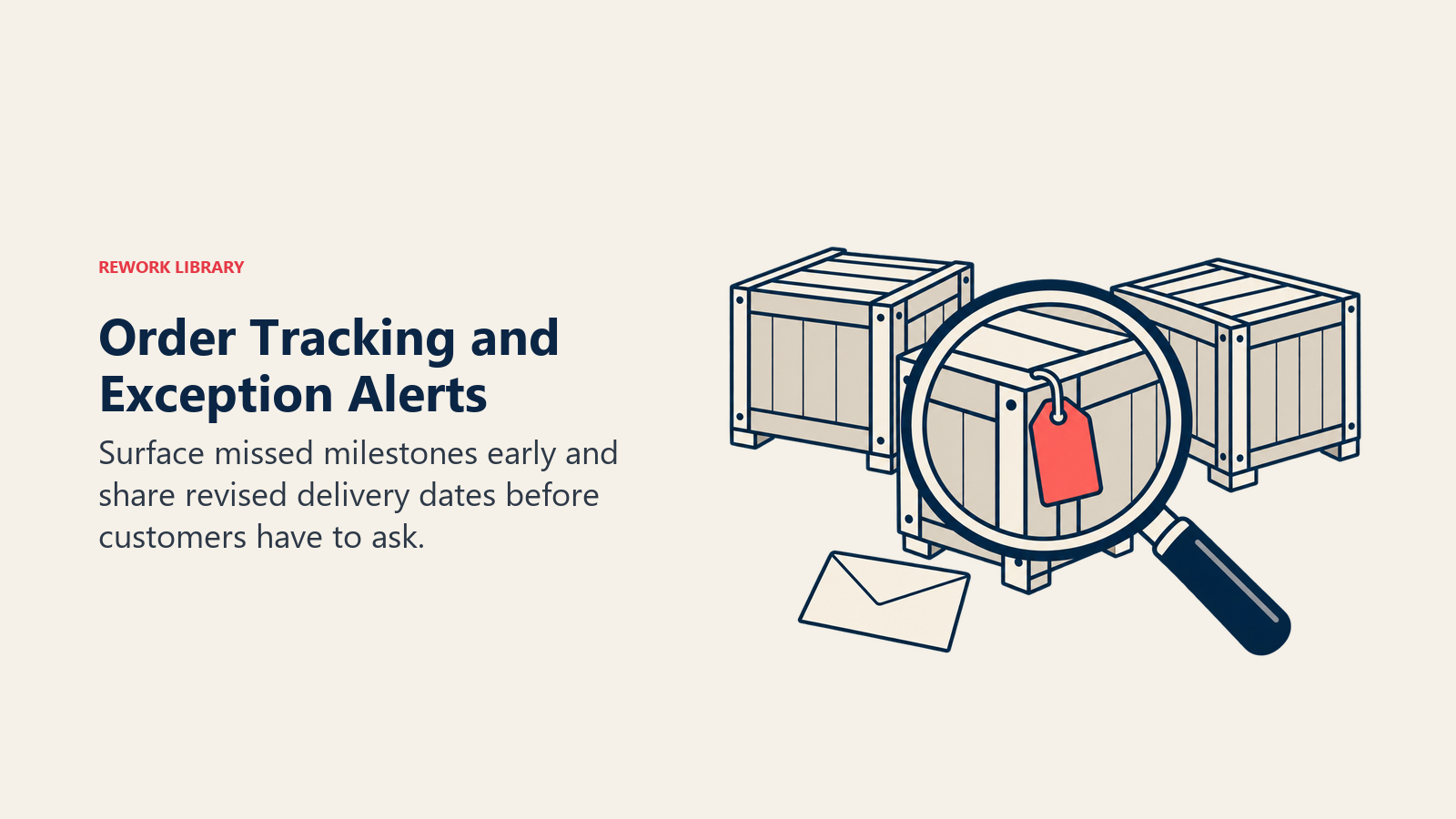
Order status monitoring systems track orders through production stages. Record order release to production, completion of key milestones, current location or work center, estimated completion time, and any issues or delays.
Real-time status visibility allows quick response when problems emerge.
Milestone tracking and alerts flag orders needing attention. Set alerts for orders behind schedule, orders approaching delivery dates, orders waiting for materials or information, and quality holds or issues.
Automated alerts ensure problems surface quickly rather than being discovered too late.
Customer portal and self-service reduce burden on customer service. Many customers want to check order status themselves. Web portals that show current order status, expected delivery dates, tracking information when shipped, and order history provide self-service convenience.
This reduces phone calls and emails while improving customer experience.
Proactive communication of delays maintains trust even when problems occur. Don't wait for customers to call asking where their orders are. Contact them immediately when orders will be late, explain what happened and what you're doing about it, provide revised delivery estimates, and follow up when issues are resolved.
Customers understand that problems happen. They don't understand being left in the dark about problems affecting their orders.
Exception management processes handle deviations. Define clear escalation paths for different types of issues, empower appropriate people to make decisions, and document exceptions for future learning.
Don't let exception handling create more delays through unclear decision-making authority.
Order Fulfillment: Execution
Production completion is just one step in fulfillment.
Production completion verification confirms orders are finished and ready for delivery. Verify quantities produced match order requirements, all operations and assembly steps are complete, work orders are closed in the system, and orders are moved to shipping or finishing area.
Don't consider orders complete until they're truly ready to ship.
Final inspection and quality release ensures products meet specifications. Conduct specified inspections and tests, verify dimensional and functional requirements, confirm appearance and cosmetic standards, and obtain quality release before shipping.
Shipping products that don't meet specs creates much bigger problems than taking time to verify quality.
Packaging and shipping coordination executes proper delivery. Package products to prevent damage in transit, select carriers based on service and cost requirements, prepare shipping documentation and labels, communicate tracking information to customers, and coordinate special delivery requirements.
The final mile from your dock to customer delivery is where many on-time performance failures occur.
Documentation and compliance completes the order record. Maintain packing lists and delivery receipts, certificates of conformance or test results, customer-specific documentation requirements, and export documentation if applicable.
Complete, accurate documentation prevents invoicing delays and customer receiving problems.
Delivery confirmation verifies receipt. Track delivery through carrier systems, follow up on delayed deliveries, resolve any damage or discrepancy reports, and confirm customer acceptance in your system.
Orders aren't complete until customers have received and accepted them.
Measuring Order Management Performance
Metrics reveal how well your order management process performs.
Order fill rate and perfect order rate measure reliability. Fill rate shows percentage of orders delivered complete and on time. Perfect order rate measures orders with no errors in quantity, quality, paperwork, or delivery timing.
World-class manufacturers achieve 95-98% perfect order rates. Below 90% indicates systemic problems.
Order cycle time and lead time accuracy track speed and reliability. Measure time from order entry to delivery, compare actual delivery dates to promised dates, and track cycle time trends over time.
Consistently meeting promised dates matters more than having the shortest lead times.
Customer satisfaction and complaints provide direct feedback. Track customer complaint rates, order-related issues by type, customer satisfaction survey results, and repeat order rates by customer.
Customer perception is the ultimate measure of order management effectiveness.
Order change frequency and impact reveal process stability. High change rates indicate unclear requirements at order entry, poor forecasting or planning by customers, or internal production issues requiring modifications.
Minimizing changes improves efficiency and reliability.
Building Order Management Excellence
Excellent order management requires systems, processes, and culture working together.
This means implementing order management systems with proper workflows, training teams on their roles and responsibilities, standardizing procedures to reduce variation, measuring performance and identifying improvement opportunities, and holding people accountable for commitments.
Companies with strong order management consistently deliver on time, communicate proactively, resolve issues quickly, and maintain high customer satisfaction. This performance drives customer loyalty, repeat business, and competitive advantage.
Your order management process directly impacts customer perception of your reliability. Make it a source of competitive strength, not operational weakness.
Learn More

Co-Founder, Rework.com