Manufacturing Revenue Streams: Diversification Strategies for Production Businesses
Turn this article into takeaways for your work.


Each assistant summarizes the article only for you and suggests best practices for your work.
When a manufacturer loses their largest customer, the impact is devastating. Single-product manufacturers face market volatility that can erase profitability overnight. But diversification isn't simple. Each new revenue stream demands different capabilities, carries distinct risks, and operates under different economics.
The most successful manufacturers build balanced revenue portfolios that provide stability while maximizing profitability. They understand which streams fit their capabilities, when to add new ones, and how to optimize the mix. This is that strategic framework.
Understanding Manufacturing Revenue Streams
Manufacturing revenue streams represent different ways production businesses generate income from their capabilities. According to Harvard Business Review, providing services has become more lucrative than making products, prompting smart manufacturers to create new business models. Each stream has distinct characteristics that affect margins, volumes, customer relationships, and operational requirements.
Most manufacturers start with a single stream and gradually add others as they develop capabilities and market relationships. The sequence matters. Adding the wrong stream at the wrong time wastes resources and creates operational complexity that destroys value.
The Five Primary Revenue Streams
Contract manufacturing generates revenue by producing goods designed by other companies. You're paid for manufacturing capacity and expertise, not product innovation. Margins are typically lower but volumes can be substantial and predictable.
Private label production creates products that retailers or brands sell under their own names. You control product design and manufacturing but the customer controls branding and distribution. This stream offers better margins than pure contract manufacturing while maintaining volume predictability.
Own-brand products give you complete control from design through sales. Margins are highest but you bear all market risk. This stream requires marketing, distribution, and brand-building capabilities beyond manufacturing.
Aftermarket services provide ongoing revenue from maintenance, repairs, parts, and upgrades. McKinsey research shows that manufacturers deploying Industry 4.0 technologies are creating new revenue streams through innovative business models. Once you've sold equipment or products, services can generate steady cash flow with margins that exceed original equipment sales.
Licensing and intellectual property monetizes your innovations through patents, designs, or processes. This stream requires minimal ongoing effort once established but demands significant upfront investment in innovation and legal protection.
Revenue Mix Analysis: Balancing Different Income Sources
The optimal revenue mix depends on your capabilities, market position, and strategic goals. But certain principles apply universally.
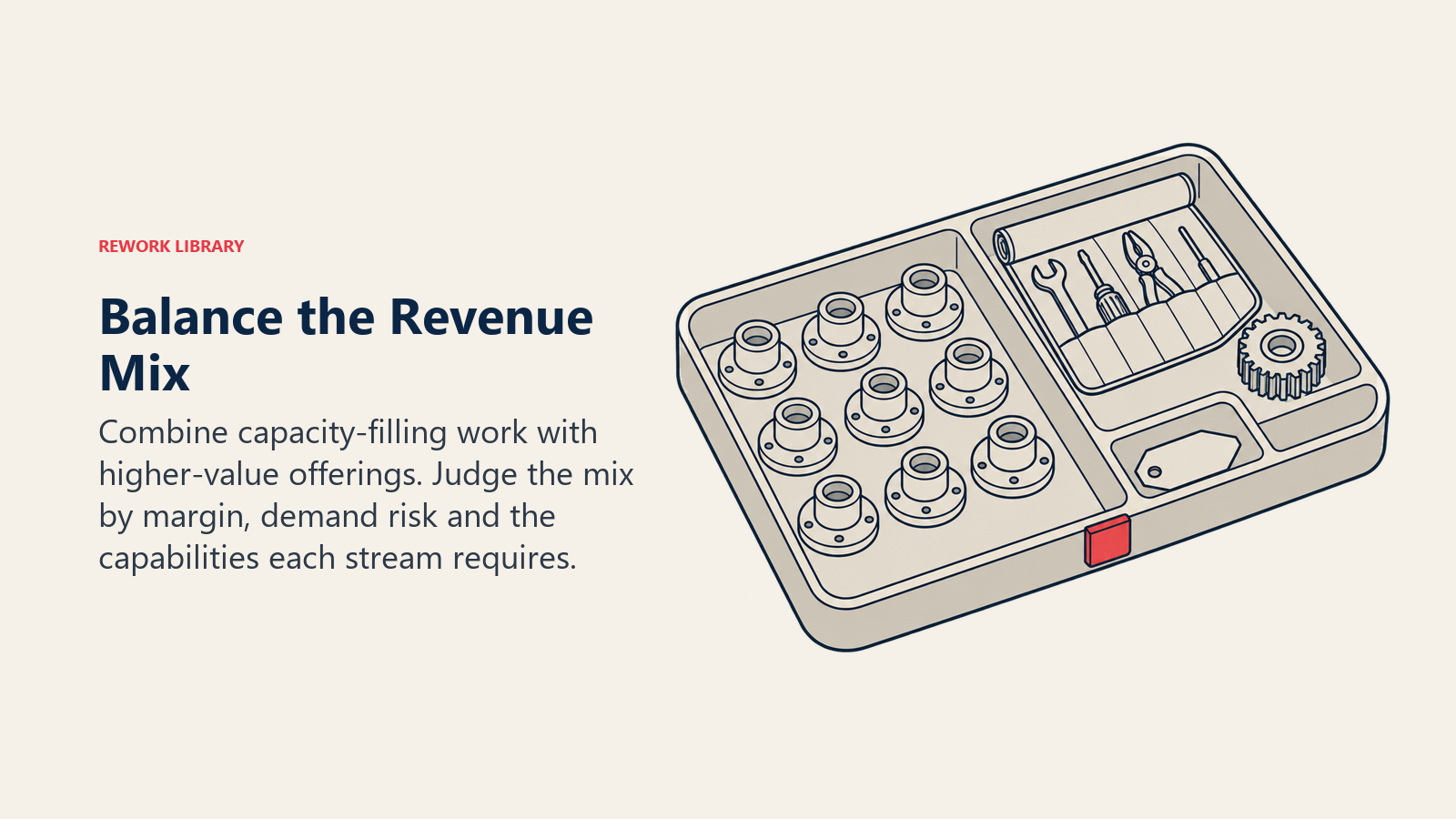
Margin Comparison by Stream
Contract manufacturing typically operates on 10-20% gross margins. You're competing primarily on price, quality, and reliability. The customers who choose contract manufacturers prioritize cost optimization over unique value. Your leverage comes from specialized equipment, technical expertise, or capacity availability.
Private label margins range from 20-35%. You're adding design and development value beyond manufacturing. But the customer still controls the market relationship, limiting your pricing power. Success requires capabilities in product development, not just production.
Own-brand margins can reach 40-60% when successful. But many branded products fail to cover their development and marketing costs. The high potential rewards come with high risks. You need market insight, brand-building skills, and distribution channels that most manufacturers don't possess.
Aftermarket services operate at 40-70% margins but generate less total revenue than equipment sales. A manufacturer selling $50M in equipment might generate $5-10M in service revenue. But that service revenue is stickier and more predictable than equipment sales.
IP licensing generates 80%+ margins on minimal infrastructure. Once you've developed and protected the innovation, licensing fees flow with little ongoing cost. But creating licensable IP requires R&D investment that most manufacturers can't justify. And licensing revenue is concentrated and unpredictable.
Volume vs. Value Trade-Offs
High-volume streams like contract manufacturing maximize capacity utilization. They create operational efficiency through repetition and scale. But they also create dependency on a few large customers and pressure margins through commoditization.
High-value streams like own-brand products or specialized services generate better margins on smaller volumes. They require more sophisticated sales and marketing. They create operational complexity through customization and variety. But they build competitive differentiation that protects profitability.
The best revenue mix combines volume streams that fill capacity and fund infrastructure with value streams that drive profitability and differentiation. Manufacturers who optimize only for volume become stuck in low-margin businesses. Those who optimize only for value can't cover fixed costs.
Risk Diversification Benefits
Revenue diversification reduces concentration risk. According to research on income diversification, businesses with diverse income sources have 30% higher survival rates during economic hardships compared to those relying on one source. A manufacturer with five customers each representing 20% of revenue can survive losing one. A manufacturer with one customer at 80% of revenue faces existential crisis if that customer leaves.
But customer diversification isn't enough. Market diversification matters too. Manufacturers serving multiple industries reduce exposure to sector-specific downturns. Geographic diversification protects against regional economic weakness. Product diversification hedges against technology shifts.
The challenge is balancing diversification with focus. Manufacturers who chase every opportunity spread resources too thin and build no competitive advantages. Those who concentrate too narrowly create fragility. The right balance depends on your scale and capabilities.
Diversification Strategy: When and How to Add New Streams
Adding revenue streams is expensive and risky. Each new stream demands capabilities you might not have, creates operational complexity, and diverts attention from existing business. Yet staying in a single stream creates vulnerability. The key is strategic timing and sequencing.
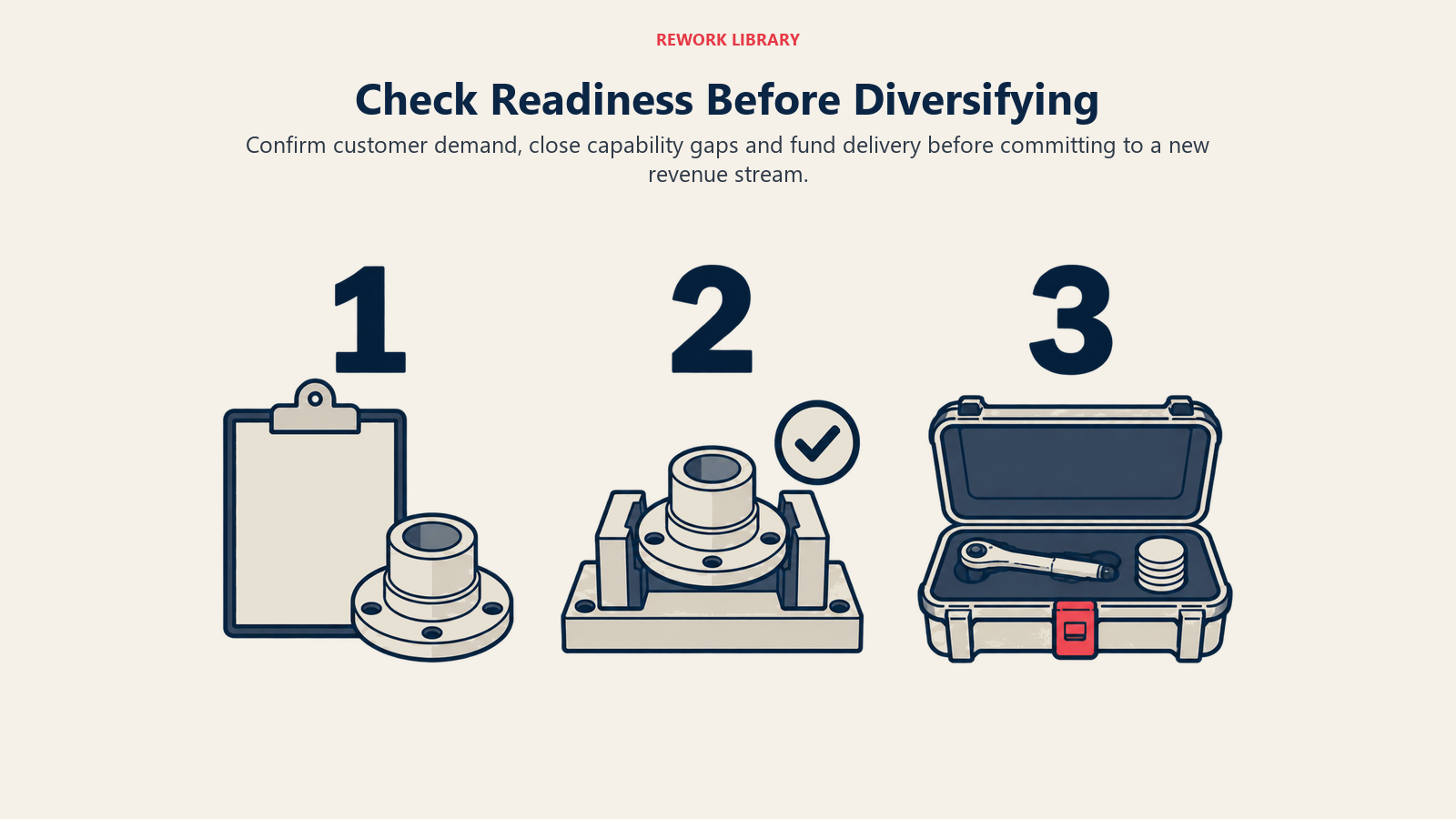
Market Demand Assessment
New streams must address real market demand, not just your desire for diversification. The best opportunities emerge from customer requests or market gaps you're uniquely positioned to fill.
Contract manufacturers often add private label streams when customers ask them to develop products, not just produce them. Private label manufacturers move to own brands when they identify markets their customers aren't serving. Understanding which doors customers are opening for you guides smart diversification.
Assess market demand by examining three factors: customer willingness to pay for the new offering, competitive intensity in that space, and market size sufficient to justify investment. A revenue stream might be theoretically attractive but practically unviable if customers won't pay adequate prices, competition is fierce, or the market is too small.
Capability Requirements
Each revenue stream demands specific capabilities beyond basic manufacturing. Contract manufacturing requires extreme cost efficiency and quality consistency. Private label adds product development and design. Own brands require marketing, branding, and distribution. Services need field technicians and parts inventory management.
Before adding a stream, honestly assess capability gaps. Contract manufacturers who try to launch brands without marketing expertise waste money on failed products. Own-brand manufacturers who think they can just "add capacity" for contract work discover they can't compete on cost with specialists.
Build capabilities before you sell them. Hire the right talent, implement necessary systems, and prove you can deliver at small scale before making major commitments. Too many manufacturers announce new offerings before they can properly execute them.
Investment Considerations
Different streams require different investment profiles. Contract manufacturing demands equipment and capacity investment. Private label requires R&D and product development investment. Own brands need marketing and distribution investment. Services require training and infrastructure investment.
Calculate return on investment carefully. A manufacturer investing $2M to add contract capacity needs clear visibility to orders that will generate adequate returns. One investing in brand development must model realistic market penetration timelines and competitive response.
The biggest mistake is underfunding new streams. Manufacturers who add brands without adequate marketing budgets fail to gain traction. Those who offer services without proper training create quality problems that damage reputation. If you can't fund a new stream properly, don't start it.
Optimization Framework: Maximizing Profitability Across Streams
Once you've established multiple revenue streams, optimization becomes critical. Each stream needs appropriate attention, resources, and management approach.
Strategic Resource Allocation
Allocate resources based on strategic value, not just current revenue. A service stream generating 10% of revenue might deserve 20% of attention if it drives customer retention and repeat equipment sales. A contract manufacturing stream at 40% of revenue might get 30% of focus if you're strategically shifting toward higher-value work.
The most common mistake is over-resourcing mature streams and under-resourcing growth streams. Manufacturers continue pouring resources into declining contract work while starving promising service businesses. Use portfolio management thinking: maintain mature cash-generating streams efficiently while investing in growth streams strategically.
Performance Metrics by Stream
Measure each stream with appropriate metrics. Contract manufacturing should optimize for operational efficiency: utilization rates, cycle times, defect rates, and cost per unit. These metrics drive profitability in volume businesses.
Private label and own brands need customer-focused metrics: market share, brand awareness, customer acquisition costs, and lifetime value. These metrics matter more than pure operational efficiency because value creation happens in the market.
Service streams require relationship metrics: retention rates, service response times, parts margins, and customer satisfaction scores. Services succeed through strong ongoing relationships, not transactional efficiency.
Don't apply the same metrics across all streams. A service organization measured on utilization rates will push technicians to handle more calls faster, destroying the relationship quality that makes services valuable.
Dynamic Portfolio Management
Your revenue mix should evolve as markets change and capabilities develop. Review portfolio balance quarterly. Ask whether each stream is performing to expectations, consuming appropriate resources, and fitting strategic direction.
Some streams should grow, others should maintain, and some should be consciously harvested or exited. The contract work you took on to fill capacity three years ago might now prevent you from serving more profitable customers. The brand you launched with enthusiasm might never reach critical mass.
Be willing to exit streams that don't work. Manufacturers hang onto failed brands for years because they hate admitting mistakes. They continue low-margin contract work because "it covers overhead." Ruthlessly cut streams that don't meet strategic and financial thresholds.
Learn More
Explore these related resources to deepen your revenue strategy:
- Manufacturing Growth Model provides the growth framework that determines when to add revenue streams
- Manufacturing Business Models explains how different business models support different revenue streams
- Manufacturing Cost Structure helps you understand the cost implications of different streams
- Make vs Buy Decision Framework guides decisions about which capabilities to develop internally
Building a Balanced Revenue Portfolio
Revenue diversification is essential but challenging. The manufacturers who succeed take a disciplined approach: they assess their capabilities honestly, time new streams carefully, invest adequately, and manage their portfolio actively.
They resist the temptation to chase every opportunity. They build capabilities before selling them. They're willing to exit streams that don't work. And they constantly rebalance their portfolio toward streams that align with strategic direction and market opportunity.
The goal isn't just revenue diversification. It's building a revenue portfolio that generates stable cash flow, maintains healthy margins, and creates sustainable competitive advantage. That requires understanding each stream's economics, managing the mix strategically, and evolving the portfolio as your business grows.
