Kaizen Continuous Improvement: How Small Changes Drive Manufacturing Excellence
Turn this article into takeaways for your work.


Each assistant summarizes the article only for you and suggests best practices for your work.
Most manufacturing transformation initiatives follow a familiar pattern: consultants arrive, big changes get announced, implementation struggles begin, momentum fades, and operations revert to familiar practices. Meanwhile, a few manufacturers steadily pull ahead through an entirely different approach.
These leaders don't rely on dramatic overhauls. Instead, they've built cultures where frontline operators identify and solve dozens of small problems every week. A machine operator notices a fixture design that slows changeovers and sketches an improvement. A materials handler suggests rerouting a pathway that eliminates unnecessary walking. A quality inspector proposes a simple visual check that catches defects earlier.
Each individual improvement seems insignificant. But compound these incremental gains across hundreds of employees over months and years, and the cumulative impact transforms operations. This is Kaizen: continuous improvement through employee-driven, small-step changes that together deliver results no single large initiative could match.
The Kaizen Philosophy
Kaizen comes from Japanese words meaning "change for the better." Toyota popularized the approach as a core element of their production system, demonstrating how continuous small improvements could create competitive advantages that competitors couldn't replicate through periodic major changes. According to Wikipedia, within the Toyota Production System, all line personnel are expected to stop their moving production line in case of any abnormality and suggest improvements to resolve problems. This philosophy forms a cornerstone of lean manufacturing principles practiced worldwide.
The philosophy rests on several key principles that distinguish it from traditional improvement approaches.
Incremental progress beats radical innovation in most manufacturing contexts. Large-scale transformation projects promise impressive gains but carry high risk. They disrupt operations, require extensive training, and often fail to deliver projected benefits. Kaizen instead pursues steady incremental gains with minimal disruption and lower risk.
Consider equipment utilization. A radical approach might involve replacing aging machinery with state-of-the-art equipment costing millions. A Kaizen approach would systematically reduce changeover times, eliminate minor stoppages, improve maintenance practices, and optimize production scheduling. These incremental improvements might boost overall equipment effectiveness from 65% to 82% without capital investment.
Frontline employees possess invaluable knowledge about day-to-day operational reality. Engineers and managers design processes, but operators run them daily and see problems firsthand. Kaizen taps this frontline expertise systematically rather than limiting improvement to technical specialists.
An electronics manufacturer struggled with quality issues on a complex assembly line. Engineering tried multiple root cause analysis methods over six months without success. When they finally asked the assembly operators, they learned that overhead lighting created glare on the inspection screens at certain times of day. A $200 lighting adjustment solved a problem that had defied months of engineering analysis.
The Plan-Do-Check-Act (PDCA) cycle provides structure for continuous improvement. Plan: identify a problem and develop a countermeasure. Do: implement on a small scale. Check: measure results against expectations. Act: standardize if successful or try a different approach if not.
PDCA turns improvement from sporadic firefighting into a disciplined process. As The Toyota Way emphasizes, continuous improvement is one of the two pillars of Toyota's operational excellence, alongside respect for people. Problems become opportunities to learn and improve rather than crises to contain. The cycle emphasizes testing changes on a small scale first, learning from results, and only standardizing proven improvements.
Respect for people means trusting employees to improve their own work processes. Traditional management assumes frontline workers follow procedures designed by experts. Kaizen assumes workers are capable problem-solvers who should continuously improve those procedures.
This shift requires management mindset change. Leaders must create systems that encourage suggestions, provide time for improvement activities, and respond quickly to employee ideas. When suggestions disappear into bureaucracy or get rejected without explanation, employees stop offering them.
Structured Kaizen Events
While daily continuous improvement provides ongoing progress, structured Kaizen events tackle specific improvement opportunities with focused intensity.
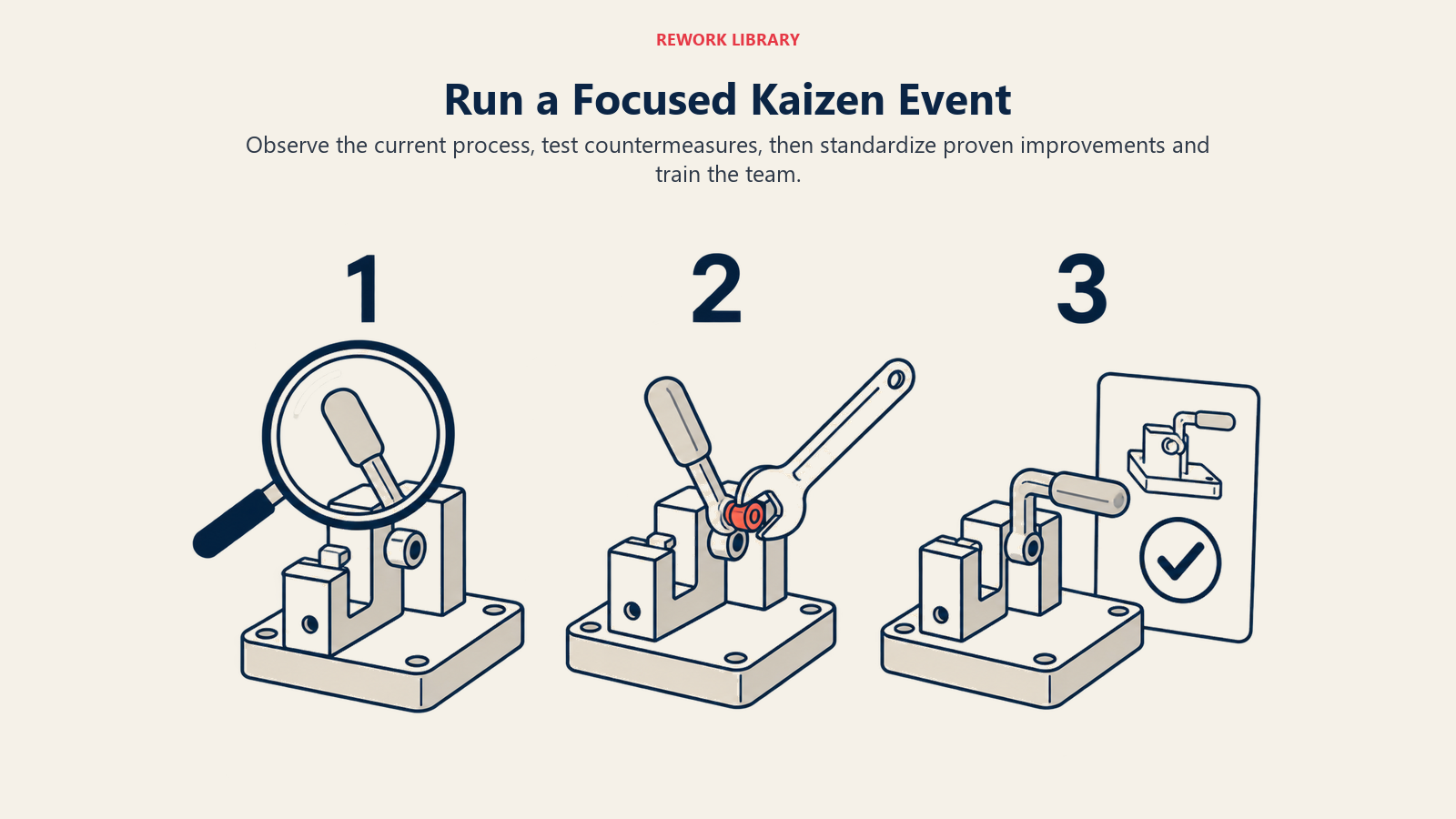
Kaizen blitz events bring cross-functional teams together for 3-5 days of intensive improvement work on a defined scope. A typical event follows this structure:
Day 1: Training on relevant tools and techniques, walking the gemba (actual place) to observe current state, collecting data on baseline performance.
Days 2-3: Analyzing root causes, generating improvement ideas, implementing changes, testing solutions, measuring results.
Day 4-5: Standardizing proven improvements, documenting new procedures, training affected employees, presenting results to leadership.
The compressed timeline creates urgency and prevents analysis paralysis. Teams implement and test ideas immediately rather than spending weeks planning. This bias toward action produces tangible results that build momentum and demonstrate improvement methodology value.
Selecting high-impact opportunities determines event success. Look for situations where:
- The problem creates measurable waste (downtime, defects, excess inventory, safety incidents)
- Root causes are unclear or solutions require creative problem-solving
- Changes will affect multiple stakeholders who should collaborate on solutions
- Success will create a visible example that demonstrates improvement methodology
A machinery manufacturer used Kaizen events to tackle their biggest constraint: a CNC machining center with 42% utilization. The five-day event brought together operators, programmers, maintenance technicians, and production schedulers. They analyzed downtime causes, implemented quick changeover techniques, revised the total productive maintenance approach, and improved programming practices. Utilization jumped to 67%, adding significant capacity without capital investment. Understanding value stream mapping helped identify this constraint's impact on overall flow.
Cross-functional team composition brings diverse perspectives to problem-solving. Include operators who work with the process daily, maintenance technicians who understand equipment, quality personnel who see defect patterns, and engineers who grasp technical options. Add upstream and downstream process workers who experience ripple effects of changes.
Team diversity prevents solutions that solve one problem while creating others. When only operators participate, ideas might improve their work but create maintenance difficulties. When only engineers participate, solutions might be technically elegant but impractical for operators to sustain.
Documentation and knowledge sharing turns individual event successes into organizational capability. Document current state baseline, improvement ideas tested, results measured, final standard work procedures, and lessons learned. Share these case studies across facilities so other sites can replicate successful improvements.
A food processing company maintains an online library of completed Kaizen events. Each entry includes the problem statement, team composition, improvements implemented, cost savings achieved, and contact information for team members who can provide guidance. New facilities beginning operations review this library to avoid reinventing solutions to common problems.
Daily Kaizen: Building Improvement into Routines
Kaizen events provide focused improvement bursts, but daily Kaizen integrates continuous improvement into ordinary work rhythms.
Gemba walks put leaders on the shop floor regularly, observing operations, asking questions, listening to frontline concerns, and providing immediate support for improvement ideas. Effective Gemba walks follow structured routines: visiting the same areas on consistent schedules, focusing on process observation rather than results reporting, asking open-ended questions that encourage discussion, and following up visibly on issues identified. As ASQ notes, the 5S method originated as part of the Toyota Production System to create workplaces suited for visual control and lean concepts. Regular walks often reveal opportunities for 5S workplace organization improvements that operators notice daily.
The presence and behavior of leaders during Gemba walks signals what matters. A plant manager who spends 90 minutes daily on the floor asking operators about improvement opportunities sends a powerful message about priorities. Leaders who only appear for crisis management signal that improvement takes a back seat to firefighting.
Suggestion systems provide channels for employees to submit improvement ideas with clear processes for evaluation, implementation, and recognition. But many suggestion systems fail because they become bureaucratic black holes where ideas disappear for months without feedback.
Successful systems prioritize speed over perfection. They empower supervisors to implement small suggestions immediately without requiring elaborate approval chains. They commit to providing feedback on every suggestion within 48 hours. They make the status of submitted suggestions visible so employees can track progress.
An automotive parts supplier implemented a "72-hour Kaizen" rule: any improvement that could be implemented for less than $500 and didn't affect other departments got evaluated and decided within 72 hours. This eliminated bureaucracy that had previously strangled their suggestion system. Monthly suggestions jumped from 12 to 87.
Distinguishing quick wins from strategic projects helps prioritize improvement efforts appropriately. Quick wins are improvements employees can implement immediately with minimal cost or coordination: rearranging tools for better ergonomics, adding labels for clarity, adjusting machine settings, or simplifying procedures. These don't require formal projects, just permission to make sensible changes.
Strategic improvements require cross-functional coordination, significant investment, or careful testing: changing production flow layouts, implementing new technology, or redesigning products. These justify formal project structures with clear objectives, resources, and timelines. Major initiatives might require six sigma in manufacturing rigor with structured problem-solving methodologies.
The mistake many manufacturers make is treating everything as a strategic project requiring extensive analysis and approvals. This organizational sludge kills momentum. Reserve formal project rigor for improvements that truly warrant it, and empower employees to implement quick wins immediately.
Creating a Kaizen Culture
Moving from occasional improvement projects to genuine continuous improvement culture requires systematic transformation of organizational behaviors and norms.
Leadership behaviors either reinforce or undermine Kaizen culture. Leaders who respond enthusiastically to employee suggestions, provide resources promptly, and celebrate improvements encourage more participation. Leaders who criticize imperfect ideas, defer decisions endlessly, or take credit for frontline improvements kill initiative.
Model the behaviors you want to see. When leaders participate in Kaizen events alongside operators, it signals importance. When leaders admit mistakes and discuss what they learned, it creates psychological safety for others to try improvements that might fail. When leaders ask "what did you improve this week?" in regular conversations, improvement becomes an expected part of everyone's role.
A chemical manufacturer transformed their culture through consistent leadership messaging. Every Monday morning meeting started with improvement sharing: what each department improved the previous week and what they learned. Within six months, this routine had normalized continuous improvement as "just how we work here."
Recognition and reward systems should acknowledge improvement efforts, not just results. If you only reward successful improvements, people pursue safe incremental changes rather than ambitious ideas that might fail. Recognize teams for applying good problem-solving methods even when initial solutions don't work. Celebrate learning from failures as much as successes.
Some manufacturers tie a portion of incentive compensation to improvement participation: suggestions submitted, Kaizen events attended, or improvements implemented. This signals improvement is part of job expectations, not optional extra credit.
But avoid over-emphasizing financial rewards. Research shows excessive focus on monetary incentives can undermine intrinsic motivation. Many employees find improvement work inherently satisfying. Public recognition, career development opportunities, and seeing their ideas implemented often motivate more powerfully than cash bonuses.
Overcoming "we've always done it this way" resistance requires patience and proof. Long-tenured employees have seen multiple improvement fads come and go. They're skeptical that Kaizen is anything different. Words won't convince them; sustained action over time will.
Start with volunteers rather than forcing participation. Run initial Kaizen events with enthusiastic early adopters who see opportunities to improve their work. Share their successes widely. As skeptics see tangible results and improved work conditions, some will become curious enough to try.
Address legitimate concerns directly. If employees resist because past improvement initiatives added work without adding support, acknowledge this and explain how this approach differs. If resistance stems from fear that improvements will eliminate jobs, commit publicly to redeploying rather than cutting headcount when productivity improves.
Measuring Kaizen Impact
Tracking improvement results maintains accountability, demonstrates value to skeptics, and identifies where additional support is needed.
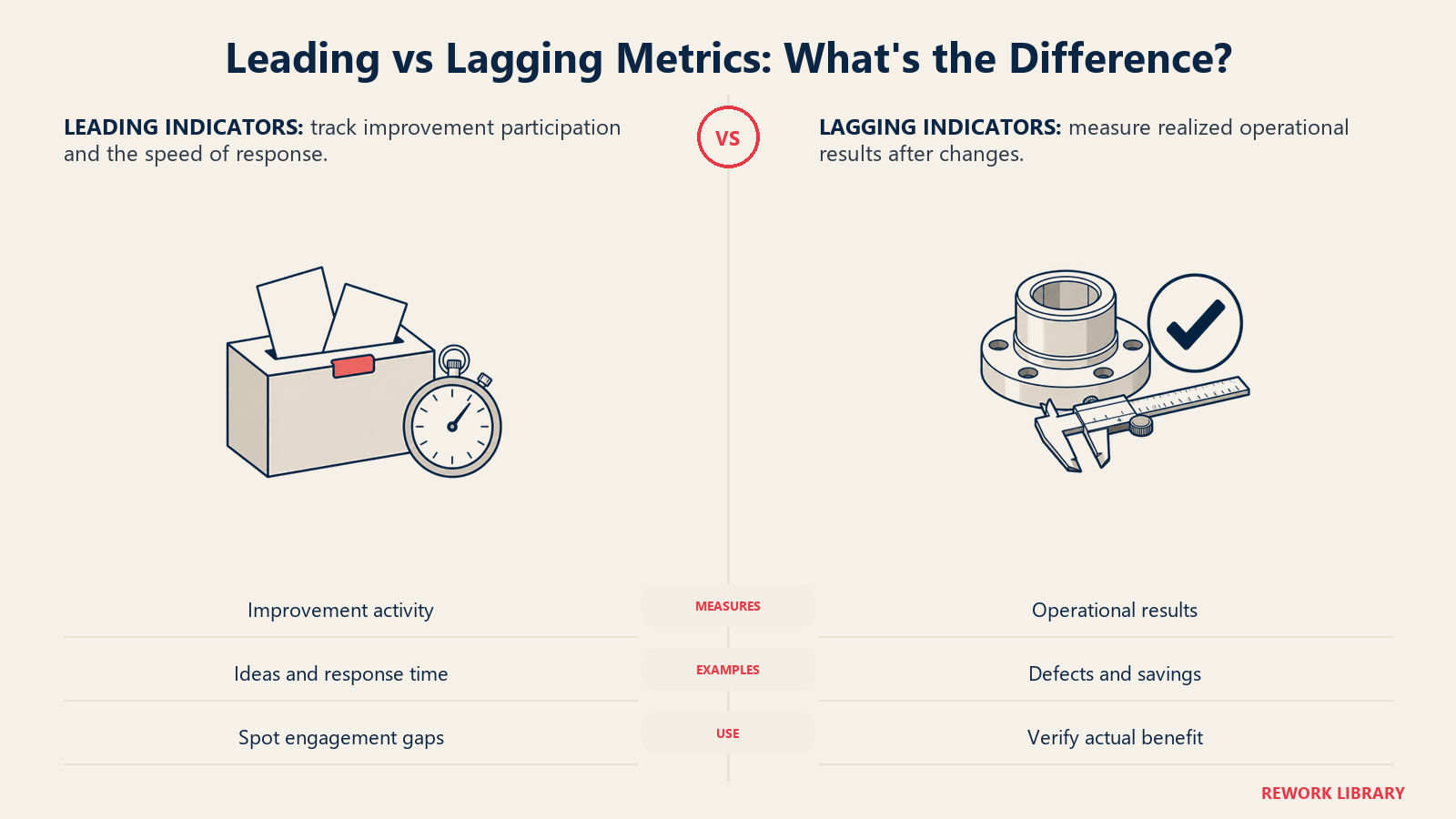
Leading indicators measure improvement activity levels: suggestions submitted per employee per month, percentage of employees who participated in Kaizen events, Gemba walk frequency by leadership, time from suggestion submission to decision. These metrics help identify engagement problems before they affect results.
If suggestion submissions drop, investigate why. Have employees become discouraged by slow responses? Are supervisors too busy to engage with improvement ideas? Is the submission process too complicated?
Lagging indicators measure actual operational improvements: cost savings from implemented suggestions, productivity improvements in areas with active Kaizen programs, quality improvements correlated with problem-solving training, safety incident reductions following specific improvements. These connect to broader manufacturing KPIs that track operational performance.
An industrial equipment maker tracks both types of metrics in a balanced scorecard approach. They measure improvement participation (leading) alongside operational results (lagging). When participation metrics drop, they intervene with additional training or leadership engagement before operational results suffer.
Cost savings calculations translate improvements into financial terms leadership understands. Document baseline state before improvement, identify measurable changes (time saved, defects reduced, materials conserved), and calculate dollar impact using standard cost assumptions. Understanding manufacturing cost structure helps quantify improvement impacts accurately.
Be conservative in these calculations to maintain credibility. Use actual current labor rates rather than fully-loaded costs unless burden reduction is genuinely achievable. Count capacity gains as savings only if that capacity gets used productively. Document assumptions so others can verify calculations.
A machinery manufacturer requires every Kaizen event to document projected savings and then verify actual savings 90 days after implementation. This discipline prevents teams from claiming inflated benefits while providing real data about improvement methodology ROI. They apply similar rigor to waste elimination strategies across all operations.
Employee engagement scores measure whether Kaizen culture is developing. Survey employees periodically about their perception of improvement opportunities: Do you feel encouraged to suggest improvements? Do you receive timely feedback on ideas you submit? Have you participated in improvement activities recently? Does leadership support continuous improvement?
Track these perception metrics over time and by department. Declining scores indicate cultural problems that need attention. Variations between departments reveal where leadership is effectively supporting improvement versus where support is lacking.
From Events to Culture
Kaizen's ultimate goal isn't conducting improvement events or accumulating suggestions. It's creating organizational cultures where continuous improvement becomes so ingrained in daily work that no one thinks of it as a special program anymore.
This transformation doesn't happen quickly. Most manufacturers who've built genuine Kaizen cultures describe 3-5 year journeys with consistent leadership commitment throughout. They start with pilot areas, demonstrate results, gradually expand, train extensively, adjust systems based on learning, and persist through obstacles.
The journey begins with a single step: select a small scope, assemble a team, identify an improvement opportunity, and work through the PDCA cycle together. Focus less on achieving perfect results and more on building capabilities and demonstrating the methodology. Share what you learn, celebrate progress, and gradually expand the approach.
Organizations that persist build remarkable capabilities. Employees routinely solve problems that previously required outside consultants. Innovation emerges from unexpected sources. Operational performance steadily improves year after year. These advantages compound into competitive positions that rivals can't replicate through occasional transformation initiatives.
Learn More
