Manufacturing Shift Management: Optimizing 24/7 Operations for Performance
Turn this article into takeaways for your work.


Each assistant summarizes the article only for you and suggests best practices for your work.
First shift runs smoothly:experienced operators, strong supervision, and engineering support readily available. Production hits targets consistently and quality is excellent.
Third shift tells a different story. Less experienced crew, minimal technical support, and a supervisor managing largely alone. Production runs 15% slower, quality issues are more frequent, and equipment problems often wait until morning for resolution.
You're essentially running two different operations under one roof. The challenge isn't equipment capability or product complexity:it's shift management consistency. And that inconsistency costs you capacity, quality, and employee morale.
Understanding Shift Operations Strategy
Running multiple shifts requires more than just scheduling people around the clock. It's a complex operational system that must balance utilization, cost, quality, and sustainability.
Shift patterns and schedules come in several standard configurations. Two-shift operations typically run Monday-Friday, covering 16 hours per day with an 8-hour gap. This pattern provides good equipment utilization while maintaining some traditional work schedule benefits.
Three-shift operations cover 24 hours with three 8-hour crews, often running five or six days per week. This maximizes equipment utilization and provides the highest capacity from fixed assets. But it requires larger workforce and creates complexity managing handoffs and maintaining consistency.
Four-crew continuous operations use 12-hour shifts with rotating patterns that cover 24/7 while giving each crew regular time off. Common patterns include 2-2-3 (work 2 days, off 2 days, work 3 days, off 2 days, work 2 days, off 3 days) or 4-4 rotations. These patterns maximize utilization while providing longer blocks of time off that many employees prefer.
The choice depends on production volume requirements, equipment utilization targets, labor market conditions and employee preferences, customer delivery expectations, and regulatory and break requirements. SHRM research shows that traditional shift structures are no longer meeting worker expectations, making alternative scheduling approaches a business necessity.
Shift premium and labor costs vary by pattern. Second shift typically carries 5-10% premium, third shift 10-15% premium, and weekend shifts additional premiums. These premiums add up:if 40% of your production runs on second and third shifts at 10% average premium, your labor costs are 4% higher than single-shift operation.
But compare that premium to the cost of additional equipment and facility space required for single-shift operation at the same volume. Usually, shift premiums are far cheaper than capital investment in capacity.
Shift performance variability represents the hidden cost in multi-shift operations. When third shift runs 15% slower than first shift, you're not getting the capacity you planned for. MIT research on workforce scheduling demonstrates that decision support tools can help optimize dynamic workforce scheduling in manufacturing environments. When night shift quality is worse, your rework and scrap costs increase. When weekend crews have higher incident rates, your safety and insurance costs rise.
Eliminating or minimizing this variability is often the highest-return opportunity in shift management.
Designing Your Shift System for Success
Effective shift management starts with deliberate system design, not just replicating what you've always done.
Production volume requirements provide your starting point. How much capacity do you need? What equipment utilization percentage is required to meet demand? Effective manufacturing workforce planning integrates these decisions. Can you achieve this with one shift plus overtime, or do you genuinely need multiple shifts?
Many manufacturers add shifts prematurely. If you can meet demand with one shift running efficiently, you avoid the complexity and cost of multiple shifts. But if you're running 60+ hours per week with extensive overtime, adding a shift often reduces total labor costs while improving work-life balance.
Equipment utilization targets influence shift decisions. Capital-intensive industries with expensive equipment often run 24/7 to maximize asset utilization. Achieving high overall equipment effectiveness across all shifts requires consistent practices. Less capital-intensive operations may run single or two shifts because labor flexibility is more valuable than incremental equipment utilization.
Calculate the breakeven. What's the incremental profit from higher utilization versus the incremental cost of shift premiums, supervision, and support? If equipment utilization only increases from 62% to 75% by adding a shift, the incremental capacity may not justify the cost.
Employee preferences and labor market conditions matter more than many operations leaders recognize. In some markets, employees strongly prefer traditional day shifts and rotating to nights creates retention problems. In other markets, shift premiums attract workers who value higher pay or prefer night schedules.
Understanding your labor market helps design shifts that you can actually staff with qualified people. The theoretically optimal shift pattern is worthless if you can't recruit and retain employees to work it.
Regulatory and break requirements vary by jurisdiction and affect shift design. Required meal breaks, rest periods between shifts, maximum consecutive days, and overtime regulations all constrain your options.
Design shifts that comply fully with regulations from the start. Retrofitting compliance into poorly designed shift patterns creates operational problems and legal risk.
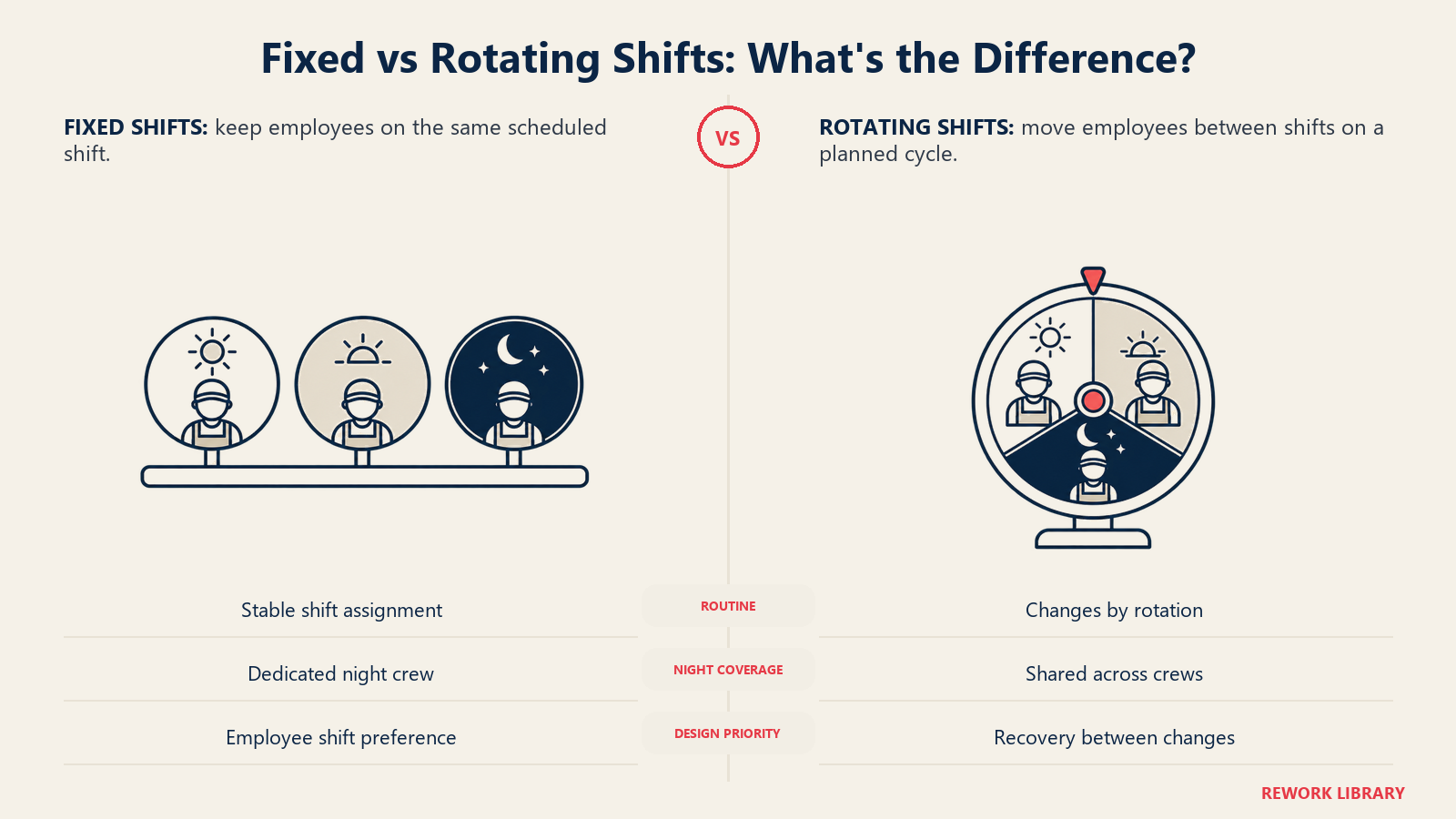
Shift rotation versus fixed shifts presents a fundamental choice. Rotation means employees work different shifts on a regular pattern:week 1 on days, week 2 on afternoons, week 3 on nights. Fixed shifts mean employees stay on the same shift indefinitely.
Rotation distributes the burden of less desirable shifts and provides consistency in who works each shift day to day. Fixed shifts allow employees to build stable routines and may improve retention for those who prefer their assigned shift. Many operations use a hybrid:core positions fixed on shifts, other positions rotating.
Building Shift Handoff Excellence
The handoff between shifts is where many operations lose quality, continuity, and accountability. Strong handoff processes prevent these losses.
Structured communication protocols ensure critical information transfers reliably. This includes formal handoff meetings where outgoing and incoming supervisors discuss production status, equipment condition, quality issues, staffing situation, priorities and special instructions, and any problems requiring follow-up.
These meetings should be brief but comprehensive:typically 10-15 minutes. Longer meetings suggest poor preparation or unclear priorities. Shorter meetings risk missing important information.
Production status and issues transfer covers what was accomplished during the shift versus plan, what's in progress and status, what orders or products are coming next, and what challenges or obstacles emerged.
Clear status prevents incoming shifts from discovering problems 30 minutes into their shift when they could have been addressed during handoff. It also creates accountability:issues don't disappear between shifts because "someone else will handle it."
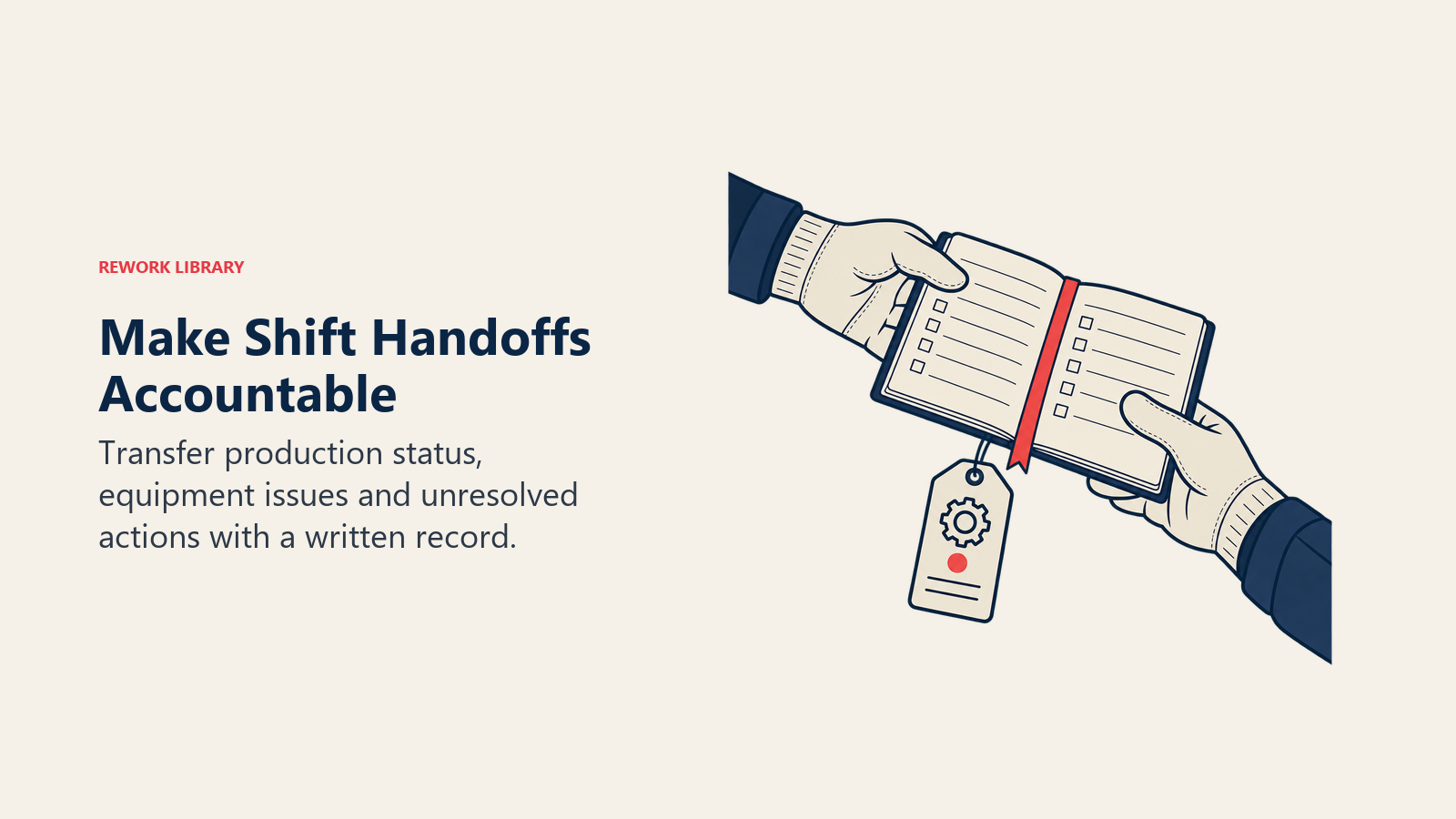
Documentation and logbook systems supplement verbal handoffs with written records. Standard logbooks should capture production counts and performance, equipment issues and maintenance needs, quality problems and disposition, material shortages or issues, safety incidents or near misses, and any unusual events or decisions.
Digital systems work well but simple paper logbooks are perfectly adequate. The key is consistent use and clear entries that anyone can understand later.
Overlap periods where shifts work simultaneously for 15-30 minutes enable better handoffs. The outgoing shift can show incoming employees current status, explain any special situations, and answer questions. This overlap costs money but often pays for itself in fewer startup issues and smoother operations.
Where overlap isn't practical, consider brief gap periods (15 minutes between shifts) that give supervisors time for thorough handoff without employees standing idle.
Accountability for handoff quality must be clear. Both outgoing and incoming supervisors are responsible for effective handoffs. Performance expectations should include handoff quality, not just production results.
When handoffs are treated as optional or administrative burden, they're done poorly. When they're treated as critical to operational success, they're done well.
Achieving Shift-to-Shift Performance Consistency
Different shift performance reveals opportunities to improve your overall operation.
Shift performance metrics and tracking should break down your key metrics by shift: productivity, quality, safety, equipment uptime, and schedule adherence. Using labor productivity metrics provides the framework for this analysis. Plot these metrics over time to identify persistent patterns versus random variation.
If one shift consistently underperforms, dig into why. Don't accept "night shift is always slower" as explanation:that's a symptom, not a cause.
Root cause analysis of shift variations investigates the drivers of performance differences. Common causes include experience and skill level differences, supervision quality variations, maintenance and technical support availability, material handling and logistics differences, and communication and information gaps.
Each cause requires targeted solutions. If the issue is skill differences, focus on training and possibly crew rebalancing. If it's support availability, ensure technical resources are available across shifts. If it's supervision, invest in leadership development for weaker supervisors.
Shift-specific improvement initiatives address identified gaps. If night shift struggles with equipment setup, provide additional training and possibly simplified setup procedures. If weekend crew has quality issues, improve quality documentation and real-time support.
Track improvement initiatives by shift just as you track performance. Are the interventions working? Are gaps closing? What additional actions are needed?
Supervisor development and standardization create consistency in leadership across shifts. Strong shop floor leadership is critical for all shifts. Supervisors should receive the same training, follow the same management processes, and be held to the same performance standards regardless of which shift they lead.
Regular supervisor meetings across all shifts enable sharing of best practices, problem-solving support, and alignment on priorities. Supervisors who learn from each other perform more consistently.
Enabling 24/7 Excellence Through Support Systems
Shifts can only perform as well as the support systems enable.
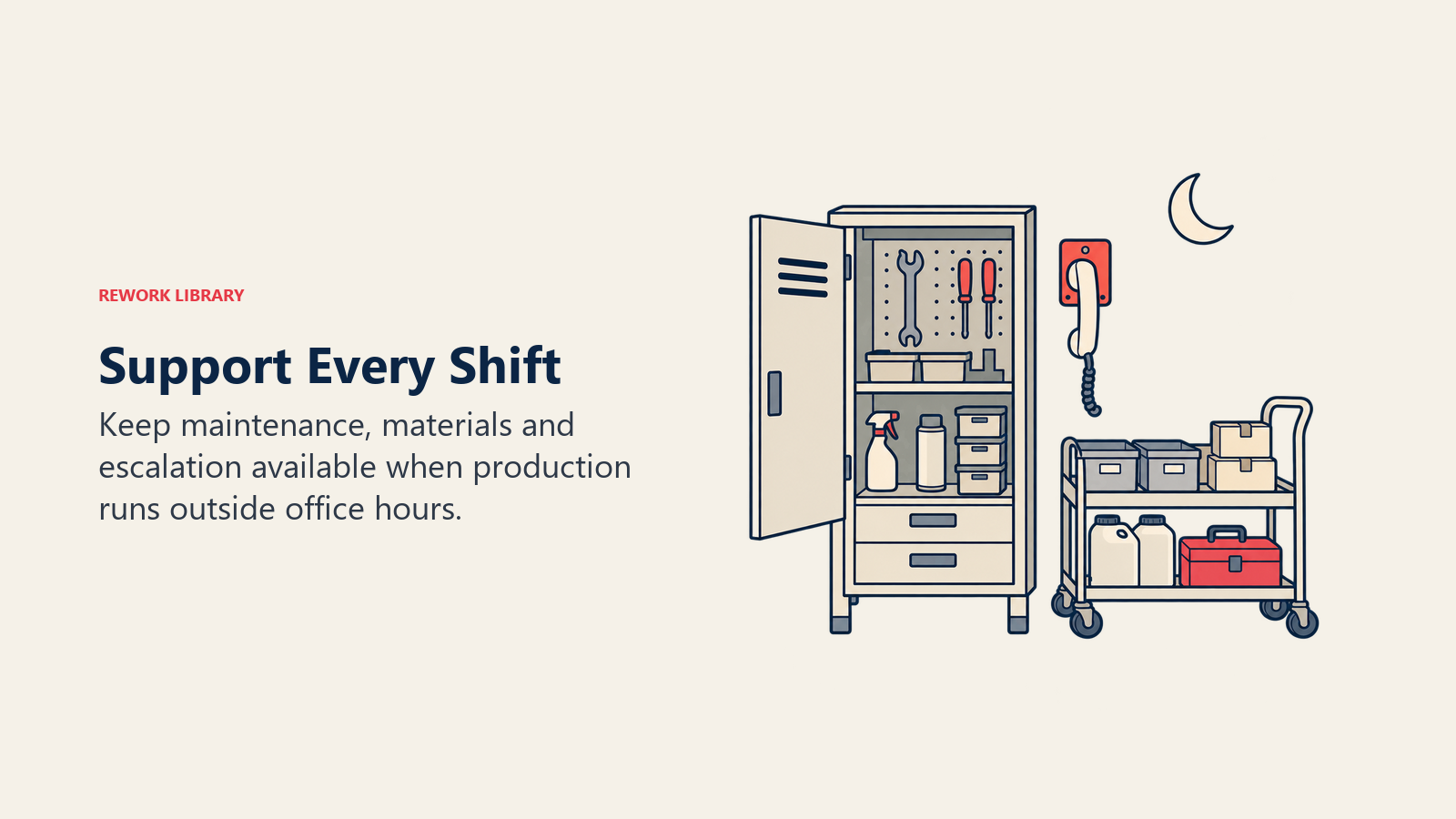
Maintenance and technical support coverage determines how quickly equipment issues get resolved. First shift usually has full maintenance staff available. Second shift might have reduced coverage. Third shift often has minimal or on-call only support.
This creates situations where equipment problems on night shift wait eight hours for resolution, losing capacity and frustrating operators. Right-size maintenance coverage based on equipment criticality and problem frequency. You probably don't need full maintenance staff 24/7, but you need enough coverage to address problems without extended downtime.
Consider having maintenance on second shift and on-call for third shift, or staggering maintenance schedules so experienced technicians cover different times.
Materials and logistics coordination ensures all shifts have what they need when they need it. Nothing frustrates a shift more than standing idle because materials weren't staged or forklifts aren't available.
Develop clear material replenishment protocols that work across shifts, ensure material handlers are scheduled appropriately on all shifts, and stage materials ahead when possible so production can start immediately.
Management presence and escalation provide support for difficult decisions and rapid problem resolution. When managers are only present during first shift, other shifts feel less supported and may struggle with issues that could be quickly resolved with management involvement.
Leadership should periodically work different shifts to understand challenges firsthand, establish clear escalation protocols so supervisors know how to reach management if needed, and ensure someone with appropriate authority is available or on-call at all times.
Technology and information systems must work reliably across all shifts. If the production system goes down on Saturday night, can it be fixed or does production wait until Monday? If operators need engineering drawings or work instructions, can they access them at 2 AM?
Modern operations increasingly rely on digital systems. Ensure those systems have appropriate support coverage and backup procedures for when they fail outside normal business hours.
Common Shift Management Problems
Even well-designed shift operations face predictable challenges.
First shift bias concentrates experienced employees, management attention, and resources on day shift while treating other shifts as secondary. This becomes self-fulfilling:when night shift gets less support, performance suffers, confirming the bias that night shift is inferior.
Break this pattern by deliberately building capability on all shifts, ensuring experienced employees are distributed across shifts not concentrated on one, providing equivalent support and resources, and holding all shifts to the same performance standards.
Poor handoff discipline loses information and creates problems. When handoffs are rushed, informal, or skipped entirely, critical information doesn't transfer. Incoming shifts discover problems that could have been addressed proactively.
Make handoffs non-negotiable. Schedule overlap or gap time specifically for handoffs. Include handoff quality in supervisor performance expectations.
Inconsistent procedures and practices create confusion and variable results. When different shifts follow different procedures, quality becomes unpredictable and improvement efforts founder.
Standardize core procedures across all shifts through documented standard work, regular audits to verify compliance consistent with manufacturing quality management principles, and visible management commitment to consistency over individual preferences.
Schedule fatigue and work-life balance issues affect retention and safety. Some shift patterns are inherently exhausting:too many consecutive days, insufficient recovery time between shift changes, or constantly rotating schedules that prevent stable routines.
Design schedules that provide adequate rest, respect circadian rhythms where possible, limit consecutive workdays to sustainable levels, and gather employee feedback on schedule impacts.
Building Sustainable 24/7 Operations
The best shift operations don't just function:they thrive through systematic management and continuous improvement.
This requires treating each shift as equally important and holding each to the same high standards. It demands investment in leadership development for all shift supervisors, not just day shift. It needs reliable systems that enable consistent operations regardless of which shift is working.
Most fundamentally, it requires recognizing that shift work is challenging and supporting employees who do it. Competitive shift premiums, schedule predictability, opportunities for advancement, and genuine concern for work-life balance all contribute to attracting and retaining quality employees across all shifts.
Your equipment runs 24/7. Your customers expect consistent quality 24/7. Your safety obligations don't pause at 5 PM. Build shift operations that deliver excellence around the clock, not just during day shift.
The capacity and cost advantages of well-managed multi-shift operations are substantial. But they only materialize when you manage shifts as an integrated system with consistent standards, clean handoffs, appropriate support, and genuine commitment to excellence across all shifts.
Learn More

Co-Founder, Rework.com