Circular Economy in Manufacturing: From Linear to Regenerative Production Models
Turn this article into takeaways for your work.


Each assistant summarizes the article only for you and suggests best practices for your work.
A lighting manufacturer shifted from selling fixtures to selling illumination as a service. Customers pay for light, not equipment. The manufacturer retains ownership, maintains systems, and recovers fixtures at end-of-life for remanufacturing. This circular model transformed their business. Instead of cheap fixtures discarded after failure, they design durable systems that can be upgraded, repaired, and remanufactured. Material recovery pays for reverse logistics. Customers get better service at lower total cost. The manufacturer earns recurring revenue instead of transactional sales. Environmental impact dropped 60%. Everybody wins.
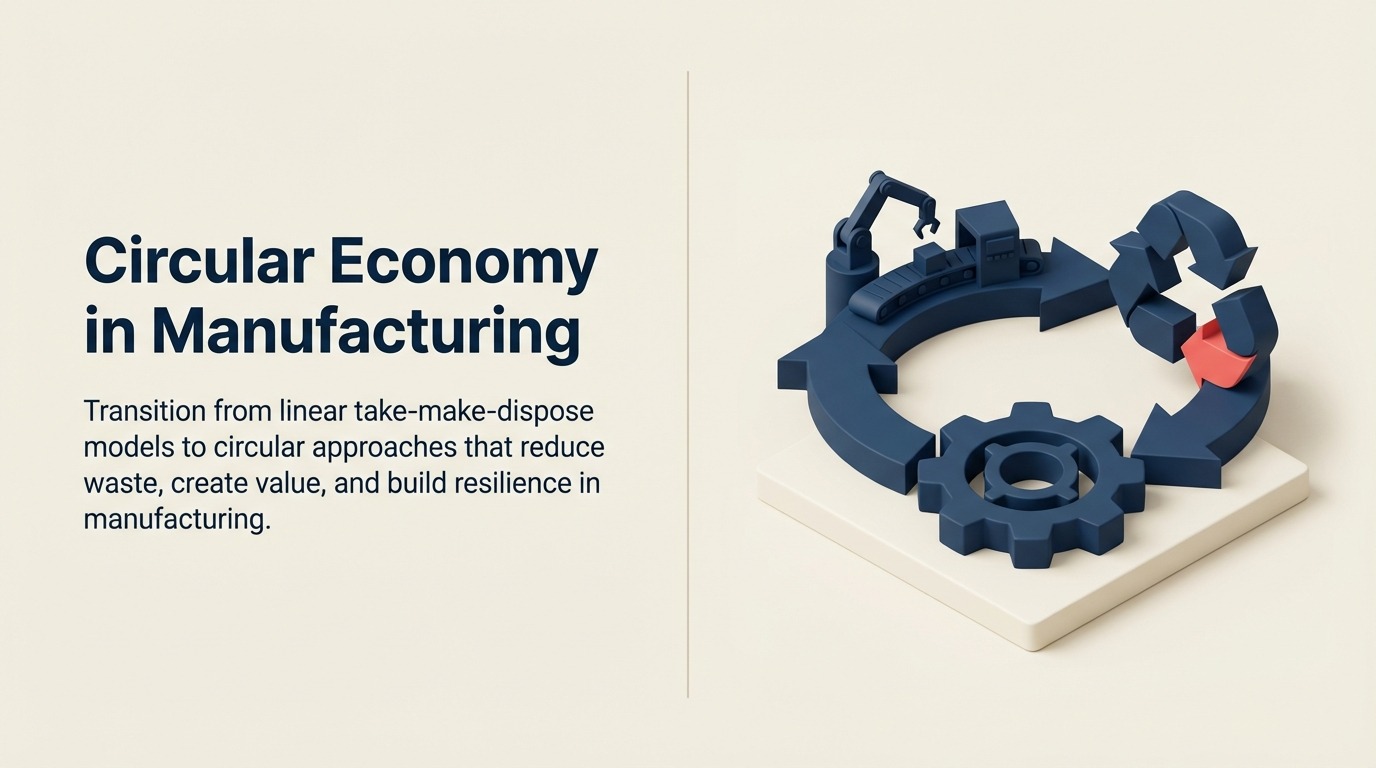
The linear economy (extract materials, make products, use them, throw them away) is economically and environmentally unsustainable. Material costs rise. Disposal costs increase. Regulations tighten. Customers demand sustainability. The companies winning the future are those transitioning from linear to circular models that retain value through reuse, remanufacturing, and regeneration. Circular economy isn't just environmental feel-good. It's competitive strategy.
Why Linear Models Fail
Linear manufacturing assumes infinite raw materials, infinite disposal capacity, and customers who don't care about environmental impact. None of these assumptions hold anymore.
Material costs have increased dramatically as easy-to-extract resources deplete and demand grows. Metals, chemicals, and energy all cost more than a decade ago. Linear models treat materials as cheap inputs to be used once and discarded. This made sense when materials were abundant and cheap. It makes no sense when materials represent 40-70% of product cost and prices trend upward.
Disposal costs are rising as landfills reach capacity and regulations tighten. What used to be nearly free now costs real money. Hazardous waste disposal is particularly expensive. Electronic waste faces specific regulations. Plastics are increasingly restricted. The assumption that disposal is cheap endpoint of linear flows no longer holds. Disposal is expensive problem that circular approaches solve.
Regulatory pressure constrains linear models through extended producer responsibility, recycling requirements, and disposal restrictions. European Union requires producers to finance product take-back and recycling. Many jurisdictions ban certain materials from landfills. Planned obsolescence faces criticism. Regulations increasingly force circularity that companies might not choose voluntarily.
Customer expectations shift toward sustainability and away from disposable products. Business customers face their own sustainability pressures and need sustainable suppliers. Consumers increasingly prefer brands demonstrating environmental responsibility. The Ellen MacArthur Foundation reports that over 1,000 companies worldwide support circular economy principles. This isn't tiny niche market. It's mainstream expectation affecting purchase decisions and brand loyalty.
Resource security concerns motivate circular approaches. Companies dependent on materials subject to supply disruptions or price volatility recognize that material recovery creates supply resilience. Circular models provide partial independence from virgin material markets. This risk management value justifies circular investment even without environmental motivation.
Circular Economy Principles
Circular economy isn't just recycling. It's systemic approach that designs out waste, keeps materials and products in use, and regenerates natural systems. The Ellen MacArthur Foundation defines circular economy as a system that is restorative and regenerative by design. Understanding these principles guides circular strategy development.
Design for durability creates products that last. This contradicts planned obsolescence but makes sense when you retain ownership through service models or capture value through take-back programs. Durable products require less frequent replacement conserving resources and reducing customer costs. Design choices about materials, construction, and maintenance access determine durability. The question shifts from "how cheaply can we make this?" to "how long can we make it last?"
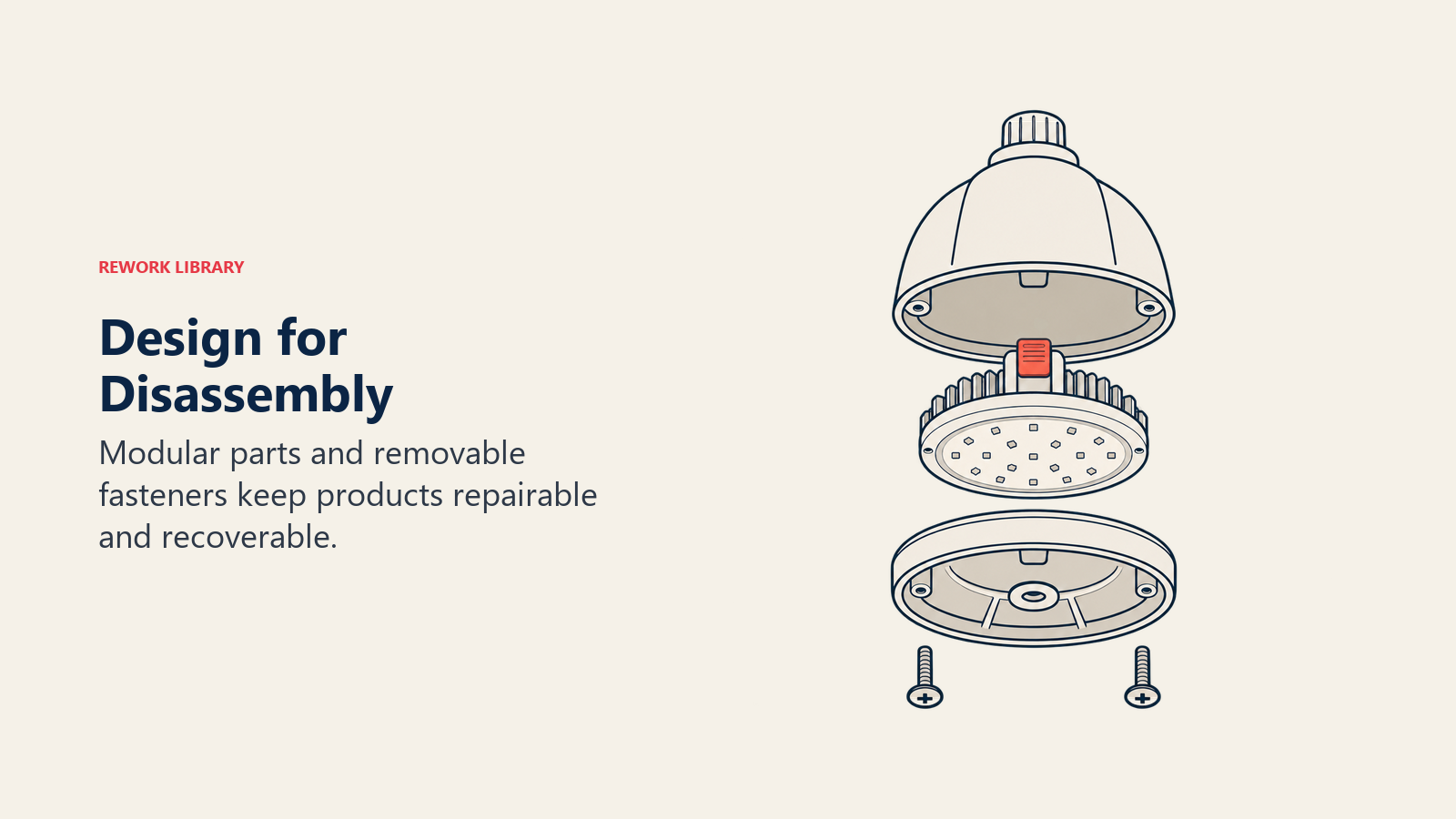
Design for disassembly enables product recovery at end-of-life. Products designed for disassembly use mechanical fasteners instead of adhesives, modular construction instead of integrated assemblies, and material separation instead of mixed composites. These choices cost marginally more initially but enable valuable material recovery later. When products are designed to be taken apart, remanufacturing and recycling become economically viable.
Material selection emphasizes recyclability and sustainability. Some materials recycle easily. Others don't. Aluminum recycles indefinitely with minimal quality loss. Mixed plastics degrade with each recycling iteration. Composites are nearly impossible to separate. Design choices about materials determine whether products become waste or feedstock. Choosing recyclable materials enables circular flows.
Modularity enables component replacement and upgrading. Instead of replacing entire products when one component fails or becomes obsolete, modular designs enable targeted replacement. This extends product life, reduces waste, and creates upgrade revenue opportunities. Technology products particularly benefit from modularity because rapid technological advancement otherwise forces premature disposal of working products.
Service-based business models shift from selling products to selling outcomes. Customers pay for performance or access rather than ownership. This aligns manufacturer incentives with longevity, repairability, and resource efficiency. When you retain ownership, you design for durability and build revenue from service rather than replacement sales. This fundamental business model change enables circular approaches.
Value Recovery Strategies
Circular economy creates value by keeping materials and products in productive use longer. Multiple strategies recover value that linear models waste.
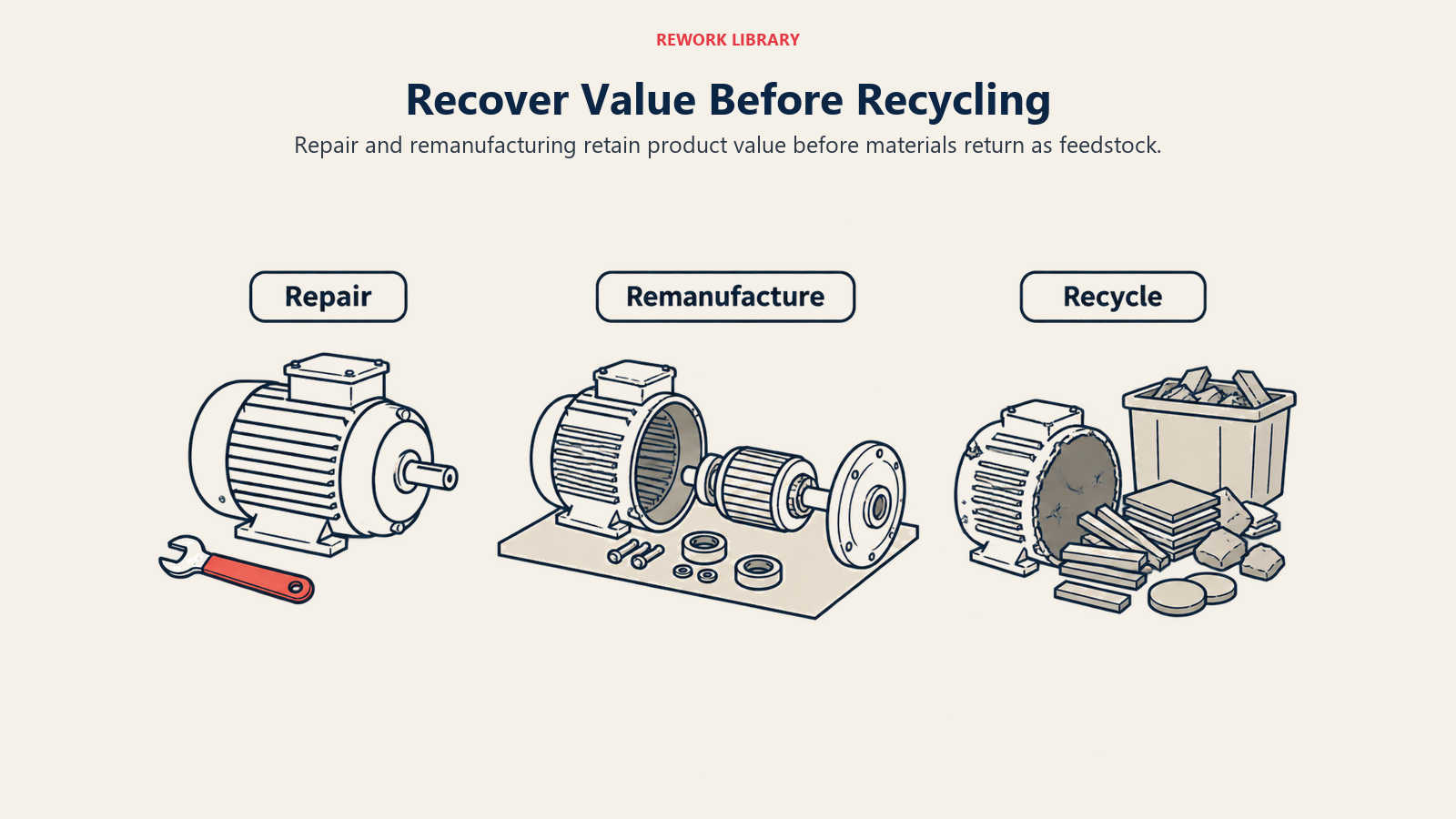
Maintenance and repair extend product life through active management. Regular maintenance prevents failures. Repair fixes problems keeping products in service. This seems obvious but linear models often make repair difficult or uneconomic compared to replacement. Circular models make products repairable and build repair into service offerings. This requires spare parts availability, diagnostic tools, and trained service personnel.
Refurbishment upgrades used products to like-new condition. This might involve replacing worn components, updating aesthetics, or cleaning and testing. Refurbished products sell at discounts to new but provide attractive margins because material costs are low. The refurbishment market for electronics, machinery, and automotive parts demonstrates economic viability. Refurbishment requires reverse logistics to collect used products and facilities to perform refurbishment.
Remanufacturing disassembles products, salvages components in good condition, and manufactures products from mix of recovered and new components. Remanufactured products meet new product specifications at 50-70% of new product costs. This creates competitive pricing while reducing environmental impact 80-90%. Remanufacturing requires designs enabling disassembly, component specifications allowing mix of new and recovered parts, and quality systems ensuring remanufactured products perform reliably.
Repurposing finds new uses for products or materials no longer suitable for original purpose. Materials from demolished buildings become feedstock for new construction. Industrial byproducts become raw materials for other industries. Products too worn for primary markets serve secondary markets. Repurposing requires creativity and ecosystem connections finding users for materials others consider waste.
Recycling processes materials into feedstock for new products. Mechanical recycling physically processes materials into recycled content. Chemical recycling breaks materials to molecular level enabling higher-quality recycling. Biological recycling composts organic materials. Effective recycling requires material purity, collection logistics, and end markets for recycled content. Designing products for recyclability enables economically viable recycling.
Business Model Innovation
Circular economy often requires business model changes that feel radical. Selling products generated revenue. Circular models generate revenue differently, requiring financial and operational shifts.
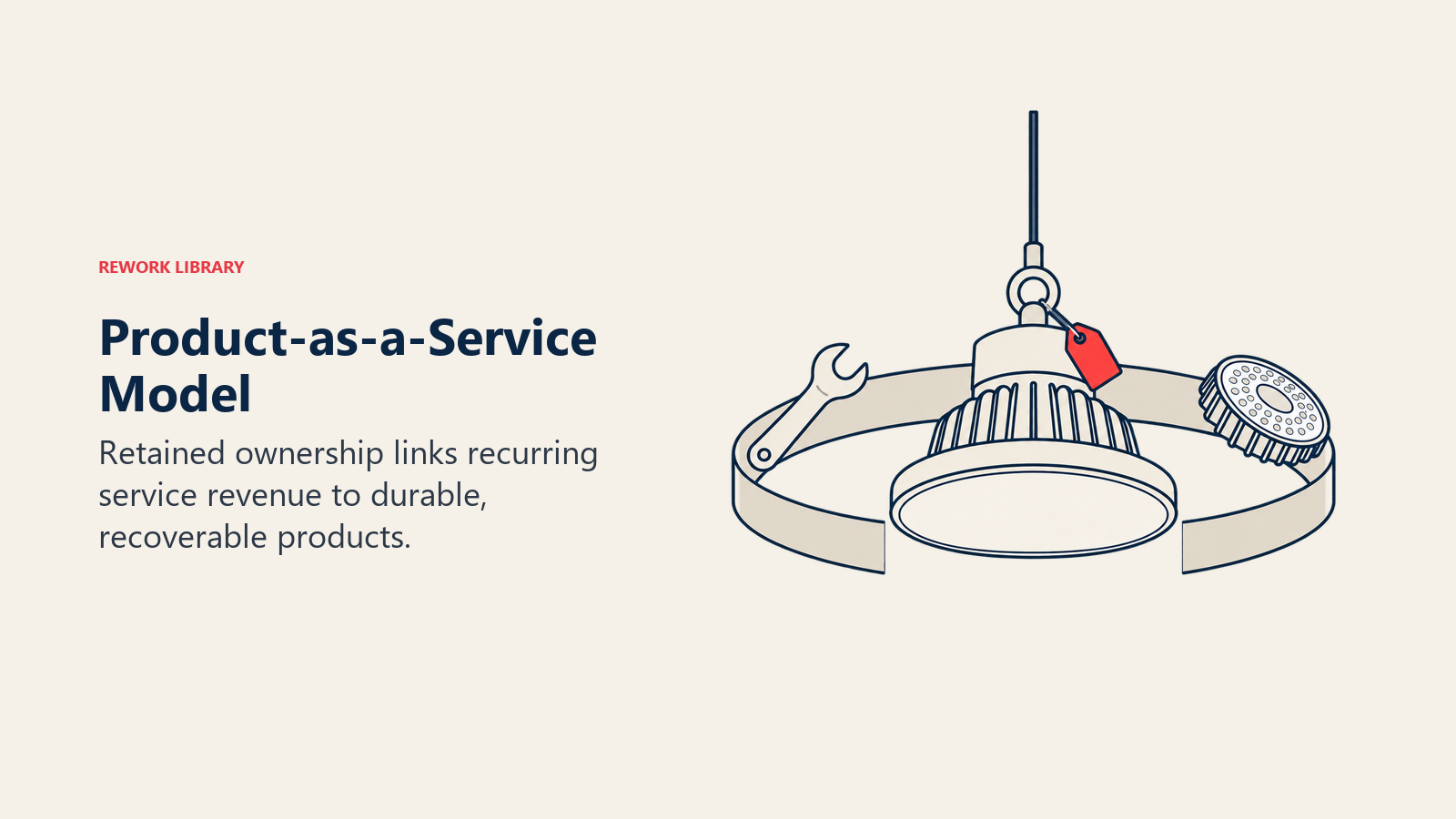
Product-as-a-service shifts from selling to leasing or subscription. Customers pay monthly for product access rather than upfront for ownership. Manufacturers retain ownership, maintain products, and recover them at end-of-life. This creates recurring revenue, aligns incentives with durability, and enables systematic material recovery. The challenge is financial transition from transaction revenue to service revenue and operational capability to provide service reliably.
Performance contracting sells outcomes rather than products. Lighting-as-a-service sells illumination, not fixtures. Transportation-as-a-service sells mobility, not vehicles. HVAC-as-a-service sells comfortable environments, not equipment. Performance contracting transfers risk from customers to providers who then optimize for efficiency and longevity. This requires sophisticated operational capabilities and strong customer relationships.
Take-back programs collect used products from customers providing feedstock for remanufacturing or recycling. Some programs offer discounts on new purchases when returning old products. Others pay for returned products. Successful take-back requires reverse logistics networks, sorting facilities, and processing capabilities. The economic viability depends on recovered material value and processing costs.
Sharing platforms enable multiple users to share access to products rather than individual ownership. Shared machinery, tools, or equipment increase utilization reducing total resource consumption. Platform operators facilitate sharing, maintain products, and earn fees from users. This works best for expensive products used intermittently where ownership costs exceed usage costs.
Implementation Challenges
Circular models promise benefits but implementation faces real obstacles. Understanding challenges enables realistic planning.
Reverse logistics cost more than forward logistics. Products return in unpredictable conditions at unpredictable times from dispersed locations. Collection, sorting, and processing require infrastructure that doesn't exist for most products. Building reverse logistics networks requires investment that takes years to pay back. Starting small and scaling gradually makes this more manageable than trying to build comprehensive systems immediately.
Product design legacy prevents circularity. Existing products weren't designed for disassembly, repair, or material recovery. Retrofitting circular principles into existing designs is difficult or impossible. Design changes take time. You can't make current products circular overnight. But you can design new products with circular principles ensuring future products enable circular flows.
Customer acceptance varies. Some customers embrace service models. Others prefer ownership. Some value sustainability. Others prioritize price. Circular business models must appeal to enough customers to generate viable economics. This might mean targeting sustainability-conscious segments initially while developing offerings that appeal more broadly over time.
Financial transition from product sales to service revenue affects cash flow and accounting. Product sales generate immediate revenue. Service models generate revenue over time. This transition strains finances short-term even when long-term economics are superior. Managing this financial bridge requires planning and might require external financing.
Ecosystem coordination challenges emerge when circularity requires multiple parties. Your circular model might depend on suppliers providing sustainable materials, customers returning products, recyclers processing materials, and secondary markets buying recovered materials. Coordinating these actors requires relationship building and often formal partnerships. Single companies can't create circular economy alone.
Technology Enablers
Technology reduces barriers to circular economy implementation. Digital tools, material innovations, and processing technologies enable circular flows.
Digital product passports track materials and components through lifecycles. These digital records identify what materials products contain, which components are installed, maintenance history, and recovery instructions. This enables efficient remanufacturing and recycling by providing information otherwise lost. Blockchain and IoT technologies enable product passports at scale.
Advanced sorting technologies separate mixed materials economically. AI-powered vision systems identify material types. Robotic sorting handles volume efficiently. These technologies make recycling economically viable for material streams that previously weren't worth sorting. As sorting technology improves, more materials become recyclable.
Material innovation develops alternatives with better circular properties. Bio-based plastics that decompose or recycle cleanly. Modular electronics that enable component replacement. Dissolvable adhesives that enable disassembly. Material science advances create options that weren't previously available. Designing products with these materials enables circular flows.
Digital marketplace platforms connect material suppliers and users. One company's waste becomes another's feedstock. Platforms facilitate these connections at scale creating industrial ecosystems. These digital tools reduce transaction costs making material recovery economically viable.
Moving Forward
Circular economy represents fundamental shift from extract-make-dispose to retain-reuse-regenerate. This transition requires strategic vision, operational capability, and patient investment. But the competitive and environmental benefits justify the effort.
Start with circular design principles in new product development. You can't make existing products circular quickly but you can ensure new products enable circular flows. Design for durability, disassembly, and material recovery. These choices determine whether future products can participate in circular economy.
Experiment with circular business models on pilot products or segments. Don't try to transform everything at once. Pick products suitable for service models or take-back programs. Test approaches. Learn what works. Scale success while adjusting or abandoning approaches that don't work. Iterative experimentation builds capability.
Build ecosystem partnerships enabling circular flows. You need suppliers providing sustainable materials, logistics partners handling reverse flows, processors remanufacturing or recycling products, and customers accepting new business models. These relationships take time to develop. Start building them now.
Measure circular performance through metrics beyond traditional financial measures. Track material recovery rates, product lifetime extension, and resource efficiency. These metrics reveal whether circular strategies work and guide improvement. What gets measured gets managed.
Remember that circular economy creates competitive advantage beyond environmental benefits. Resource efficiency reduces costs. Service models create recurring revenue and customer relationships. Product longevity builds brand reputation. Material recovery provides supply resilience. The business case for circular economy stands on its own without requiring environmental justification.
The manufacturers leading in ten years will be those transitioning to circular models today. Linear models are ending not because of environmental regulation alone but because circular approaches create better businesses. Start the transition now.
Learn More
