Regulatory Compliance Management in Manufacturing: Building Systems for Multi-Jurisdictional Compliance
Turn this article into takeaways for your work.


Each assistant summarizes the article only for you and suggests best practices for your work.
A medical device manufacturer with facilities in five countries faced an escalating compliance challenge. Environmental regulations in the EU tightened restrictions on chemical usage. U.S. OSHA introduced new workplace safety standards. FDA changed quality system requirements. Export control rules added complexity to international shipments. Each facility had compliance specialists, but no central visibility or standardized approach.
Then a surprise audit at their UK facility revealed gaps in chemical documentation that triggered enforcement action. The investigation spread to other facilities, revealing inconsistent compliance approaches and inadequate tracking of changing requirements. The company faced fines, remediation costs, and customer concerns about their quality systems.
They invested in building an integrated compliance management system: centralized requirement tracking, standardized processes across facilities, unified documentation and training, and proactive monitoring. Two years later, they passed audits at all facilities with minor findings, avoided recurring violations, and reduced compliance costs by consolidating redundant efforts.
More importantly, strong compliance became a sales advantage. Customers increasingly require proof of systematic compliance management. The company's integrated approach differentiated them from competitors struggling with fragmented compliance.
Regulatory Compliance Scope in Manufacturing
Environmental regulations cover multiple domains that manufacturers must navigate. Air emissions require permits, monitoring, and reporting for everything from VOCs in painting operations to criteria pollutants from combustion. Water discharge needs permits specifying allowable contaminants and concentrations. Waste management includes characterization, storage, transportation, and disposal requirements that vary by waste type and jurisdiction. Chemical management under programs like REACH (EU) and TSCA (U.S.) requires registration, restriction compliance, and hazard communication.
Health and safety requirements protect workers across multiple regulatory frameworks. OSHA (U.S.) and equivalent agencies elsewhere set standards for machine guarding, hazard communication, lockout/tagout, confined spaces, and countless other workplace hazards. Compliance requires hazard assessment, control implementation, training, and documentation. Building a strong safety culture goes beyond compliance. Violations can result in citations, fines, and production shutdowns.
Product safety and quality standards ensure products don't harm users. FDA regulates medical devices, pharmaceuticals, and food manufacturing with detailed quality system requirements. Consumer Product Safety Commission (CPSC) sets standards for consumer products. Industry-specific regulations apply to automotive, aerospace, electronics, and other sectors. These requirements affect design, manufacturing processes, testing, and documentation.
Trade compliance encompasses import/export regulations that affect international manufacturers. Export control laws restrict technology and product shipments to certain countries or end-users. Customs regulations require accurate product classification and valuation. Free trade agreements provide tariff benefits but require certificates of origin and content documentation. Violations can result in denied export privileges, seizures, and significant penalties.
Data privacy and cybersecurity regulations increasingly affect manufacturers. GDPR (EU), CCPA (California), and emerging laws worldwide require protecting personal information of employees, customers, and suppliers. As manufacturing becomes more connected, cybersecurity requirements protect critical infrastructure and proprietary data from breaches.
Compliance Management System
Regulatory intelligence and requirement tracking answers the question: what do we need to comply with? Requirements change constantly: new regulations, revised standards, court decisions, agency guidance. You need systematic monitoring of relevant regulatory sources, assessment of applicability to your operations, translation into specific requirements, and communication to affected personnel.
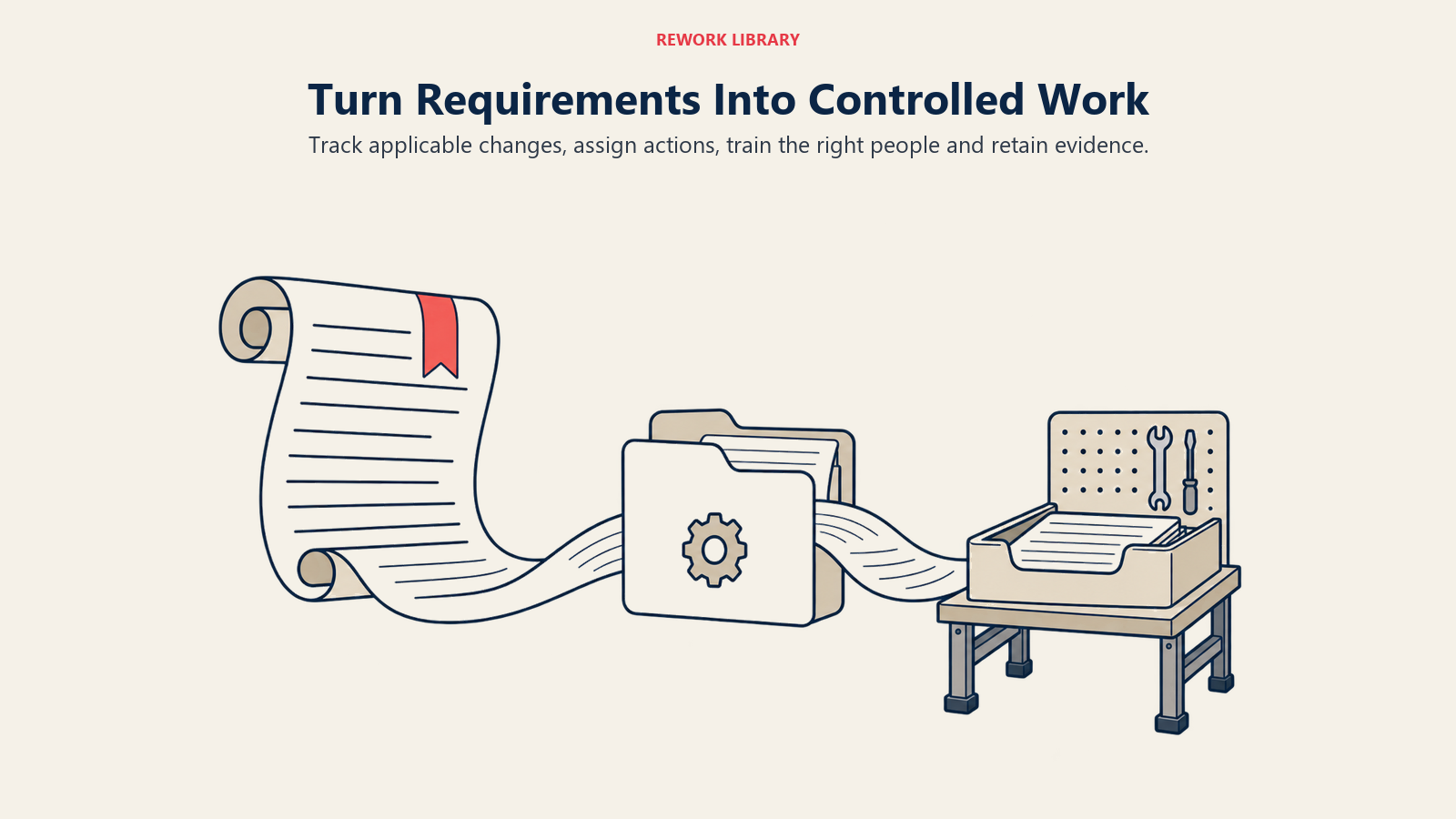
A specialty chemicals manufacturer subscribes to regulatory tracking services for environmental, safety, and chemical regulations across the 12 countries where they operate. A compliance team reviews updates monthly, assesses impact, and updates internal requirements. This proactive approach gives them 6-12 months to prepare for new requirements rather than scrambling at enforcement deadlines.
Gap assessment and risk prioritization identifies where current practices fall short of requirements. Conduct periodic audits against applicable regulations, document gaps and deficiencies, assess the risk (likelihood of detection and severity of consequences), and prioritize remediation based on risk. Not every gap requires immediate action, but conscious risk acceptance based on data beats ignorance.
Policies, procedures, and work instructions translate requirements into actionable guidance. Policies establish high-level compliance commitments and responsibilities. Procedures define processes for meeting requirements: permit management, incident reporting, document control. Work instructions provide step-by-step guidance for specific tasks. This hierarchy ensures requirements cascade from regulatory source to shop floor execution.
Training and competency management ensures people understand and can fulfill compliance requirements. Role-based training provides relevant requirements for each position: operators, supervisors, specialists, managers. Initial training for new hires, periodic refresher training, and additional training when regulations change. Documentation proves who was trained, on what, and when, essential for demonstrating due diligence.
Monitoring, measurement, and reporting provide evidence of compliance. Emission monitoring, waste manifests, training records, inspection reports: these documents demonstrate compliance to regulators and auditors. Compliance dashboards give management visibility into key metrics: outstanding corrective actions, overdue training, permit expiration dates, audit findings. What gets measured gets managed.
Organizational Framework
Roles and responsibilities define who owns compliance activities. The compliance officer (or equivalent role) provides expertise, coordinates the compliance program, tracks requirements, and liaises with regulators. But compliance isn't just the compliance department's job. Functional owners (EHS manager, quality manager, HR director) implement requirements in their domains. Facility managers ensure local compliance. Everyone has some compliance responsibility.
A building products manufacturer clarified compliance roles after an audit found confusion about who owned certain environmental requirements. They created a RACI matrix (Responsible, Accountable, Consulted, Informed) for each major requirement. Accountability improved immediately when people knew exactly what they owned.
Governance and oversight provides executive leadership and resource allocation. A compliance steering committee with cross-functional leadership reviews compliance performance, allocates resources, approves policies, and escalates significant issues to executive leadership. This governance ensures compliance gets appropriate priority and resources.
Third-party management and auditing addresses compliance in your supply chain. Suppliers must comply with regulations affecting materials and components they provide. Contractors working in your facilities must follow your safety and environmental requirements. Audit key suppliers for compliance with relevant requirements, include compliance provisions in contracts, and verify compliance through periodic assessment. Strong supplier quality management supports this process.
Issue escalation and remediation processes handle problems when they arise. Define what constitutes a reportable incident or noncompliance, establish notification and reporting workflows, conduct root cause analysis to prevent recurrence, implement corrective actions with accountability and deadlines, and track issues through closure with verification.
Technology Solutions
Compliance management platforms consolidate requirements, assessments, actions, and documentation in one system. These platforms provide regulatory content libraries that update automatically, workflow tools for managing assessments and audits, action tracking with accountability and deadlines, document management for policies and procedures, and reporting for compliance metrics and regulatory filings.
An industrial equipment manufacturer implemented a compliance platform that reduced the time compliance staff spent researching requirements by 60%, eliminated spreadsheet-based tracking that created visibility gaps, and provided executives with real-time compliance dashboards.
Regulatory tracking services provide professional monitoring of changing requirements. These services employ teams of specialists who monitor regulatory sources, summarize changes, assess impact, and provide implementation guidance. For manufacturers operating across multiple jurisdictions and regulatory domains, professional services are more comprehensive and cost-effective than internal monitoring.
Audit management tools streamline the audit process. Schedule audits, assign auditors, conduct evaluations using checklists, document findings with photos and notes, assign corrective actions, and track through closure. Digital tools replace paper-based audit processes that were difficult to track and analyze for trends.
Multi-Site Compliance
Harmonization versus local adaptation balances efficiency with jurisdictional requirements. Some requirements are consistent across locations: corporate safety policies, quality standards, ethics policies. These benefit from harmonization: one policy, one training program, one audit protocol. Other requirements vary by jurisdiction: environmental permits, chemical restrictions, labor laws. These need local adaptation while maintaining consistent management approach.
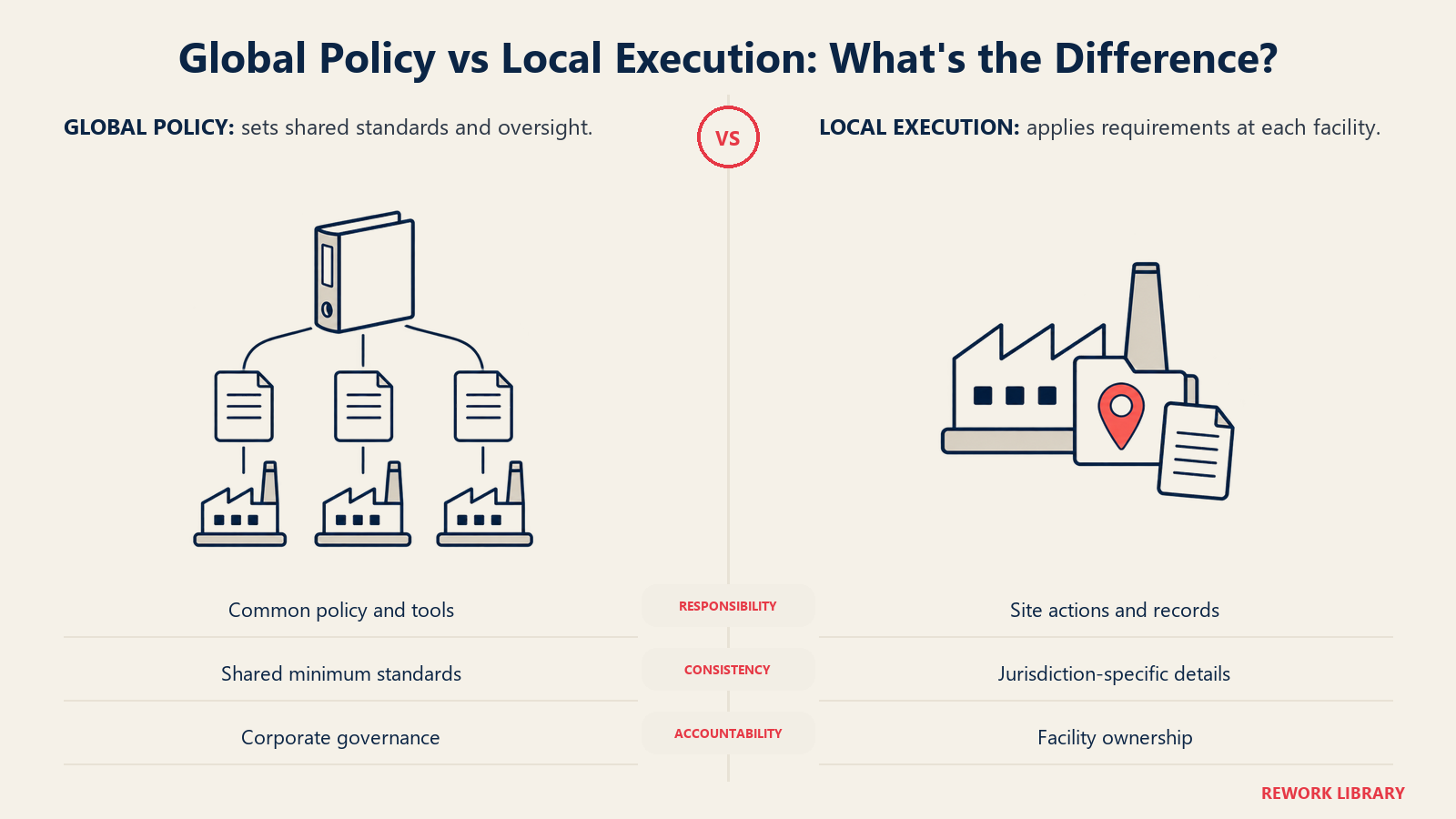
Centralized versus decentralized management affects who makes decisions and controls resources. Centralized compliance (corporate compliance team setting requirements and overseeing implementation) provides consistency and expertise but can be disconnected from facility realities. Decentralized compliance (facility teams managing their own compliance) understands local context but risks inconsistency and knowledge gaps. The optimal model often combines centralized policy and expertise with decentralized execution and accountability.
A global manufacturer uses a hub-and-spoke model. Corporate compliance sets minimum standards, provides tools and training, and conducts audits. Regional compliance specialists provide local expertise and support implementation. Facility teams execute day-to-day compliance with clear accountability. This balances consistency with local flexibility.
Building a Compliance Culture
Regulatory compliance in manufacturing has evolved from periodic audits and reactive fixes to systematic risk management that protects the business while enabling growth.
The manufacturers with mature compliance management share common characteristics: executive commitment demonstrated through resources and accountability, integrated systems rather than compliance silos, proactive requirement tracking before enforcement deadlines, standardized processes with appropriate local adaptation, and continuous improvement through root cause analysis and corrective action.
They avoid common pitfalls: treating compliance as the compliance department's job rather than everyone's responsibility, reacting to violations rather than preventing them, maintaining requirements in multiple incompatible systems, focusing on documentation over actual compliance, and viewing compliance as cost rather than risk management.
The compliance advantage goes to manufacturers who build systematic capabilities rather than reactive responses. Customers increasingly require compliance evidence before awarding business. Regulatory enforcement is intensifying. Supply chain disruptions from compliance failures create business continuity risks. Compliance capability is becoming a competitive requirement.
Start with clear ownership and governance. Know your requirements through systematic tracking. Assess gaps honestly and prioritize remediation by risk. Document policies and procedures. Train people and verify competency. Monitor performance and audit regularly. Treat noncompliance as opportunities for system improvement.
The goal isn't perfect compliance. It's managing compliance risk systematically while enabling the business to operate and grow across multiple jurisdictions and regulatory domains.
Learn More
