Manufacturing Workforce Planning: Strategic Staffing for Production Excellence
Turn this article into takeaways for your work.


Each assistant summarizes the article only for you and suggests best practices for your work.
Your production line just received a major order:but you're already running three shifts. Do you hire? Add overtime? Bring in temps? And what happens when this order ends?
These decisions happen daily in manufacturing, but the best operations directors aren't making them reactively. They've built workforce planning systems that anticipate needs months ahead, balance flexibility with stability, and ensure they have the right people with the right skills when production demands shift.
What Makes Workforce Planning Different in Manufacturing
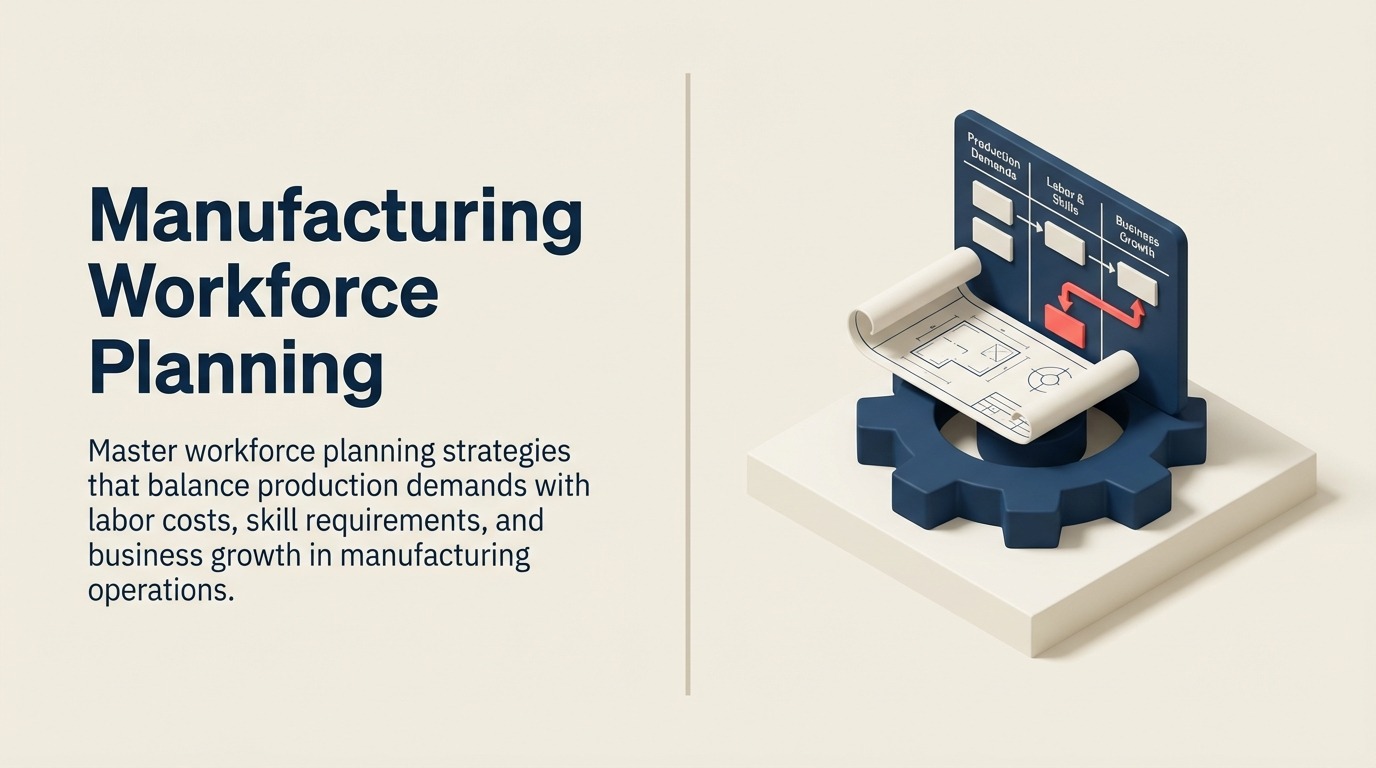
Manufacturing workforce planning goes far beyond simple headcount calculations. It's the systematic process of aligning your labor capacity with production requirements while maintaining the skills, flexibility, and efficiency your operations need.
The distinction matters. Traditional HR planning focuses on filling positions. Manufacturing workforce planning connects directly to your production schedule, equipment capacity, and growth strategy. When you plan a new product launch, workforce planning tells you exactly what skills you'll need, when you'll need them, and how to acquire them without disrupting current production.
This requires thinking in three dimensions simultaneously: capacity (how many people), capability (what skills they need), and flexibility (how to adapt to changes). Miss any one of these, and you'll either have too many workers during slow periods or production bottlenecks during peak demand.
The financial stakes are substantial. Labor typically represents 15-30% of manufacturing costs, and poor workforce planning shows up in overtime expenses, temp agency fees, training costs, quality issues from undertrained workers, and lost revenue from missed delivery dates. According to Deloitte research, labor productivity challenges and workforce dynamics significantly impact manufacturing competitiveness.
Translating Production Forecasts Into Staffing Needs
Effective workforce planning starts with understanding your production requirements:not just next week, but six to twelve months ahead.
Your production forecast provides the foundation. Take your expected production volumes and break them down by product line, manufacturing process, and time period. Implementing strong production planning fundamentals ensures accurate forecasts. A forecast that simply says "increase production 20%" doesn't help with workforce decisions. You need to know which lines will increase, which shifts will be affected, and which skills become more critical.
Calculate standard labor hours per unit for each product. If Product A requires 2.4 labor hours and Product B needs 3.8 hours, a shift in your product mix changes labor requirements even if total unit volume stays flat. Many manufacturers miss this, staffing for total volume while their actual labor needs have shifted dramatically.
Account for productivity assumptions realistically. If you're planning to improve efficiency by 8%, your workforce model needs to reflect that:but don't count efficiency gains before they're proven. Conservative assumptions prevent understaffing.
Factor in seasonal and cyclical patterns. Most manufacturers face predictable demand variations. Using demand forecasting for manufacturing helps identify these patterns accurately. If Q4 is always your busiest season, your workforce plan should show the ramp-up starting in Q3 (not the week before Thanksgiving). Map these patterns over multiple years to identify the true cycles rather than one-time events.
Don't forget non-production time. Vacation schedules, training requirements, machine maintenance periods when lines run slower, and quality hold time all reduce available productive hours. Budget for these realities rather than planning for 100% availability that never happens.
Building the Right Skills Architecture
Having enough warm bodies on the floor doesn't guarantee you can run production. You need specific skills in the right combinations.
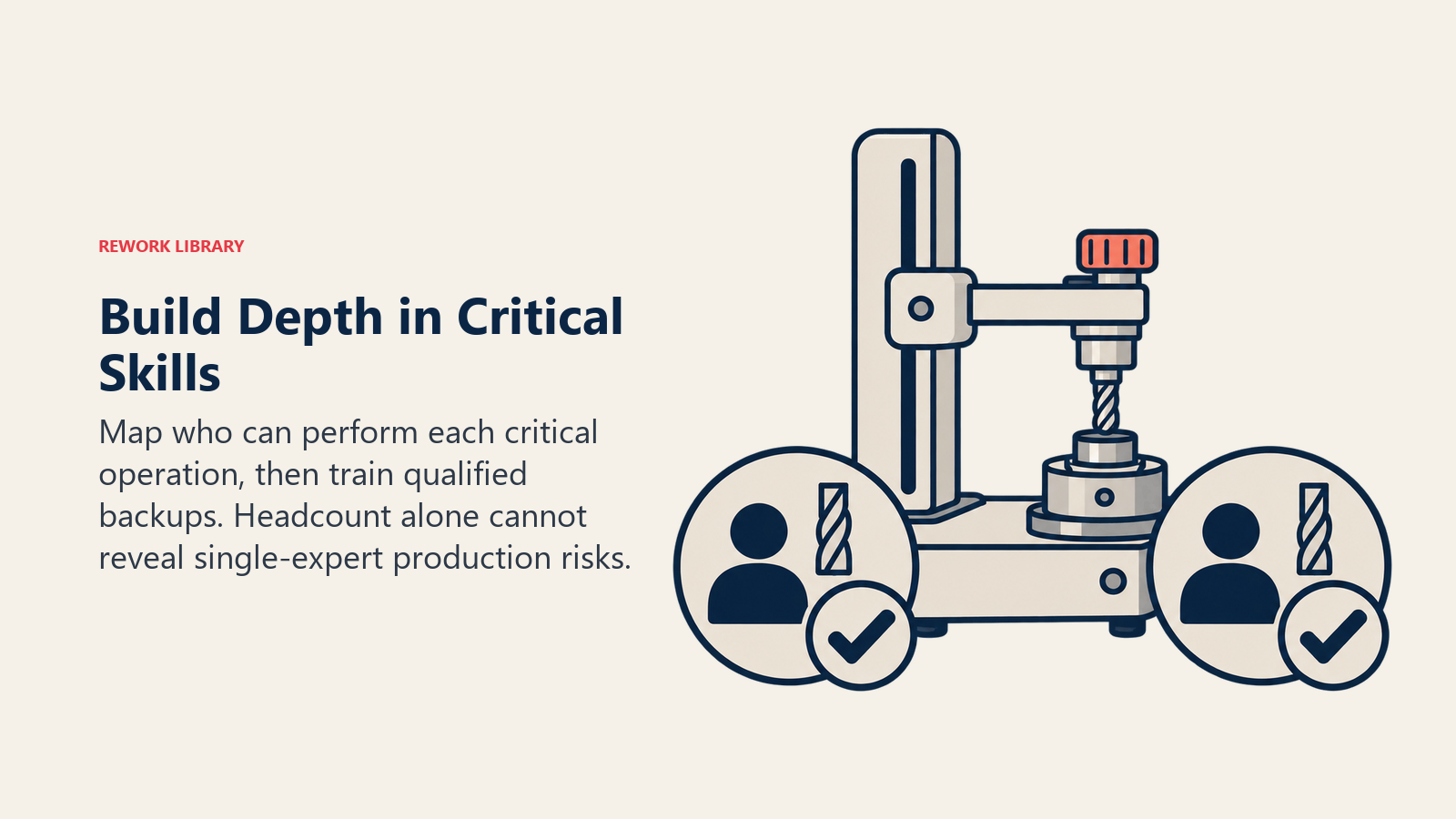
Start by mapping your critical skill requirements. Which capabilities are essential for core production processes? What skills create bottlenecks when absent? Where do you rely on a few key experts? This analysis reveals your skills vulnerability points:the areas where losing two or three people would seriously impact operations.
Distinguish between technical skills and operational capabilities. Technical skills involve running specific equipment, reading technical drawings, or programming machines. Operational skills include problem-solving, quality judgment, teamwork, and continuous improvement mindset. Both matter, but they're developed differently.
Consider your skills depth and breadth strategy. Depth means having multiple people who can perform complex operations expertly. Breadth means having people who can handle multiple different tasks competently. You need both, balanced strategically.
Most manufacturers need deep skills for complex, critical operations:like die-setting, quality inspection, or maintenance troubleshooting. These skills take years to develop, so you need multiple qualified people and active succession planning. For simpler, repetitive operations, breadth through cross-training programs provides better flexibility.
Plan for future skill requirements now. If you're implementing automation, who will program and troubleshoot those systems? If you're adding new product lines, what different capabilities will they require? Skills take time to develop, so workforce planning must anticipate capability needs before they become urgent.
Create skills matrices that show who can do what at what competency level. These matrices reveal gaps, identify succession risks, and guide training priorities. Update them quarterly as people develop new capabilities and job requirements evolve.
Optimizing Your Labor Model for Flexibility
How you structure your workforce determines your ability to scale efficiently as demand varies. The core question: which capabilities should be permanent employees versus flexible labor sources?
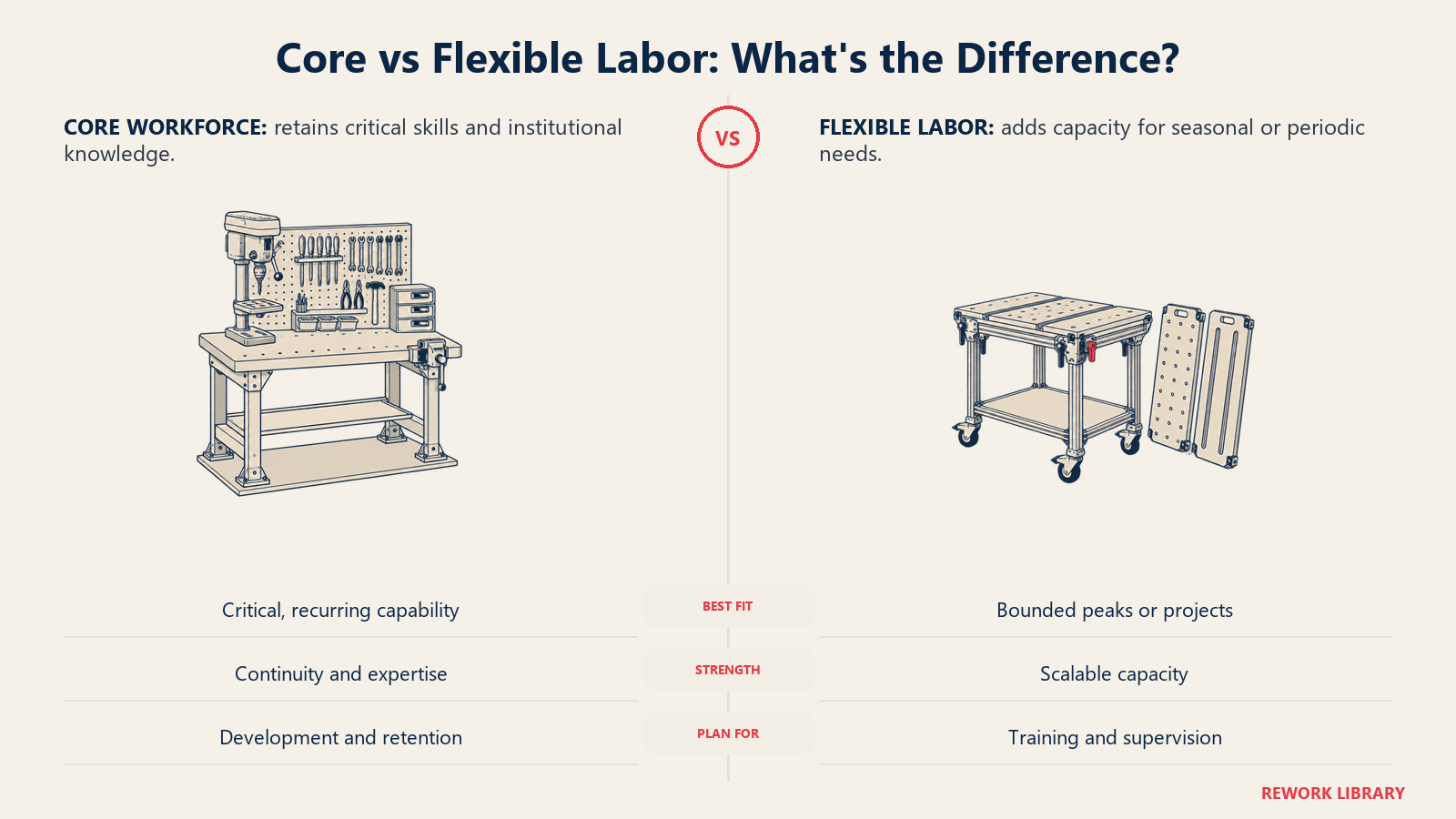
Your core workforce should include employees with deep institutional knowledge, critical technical skills, and leadership capabilities. These people form your operational foundation. They train others, solve complex problems, and maintain your production standards. Invest in their development and retention:they're difficult to replace.
But relying entirely on permanent employees creates rigidity. When demand drops, you carry excess labor costs. When it spikes, you can't scale fast enough. This is where contingent labor strategies provide flexibility.
Temporary workers through staffing agencies offer quick scalability for basic operations. You can adjust headcount weekly without hiring and firing permanent employees. The tradeoffs: higher hourly costs, training investment with high turnover, and typically lower productivity and quality consciousness.
Use temps strategically. They work well for predictable seasonal peaks where you know you'll need extra capacity for three months. They work poorly for operations requiring deep technical knowledge or where quality and safety risks are high.
Consider contract workers for specialized skills you need periodically but not continuously. Contract maintenance technicians, programmers, or project engineers provide expertise without permanent headcount.
Multi-skilling your core workforce creates internal flexibility. When employees can work in multiple areas, you can shift them to bottlenecks or cover absences without external hiring. This requires systematic skills training and development but pays dividends in operational flexibility.
The overtime decision deserves careful analysis. Overtime allows quick capacity increases without hiring, but it gets expensive beyond 10-15% of total hours and brings quality and safety risks from fatigue. Implementing effective shift management optimization helps balance these tradeoffs. Model the breakeven point where hiring becomes more economical than sustained overtime.
Building Your Workforce Planning Process
Effective workforce planning requires a systematic, repeatable process that connects your business planning to staffing decisions.
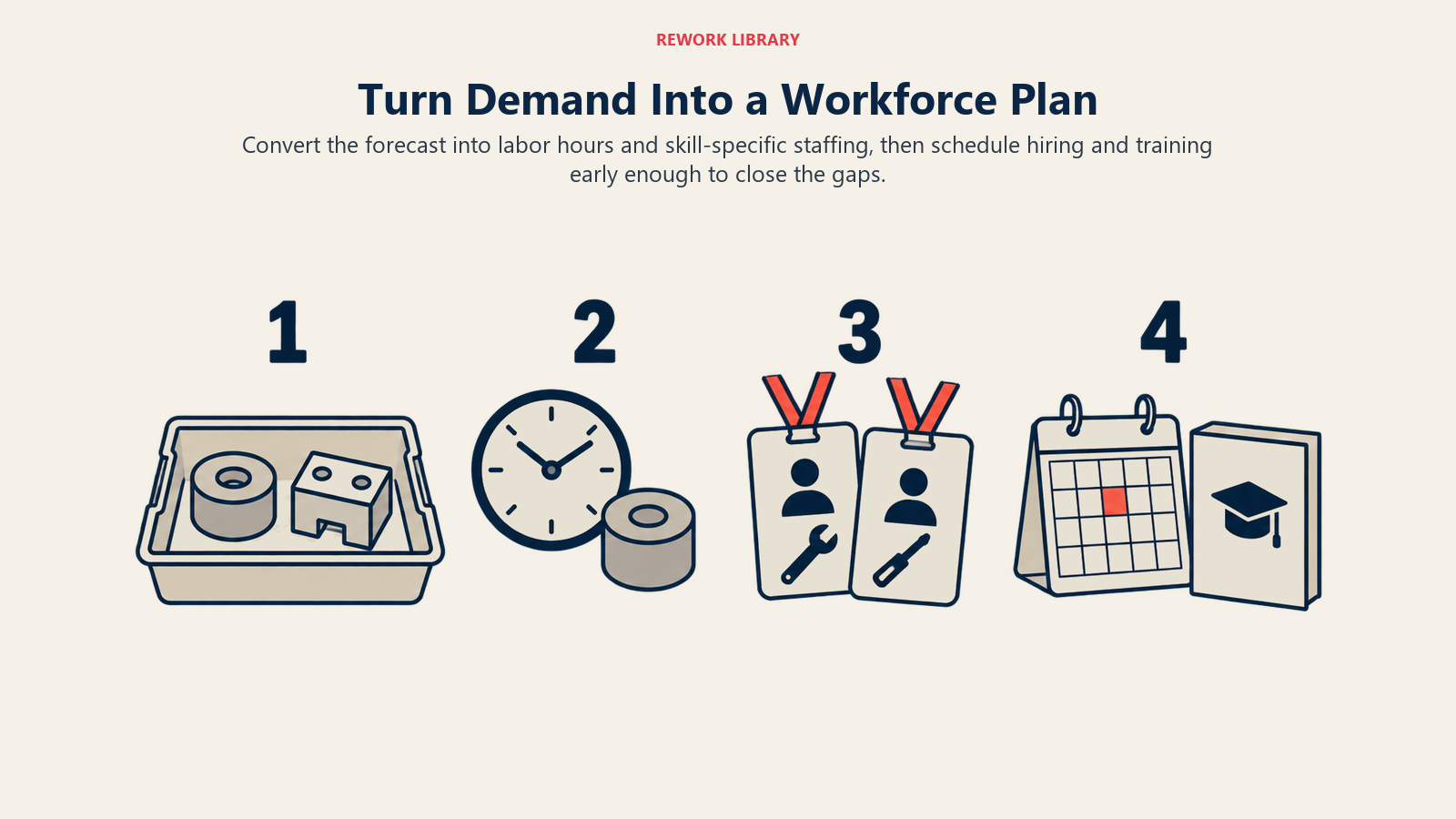
Start with your demand forecast. Pull production volumes by product line, ideally on a monthly basis for the next 12-18 months. Include scenario planning for best case, expected case, and worst case demand levels.
Convert production volumes to labor hours using your standard labor content per unit. Apply your capacity utilization assumptions:realistically account for efficiency levels, downtime, and non-production activities.
Translate labor hours to headcount by shift and skill category. Account for hours per employee per year (typically 1,800-1,950 productive hours after vacation, training, and other lost time). This gives you required headcount by time period.
Compare required headcount to your current workforce. Where are the gaps? When do they appear? Which skills are short versus general labor?
Develop your sourcing strategy for gaps. Options include internal transfers, new hiring, cross-training existing workers, overtime, or external contract labor. Choose based on duration of need, skill level required, and relative costs.
Create your recruitment timeline. If you need 15 new assemblers by July, recruitment should start in April to allow time for hiring, onboarding, and training. Skilled positions may need six months lead time.
Build your training plan. Which existing employees need new skills? What's the training sequence and timing? Your shop floor leadership team plays a critical role in this process. Who will train them, and when can they be released from regular duties for training?
Calculate your costs by scenario. What's the total labor cost under each plan? How do hiring versus overtime versus temps compare financially?
Review and update monthly. As actual production varies from forecast, adjust your workforce plan accordingly. This prevents getting caught six weeks behind in staffing as demand shifts.
Making Data-Driven Workforce Decisions
The best workforce plans are built on solid metrics and data, not guesswork.
Track your labor efficiency trends. What's your actual labor hours per unit over time by product line? BLS data tracks manufacturing sector productivity and employment trends. Improving efficiency means you need fewer labor hours for the same production volume:your workforce plan should reflect realistic efficiency improvements.
Monitor your overtime patterns. Sustained overtime above 10% of total hours often signals understaffing. Tracking labor productivity metrics helps identify these patterns. But if overtime is sporadic and unpredictable, the problem may be schedule variability rather than headcount.
Measure your training effectiveness. How long does it take new hires to reach full productivity? How does their quality compare to experienced workers? These metrics inform how far ahead you need to hire and train.
Track your turnover by job category and tenure. High turnover in the first 90 days suggests hiring or onboarding problems. High turnover among experienced workers indicates retention issues. Both affect your workforce planning assumptions about how many people you need to hire to maintain staffing levels.
Calculate your labor flexibility metrics. What percentage of your workforce is cross-trained? How many operations have only one or two qualified people? These metrics reveal your vulnerability to absences and your ability to shift resources to bottlenecks.
Monitor your temporary labor usage and costs. If you're consistently using temps beyond seasonal peaks, you likely need to adjust your core staffing levels. Calculate the breakeven point where hiring becomes more economical.
Common Workforce Planning Pitfalls
Even experienced operations leaders make predictable mistakes in workforce planning.
Planning for average demand rather than variation creates constant problems. If your production volume varies 30% month to month but you staff for the average, you'll be understaffed half the time and overstaffed the other half. Plan for your demand pattern, not a mythical average.
Ignoring skills mix changes as product mix shifts causes bottlenecks. Just because total labor hours stay constant doesn't mean you have the right skills. Track labor requirements by skill category, not just total headcount.
Treating all labor as interchangeable creates quality and safety problems. New hires aren't equivalent to experienced workers, and temporary workers aren't equivalent to trained permanent employees. Factor in productivity and quality differences in your capacity calculations.
Failing to account for training time means your new hires arrive but can't actually run production. Every new employee consumes experienced worker time for training while producing less themselves initially. Budget for this reality.
Underestimating the time required to recruit and hire leaves you scrambling. In tight labor markets, finding qualified manufacturing workers takes months, not weeks. MIT Sloan research identifies practical strategies for addressing manufacturing's labor challenges. Start your hiring process before you need the people on the floor.
Not planning for turnover means you're always behind. If you have 10% annual turnover, you need to hire and train replacements continuously just to maintain staffing levels. Build this into your workforce plan.
Building Workforce Agility for the Long Term
The most successful manufacturers don't just plan their workforce:they build systematic capability to adapt as conditions change.
This starts with skills development systems that continuously expand your workforce capabilities. Regular training, structured cross-training programs, and clear skills progression paths create a workforce that can flex to changing needs.
It requires workforce data systems that provide visibility into who can do what, who's being trained on what, and where your capability gaps exist. Modern ERP for manufacturing and manufacturing execution systems can provide these capabilities. Many manufacturers still track this in spreadsheets or in supervisors' heads:neither scales.
It demands leadership that views workforce planning as strategic, not administrative. When workforce planning connects to business planning, production scheduling, and capital investment decisions, you make better decisions across all these areas.
The manufacturers who consistently hit delivery dates while controlling labor costs have one thing in common: they've made workforce planning a systematic, data-driven process that runs continuously. They're not reacting to staffing crises:they're anticipating needs and building capability ahead of demand.
Your workforce is your most important production asset and your most controllable cost. Planning it strategically isn't optional:it's fundamental to manufacturing excellence.
Learn More

On this page
- What Makes Workforce Planning Different in Manufacturing
- Translating Production Forecasts Into Staffing Needs
- Building the Right Skills Architecture
- Optimizing Your Labor Model for Flexibility
- Building Your Workforce Planning Process
- Making Data-Driven Workforce Decisions
- Common Workforce Planning Pitfalls
- Building Workforce Agility for the Long Term
- Learn More