Building a Safety Culture in Manufacturing: Leadership's Role in Zero Harm
Turn this article into takeaways for your work.


Each assistant summarizes the article only for you and suggests best practices for your work.
The machine guard was removed to clear a jam. The operator planned to put it back immediately after. But a supervisor walked by and needed a quick part run "while the line's down anyway." The guard stayed off. Production resumed. Twenty minutes later, the operator's hand got caught in the mechanism.
This scenario plays out in different forms across manufacturing operations daily. Not because people don't care about safety, but because safety culture:the actual behaviors and priorities that govern decisions:doesn't match the safety policies posted on walls.
Real safety culture shows up in the moment when production pressure meets safety protocol. When meeting the schedule conflicts with following procedure. When "just this once" seems acceptable. Those moments reveal whether your safety culture is genuine or performative.
Understanding Safety Culture Maturity
Safety culture exists on a spectrum from reactive to proactive, and most manufacturers are somewhere in the middle.
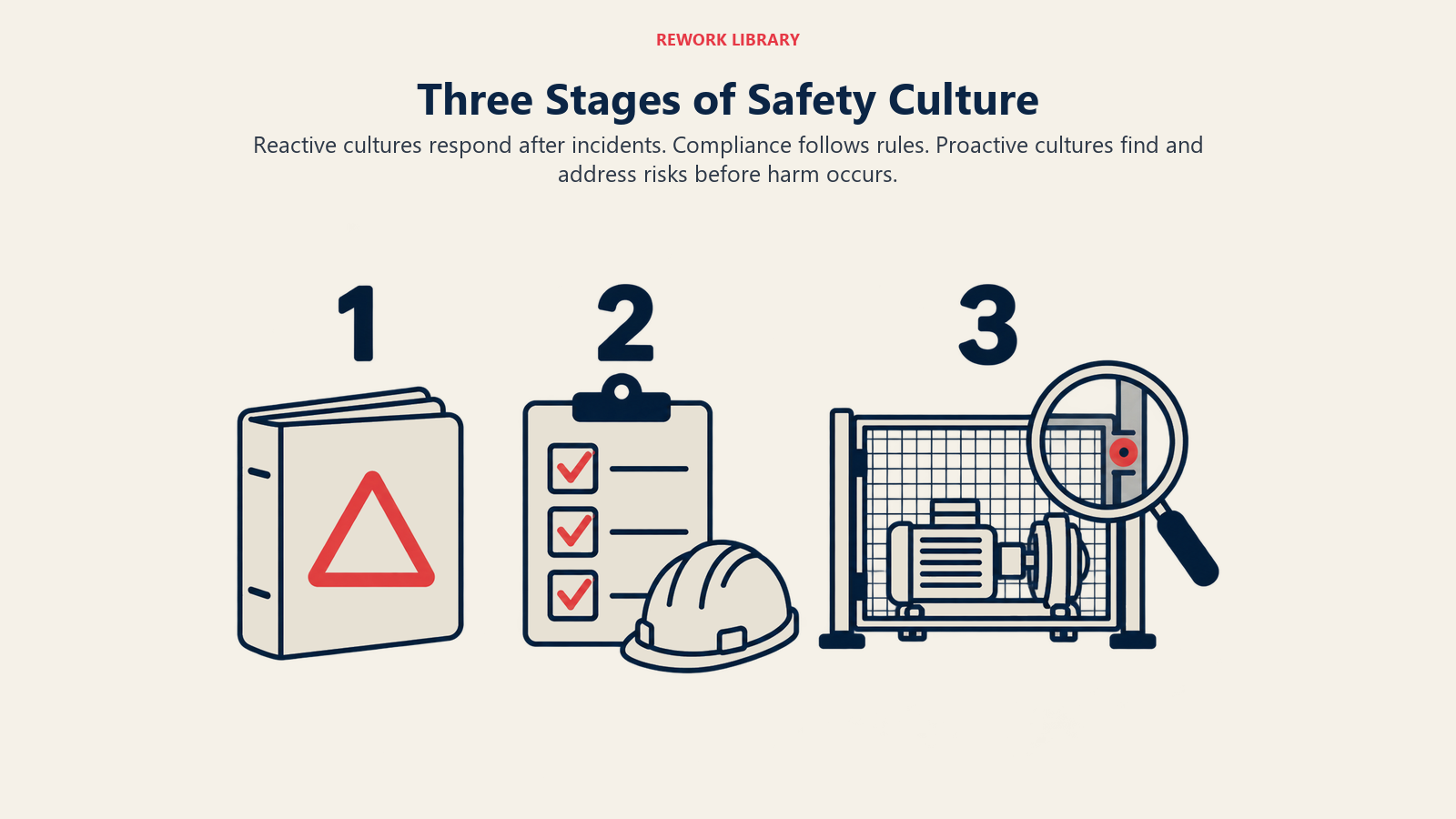
Reactive safety cultures respond to incidents after they occur. Safety activities focus on compliance with regulations, incident investigations assign blame, and safety is primarily the responsibility of the safety department. Leadership attention to safety spikes after serious incidents but fades during periods without major events.
Organizations at this level meet minimum regulatory requirements but experience elevated incident rates. Employees view safety as rules imposed from above rather than practices that protect them. Near misses go unreported because reporting leads to punishment. The culture message is "don't get caught" rather than "stay safe."
Compliance-based cultures have better systems and follow procedures more consistently. Safety programs exist, training happens regularly, and incidents are investigated systematically. But safety is still viewed as a separate function:something you do in addition to your "real work."
These organizations track safety metrics diligently and celebrate milestones like "days without incidents." But they haven't fundamentally integrated safety into how work gets done. When production and safety conflict, production often wins:especially if leadership isn't watching.
Proactive safety cultures have integrated safety into operations so thoroughly that it's inseparable from how work happens. Employees at all levels view safety as their personal responsibility, not just compliance with rules. Near misses are reported and addressed as learning opportunities. Safety conversations happen naturally throughout the day.
Leadership commitment to safety is visible, consistent, and non-negotiable. Production goals never override safety requirements. The organization learns from incidents and near misses to prevent future problems rather than just responding after harm occurs.
The business case for moving up this maturity curve is clear. Proactive safety cultures experience 70-80% fewer incidents than reactive cultures. Insurance costs drop significantly. Recruitment and retention improve:people want to work for companies that protect them. OSHA research demonstrates that employers implementing safety culture practices often experience dramatic decreases in workplace injuries. Quality often improves because the discipline required for safety carries into other operational areas.
But the real imperative is moral. Every person who comes to work should go home safely. According to BLS statistics, worker deaths in America have decreased from about 38 per day in 1970 to 15 per day in 2023, but every preventable death remains unacceptable. This isn't negotiable, and it's leadership's responsibility to create the conditions that ensure it happens.
Leadership Behaviors That Build Safety Culture
Safety culture flows from leadership behavior far more than from policies and programs.
Visible leadership commitment means leaders spend significant time on safety:not just talking about it but actively participating in safety activities. This includes regular safety walks where leaders observe conditions and engage with employees about safety concerns, attendance at safety committee meetings, participation in incident investigations, and personal follow-through on safety issues.
When employees see executives and plant managers regularly engaged with safety, they understand it's genuinely important. When they only hear about safety in speeches but never see leaders actively involved, they correctly conclude it's not really a priority.
Walking the talk means leaders follow safety rules personally and hold themselves accountable to the same standards they expect from others. If personal protective equipment is required, leaders wear it:no exceptions for visitors, executives, or "just quick walkthroughs." Effective shop floor leadership models this behavior consistently. If procedures require lockout/tagout, leaders wait for proper lockout even when it's inconvenient.
The moment a leader shortcuts a safety requirement, every employee watching gets the message that safety rules are suggestions for other people. Leadership credibility on safety is won or lost through personal example.
Safety in decision-making means considering safety implications in every significant decision:investment priorities, production schedules, staffing levels, and performance expectations. When cost reduction initiatives are evaluated, safety impact is a primary consideration, not an afterthought. When production schedules are set, they account for time to do work safely, not just time to do work fast.
Leaders who consistently choose the safe path even when it costs money or time signal that safety is genuinely non-negotiable. Leaders who pressure for shortcuts or accept compromises signal the opposite, regardless of what they say.
Accountability for safety performance applies to everyone, including supervisors and managers. Safety behavior and leadership are explicit parts of performance evaluation. Supervisors who allow or encourage safety violations face consequences. Teams and individuals who demonstrate strong safety practices receive recognition.
Without accountability, safety expectations are just suggestions. With clear, consistent accountability, safety becomes how we work, not just a box to check.
Building Effective Safety Management Systems
Strong safety culture requires systematic infrastructure that makes safe work the path of least resistance.
Risk assessment and hazard identification create the foundation. Systematically identify potential hazards in your operations through job safety analysis that breaks tasks into steps and identifies risks at each, facility inspections that check for physical hazards and unsafe conditions, employee observations and suggestions, and incident pattern analysis.
Don't just identify hazards once during facility design. Continuously look for risks as equipment, processes, and materials change. The best safety systems actively seek hazards before they cause harm.
Standard operating procedures and safe work practices document the right way to do work:including safety precautions and controls. These procedures should be clear, specific, and based on actual work conditions. Generic procedures copied from manuals don't protect anyone.
Involve the people doing the work in developing procedures. They know the practical realities and potential shortcuts. Procedures they help create are more likely to be followed than procedures imposed from above.
Incident investigation and root cause analysis should focus on understanding system failures, not just finding someone to blame. Why did the incident occur? What conditions or decisions enabled it? How can we prevent similar incidents?
Effective investigations look beyond "operator error" to understand why the error occurred. Was training inadequate? Was the procedure unclear? Was there pressure to work faster? Were safeguards disabled or bypassed? Addressing root causes prevents recurrence.
Safety training and competency verification ensure everyone knows how to work safely. This includes new hire safety orientation, job-specific safety training, refresher training on critical procedures, and emergency response training.
Training shouldn't be checkbox compliance:sitting through a video and signing a form. Strong skills training and development programs integrate safety throughout. It should build actual capability through explanation of hazards and consequences, demonstration of safe procedures, practice with supervision, and assessment of competency before people work independently.
Personal protective equipment and engineering controls provide physical protection. Follow the hierarchy of controls: eliminate hazards where possible through design or process changes, engineer safeguards into equipment (guards, interlocks, ventilation), implement administrative controls and procedures, and provide appropriate PPE as the last line of defense.
PPE requirements should be clear, consistently enforced, and properly maintained. If employees don't have access to the right PPE in good condition, you can't expect them to use it.
Creating Safety Behavior Through Engagement
Rules and procedures create the structure for safety, but behavior creates actual safety outcomes. And behavior is shaped through engagement, feedback, and reinforcement.
Behavioral observation programs involve trained observers watching work and providing feedback on safety behaviors. The goal isn't to catch people doing wrong things:it's to recognize safe behaviors and coach improvements on unsafe ones.
Effective observation programs are non-punitive and focused on learning. Observations are conducted regularly, feedback is provided immediately and respectfully, positive behaviors receive recognition, and at-risk behaviors trigger coaching conversations.
The data from observations reveals systemic patterns. If many people shortcut a particular procedure, the procedure may be impractical or poorly designed. If certain hazards are commonly ignored, the risk perception or controls may be inadequate.
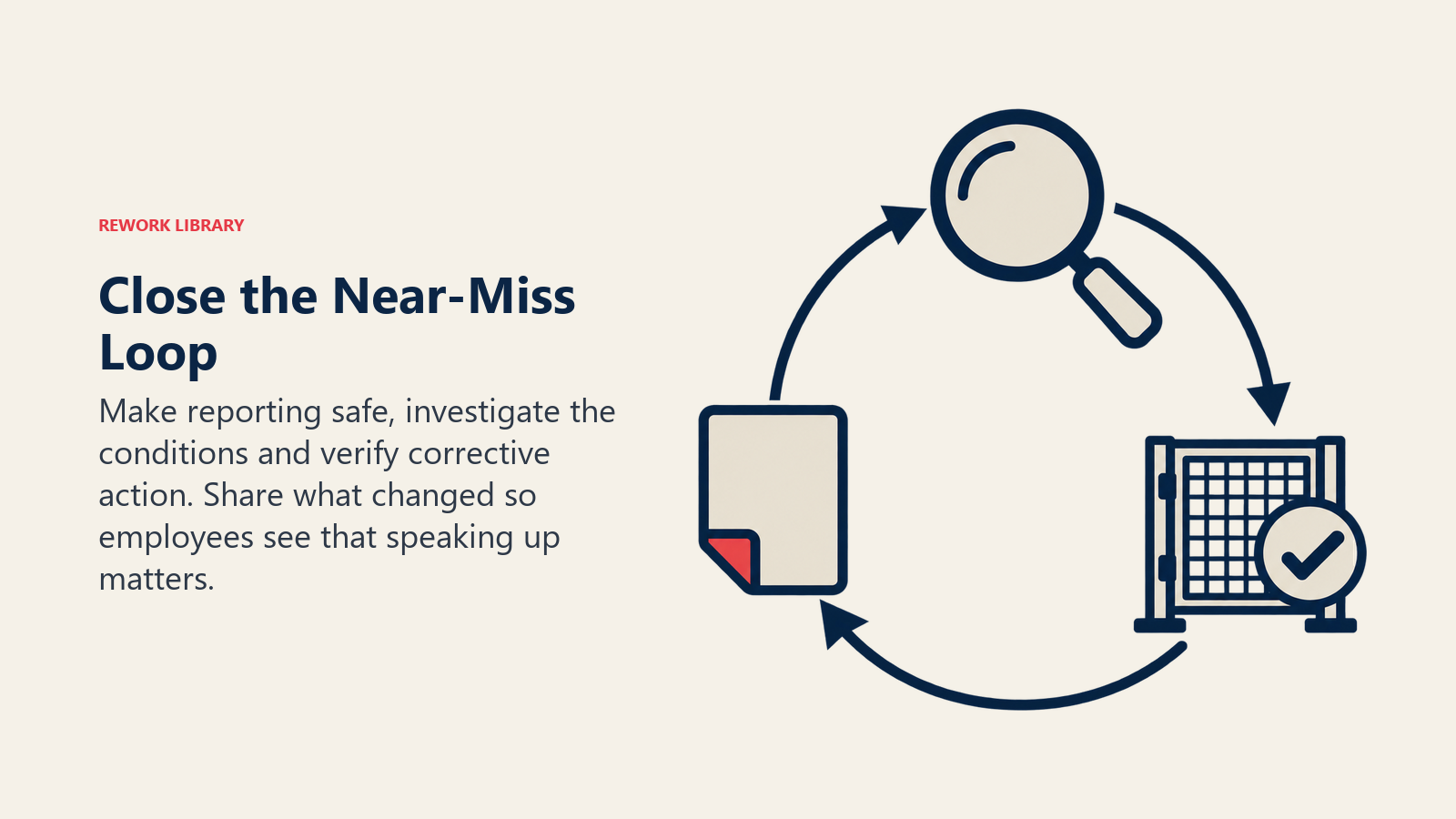
Near-miss reporting and response treat close calls as opportunities to prevent future incidents. A near miss is an incident that could have caused injury or damage but didn't:pure luck prevented harm.
Organizations with strong safety cultures have high near-miss reporting rates because people understand that reporting helps prevent future incidents. Reactive cultures have low reporting because people fear blame or believe nothing will change.
Create a non-punitive reporting system, respond to every report with investigation and corrective action, share lessons learned widely so everyone benefits from the experience, and recognize people who report near misses.
Safety conversations and coaching happen continuously on the floor. Supervisors don't just enforce rules:they engage employees in dialogue about hazards, precautions, and safe practices. When they observe at-risk behavior, they approach with curiosity rather than accusation.
"I noticed you weren't wearing your safety glasses just now:what's going on?" often reveals legitimate issues like glasses fogging up, being uncomfortable, or not being available nearby. Address those real problems rather than just demanding compliance.
Recognition and reinforcement celebrate safe behavior and safety contributions. This includes formal recognition for safety milestones and achievements, spot recognition when leaders observe exemplary safety practices, team recognition for strong safety performance, and appreciation for safety suggestions and improvements.
Recognition works best when it's specific, timely, and authentic. "Thanks for following safety procedures" is generic. "I noticed you took the time to properly lock out that equipment before maintenance, even though you were behind schedule. That's exactly the safety commitment we need" is meaningful.
Measuring Safety Performance Effectively
Traditional safety metrics focus on lagging indicators:injuries and incidents that already occurred. Leading indicators predict future safety performance and enable proactive intervention.
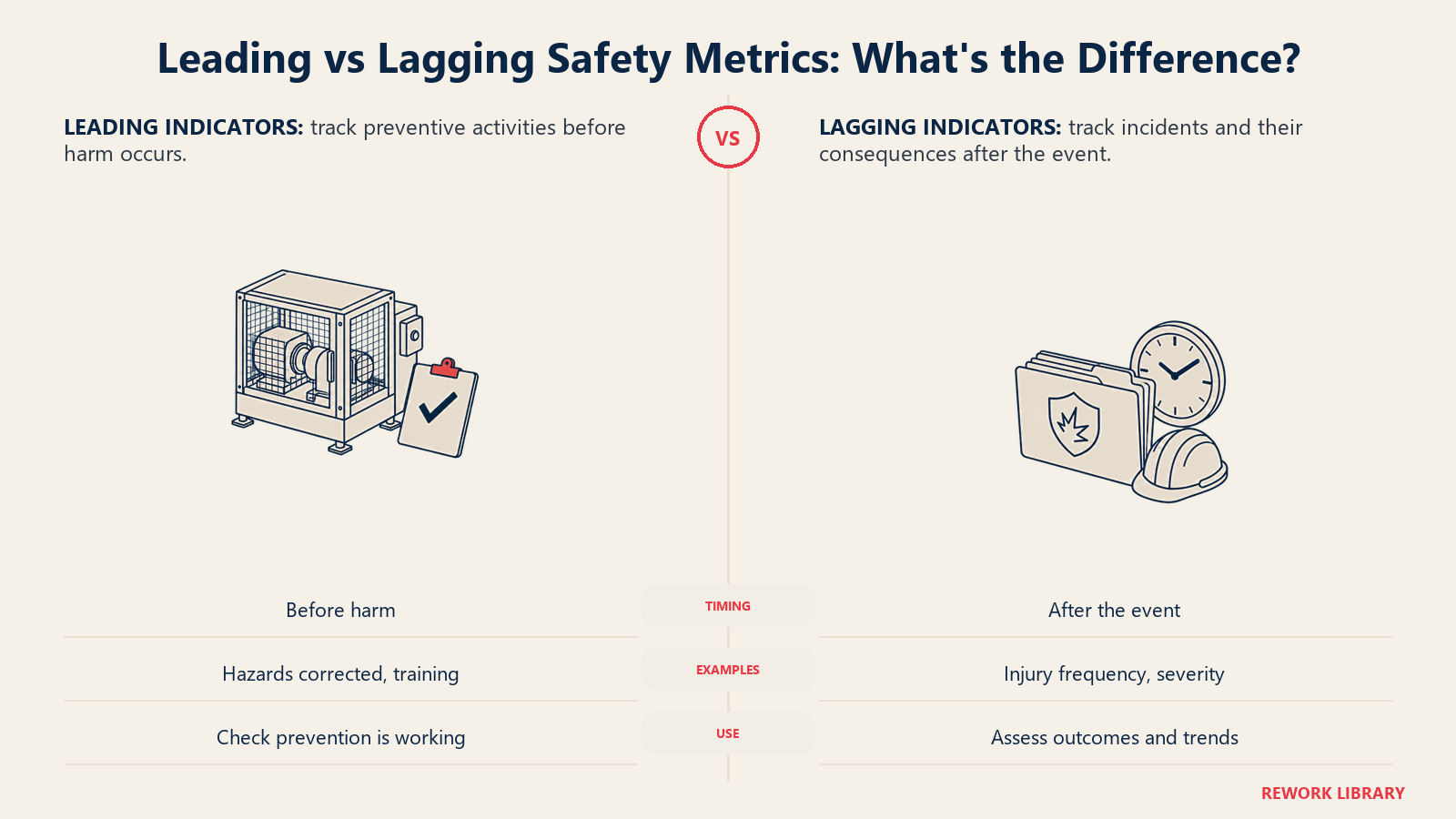
Lagging indicators still matter. Track total recordable incident rate (TRIR), lost time incident rate, severity rate (days away from work), and near-miss frequency. These measures tell you if safety is improving or degrading and allow benchmarking against industry standards.
But lagging indicators only tell you about failures that already happened. Leading indicators help prevent failures.
Leading indicators measure activities that drive safety outcomes. Examples include safety training completion rates, percentage of employees participating in safety committees or observation programs, hazard reports and corrective actions completed, safety improvement suggestions submitted, percentage of supervisors conducting regular safety conversations, and completion of scheduled safety inspections and audits.
These metrics reveal whether your safety management system is functioning. High leading indicator performance predicts low incident rates.
Safety engagement and culture surveys assess employee perceptions and attitudes. Do employees believe leadership is committed to safety? Do they feel empowered to stop work for safety concerns? Do they believe safety and production are balanced appropriately? Are they comfortable reporting near misses and safety concerns?
Survey results reveal cultural gaps that won't show up in incident data until someone gets hurt. Regular surveys track whether culture is improving.
Behavioral observations and audits provide direct visibility into safety practices. What percentage of observed behaviors are safe versus at-risk? Are specific high-risk behaviors improving? Do observations reveal systemic procedure issues?
Learning from incidents and near misses closes the loop. Track incident investigations completed on time, corrective actions implemented, and effectiveness verification. Measure whether lessons learned are communicated and whether similar incidents recur.
Organizations that learn from every incident and near miss continuously improve. Organizations that investigate but don't implement learning or verify effectiveness repeat the same problems.
Common Safety Culture Barriers
Even with commitment and good intentions, predictable obstacles impede safety culture development.
Production pressure creates the most common conflict. When delivery dates are tight and safety procedures slow things down, shortcuts happen. Supervisors face pressure to hit numbers, so they tolerate minor violations. Employees feel they must choose between being safe and meeting expectations.
Address this by making safety performance equal in weight to production metrics, giving supervisors authority to slow or stop production for safety concerns without penalty, building adequate time for safe work into schedules through proper production planning fundamentals, and holding leaders accountable for creating conditions where safety and production don't conflict.
Inconsistent enforcement undermines credibility. If some people get held accountable for violations while others don't, if rules are enforced sometimes but not always, or if consequences vary based on who's involved, employees conclude that safety standards aren't really standards.
Consistency matters more than severity. Mild consequences applied consistently are more effective than harsh consequences applied arbitrarily.
Poor communication leaves employees unclear about expectations, unaware of hazards, or uninformed about incidents and lessons learned. Safety information must flow in all directions:top-down communication of expectations and priorities, bottom-up reporting of concerns and suggestions, and lateral sharing of best practices and lessons learned.
Insufficient resources for safety:inadequate staffing to do work safely without excessive overtime and fatigue, poor equipment condition requiring workarounds, missing or inadequate PPE, and insufficient time for proper training:signal that safety isn't actually the priority leadership claims.
You can't expect strong safety culture while under-resourcing safety fundamentals. Effective manufacturing workforce planning ensures adequate staffing to work safely. This isn't about unlimited budgets, but safety must have adequate resources to function effectively.
Safety as Competitive Advantage
Organizations with strong safety cultures outperform in ways that extend far beyond injury rates.
Operational excellence correlates with safety excellence. The discipline, attention to detail, and systematic problem-solving required for strong safety also drive quality, productivity, and efficiency. Principles from lean manufacturing align naturally with safety culture. Organizations that can't control safety risks typically struggle with quality and operational risks too.
Employee engagement and retention improve in safe workplaces. People want to work for organizations that demonstrably care about their well-being. Low turnover preserves institutional knowledge and reduces recruiting and training costs.
Customer confidence increases when customers see evidence of strong safety culture. Many customers audit supplier safety performance. Excellent safety becomes a qualification to compete for premium customers and contracts.
Insurance and regulatory costs drop. Organizations with strong safety records pay lower workers compensation premiums, face fewer OSHA citations and penalties, and spend less time managing claims and investigations.
The manufacturers who dominate their industries almost universally have exceptional safety cultures. This isn't coincidence:it reflects the operational discipline and leadership quality required to excel in both safety and business performance.
Your safety culture is your choice. It flows from leadership behavior, systematic management practices, employee engagement, and consistent accountability. It requires sustained commitment, not periodic campaigns. But it's the foundation on which operational excellence and sustainable growth are built.
Every person deserves to work in an environment where their safety is genuinely valued and protected. Build that culture. Your people, your business, and your conscience all depend on it.
Learn More

Co-Founder, Rework.com