Six Sigma in Manufacturing: Data-Driven Quality Improvement and Defect Elimination
Turn this article into takeaways for your work.


Each assistant summarizes the article only for you and suggests best practices for your work.
An automotive supplier consistently met their 98.5% quality specification. Good performance by most standards. But a potential new customer demanded 99.97% defect-free delivery:a 50-fold improvement in defect rate. The contract represented $8 million annually, but achieving that quality level seemed impossible with their current approaches.
They implemented Six Sigma methodology. Cross-functional Black Belt teams tackled their highest-defect processes using rigorous statistical analysis. They identified root causes previous quality improvement efforts had missed. They tested solutions methodically. They implemented controls ensuring gains stuck.
Eighteen months later, they'd achieved 99.95% defect-free delivery. They won the contract. More importantly, they'd reduced quality costs by $2.1 million annually and built organizational capability for data-driven problem-solving that transformed how they operated.
Understanding Six Sigma Methodology
Six Sigma pursues near-perfect quality through statistical process control and disciplined problem-solving.
The meaning of Six Sigma:3.4 defects per million opportunities:describes process capability where specifications lie six standard deviations from the process mean. According to ASQ, the numerical goal of a process operating at a 6-sigma level is 3.4 defects per million opportunities (DPMO). Wikipedia explains that processes operating with "six sigma quality" over the short term are assumed to produce long-term defect levels below 3.4 DPMO. Most manufacturing processes operate at 3-4 sigma (6,200 to 66,800 defects per million), leaving substantial improvement opportunity.
The name comes from statistics, but Six Sigma's power lies in structured methodology for eliminating defects. It's less about achieving literal six-sigma capability and more about systematic reduction of variation and defects through data-driven analysis.
Statistical foundation and process capability underpin Six Sigma thinking. Process capability compares process variation to specification width. Capable processes produce consistently within specifications. Incapable processes create defects even when centered properly because inherent variation exceeds tolerance.
Capability indices measure this relationship: Cp compares specification width to process spread. Cpk accounts for how well the process is centered. A Cpk of 1.0 means the process just barely fits within specifications. Values below 1.0 indicate incapability requiring improvement. Six Sigma targets Cpk of 2.0, providing substantial margin against variation and drift.
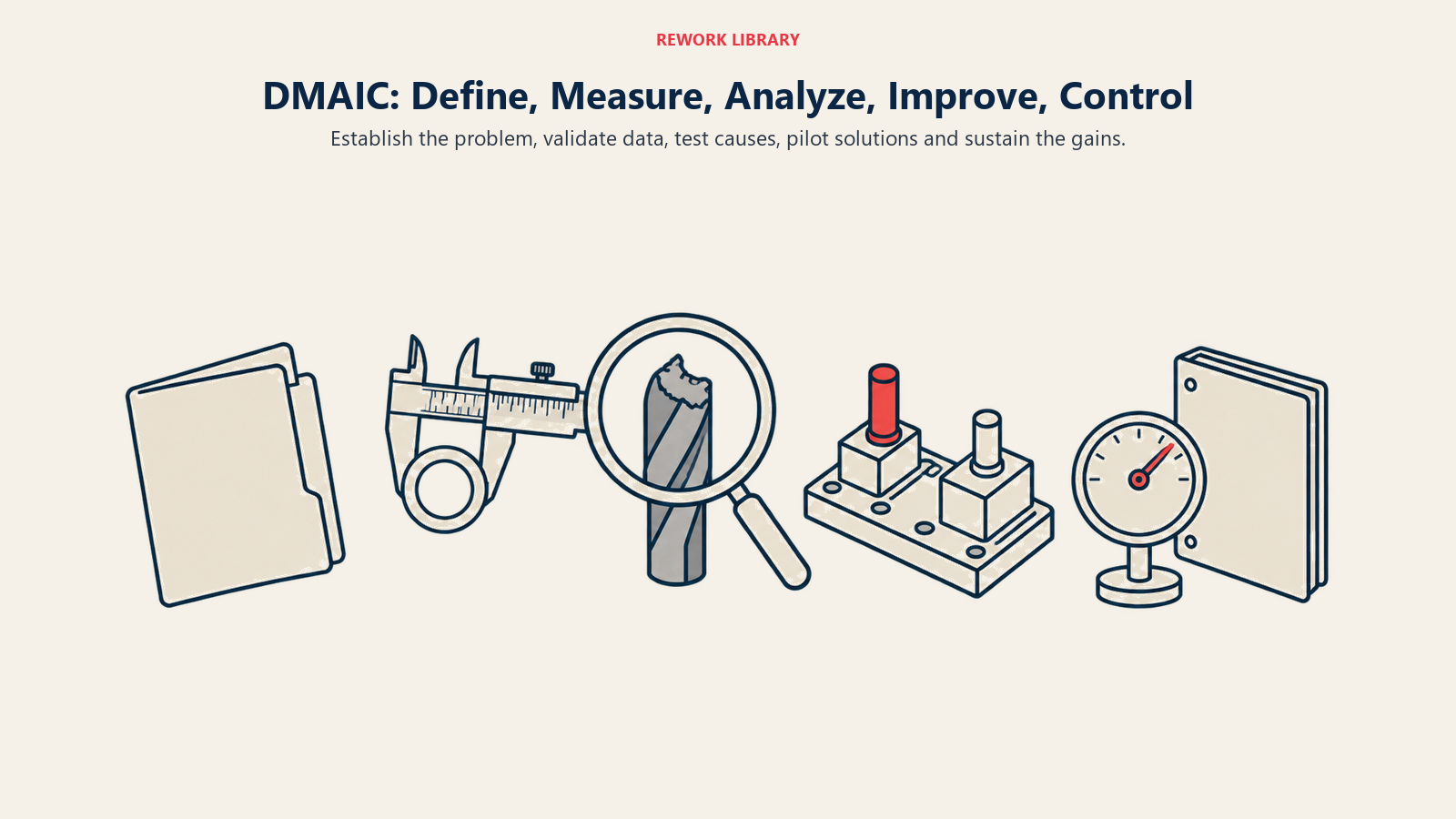
DMAIC methodology structures Six Sigma projects through five phases. ASQ describes DMAIC as a data-driven improvement cycle used for optimizing and stabilizing business processes, and it's the core tool used to drive Six Sigma projects:
Define: Establish project scope, goals, and customer requirements. Create project charter documenting problem statement, objective, expected benefits, timeline, and team.
Measure: Quantify current performance through data collection. Validate measurement systems. Establish process capability baseline.
Analyze: Identify root causes using statistical tools. Test hypotheses about what drives defects. Determine vital few factors creating most problems.
Improve: Generate solution alternatives. Test promising solutions through pilot studies. Implement proven improvements.
Control: Sustain gains through control plans, statistical process control, documented procedures, and training.
This disciplined approach prevents jumping to solutions before understanding problems:a common failure mode of improvement initiatives.
DMADV for design (Define, Measure, Analyze, Design, Verify) applies Six Sigma principles to new product development. Design for Six Sigma prevents quality problems from ever entering production by building robustness into products and processes from the start.
Difference from other quality approaches: Six Sigma emphasizes statistical rigor more than lean manufacturing (which focuses on flow and waste). It requires more training investment than Kaizen (which relies on common sense improvements). It works best for complex problems requiring data analysis to understand root causes.
Many organizations combine approaches: Lean Six Sigma merges waste elimination with variation reduction. Kaizen provides continuous incremental improvement while Six Sigma tackles breakthrough projects.
Six Sigma Organizational Infrastructure
Successful Six Sigma requires more than training people on statistical tools. It demands organizational infrastructure supporting rigorous project execution.
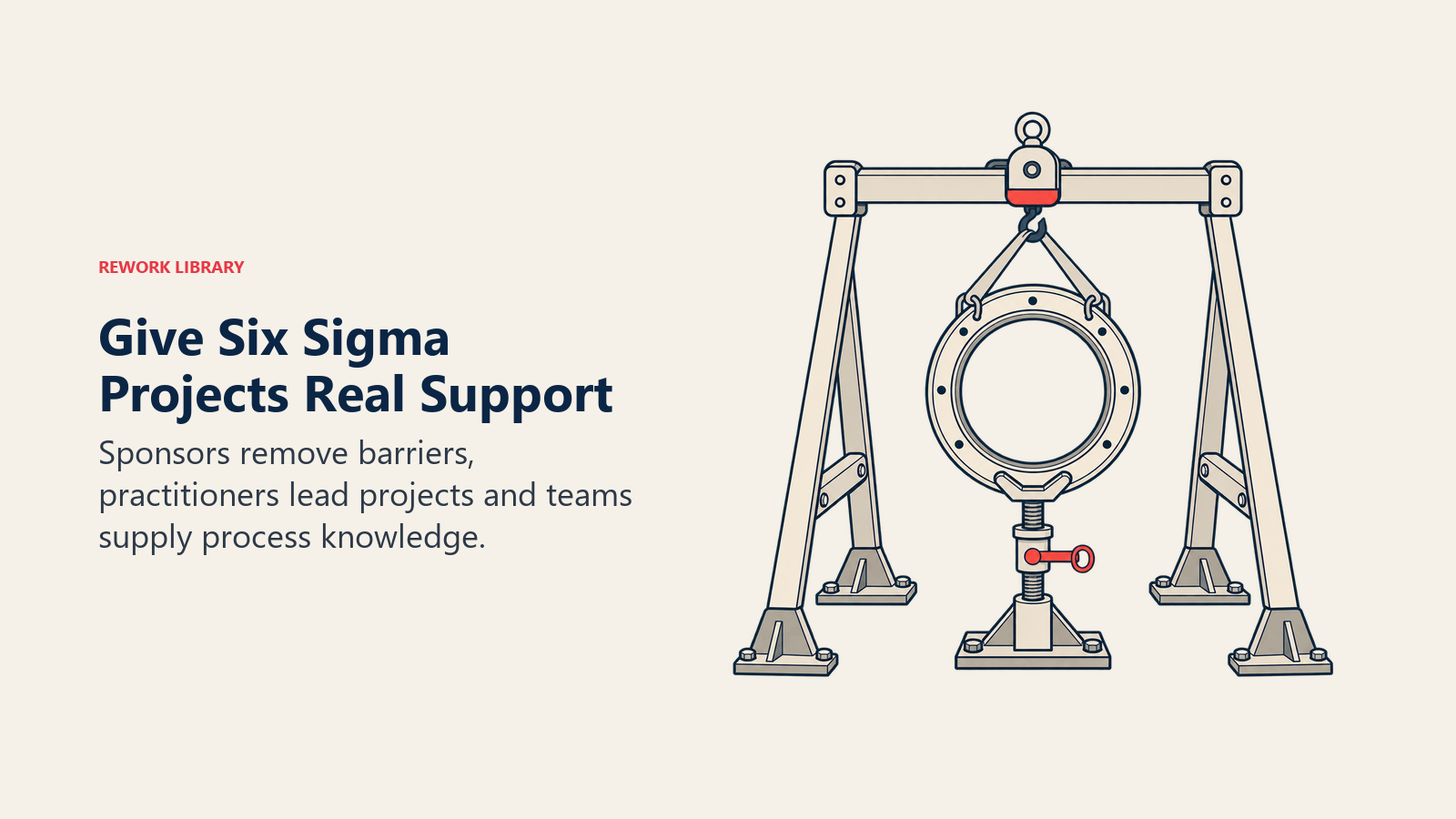
The belt system creates a structured hierarchy of capability:
Champions are senior leaders who select projects, remove barriers, and ensure Six Sigma aligns with business strategy. They don't execute projects but provide executive sponsorship and resources.
Master Black Belts are expert practitioners who mentor Black Belts, teach advanced statistical methods, and ensure methodology rigor. Large organizations employ full-time Master Black Belts; smaller companies may rely on external consultants initially.
Black Belts are full-time improvement leaders executing major projects. They receive 160+ hours of training in statistics, project management, and change management. They typically complete 4-6 projects annually, each delivering $100,000-250,000 in savings.
Green Belts are part-time practitioners who lead smaller projects while maintaining regular job responsibilities. They receive 40-80 hours of training covering essential Six Sigma tools. They complete 1-2 projects annually alongside their primary duties.
Yellow Belts understand Six Sigma basics and participate as project team members without leading projects independently.
A packaging manufacturer built this infrastructure methodically: trained 4 Black Belts in year one, added 15 Green Belts in year two, and developed 50 Yellow Belts in year three. This created sustainable improvement capability rather than relying solely on external consultants.
Project selection and prioritization determines Six Sigma success more than methodology expertise. Poor project selection means perfectly executed projects that deliver minimal business value.
Select projects based on: business impact (revenue, cost, customer satisfaction), data availability for analysis, scope manageable in 3-6 months, clear connection to strategic priorities, and executive sponsor commitment.
Avoid projects that are too broad (requiring years), too narrow (solvable through common sense), lacking data (forcing excessive data collection), or addressing symptoms rather than root causes.
Resource allocation and training investment require significant commitment. Black Belt training costs $15,000-25,000 per person. Projects consume 40-80 hours from team members. Statistical software licenses add costs. This investment pays off through project savings, but requires patience and sustained commitment.
Governance and steering committees provide oversight ensuring projects stay on track, resources get allocated appropriately, and results get verified. Monthly reviews maintain momentum while preventing projects from drifting or stalling.
DMAIC Methodology in Practice
Each DMAIC phase has specific objectives, tools, and deliverables.
Define phase establishes project foundation. Create a project charter documenting the problem statement in quantifiable terms, the goal (specific, measurable, time-bound), business case showing expected benefits, project scope defining boundaries, and team composition.
Capture Voice of Customer (VOC) through interviews, surveys, and complaints analysis to understand what quality means to customers. Create SIPOC (Suppliers, Inputs, Process, Outputs, Customers) diagrams mapping the process end-to-end.
A bearing manufacturer defined their project clearly: "Reduce bearing dimensional variation causing customer returns. Current Cpk of 0.87 creates 2.3% defect rate. Achieve Cpk of 1.67 and reduce defects to 0.15% within six months. Estimated savings: $340,000 annually."
Measure phase quantifies current performance. Conduct Measurement System Analysis (MSA) using Gage R&R studies to verify measurement equipment is accurate and repeatable. Collect baseline data on defect rates, process capability, cycle times, or other relevant metrics.
Calculate process capability indices (Cp, Cpk) showing how current process compares to requirements. Create baseline control charts showing process stability. Document data collection procedures for consistency.
Don't rush measurement. Inadequate baseline data undermines analysis and prevents demonstrating actual improvement later.
Analyze phase identifies root causes using statistical tools. Create process maps detailing every step. Use Pareto analysis to focus on vital few causes creating most defects. Apply fishbone diagrams and other root cause analysis methods organizing potential causes into categories.
Test hypotheses statistically: does material supplier affect defect rates? Do defects correlate with shift, operator, or time of day? Use hypothesis testing, correlation analysis, and regression to validate relationships.
Design of Experiments (DOE) systematically varies factors to determine which truly drive outcomes. This prevents implementing solutions based on hunches rather than data.
The bearing manufacturer's analysis revealed dimensional variation correlated strongly with grinding machine temperature. Statistical analysis showed the first hour after startup produced 68% of defects as machines warmed up.
Improve phase develops and tests solutions. Generate alternatives through brainstorming. Evaluate options using criteria matrices considering impact, cost, implementation difficulty, and risk.
Pilot promising solutions on limited scale before full implementation. This tests effectiveness while limiting risk if solutions don't work as expected. Measure pilot results against baseline to verify improvement.
Implement proven solutions, documenting new procedures and training affected personnel. The bearing manufacturer implemented machine pre-warming procedures and installed temperature monitoring with alarms. Pilot results showed dimensional Cpk improved to 1.73.
Control phase sustains improvements after projects end. Create control plans specifying what to measure, how often, control limits, and response procedures when processes drift. Implement Statistical Process Control (SPC) charts monitoring critical characteristics.
Document revised standard operating procedures incorporating improvements. Train all relevant personnel. Transfer ownership from Black Belt to process owner. Schedule follow-up reviews verifying sustainability.
Controls prevent the common problem where impressive project results erode within months as processes drift back to previous performance.
Six Sigma Statistical and Problem-Solving Tools
DMAIC phases employ specific tools appropriate for each stage.
Process mapping and value stream analysis visualize operations showing inputs, outputs, decision points, and flow. Detailed maps reveal complexity, waste, and improvement opportunities that narrative descriptions miss.
Statistical tools include hypothesis testing (are observed differences statistically significant or due to random chance?), regression analysis (what's the mathematical relationship between variables?), and Design of Experiments (systematically testing factor combinations to optimize processes).
These tools require training but enable insights impossible through intuition alone. They distinguish real signals from noise, quantify relationships, and predict outcomes.
Problem-solving tools like 5 Whys, fishbone diagrams, and Pareto charts organize thinking and focus efforts. While less statistically sophisticated, they structure analysis and communication effectively.
Control charts and capability indices monitor process performance over time, detecting shifts requiring investigation while avoiding overreaction to normal variation. These tools are central to maintaining process stability through SPC.
The tool arsenal matters less than knowing which tool fits each situation. Black Belt training builds this judgment alongside technical skills.
Implementation Strategy and Sustainability
Six Sigma implementation requires strategic planning beyond initial training.
Pilot projects versus full deployment represents a key decision. Pilots with limited scope demonstrate methodology and build credibility before major resource commitment. Full deployment achieves scale faster but risks overwhelming organizations not ready for change.
Most successful implementations start with 3-5 Black Belts tackling high-visibility projects demonstrating value. This creates proof points justifying expansion while building expertise.
Training and certification programs develop capability progressively. Train Champions and Black Belts first, adding Green Belts as projects expand. Ensure training combines classroom learning with actual project work applying concepts immediately.
Integration with existing improvement initiatives prevents competing methodologies from confusing organizations. Clarify when to use Six Sigma versus Kaizen or lean techniques. Show how approaches complement rather than conflict.
Sustaining momentum and results requires making Six Sigma part of how you operate, not a temporary program. Embed Six Sigma project execution in performance expectations. Include training in career development paths. Celebrate successes prominently. Review project portfolios regularly ensuring continuous pipeline.
Organizations succeeding long-term with Six Sigma move beyond viewing it as quality department work to making data-driven problem-solving an organizational capability expected from all leaders.
Quantifying Six Sigma Impact
Demonstrating value maintains commitment and justifies continued investment.
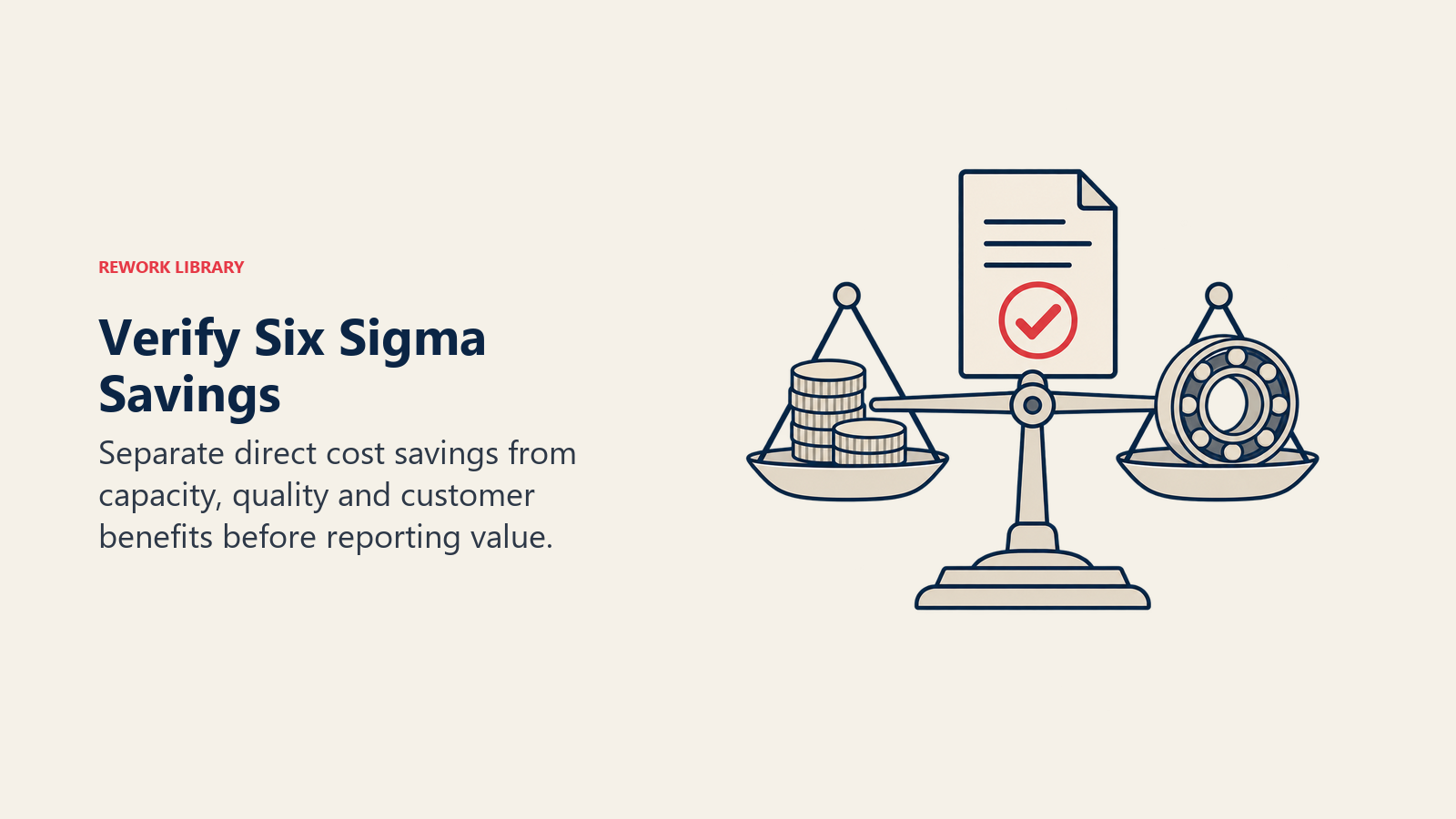
Hard savings calculations quantify direct financial benefits: reduced scrap costs, lower rework labor, decreased warranty expenses, eliminated inspection costs. Use conservative assumptions to maintain credibility.
Soft benefits include improved process capability allowing tighter tolerances, enhanced customer satisfaction, increased capacity from higher yields, and cultural change toward data-driven decisions. While harder to quantify precisely, these often exceed hard savings.
Project tracking and portfolio management maintains visibility of all active projects, completion status, and achieved savings. This portfolio view helps prioritize resources and celebrate cumulative impact.
A diversified manufacturer tracked 87 Six Sigma projects over four years. Hard savings totaled $23.4 million. Average project ROI was 11:1. This clear financial return justified ongoing investment in training and resources.
Six Sigma as Strategic Capability
Six Sigma delivers most value when it becomes organizational capability for tackling complex problems, not just a collection of completed projects.
This transformation requires patience. Early projects demonstrate methodology. Subsequent waves build expertise. Over 3-5 years, data-driven problem-solving becomes how the organization addresses challenges routinely.
Manufacturers achieving this transformation develop competitive advantages competitors can't easily copy. Quality improves. Costs drop. Customer satisfaction increases. Perhaps most importantly, they build systematic approaches to improvement that compound over time.
Consider whether Six Sigma fits your situation. Complex quality problems with unclear root causes are ideal candidates. High-volume processes where small percentage improvements create substantial value justify the rigor. Organizations willing to invest in training and infrastructure position themselves for success.
Begin with appropriate scope: train a few Black Belts, select high-impact projects, demonstrate value, then expand based on results and capability development.
Learn More
- Statistical Process Control: Monitoring and Preventing Variation
- Root Cause Analysis Methods: Getting to the Heart of Manufacturing Problems
- Manufacturing Quality Management Overview: Building Defect Prevention Systems
- Lean Manufacturing Principles: Building a Waste-Free Operation
- Defect Prevention Strategies: Building Quality at the Source
- First Pass Yield Optimization: Reducing Defects at the Source
