Energy Cost Management in Manufacturing: Strategies to Reduce Your Second-Largest Expense
Turn this article into takeaways for your work.


Each assistant summarizes the article only for you and suggests best practices for your work.
A plastics manufacturer received a utility bill that stopped production planning in its tracks. Energy costs had jumped 40% in six months. What had been a manageable 8% of total costs now consumed 11% and climbing. The plant manager realized they'd been treating energy like weather, something that just happened to them. They had no measurement systems, no targets, no accountability. They were flying blind on their second-largest cost category.
Energy represents 5-15% of manufacturing costs for most plants, sometimes much more for energy-intensive processes. According to the U.S. Department of Energy, manufacturing accounts for approximately 25% of total U.S. energy consumption, making efficiency improvements critical. Yet many manufacturers manage energy passively. They pay the bills, complain about rates, and accept costs as given. This approach made sense when energy was cheap and stable. Neither condition holds anymore. Volatility has increased. Costs have risen. Competitive pressure demands efficiency everywhere, including energy.
Understanding Energy Costs
Manufacturing energy costs split into two components: commodity cost and demand cost. Commodity cost is kilowatt-hours times the energy rate. This varies with usage but not dramatically within a month. Demand cost is the peak power draw during the billing period times the demand charge. This single highest point of consumption can drive 30-50% of total energy expense.
Most manufacturers focus on total consumption and miss demand management opportunities. You can reduce kilowatt-hours 10% but see only 5% cost reduction because demand charges don't decline. Understanding this split changes how you approach reduction. Consumption reduction lowers commodity cost. Peak shaving lowers demand cost. Both matter, but the strategies differ.
Rates vary by time of use in many markets. Peak hours cost more than off-peak hours. Some manufacturers can shift energy-intensive operations to lower-cost periods. Others can't without disrupting production schedules. But knowing your rate structure reveals whether scheduling flexibility delivers financial benefit.
Contract structure affects costs too. Some plants operate on variable rates that fluctuate monthly. Others have locked in fixed rates through long-term contracts. Some generate power on-site through combined heat and power or renewable installations. Your contract structure determines which cost reduction strategies work and which investments make sense.
Measurement and Monitoring
Energy management starts with visibility. You can't manage what you don't measure. Yet many plants have only building-level metering that provides total consumption without detail about where energy goes or when peaks occur.
Submetering major equipment and departments reveals consumption patterns. Which production lines use the most power? When do peaks happen? Which equipment runs inefficiently? Submetering costs thousands of dollars but pays for itself quickly through targeted reduction opportunities.
Real-time monitoring enables active management rather than reactive response. When you can see energy consumption by hour or minute, you can identify peaks before they set monthly demand charges. You can spot equipment running unnecessarily. You can validate that efficiency projects actually reduce consumption. Monthly utility bills tell you what happened. Real-time monitoring lets you change what happens next.
Modern energy management systems integrate metering data with production schedules and equipment controls. These systems can automatically shed non-critical loads during peak demand periods, optimize equipment sequences to minimize consumption, and alert operators to abnormal usage patterns. The technology has become affordable enough for mid-sized plants, not just large industrial complexes.
Demand Management and Peak Shaving
Demand charges penalize poor load management. When multiple high-power devices start simultaneously, demand spikes. When equipment runs during system-wide peak periods, utility demand charges increase. When standby equipment remains energized unnecessarily, baseline demand stays elevated. All of these patterns are fixable.
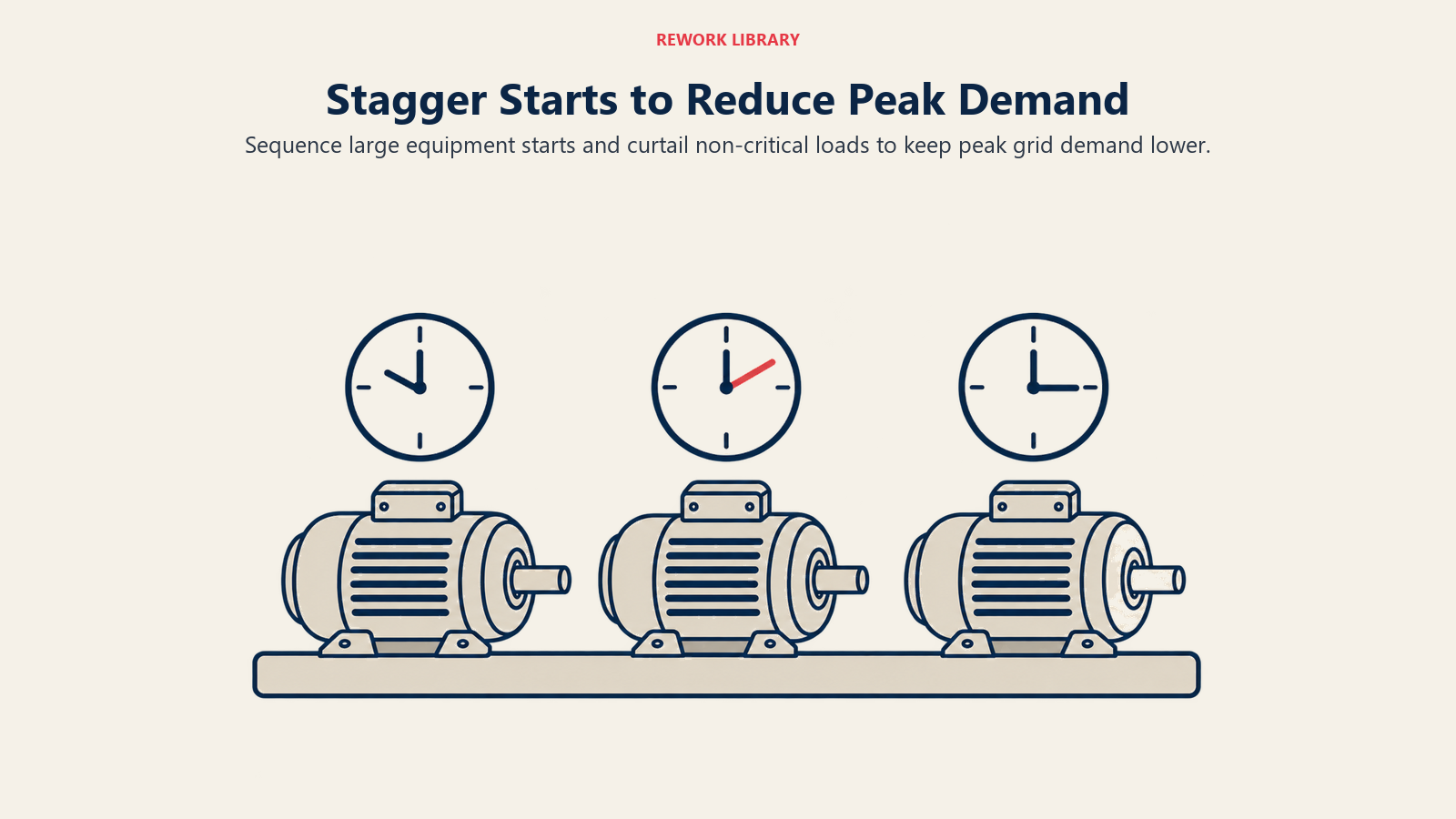
Load sequencing staggers equipment startups to prevent demand spikes. Instead of starting three large motors at once after lunch break, start them in five-minute intervals. Peak demand stays lower and demand charges decrease. This requires no equipment investment, just operational discipline and awareness.
Peak shaving uses load curtailment or energy storage to cap maximum demand. When demand approaches your target peak, you shed non-critical loads temporarily. Lighting, HVAC, or auxiliary equipment gets turned off for short periods. Production equipment keeps running. The brief interruption to comfort systems is barely noticeable, but demand charges drop 20-30%.
Energy storage makes peak shaving more sophisticated. Battery systems charge during off-peak hours and discharge during peak demand to supplement grid power. The battery caps your peak draw from the utility while maintaining full plant capacity. As battery costs decline, more manufacturers find this economically attractive, especially in high-demand-charge markets.
On-site generation can eliminate demand charges entirely by making you partially or fully independent of grid power. Combined heat and power systems capture waste heat for process heating or HVAC while generating electricity. Solar installations reduce peak demand during sunny periods when many utilities charge highest rates. These investments require careful analysis but can deliver strong returns in the right circumstances.
Equipment Efficiency Upgrades
Production equipment varies enormously in efficiency. An old motor might draw 20% more power than a modern high-efficiency replacement. An inefficient compressor can waste 30% of input energy. HVAC systems can consume double necessary energy due to poor maintenance or obsolete technology. Lighting can account for 15% of total usage while delivering inadequate illumination.
Motor upgrades deliver reliable returns. When motors fail, replace them with premium efficiency models. The incremental cost pays back in months through energy savings. Don't wait for failure on the highest-consumption motors. Proactive replacement makes sense when payback is under three years.
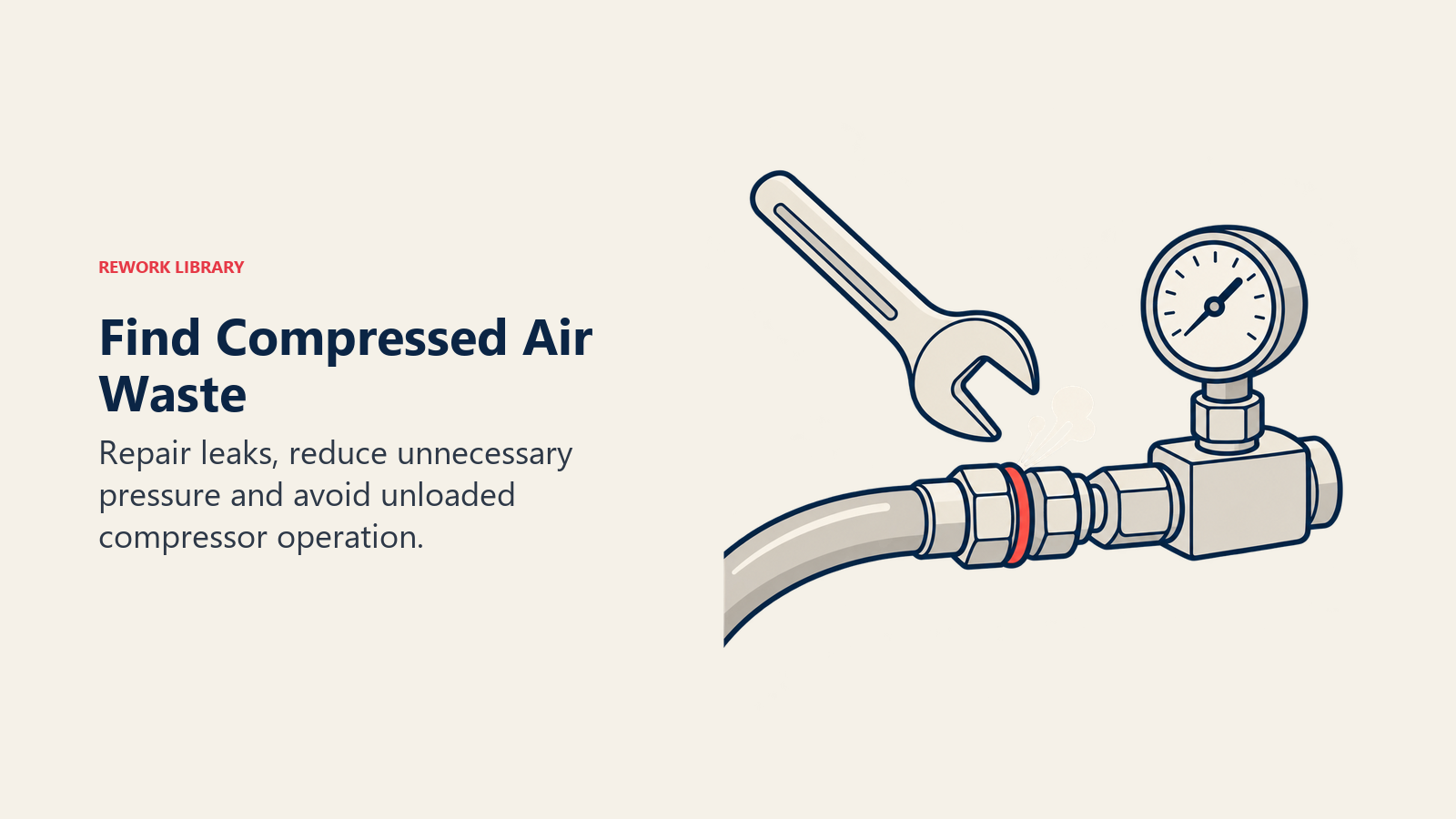
Compressed air systems are notorious energy wasters. Leaks can waste 20-30% of compressor output. Pressure higher than necessary wastes power. Compressors running unloaded consume 30-40% of full-load power while producing no output. The DOE estimates 30% of compressed air energy is wasted through leaks alone. A systematic compressed air audit typically finds reduction opportunities worth 25% of air system cost.
HVAC optimization yields significant savings with modest investment. Programmable thermostats prevent heating and cooling empty buildings. Variable frequency drives modulate fan and pump speeds to match loads. Economizers use outside air for cooling when conditions allow. Insulation and sealing prevent conditioned air from escaping. The combination can cut HVAC energy use by 30-40%.
LED lighting retrofits are obvious improvements now. LEDs use 50-75% less energy than older technologies while lasting longer and providing better illumination. Payback runs 2-4 years in most manufacturing applications. Add occupancy sensors and daylight harvesting to maximize savings by ensuring lights run only when needed.
Process Optimization
Beyond equipment efficiency, process design and operation significantly affect energy consumption. Heat recovery, process sequencing, temperature optimization, and automation all create reduction opportunities that equipment upgrades alone can't capture.
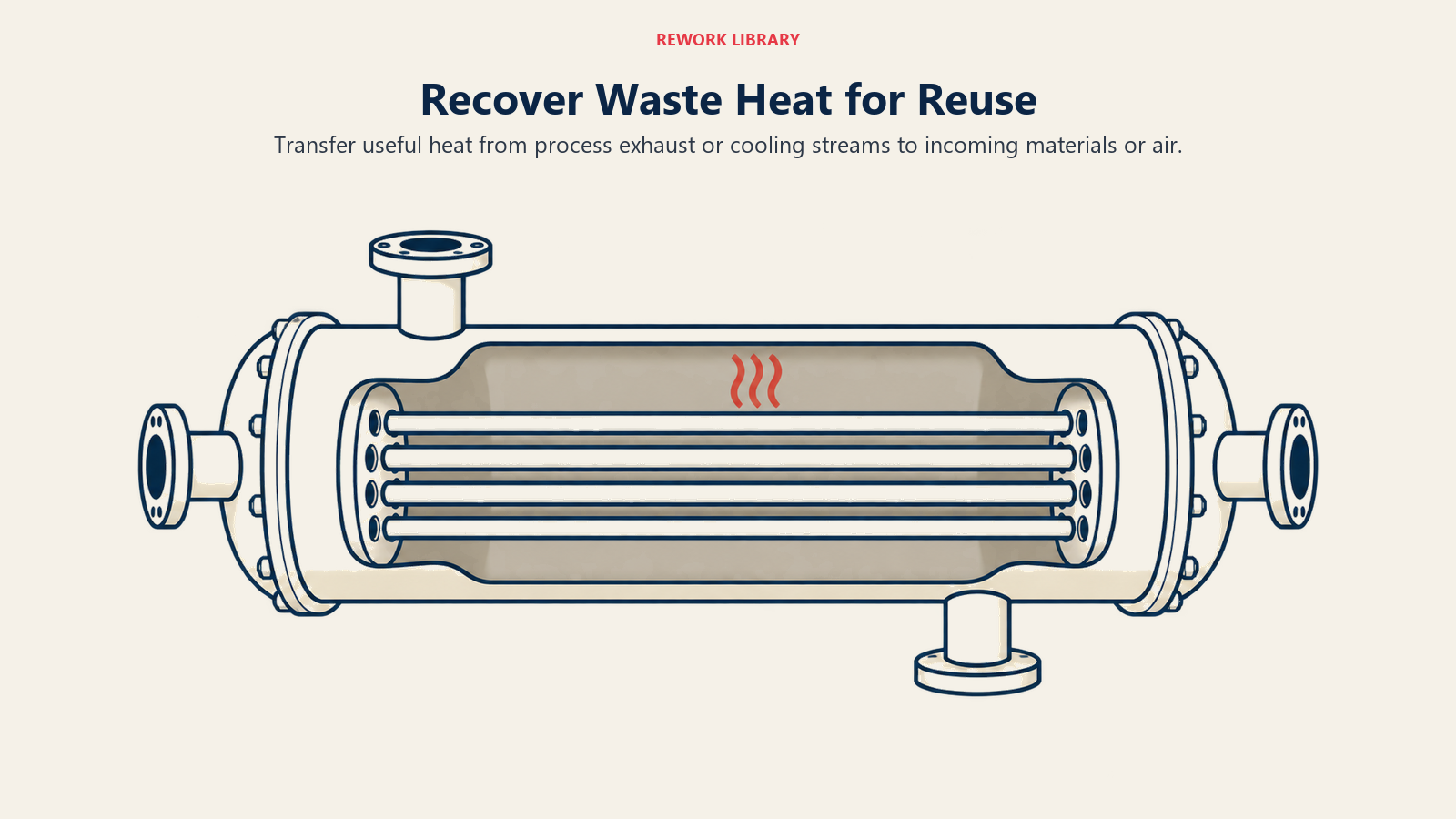
Heat recovery captures waste heat from one process to preheat inputs for another. Exhaust from ovens can preheat combustion air. Cooling water from equipment can provide space heating. Hot process outputs can warm cold incoming materials. Every BTU you recover is a BTU you don't have to generate. Heat recovery projects often have paybacks under two years.
Process temperature optimization balances energy cost against production requirements. Running processes hotter than necessary wastes energy. But running too cool affects quality or throughput. Careful testing often reveals that processes run at historical temperatures that no longer serve any purpose. Small reductions in process temperature can yield meaningful energy savings without performance impact.
Batch process scheduling affects energy consumption through thermal cycling. Stopping and starting processes wastes energy reheating equipment and materials. Extending run lengths reduces starts per year, cutting total energy consumption. This requires coordination with production planning but delivers savings without capital investment.
Variable frequency drives on pumps, fans, and process equipment allow speed adjustment to match actual demand rather than running at full speed with throttled output. The energy savings are dramatic because motor power consumption increases with the cube of speed. Running a pump at 80% speed cuts power consumption by roughly 50%. According to the U.S. Department of Energy, 18% of energy used in motors could be saved through efficient technologies like VFDs. VFD paybacks typically run 1-3 years.
Renewable Energy and On-Site Generation
Solar installations have become economically attractive for many manufacturers. Panel costs have dropped 80% over the last decade while efficiency has improved. Federal and state incentives reduce net costs further. Plants with large roof areas or available land can generate significant portions of their energy consumption.
The economics depend on local electricity rates, available incentives, and solar resources. Plants in high-rate markets with good solar exposure see paybacks of 4-7 years. Lower-rate markets or less favorable sites might see 10-15 years. But as grid rates increase and solar costs decline, more sites become viable each year.
Combined heat and power (CHP) makes sense for facilities with significant thermal loads. Natural gas engines or turbines generate electricity while capturing waste heat for process heating, hot water, or HVAC. The combined efficiency can exceed 70% compared to 30-40% for conventional grid electricity and on-site boilers.
CHP economics depend on the spark spread: the relationship between natural gas and electricity prices. When electricity costs much more than gas, CHP looks attractive. When gas prices spike or electric rates drop, economics deteriorate. Many CHP installations include grid interconnection to buy or sell power depending on relative prices.
Wind power works for some industrial sites with suitable wind resources and space for turbines. But this remains less common than solar for manufacturers due to permitting challenges, space requirements, and intermittency management.
Procurement and Contracting
Energy procurement strategy significantly affects costs, especially in deregulated markets. Manufacturers can negotiate with multiple suppliers, lock in fixed rates during favorable markets, or ride variable rates when futures look unfavorable. This requires market awareness and procurement expertise many plants lack.
Energy brokers and consultants can provide market intelligence and negotiation support. They analyze your consumption patterns, forecast market trends, and structure contracts that balance risk and cost. Good brokers add value through expertise and supplier relationships. Bad brokers push products that maximize their commissions regardless of your interests. Choose carefully and maintain independent market awareness.
Contract timing matters. Energy markets cycle with seasonal patterns and longer-term supply-demand dynamics. Locking in rates at market peaks costs dearly. Contracting during market lows captures years of favorable rates. Missing market timing by six months can mean 20-30% cost differences over the contract term.
Contract structure should match your risk tolerance and operational constraints. Fixed-rate contracts eliminate price volatility but might cost more than variable rates if markets drop. Variable rates capture market downturns but expose you to price spikes. Block-and-index approaches combine fixed blocks of volume at locked rates with variable rates on usage above or below the block. This balances risk and opportunity.
Demand response programs pay manufacturers to reduce consumption during grid stress periods. Utilities need to manage peak demand to avoid building expensive additional generation capacity. They'll pay you to shut down temporarily or switch to on-site generation when grid load is highest. This can offset thousands or tens of thousands of dollars annually depending on your ability to curtail and program generosity.
Building Organizational Capability
Technology and contracts matter, but culture and capability determine whether energy management becomes sustained practice or a one-time project. Successful manufacturers embed energy thinking into operations through accountability, training, and continuous improvement.
Assign energy management responsibility explicitly. Someone needs to own utility bill analysis, monitor consumption trends, identify opportunities, and drive projects. Without clear ownership, energy remains everyone's responsibility and no one's priority. This doesn't require a full-time position in most plants. But it does require named accountability and protected time.
Include energy metrics in operational dashboards alongside quality, productivity, and safety. What gets measured and reviewed gets managed. Display energy cost per unit produced, consumption by department, and performance versus targets. Make energy visible and make performance transparent.
Train operators and maintenance staff about energy impact. They control equipment usage, identify waste, and can make micro-decisions that aggregate into macro-savings. An operator who understands that leaving equipment running overnight wastes $500 will turn it off. An operator who sees equipment as someone else's problem won't. Knowledge changes behavior.
Incentivize improvement through recognition and rewards. When teams reduce energy consumption without sacrificing production, celebrate it. Share savings. Create friendly competition between shifts or departments. People respond to recognition and engagement far more than exhortation.
Measuring Success
Energy management delivers both financial and operational benefits. Cost savings are obvious and immediate. But efficiency improvements often correlate with better equipment reliability, lower maintenance costs, and improved process control. These secondary benefits can exceed direct energy savings.
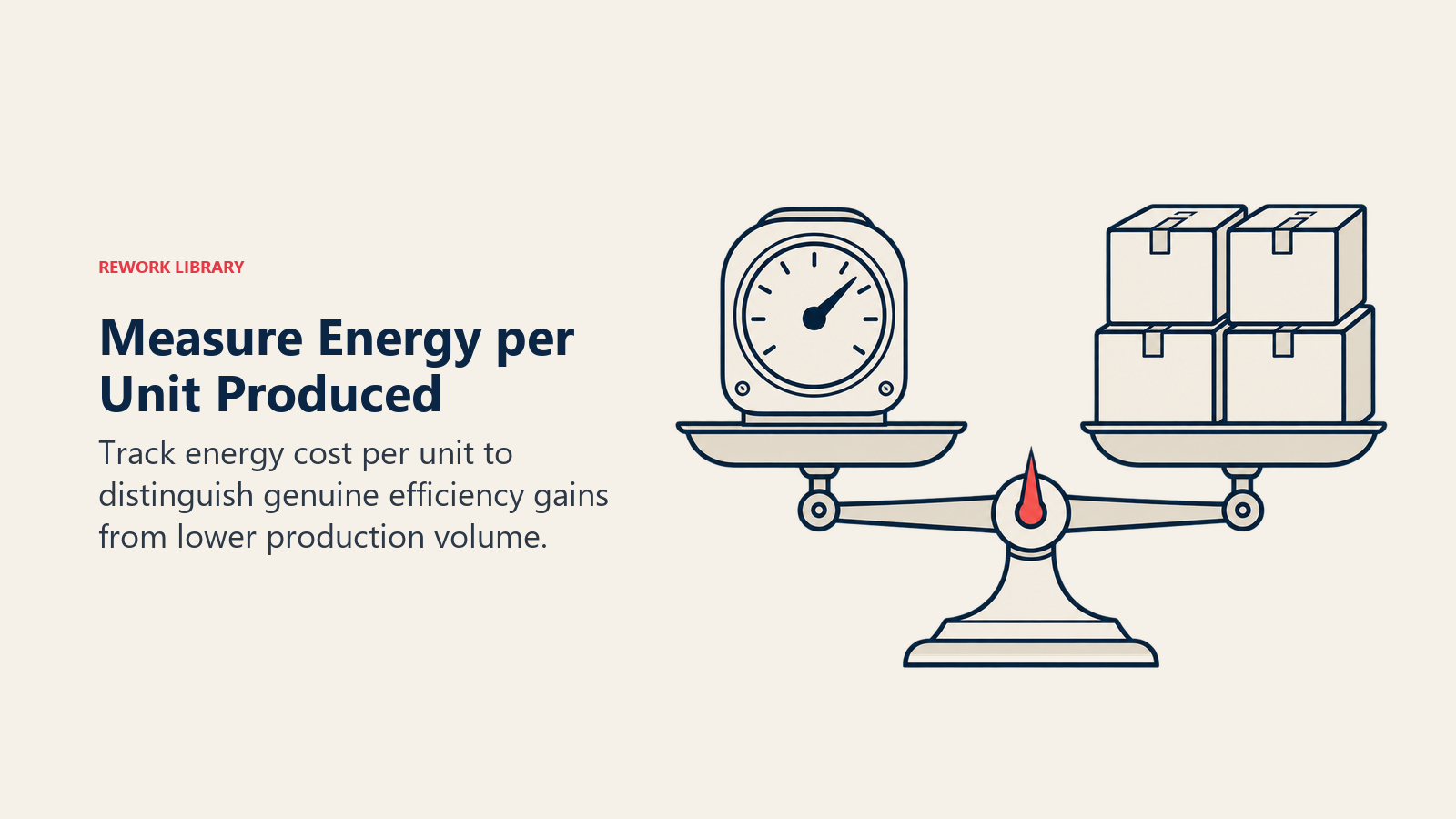
Calculate energy intensity: energy cost per unit produced: rather than just absolute consumption. Production volumes fluctuate. Absolute energy use tells you little about efficiency. Energy per unit reveals whether you're getting more efficient or just producing less. Track this monthly and investigate significant changes.
Benchmark against industry standards when possible. Trade associations and efficiency programs publish energy intensity data by industry sector. Knowing that your plant uses 20% more energy per unit than typical peers indicates opportunity. Being 20% below industry average suggests you're already efficient and should focus improvement efforts elsewhere.
Track project returns religiously. When you invest in efficiency upgrades, measure actual savings against projections. This validates projects delivered promised returns and improves estimation for future investments. It also identifies projects that underperformed so you can understand why and avoid similar mistakes.
Taking Action
Energy cost management doesn't require massive capital investment or revolutionary technology. It requires visibility, accountability, and systematic attention. Start with metering to understand consumption patterns. Analyze utility bills to understand rate structures and identify demand management opportunities. Look for quick wins like lighting upgrades, compressed air leak repair, and scheduling changes.
Build momentum through successes. Early wins demonstrate value and build organizational support for larger investments. They also develop capability. Teams learn to identify opportunities, analyze returns, and implement projects. This capability compounds over time.
Think of energy management as continuous improvement, not a project with an end date. There's always another efficiency opportunity, another rate to negotiate, another behavior to optimize. The manufacturers who treat energy costs as controllable competitive advantage continuously find ways to reduce consumption even after "all the obvious opportunities" are captured.
Energy represents a significant cost you can control. Whether energy expenses are high because of market conditions or high because of inefficiency, you can reduce them through systematic management. That reduction flows directly to profitability while also reducing environmental impact. Both your CFO and your corporate responsibility program benefit from energy excellence.
Learn More

Co-Founder, Rework.com