Capacity Planning Strategy: Aligning Manufacturing Resources with Demand
Turn this article into takeaways for your work.


Each assistant summarizes the article only for you and suggests best practices for your work.
Capacity planning mistakes cost manufacturers millions. McKinsey research shows that the average capital project runs approximately 60% over schedule and more than 70% over budget. Add too much capacity too soon and you carry excess costs that destroy margins. Add too little too late and you lose revenue to competitors while disappointing customers. The difference between strategic and reactive capacity planning often separates thriving manufacturers from struggling ones. Your manufacturing growth model determines capacity planning needs at each stage.
Capacity isn't just about equipment. It's about people, space, materials, and the systems that coordinate them. A manufacturer might have adequate machines but insufficient skilled operators, or plenty of production capacity but inadequate material supply. True capacity planning addresses all constraints, not just the obvious ones.
Understanding Manufacturing Capacity
Manufacturing capacity is the maximum output your operation can sustain over a given time period. But "maximum" has multiple definitions that create confusion and poor decisions.
Theoretical vs. Practical Capacity
Theoretical capacity assumes 24/7 operation with no downtime, perfect quality, instant changeovers, and optimal conditions. It's the number on equipment spec sheets and in marketing brochures. It's also useless for planning because no manufacturer achieves theoretical capacity in sustained operations.
Practical capacity accounts for planned downtime (maintenance, breaks, meetings), normal delays (changeovers, material wait time), typical quality issues, and realistic operating conditions. It represents what you can actually achieve consistently, typically 70-85% of theoretical capacity.
Use practical capacity for planning. Scheduling against theoretical capacity guarantees disappointment. You'll constantly miss production targets, frustrate customers, and blame execution when planning was unrealistic.
Design Capacity and Effective Capacity
Design capacity is what engineers intended when they laid out the facility. A production line designed for 100 units per hour has that design capacity. But effective capacity is what you actually achieve given product mix, operator skill, material flow, and coordination quality.
A line designed for 100 units/hour of a single standard product might achieve only 75 units/hour when running multiple products requiring frequent changeovers. That 75 units/hour is effective capacity for planning purposes. Don't plan against the 100 units/hour design unless you're willing to simplify product mix.
Capacity Types: Machine, Labor, Material
Machine capacity limits come from equipment availability and throughput rates. Most manufacturers focus here because machines are visible and expensive. But machine capacity rarely constrains alone.
Labor capacity limits come from available skilled workers. Deloitte research reports that 48% of manufacturers report moderate to significant difficulty filling production and operations-management roles. You might have machine capacity for 10,000 units but labor for only 8,000. The lower number constrains. Labor constraints are often harder to address than machine constraints because skilled workers take months to develop.
Material capacity limits come from supplier capability, material availability, or logistics constraints. During material shortages, supplier capacity determines your effective capacity regardless of internal resources.
Identify which capacity type actually constrains your operation. Additional machines won't help if you can't staff them. More workers won't help if materials are unavailable. Address the real constraint, not the assumed one.
Planning Approaches: Strategic Capacity Decisions
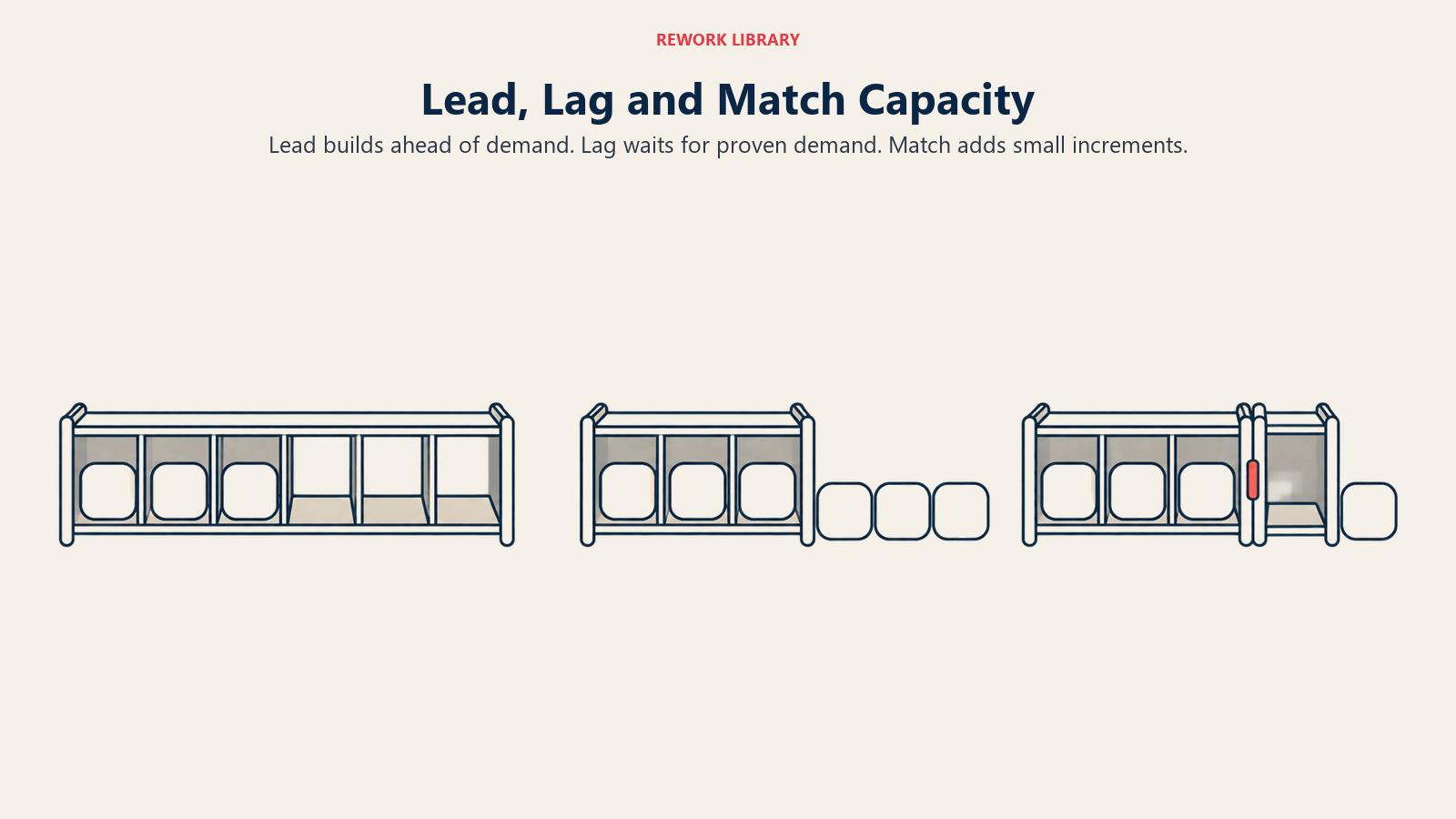
Three primary strategies guide capacity expansion timing: lead capacity, lag capacity, and match capacity. Each creates different trade-offs between cost and service.
Lead Capacity Strategy
Lead capacity adds resources ahead of demand increases. You build capacity when you forecast growth, before orders materialize. This enables excellent customer service through fast delivery and ability to handle demand spikes.
Lead capacity requires strong capital and tolerance for temporary underutilization. You'll carry excess capacity costs while building demand. If growth materializes slower than planned, you'll waste capacity investment. If it never materializes, you've destroyed capital.
This strategy suits growth markets, situations where delivery speed is competitively critical, and companies with strong balance sheets. It's how market leaders capture share from slower competitors. But it's risky when demand forecasts are unreliable.
Lag Capacity Strategy
Lag capacity adds resources only after demand increases prove sustainable. You wait until current capacity reaches 90-95% utilization before expanding. This minimizes capital at risk and ensures investments respond to proven demand, not hoped-for demand.
Lag capacity accepts service limitations during high-demand periods. You'll miss some orders, have longer lead times, and potentially lose customers to faster competitors. But you'll avoid investing in capacity that proves unnecessary.
This strategy suits mature markets, price-sensitive customers who accept longer lead times, and companies with limited capital. It's how conservative manufacturers protect profitability. But it limits growth potential when markets are expanding.
Match Capacity Strategy
Match capacity adds incremental resources to closely track demand growth. Instead of large capacity steps, you make frequent small adjustments. This balances service and cost by maintaining modest excess capacity without large overbuilds.
Match capacity requires flexible capacity options: temporary labor, contract manufacturing, overtime, and equipment leasing. You need ways to add small capacity increments quickly without multi-year capital projects. Without flexibility, you default to large steps that look like lead strategy.
This strategy suits variable demand, uncertain markets, and manufacturers who can access flexible capacity. It's how pragmatic manufacturers balance growth with capital efficiency. But it requires operational excellence to make frequent adjustments smoothly.
Capacity Cushion Considerations
Capacity cushion is the percentage of capacity held in reserve. A 20% cushion means running at 80% utilization, keeping 20% available for demand spikes, product mix changes, or equipment problems.
Optimal cushion depends on demand variability, service level targets, and capacity flexibility. Highly variable demand needs larger cushions, perhaps 30%. Stable demand with flexible capacity can run at 90%+ utilization. There's no universal answer.
Too small a cushion creates delivery problems, forces excessive overtime, and prevents schedule changes. Too large a cushion wastes capacity investment and inflates costs. Find the balance where service is excellent and costs are reasonable.
Analysis Framework: Tools for Capacity Planning
Capacity planning requires systematic analysis using several complementary tools.
Capacity Requirements Planning
Capacity Requirements Planning (CRP) calculates the capacity needed to execute your production schedule. It multiplies scheduled quantities by routing times and sums across work centers. This reveals where and when you'll have capacity shortfalls or excesses. Your master production scheduling drives CRP calculations.
Run CRP whenever master schedules change significantly. It answers "can we produce what's planned with available capacity?" If not, you must adjust schedules, add capacity, or outsource work.
CRP is only as accurate as your routing data and utilization assumptions. Review actual vs. planned capacity consumption to validate and refine assumptions. Poor data generates wrong capacity conclusions.
Bottleneck Identification
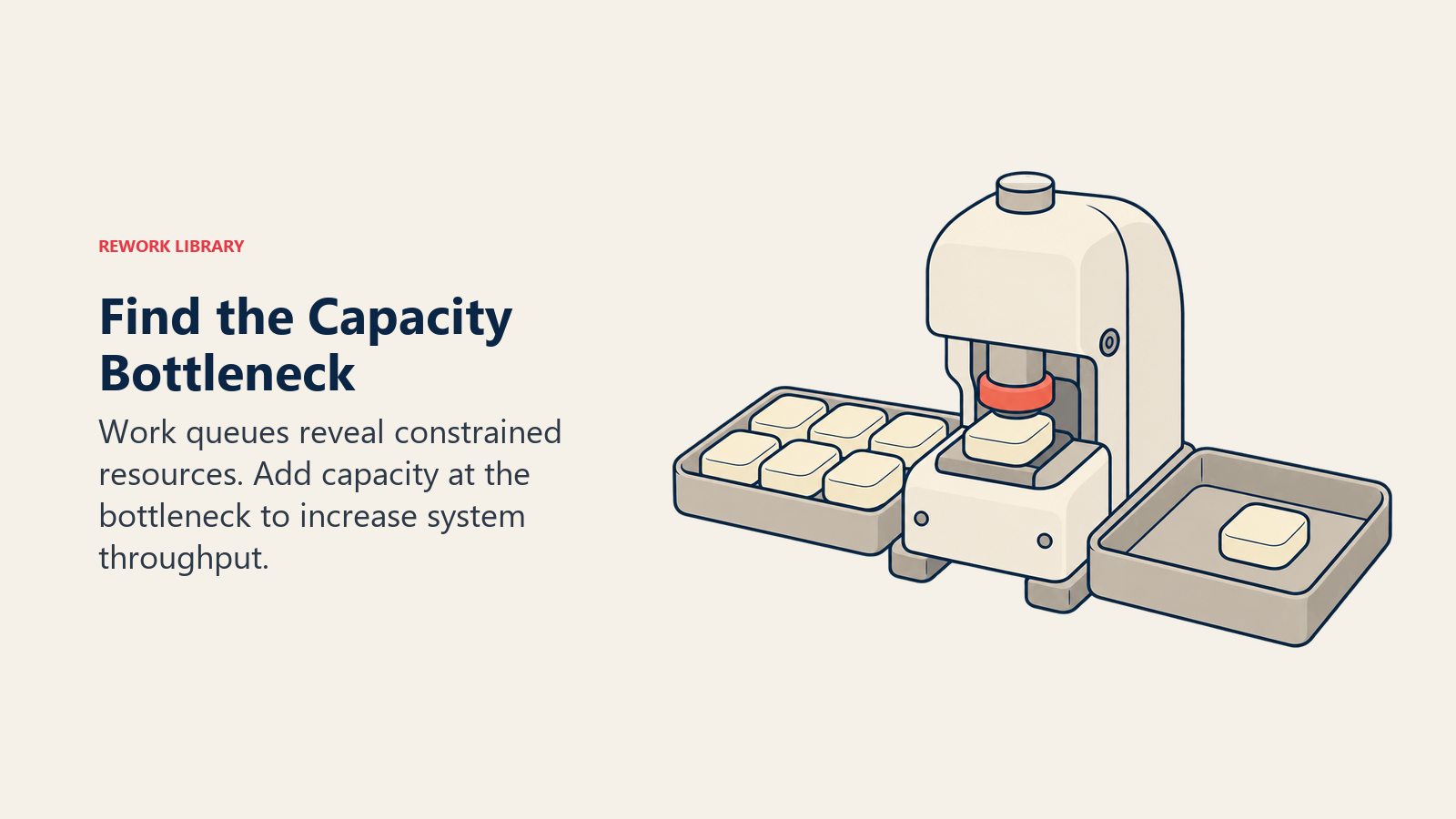
Identify bottleneck resources that constrain total system throughput. These are work centers consistently running at 90%+ utilization while others wait for work. The bottleneck determines your effective capacity regardless of other resources' capability. Production bottleneck analysis provides systematic methods for identifying and managing constraints.
Track work center utilization monthly. The consistently highest-utilized resources are bottleneck candidates. Verify by checking whether WIP accumulates before these resources. Bottlenecks have queues of work waiting.
Focus capacity additions on bottlenecks. Adding capacity to non-bottlenecks doesn't increase throughput. It just creates more idle time at those resources. Bottleneck capacity additions directly increase system capacity dollar-for-dollar.
Utilization Analysis
Utilization analysis compares actual output to available capacity. But distinguish between good utilization (productive work on value-adding products) and bad utilization (production of products that sit in inventory or work on inefficient products).
High utilization sounds positive but creates problems when achieved through producing to inventory rather than demand, or running inefficient products just to keep machines busy. Track utilization alongside inventory turns and on-time delivery. True efficiency maintains high utilization without building excess inventory.
Gap Analysis
Gap analysis compares capacity requirements under demand scenarios against available capacity. Create best-case, expected-case, and worst-case demand scenarios. Calculate capacity needed for each. Compare to current and planned capacity.
Gaps reveal where capacity additions are critical (even expected case exceeds capacity), where they're prudent (worst case exceeds capacity), and where they're unnecessary (best case fits within capacity). This guides prioritization and timing of capacity investments.
Expansion Options: Adding Capacity Strategically
Multiple options exist for adding capacity. Choose based on permanence needed, capital available, and timing urgency.
Intensive Capacity Utilization
Before adding capacity, maximize current resources. Options include:
Additional shifts spread fixed costs over more hours without equipment investment. A single-shift operation running at 75% utilization has 300% capacity headroom through adding second and third shifts. Labor and utilities increase, but equipment depreciation remains constant.
Overtime provides temporary capacity increases without permanent commitments. It's expensive per hour (time-and-a-half wages) but avoids capital investment. Use overtime for temporary demand spikes, not sustained capacity needs.
Setup reduction increases effective capacity by converting setup time to production time. A 4-hour setup reduced to 1 hour adds 3 hours of production capacity per setup without equipment investment. This is often the highest-ROI capacity expansion. Lean manufacturing principles include SMED techniques for setup reduction.
External Capacity
Contract manufacturing provides capacity without capital investment. You pay per unit but avoid fixed costs of equipment, facilities, and underutilization risk. Use contract manufacturing for overflow demand, specialized processes, or uncertain markets. Effective make vs buy decision frameworks guide these choices.
Outsourcing differs from contract manufacturing. Contract manufacturing maintains your product designs while using others' capacity. Outsourcing buys finished components or products from suppliers who design and produce them. Both add capacity but with different control and economic profiles.
Internal Capacity Expansion
Equipment addition is the most obvious capacity expansion. Buy machines to increase capacity directly. But equipment carries high capital cost, long lead times, and permanent overhead. Only add equipment when other options are exhausted and demand justifies permanent capacity. Understand your manufacturing cost structure implications before major capital investments.
Facility expansion adds space for additional equipment, workers, and inventory. It's expensive and slow but necessary when current facilities constrain growth. Consider facility expansion when you're running 24/7 with optimized processes and still lack capacity.
Process improvement increases capacity without capital by reducing cycle times, improving yields, and eliminating waste. A 20% cycle time reduction increases capacity 25% without equipment purchase. This is often the best capacity expansion option. Value stream mapping identifies process improvement opportunities.
Capacity Divestment
Don't forget capacity reduction. Permanently declining demand or strategic shifts might require capacity reduction to maintain profitability. Options include equipment sales, facility consolidation, or workforce reductions.
Capacity reductions are painful but necessary when markets contract. Manufacturers who delay reductions carry excess costs that destroy competitiveness. Act decisively to right-size capacity to demand reality.
Learn More
Expand your capacity planning expertise:
- Manufacturing Growth Model explains capacity needs at each growth phase
- Production Planning Fundamentals covers capacity's role in planning
- Master Production Scheduling uses capacity constraints in scheduling
- Production Bottleneck Analysis identifies capacity constraints systematically
- Make vs Buy Decision Framework evaluates outsourcing as capacity option
- Demand Forecasting for Manufacturing provides demand inputs for capacity planning
Capacity as Competitive Weapon
Strategic capacity planning creates competitive advantage. Manufacturers with the right capacity at the right time capture market opportunities while maintaining healthy margins. Those with wrong capacity either miss opportunities or carry excess costs.
Build capacity planning discipline. Forecast demand scenarios carefully. Analyze current capacity realistically. Evaluate expansion options comprehensively. Time additions strategically. And maintain flexibility to adjust as markets evolve.
Capacity planning is never perfect. Demand forecasts miss. Markets shift. Competitors act unexpectedly. But systematic planning beats reactive decisions every time. It's the difference between controlling your manufacturing destiny and letting market forces control you.
