Manufacturing Supply Chain Strategy: Building Resilience, Efficiency, and Competitive Advantage
Turn this article into takeaways for your work.


Each assistant summarizes the article only for you and suggests best practices for your work.
The pandemic exposed what many manufacturers had ignored: supply chains optimized purely for cost are brittle. A Michigan automotive supplier had lean inventory, single-source suppliers, and just-in-time delivery from Asia. They prided themselves on negative working capital and industry-leading margins.
Then shipping containers got stuck. Their single-source supplier in China shut down. Alternative suppliers had 16-week lead times. Production stopped for six weeks. They lost $23 million in revenue and three key customers who couldn't afford the uncertainty.
Their competitor down the road had higher inventory costs and dual-sourced critical components. They weathered the disruption with minor hiccups. And they captured market share from companies that couldn't deliver.
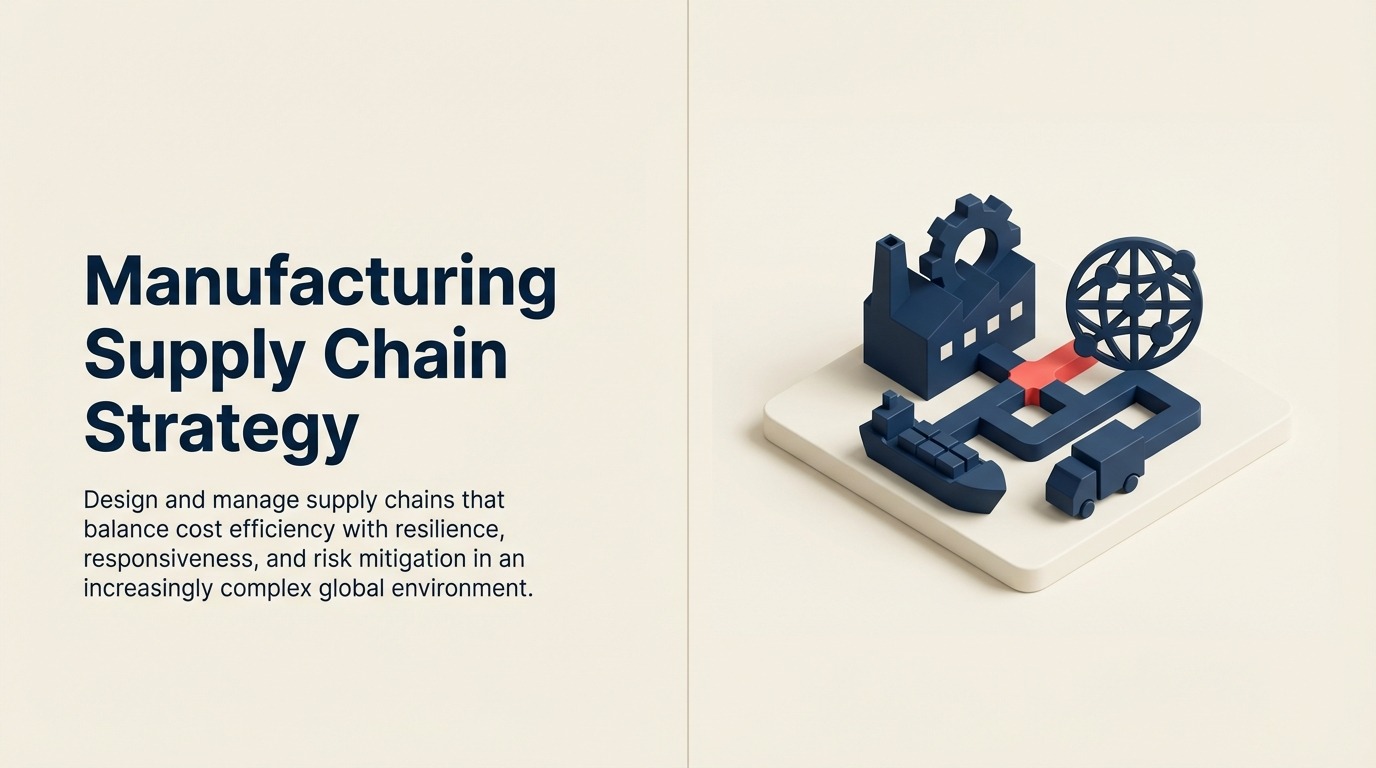
The lesson isn't that lean is wrong. It's that supply chain strategy requires balancing multiple objectives:cost, service, resilience, and sustainability:based on your specific competitive environment and risk tolerance.
Supply Chain Strategy Fundamentals: Beyond Cost Optimization
Supply chain strategy defines how you configure networks, relationships, and processes to deliver products profitably while managing risk and supporting business objectives. According to Wikipedia, supply chain management is a cross-functional approach that includes managing the movement of raw materials into an organization, certain aspects of internal processing of materials into finished goods, and the movement of finished goods out of the organization toward the end consumer.
End-to-End Supply Chain View
Most manufacturers understand their internal operations well. Wikipedia notes that a supply chain encompasses manufacturing and procurement, involving logistics that coordinate the relationships between multiple enterprises including suppliers, manufacturers, and retailers. Fewer understand the complete chain from raw material extraction through product disposal:
Upstream (Supply):
- Tier 2 and Tier 3 suppliers (suppliers to your suppliers)
- Raw material sources
- Component manufacturers
- Transportation and logistics providers
Internal (Operations):
- Receiving and warehousing
- Production processes
- Assembly and finishing
- Quality control
- Packaging and shipping
Downstream (Distribution):
- Distribution centers
- Wholesalers and distributors
- Retailers
- End customers
- Service and warranty support
- Reverse logistics and returns
Vulnerabilities can exist anywhere in this chain. You might have perfect internal operations but still fail due to upstream supplier problems or downstream distribution disruptions. End-to-end visibility and management are essential.
Strategic Objectives: Balancing Multiple Goals
Traditional supply chain thinking emphasized cost minimization. Modern strategy recognizes multiple objectives:
Cost efficiency: Minimize total supply chain costs while meeting service requirements. But don't optimize costs in isolation from other objectives.
Service level: Deliver products when customers need them with desired quality and customization. But perfect availability isn't economically feasible for every product.
Resilience and flexibility: Survive disruptions and adapt to changing conditions. But redundancy and flexibility cost money.
Sustainability: Minimize environmental impact and ensure ethical practices. But sustainable options may increase costs or complexity.
Innovation and speed: Rapidly introduce new products and respond to market changes. But speed may require less-efficient processes or higher inventory.
World-class manufacturers explicitly define target levels for each objective based on competitive priorities and customer requirements. They don't pretend all objectives can be maximized simultaneously.
Supply Chain Design Decisions
Three strategic decisions shape your supply chain architecture:
Make vs buy: What should you manufacture internally vs purchase? Vertical integration provides control but requires capital and expertise. Outsourcing provides flexibility but creates dependency.
Global vs local: Should you source globally for cost advantages or locally for responsiveness and reduced risk? Global sourcing offers lower prices but longer lead times and higher logistics complexity.
Single vs multi-source: Should you concentrate volume with single suppliers for leverage and cost, or diversify across multiple suppliers for resilience and competitive tension?
None of these decisions has universally correct answers. Right choices depend on your specific circumstances:product characteristics, competitive priorities, risk tolerance, and available resources.
A medical device manufacturer made different decisions for different product lines: commodity components sourced globally with multiple suppliers, critical components manufactured internally, and specialized sensors single-sourced from a strategic partner with unique capabilities. One-size-fits-all supply chain strategies are rarely optimal.
Alignment with Business Strategy
Supply chain strategy must support overall business strategy:
Cost leadership requires low-cost supply chain configuration:global sourcing, high utilization, minimal inventory.
Differentiation requires flexible, responsive supply chain:quick customization, short lead times, high service levels.
Focus/niche strategy requires tailored supply chain:specialized suppliers, lower volumes, premium service.
Innovation leadership requires collaborative supply chain:early supplier involvement, rapid prototyping, flexible capacity.
Misalignment between business strategy and supply chain creates competitive disadvantage. If your business competes on rapid customization but your supply chain is optimized for cost through long lead times and large batches, you can't deliver on your value proposition.
Supply Chain Design: Strategic Configuration
How you structure your physical network and relationships determines capabilities and constraints for years.
Network Design: Locations and Flow
Network design answers fundamental questions:
How many facilities? More facilities increase flexibility and reduce delivery time but increase fixed costs and complexity.
Where should facilities be located? Balance proximity to customers, suppliers, labor, and infrastructure against cost differentials.
What should each facility do? Specialize by product, process, or customer segment, or create flexible facilities that can handle multiple roles?
How should products flow? Direct from factory to customer, through distribution centers, or through multiple tiers?
Network design models use mathematical optimization to evaluate alternatives considering:
- Customer locations and demand volumes
- Facility costs (fixed and variable)
- Transportation costs
- Inventory holding costs
- Service level requirements
But don't let models dictate strategy. They inform decisions that require judgment about risk, flexibility, and strategic intent that models can't fully capture.
Vertical Integration vs Outsourcing
Vertical integration means owning more of the supply chain:from raw materials toward finished products:
Advantages:
- Control over quality, delivery, and costs
- Capture margin at multiple stages
- Protect proprietary processes or intellectual property
- Reduce dependency on suppliers
Disadvantages:
- Requires capital and expertise in non-core activities
- Less flexibility to scale up or down
- May not achieve best-in-class capabilities across all operations
- Focus diverted from core competencies
Outsourcing transfers activities to specialized suppliers:
Advantages:
- Access to specialized expertise and scale economies
- Variable cost structure (pay for what you use)
- Focus on core competencies
- Faster scaling and market entry
Disadvantages:
- Loss of direct control
- Dependency on suppliers
- Potential quality or delivery issues
- Risk of intellectual property exposure
Most manufacturers occupy middle ground:owning critical operations that differentiate products or require proprietary knowledge, while outsourcing commoditized or non-core activities.
Tesla's vertical integration strategy (making batteries, motors, software internally) contrasts with traditional auto OEMs that outsource heavily. Both can work, but they require different capabilities and create different risk profiles.
Global vs Regional vs Local Sourcing
Geographic sourcing strategy involves fundamental tradeoffs:
Global sourcing (offshore low-cost regions):
- Lower piece prices due to labor and material cost advantages
- Access to specialized capabilities or unique materials
- But: Long lead times (8-16 weeks typical)
- But: Higher logistics costs and complexity
- But: Currency risk and geopolitical uncertainty
- But: Quality control challenges across distance and culture
Regional sourcing (nearshore):
- Moderate costs (between offshore and local)
- Shorter lead times (2-6 weeks typical)
- Easier collaboration and problem-solving
- But: May not achieve lowest costs
- But: Still has international logistics complexity
Local sourcing (domestic):
- Shortest lead times (days to 2 weeks)
- Easiest communication and collaboration
- Lowest logistics complexity
- Highest supply chain visibility
- But: Typically highest piece prices
- But: May have limited supplier base for some components
Smart manufacturers segment sourcing strategy by product and component characteristics:
Commodity components with stable demand: Global sourcing for cost advantage.
Critical components or unique capabilities: Source wherever the best suppliers exist, regardless of location.
High-volume, stable products: Global sourcing with inventory buffers.
New or highly variable products: Local sourcing for flexibility and short lead times.
Bulky or heavy products: Local sourcing to avoid transportation costs.
Supplier Tiering and Strategic Partnerships
Not all supplier relationships warrant the same management intensity:
Tier 1: Strategic partners
- Critical to your success, unique capabilities, high spend
- Close collaboration, joint development, long-term contracts
- Intensive communication and relationship management
- Might be single-source with very high dependency
Tier 2: Preferred suppliers
- Important but not critical, good capabilities, significant spend
- Regular communication, annual business reviews
- Multi-year agreements with volume commitments
- Typically dual-sourced for resilience
Tier 3: Transactional suppliers
- Commodity items, multiple alternative sources, lower spend
- Arms-length relationships, focus on price and delivery
- Annual competitive bidding
- Switch suppliers freely based on performance
Allocate management attention and investment based on strategic importance, not alphabetically. Strategic partners deserve dedicated resources and executive attention. Commodity suppliers get efficient procurement processes and periodic competitive pressure.
Inventory Positioning and Postponement
Where you hold inventory affects both cost and responsiveness:
Raw materials: Safety stock protects against supplier variability and lead time.
Work-in-process: Buffers between production stages smooth flow but increase carrying costs.
Finished goods: Enables fast customer response but highest inventory investment and obsolescence risk.
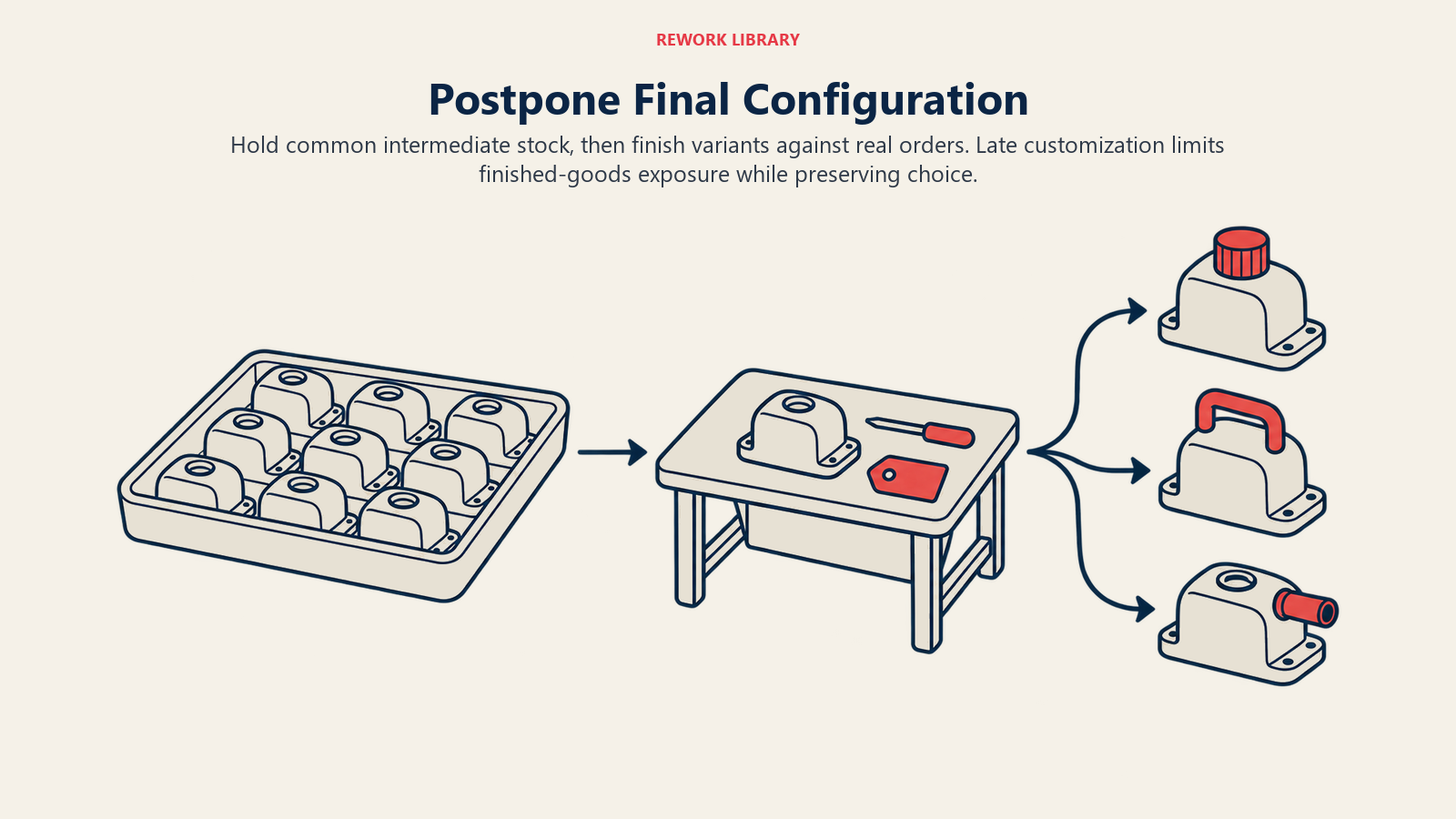
Postponement strategy delays final configuration as long as possible:
Manufacturing postponement: Make products to common intermediate stage, then customize late in process based on actual demand.
Logistics postponement: Ship products to regional distribution centers in generic form, then finalize labeling and packaging based on local requirements.
Dell pioneered this approach:building computers to order only after customers specified configurations, avoiding finished goods inventory of thousands of SKU combinations.
The tradeoff: postponement requires flexible processes and may increase manufacturing complexity, but it dramatically reduces inventory investment and obsolescence for high-variety products.
Supplier Management: Building Capable Supply Base
Your supply chain performance can't exceed your suppliers' capabilities. Supplier management creates and maintains a supply base that supports your requirements.
Supplier Selection and Qualification
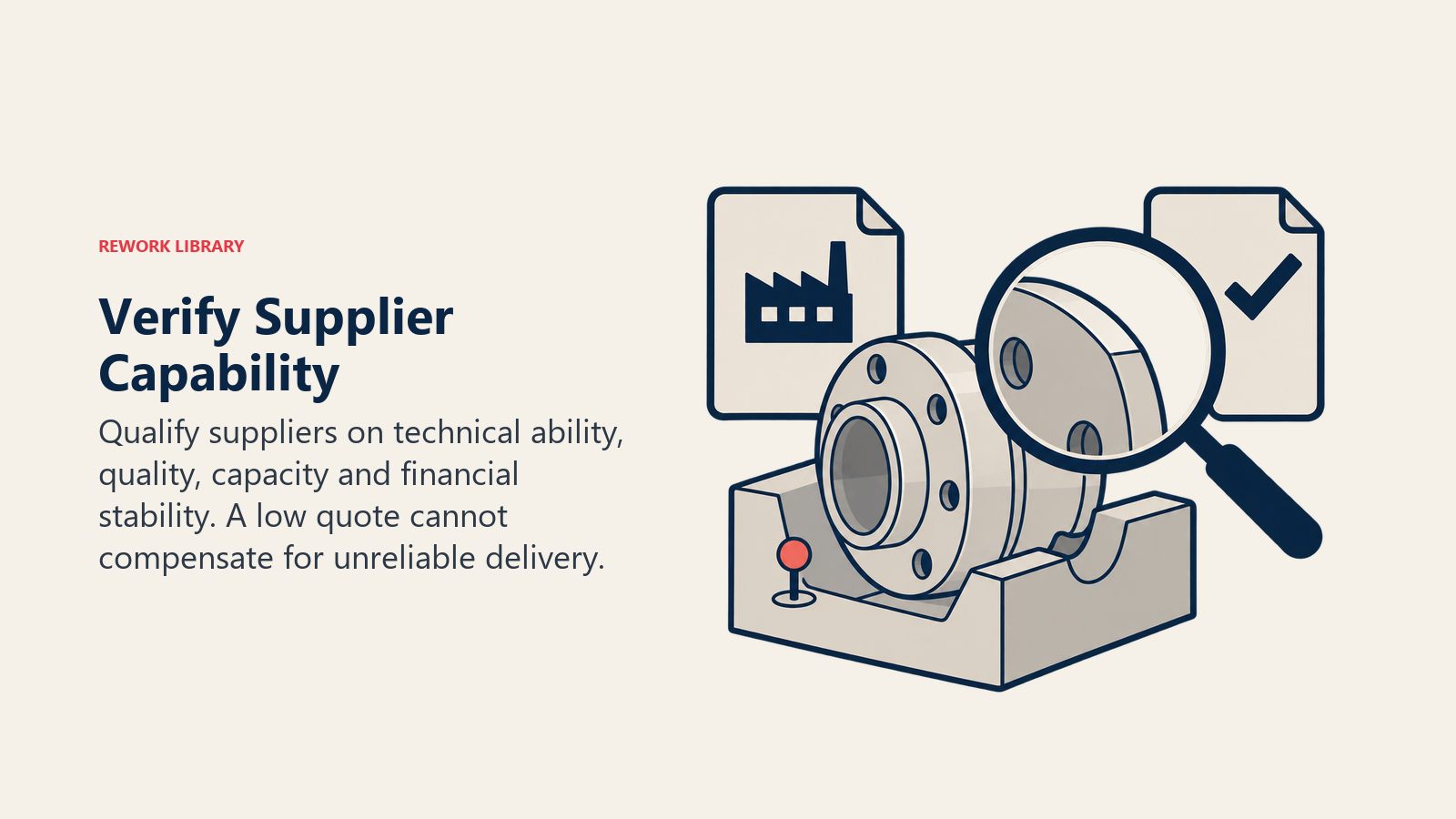
Formal supplier selection prevents problems before they start:
Capability assessment:
- Technical capability to meet specifications
- Quality management systems (ISO 9001 or equivalent)
- Production capacity for your volumes
- Financial stability
Performance history:
- Reference checks with current customers
- Audit of their facilities and processes
- Sample production runs to verify capability
- Quality and delivery performance data
Strategic fit:
- Willingness to collaborate on improvements
- Cultural compatibility
- Geographic considerations
- Risk factors (single-customer dependency, narrow product focus)
Too many manufacturers select suppliers primarily on price, then struggle with quality and delivery problems. Invest time in thorough supplier qualification, especially for strategic components.
Strategic Supplier Relationships vs Transactional
Relationship intensity should match strategic importance:
Strategic relationships:
- Long-term contracts (3-5 years)
- Early involvement in product development
- Joint cost reduction and quality improvement projects
- Shared information and planning
- Executive sponsor relationships
- Sometimes exclusive or heavily preferred status
Transactional relationships:
- Annual or project-based contracts
- Standard products to specifications
- Periodic competitive bidding
- Limited information sharing
- Minimal collaboration beyond basic transactions
A food processing company had 847 active suppliers. Analysis revealed 12 suppliers represented 65% of spend and provided critical ingredients or packaging. They shifted to strategic partnerships with those 12:long-term agreements, joint development, shared forecasts, and dedicated account management. For the other 835 suppliers, they maintained transactional relationships with annual competitive bidding. Total procurement costs dropped 18%, and quality improved significantly for critical materials.
Supplier Development and Continuous Improvement
Rather than just switching suppliers when problems occur, develop capability in strategic suppliers:
Technical assistance: Help suppliers improve their processes, quality systems, or equipment.
Training: Provide training on your requirements, quality expectations, or improvement methodologies.
Shared metrics: Regular performance reviews with data on quality, delivery, cost, and responsiveness.
Joint improvement projects: Collaborate on cost reduction or quality improvement with shared benefits.
Supplier conferences: Annual events where suppliers learn about your strategy, share best practices, and build relationships.
Supplier development creates capability that benefits both parties. You get better quality and lower costs; suppliers become more competitive and valuable to you.
Supplier Scorecards and Performance Management
What gets measured gets managed. Formal supplier scorecards track performance:
Quality metrics:
- Defect rates (PPM or percentage)
- Supplier-caused production disruptions
- Inspection or return costs
- Certification status
Delivery metrics:
- On-time delivery percentage
- Lead time compliance
- Order fill rate
- Responsiveness to urgent requests
Cost metrics:
- Price competitiveness
- Cost reduction contributions
- Total cost of ownership
Collaboration metrics:
- Responsiveness to issues
- Proactive improvement suggestions
- Technology or innovation contributions
Use scorecards to drive improvement, not punishment. Share scores regularly, discuss issues openly, and recognize excellent performance.
Poor performers get corrective action plans with timelines. Persistently poor performers lose business gradually to better alternatives.
Early Supplier Involvement
Engage key suppliers during product development, not after designs are finalized:
Design reviews: Supplier engineers review designs and suggest improvements for manufacturability, cost, or performance.
Material selection: Suppliers recommend materials that balance performance with availability and cost.
Process capability input: Suppliers advise on tolerances and specifications that match their process capabilities.
Prototype support: Suppliers provide early samples for testing and validation.
Early involvement prevents costly changes late in development and builds supplier commitment to your success. A semiconductor equipment manufacturer that involves suppliers in early design phases launches new products 30% faster with 40% fewer supplier-related issues compared to previous products developed internally then "thrown over the wall" to suppliers.
Demand and Supply Planning: Balancing Supply and Demand
Effective supply chains synchronize supply with demand, minimizing both shortages and excess inventory.
Demand Forecasting and S&OP
Demand forecasting predicts future customer demand using:
Historical data analysis: Patterns, trends, seasonality in past demand.
Market intelligence: Customer feedback, sales pipeline, economic indicators.
Promotional planning: Expected impact of marketing activities and price changes.
New product introductions: Anticipated demand for products without history.
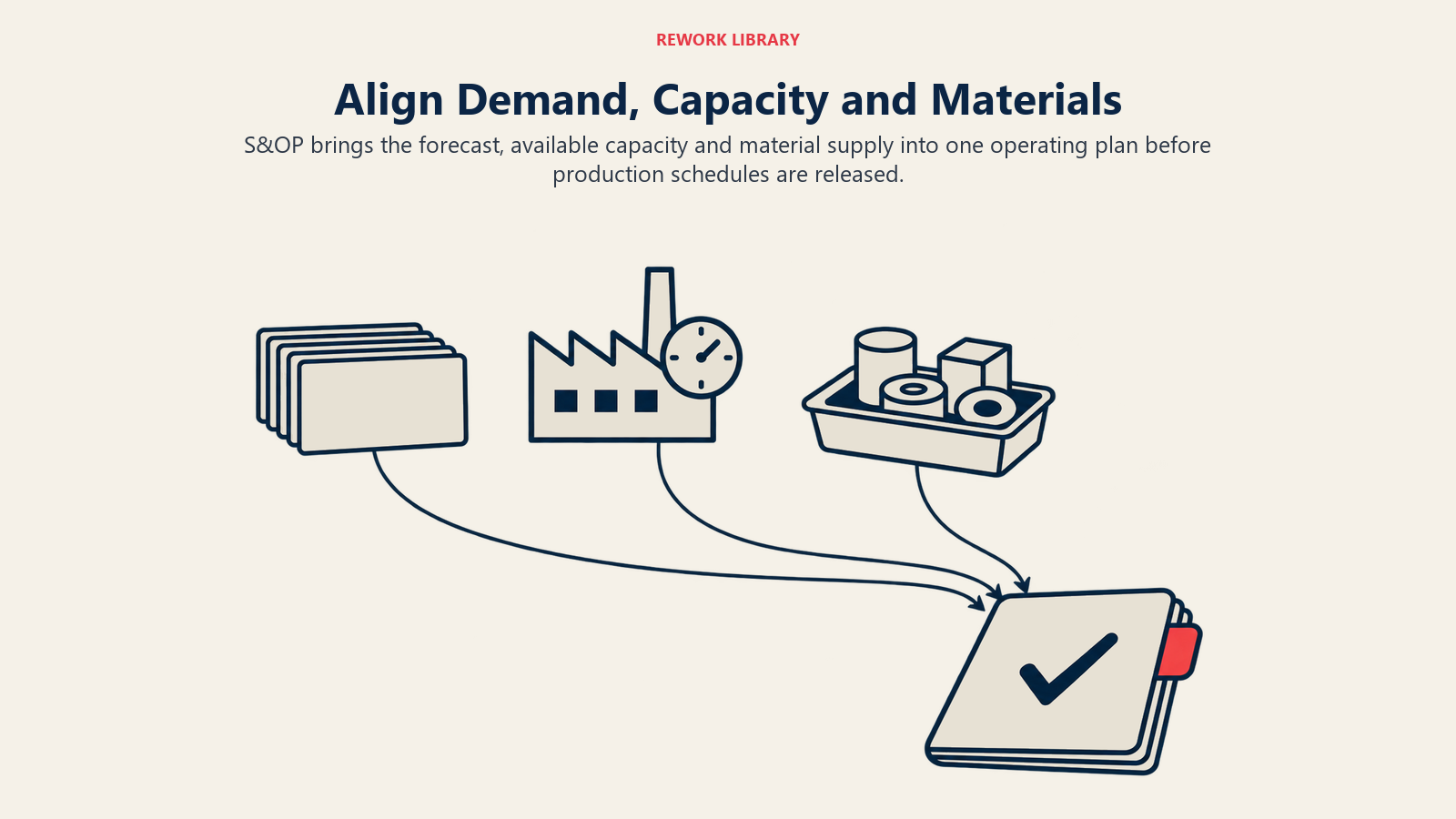
Sales and Operations Planning (S&OP) is a cross-functional process that:
- Reviews demand forecast and adjusts based on latest information
- Evaluates capacity and material availability
- Identifies gaps between demand and supply capability
- Makes decisions about capacity, inventory, and commitments
- Aligns organization around a single operating plan
Monthly S&OP meetings with sales, operations, supply chain, finance, and executive leadership ensure everyone works from the same plan rather than functional silos optimizing locally.
Inventory Optimization
Right inventory levels balance service and cost:
Safety stock: Buffer inventory to absorb demand variability and supply uncertainty. Calculate based on demand variability, lead time, and desired service level.
Reorder points: Inventory level that triggers replenishment order. Balances lead time demand with safety stock.
Economic order quantity: Batch size that minimizes combined ordering and carrying costs.
But sophisticated calculations don't replace judgment. Consider:
- Strategic importance (carry more safety stock for critical customers)
- Obsolescence risk (minimize inventory for short-lifecycle products)
- Value (carry less inventory of expensive items)
- Storage constraints (physical space limitations)
Production Planning and Scheduling
Production planning translates demand forecast and current orders into manufacturing schedules:
Master Production Schedule: What finished products to make, in what quantities, when.
Capacity planning: Ensuring sufficient equipment and labor capacity to meet the MPS.
Material planning: Calculating material requirements based on bills of material and current inventory.
Shop floor scheduling: Detailed sequencing of orders through production operations.
Effective planning balances:
- Customer delivery requirements
- Capacity utilization (minimizing idle time)
- Changeover minimization (reducing setup time and cost)
- Inventory levels (not building too far ahead of demand)
Materials Requirements Planning (MRP)
MRP is a systematic approach to calculating material requirements:
- Start with master production schedule (what finished products are needed when)
- Explode bills of material to determine component requirements
- Compare to current inventory and open orders
- Generate purchase requisitions and production orders to fill gaps
MRP ensures you have materials when needed without excessive inventory. But MRP is only as good as the data:accurate bills of material, lead times, and inventory records are essential.
Lean Principles: Pull Systems and JIT
Just-In-Time (JIT) and pull systems produce or deliver only what's needed, when needed:
Pull vs push: Produce based on actual consumption (pull) rather than forecast (push).
Kanban systems: Visual signals that trigger replenishment automatically.
Reduced batch sizes: Smaller, more frequent production runs reduce inventory and lead time.
Supplier partnerships: Close collaboration enables frequent small deliveries economically.
JIT reduces inventory and improves cash flow but requires stable processes, reliable suppliers, and geographic proximity. It's powerful but not appropriate for all situations:products with long supply chains or high variability may need buffer inventory.
Supply Chain Resilience: Managing Risk and Disruption
Recent years taught painful lessons about supply chain fragility. Resilience is now a strategic priority.
Risk Assessment and Scenario Planning
Identify and assess supply chain risks:
Supplier risks: Financial instability, limited capacity, geographic concentration, single-source dependencies.
Operational risks: Equipment failures, quality issues, labor shortages, natural disasters.
Demand risks: Forecast errors, sudden demand spikes or crashes, new competitors.
External risks: Geopolitical instability, trade restrictions, currency fluctuations, transportation disruptions.
For each significant risk, estimate likelihood and potential impact. Prioritize mitigation efforts on high-impact risks with reasonable probability.
Scenario planning explores "what if" situations:
- What if a key supplier fails?
- What if tariffs double on imported materials?
- What if shipping costs triple?
- What if a natural disaster hits a major production region?
Develop response plans before crises occur, not during chaos.
Business Continuity and Contingency Plans
Documented plans for responding to disruptions:
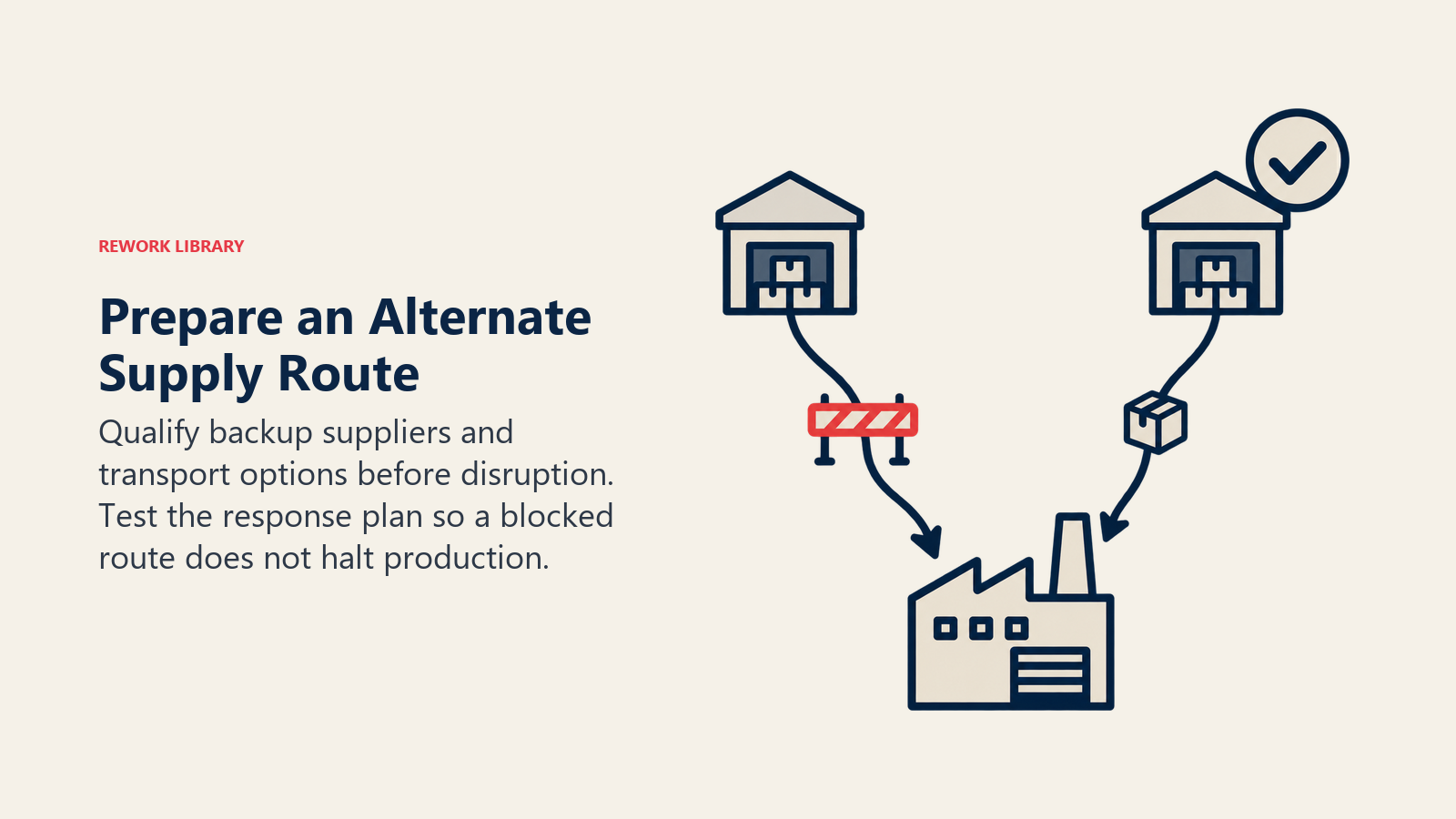
Alternative suppliers: Pre-qualified backup suppliers for critical components.
Alternate transportation: Multiple shipping options if primary routes are disrupted.
Inventory buffers: Strategic safety stock for high-risk, critical materials.
Flexible capacity: Ability to shift production between facilities or add capacity quickly.
Communication protocols: How to coordinate response during disruptions.
Test plans periodically. Tabletop exercises reveal gaps that real disruptions will exploit brutally.
Dual Sourcing and Supplier Diversification
Single-source suppliers create vulnerability:
Dual sourcing: Qualify and maintain active business with at least two suppliers for critical components.
Geographic diversification: Avoid concentration in single region susceptible to common disruptions.
Technology diversification: Alternative suppliers with different manufacturing processes reduce risk of technology-specific problems.
But diversification has costs:
- Split volumes reduce leverage with each supplier
- Multiple suppliers increase management complexity
- Duplicate qualification and relationship costs
Balance risk mitigation against cost and complexity. Dual-source critical components where supply disruption would be catastrophic; single-source less critical items where alternatives could be developed quickly if needed.
Near-Shoring and On-Shoring Considerations
The pandemic and geopolitical tensions are driving re-evaluation of global supply chains:
Near-shoring (moving production closer):
- Shorter lead times improve responsiveness
- Reduced transportation costs and carbon footprint
- Easier collaboration and problem-solving
- But: Higher labor costs than offshore locations
On-shoring (bringing production home):
- Maximum control and visibility
- Shortest lead times
- Eliminate most geopolitical and currency risk
- But: Highest costs, may lack supplier base or specialized capabilities
Don't make emotional reactions to recent disruptions. Analyze total cost of ownership including:
- Landed cost (materials + labor + freight + duties)
- Inventory carrying cost (longer lead times require more inventory)
- Quality and lead time risk costs
- Responsiveness value (how much is flexibility worth?)
For many products, balanced approach makes sense: critical or high-variability products sourced closer to home; stable, cost-sensitive products sourced globally with appropriate inventory buffers.
Buffer Strategies: Inventory, Capacity, Time
Three ways to absorb variability and disruption:
Inventory buffers: Safety stock absorbs demand spikes or supply delays. Expensive but enables fast response.
Capacity buffers: Excess production capacity enables rapid increases in output. Maintains flexibility but reduces utilization.
Time buffers: Longer lead times absorb variability through advance planning. Low cost but reduces responsiveness.
Choose buffers appropriate for your situation:
- High-value products: prefer time or capacity buffers over inventory
- Critical customer service: carry inventory buffers
- Commodity products: time buffers may be sufficient
- Highly variable demand: need some combination of all three
Supply Chain Visibility: Information and Technology
You can't manage what you can't see. Visibility throughout the extended supply chain enables better decisions.
End-to-End Visibility and Tracking
Track materials and products through the entire supply chain:
Supplier visibility: Status of supplier production, quality, and shipments.
In-transit visibility: Real-time location and condition of shipments.
Internal visibility: Work-in-process location and status through manufacturing.
Customer visibility: Delivery confirmation and product performance in field.
Modern tracking technologies include:
- EDI (Electronic Data Interchange) for structured data exchange
- IoT sensors for real-time location and condition monitoring
- Blockchain for immutable transaction records and traceability
- APIs connecting disparate systems across organizational boundaries
Supply Chain Control Towers
Control towers provide centralized visibility and coordination:
Dashboard displays: Real-time status of key metrics:inventory levels, shipment status, production progress, supplier performance.
Exception management: Automated alerts when parameters deviate from plan:late shipments, quality issues, demand changes.
Scenario analysis: Impact assessment and alternative evaluation when disruptions occur.
Coordination: Communication hub connecting internal teams, suppliers, logistics providers, and customers.
Large manufacturers and 3PLs have implemented sophisticated control towers with dedicated staff monitoring supply chain flows 24/7, but even small operations can create simple versions using cloud-based tools and dashboards.
Integration with ERP, MES, and Supplier Systems
Disconnected systems create blind spots and delays:
ERP integration: Supply chain systems connect with enterprise planning and execution systems for real-time demand, inventory, and production data.
MES integration: Manufacturing execution systems provide real-time production status and quality data.
Supplier integration: Direct connections to supplier systems enable visibility into their production status and inventory levels.
Logistics provider integration: Real-time shipment tracking and delivery confirmation.
Integration eliminates manual data entry, reduces errors, and enables faster response to changing conditions.
Predictive Analytics and Demand Sensing
Advanced analytics improve forecast accuracy and enable proactive response:
Machine learning forecasting: Algorithms identify complex patterns in demand data that traditional statistical methods miss.
Demand sensing: Short-term forecast adjustments based on real-time signals:POS data, web traffic, social media sentiment.
Prescriptive analytics: Recommendations for optimal actions:when to expedite, which suppliers to prioritize, where to allocate inventory.
Supply risk prediction: Early warning of potential supplier issues based on financial data, social media, news, and performance trends.
These capabilities require data infrastructure and analytical talent, but leading companies report forecast accuracy improvements of 15-30% and faster response to market changes.
Sustainability and Ethics: Responsible Supply Chains
Supply chain sustainability is shifting from nice-to-have to competitive requirement.
Environmental Impact and Carbon Footprint
Manufacturing and logistics generate significant environmental impact:
Scope 1: Direct emissions from owned facilities and vehicles.
Scope 2: Indirect emissions from purchased electricity and energy.
Scope 3: All other indirect emissions in supply chain:supplier operations, transportation, product use, disposal.
Most manufacturing carbon footprint comes from Scope 3:suppliers and logistics. Addressing it requires supply chain action:
- Supplier environmental performance requirements
- Transportation mode optimization (rail and sea vs air freight)
- Packaging reduction and sustainable materials
- Reverse logistics and circular economy practices
Leading customers increasingly require carbon footprint disclosure and reduction commitments. Sustainability is becoming a supplier selection criterion, not just a corporate social responsibility activity.
Ethical Sourcing and Labor Practices
Supply chains must ensure ethical treatment of workers:
Supplier audits: Verify working conditions, wages, safety practices.
Conflict minerals compliance: Ensure materials don't fund conflict or use forced labor.
Child labor prevention: Verify suppliers don't use child labor.
Freedom of association: Respect workers' rights to organize.
Major brands have suffered reputational damage when suppliers were found using forced labor or unsafe working conditions. Due diligence in supplier selection and ongoing monitoring are essential.
Circular Economy and Closed-Loop Supply Chains
Linear supply chains (take-make-dispose) are giving way to circular models:
Product design for circularity: Design for durability, repairability, and recyclability.
Reverse logistics: Systems to collect used products and materials.
Remanufacturing and refurbishment: Restore used products to like-new condition.
Material recovery and recycling: Reclaim materials for reuse in new production.
Circular approaches reduce material costs, minimize waste, and create new revenue streams from service and take-back programs.
Caterpillar's remanufacturing business returns used components to like-new condition at 40-60% the cost of new parts while diverting millions of pounds of material from landfills.
Regulatory Compliance and Reporting
Growing regulatory requirements for supply chain sustainability:
Carbon disclosure: Requirements to report Scope 1, 2, and 3 emissions.
Conflict minerals: Disclosure of tin, tungsten, tantalum, and gold sources.
Extended producer responsibility: Take-back and recycling obligations.
Modern slavery acts: Due diligence and reporting on forced labor risks.
Compliance requires supply chain visibility and documentation that many manufacturers are still developing.
Evolving Supply Chain Strategy for Competitive Advantage
Supply chain strategy isn't static. Continuous evolution maintains alignment with changing business needs and market conditions.
Annual strategy reviews: Reassess objectives, risks, and capabilities. Are current strategies still appropriate?
Scenario planning: Explore alternative futures and how supply chain would need to adapt.
Benchmark and learn: Study supply chain innovations and best practices in your industry and beyond.
Invest in capabilities: Develop analytical talent, technology platforms, and process excellence that enable strategic options.
Cultivate supplier relationships: Strong supplier partnerships create capabilities that competitors can't easily replicate.
World-class supply chains are strategic weapons, not just cost centers. They enable capabilities:speed, flexibility, customization, sustainability:that differentiate your company and create value that customers recognize and pay for.
That Michigan automotive supplier that struggled during the pandemic? They rebuilt their supply chain strategy with balanced objectives. They accepted 2% higher costs for dual-sourcing critical components and carrying strategic safety stock. They near-shored some production for shorter lead times. They invested in supply chain visibility and control tower capabilities.
When the next disruption hit 18 months later, they managed through it with minor impact while competitors again struggled. Customers recognized their reliability, and the supplier gained market share and premium pricing that more than offset higher supply chain costs.
That's supply chain strategy delivering competitive advantage:resilience, flexibility, and reliability that customers value and competitors can't easily match.
Learn More
- Just-in-Time Production: Reducing Inventory Costs While Improving Flow
- Supplier Relationship Management: Building Strategic Supplier Partnerships
- Demand Forecasting for Manufacturing: Improving Accuracy and Responsiveness
- Inventory Optimization Strategies: Balancing Service and Cost
- Supplier Quality Management: Ensuring Quality Throughout the Supply Chain
- Lean Manufacturing Principles: Building a Waste-Free Operation

Co-Founder, Rework.com
On this page
- Supply Chain Strategy Fundamentals: Beyond Cost Optimization
- End-to-End Supply Chain View
- Strategic Objectives: Balancing Multiple Goals
- Supply Chain Design Decisions
- Alignment with Business Strategy
- Supply Chain Design: Strategic Configuration
- Network Design: Locations and Flow
- Vertical Integration vs Outsourcing
- Global vs Regional vs Local Sourcing
- Supplier Tiering and Strategic Partnerships
- Inventory Positioning and Postponement
- Supplier Management: Building Capable Supply Base
- Supplier Selection and Qualification
- Strategic Supplier Relationships vs Transactional
- Supplier Development and Continuous Improvement
- Supplier Scorecards and Performance Management
- Early Supplier Involvement
- Demand and Supply Planning: Balancing Supply and Demand
- Demand Forecasting and S&OP
- Inventory Optimization
- Production Planning and Scheduling
- Materials Requirements Planning (MRP)
- Lean Principles: Pull Systems and JIT
- Supply Chain Resilience: Managing Risk and Disruption
- Risk Assessment and Scenario Planning
- Business Continuity and Contingency Plans
- Dual Sourcing and Supplier Diversification
- Near-Shoring and On-Shoring Considerations
- Buffer Strategies: Inventory, Capacity, Time
- Supply Chain Visibility: Information and Technology
- End-to-End Visibility and Tracking
- Supply Chain Control Towers
- Integration with ERP, MES, and Supplier Systems
- Predictive Analytics and Demand Sensing
- Sustainability and Ethics: Responsible Supply Chains
- Environmental Impact and Carbon Footprint
- Ethical Sourcing and Labor Practices
- Circular Economy and Closed-Loop Supply Chains
- Regulatory Compliance and Reporting
- Evolving Supply Chain Strategy for Competitive Advantage
- Learn More