Defect Prevention Strategies: Building Quality at the Source and Eliminating Rework
Turn this article into takeaways for your work.


Each assistant summarizes the article only for you and suggests best practices for your work.
An aerospace parts manufacturer was spending $2.3 million annually on inspection and rework. Their quality department was excellent at finding defects, but they found a lot of them:8% of parts needed rework before shipment. Then they asked a different question: What if we prevented defects instead of catching them?
Eighteen months later, their defect rate dropped to 1.2%, inspection costs fell 60%, and throughput increased 15%. The secret wasn't better inspectors. It was better prevention.
The economics are straightforward: catching defects costs money, but preventing them creates value. Studies consistently show that prevention costs about one-tenth what detection and correction cost. But more than that, prevention eliminates all the hidden costs: delays, expediting, customer frustration, and the internal chaos of sorting good parts from bad.
Understanding Prevention vs Detection: A Fundamental Shift
Traditional quality management focuses on detection: inspect parts, find defects, fix or scrap them. Prevention flips this approach by making defects impossible or highly unlikely in the first place.
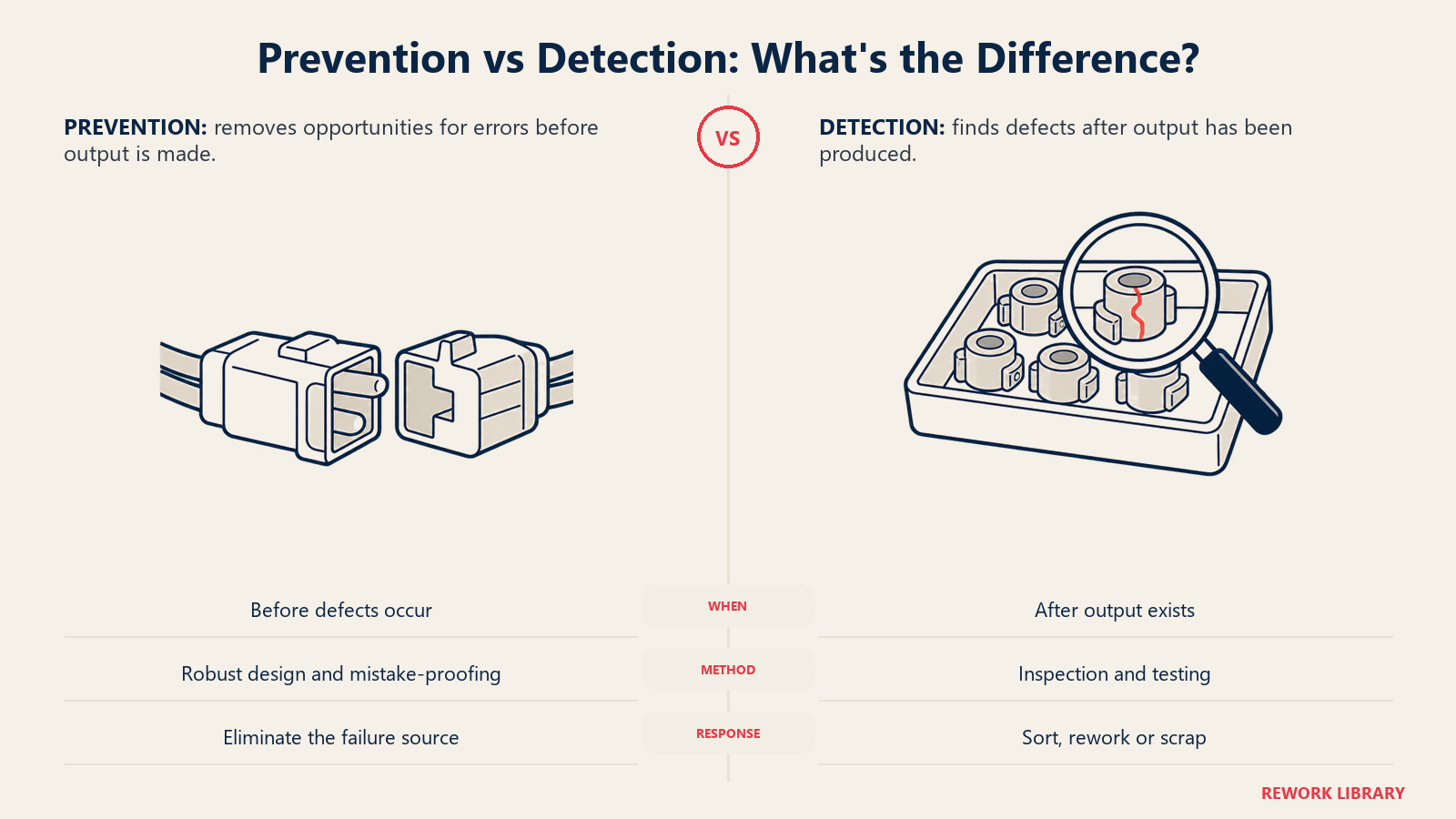
Detection happens downstream. You make parts, then check if they're good. Prevention happens upstream. You design products and processes so they naturally produce good parts.
This isn't just a philosophical difference. Detection requires armies of inspectors, generates scrap and rework, and always lets some defects slip through. Prevention builds quality into the source, reduces inspection needs, and fundamentally improves capability.
The Cost of Quality Framework
Philip Crosby's cost of quality model divides quality costs into four categories:
Prevention costs: Design reviews, process validation, training, preventive maintenance, money spent to prevent defects.
Appraisal costs: Inspection, testing, audits, money spent finding defects.
Internal failure costs: Scrap, rework, retesting, downtime, money lost to defects caught before shipment.
External failure costs: Warranty claims, returns, complaints, lost customers, money lost to defects that reach customers.
Most manufacturers spend 80% of quality costs on appraisal and failure. World-class operations flip this ratio, spending more on prevention than all other categories combined. And their total quality costs are lower because prevention is cheap compared to failure.
That aerospace manufacturer's analysis revealed they spent $200,000 on prevention, $800,000 on appraisal, and $1.5 million on internal failures. After shifting resources to prevention (better design validation, mistake-proofing, operator training), their total quality costs dropped to $900,000. They spent more on prevention, dramatically less on everything else.
The Cultural Shift Required
Moving from detection to prevention requires fundamental changes in how people think about quality:
From "find and fix" to "build it right the first time." From quality department responsibility to everyone's responsibility. From blame for defects to curiosity about why they were possible. From volume at any cost to stopping production when quality is at risk.
This cultural shift is harder than implementing technical solutions. It requires leadership commitment, clear communication about why prevention matters, and consistent reinforcement through actions, not just words.
Toyota's concept of Jidoka (building in quality at the process, with authority to stop production when problems occur) exemplifies this culture. Operators don't just make parts; they're responsible for quality and empowered to address problems immediately. That mindset prevents small issues from becoming big disasters.
Design for Quality: Prevention Starts Upstream
The most effective defect prevention happens before production even starts. Good design creates inherently robust products and processes that are difficult to execute incorrectly.
Design FMEA and Risk Assessment
Failure Mode and Effects Analysis (FMEA) during design systematically evaluates what could go wrong with a product, how likely failures are, how severe the consequences would be, and how well you'd detect problems before they cause harm.
For each potential failure mode, teams assess:
Severity: How bad would the impact be on the customer or downstream processes? Occurrence: How likely is this failure to happen? Detection: How likely are we to catch it before it causes problems?
Multiply these scores together to get a Risk Priority Number (RPN). High RPN items get design changes to reduce severity, occurrence, or improve detection, preferably all three.
A medical device company identified 63 potential failure modes during design FMEA for a new diagnostic instrument. The highest RPN went to a connector that could be installed backward, causing incorrect readings. They redesigned the connector with an asymmetric pattern that made incorrect installation physically impossible. Problem eliminated before the first unit was built.
Design for Manufacturability
Products that are easy to manufacture have fewer defects. Design for Manufacturability (DFM) principles include:
Minimize part count: Fewer parts mean fewer opportunities for defects and assembly errors.
Standardize components: Using common parts across products reduces complexity and improves supplier quality.
Design obvious assembly: Parts should only fit together one way. Make correct assembly easy and obvious; make incorrect assembly difficult or impossible.
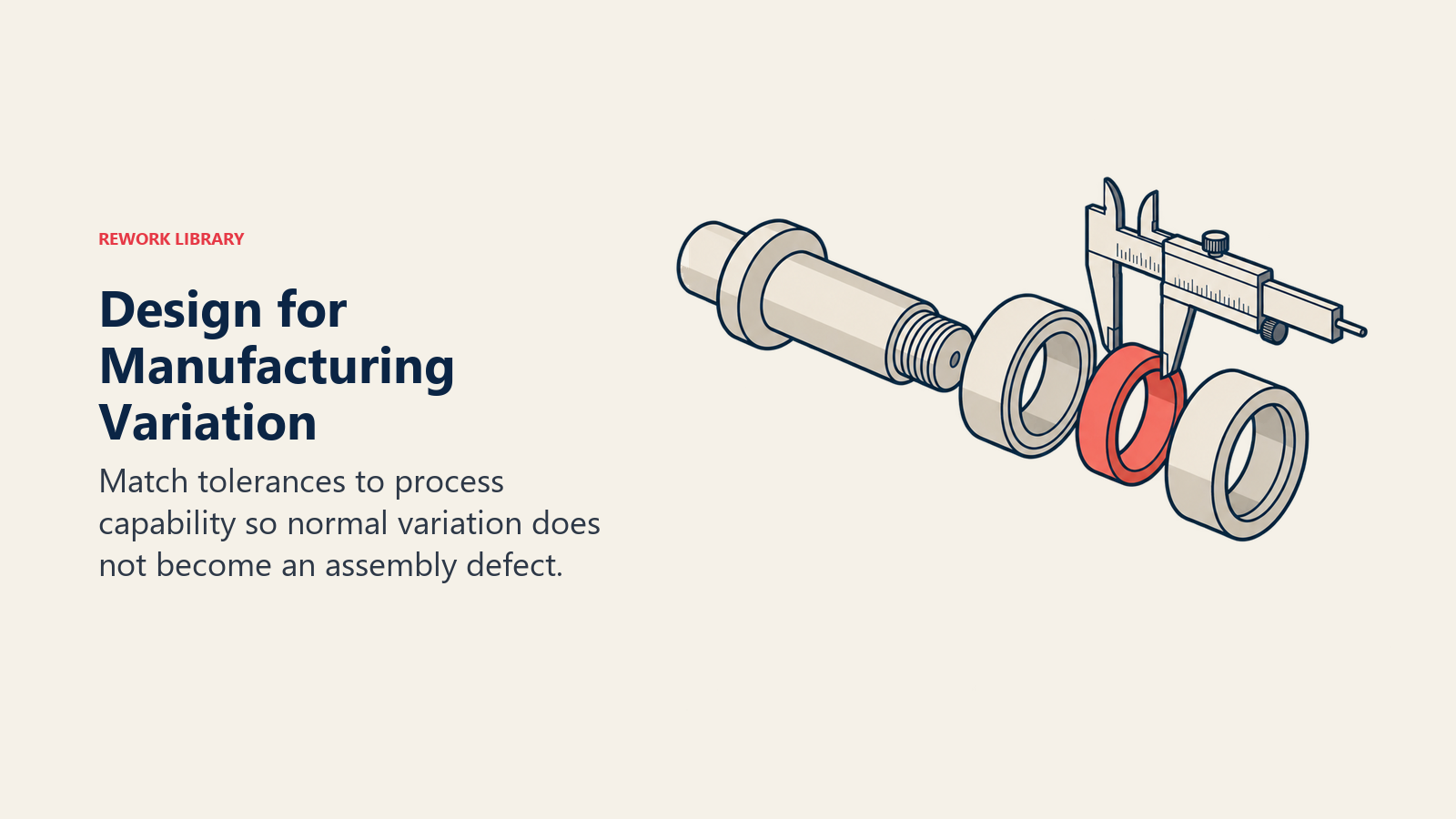
Use appropriate tolerances: Don't specify tighter tolerances than necessary. Every additional decimal place increases cost and defect risk.
Consider process capabilities: Design products to match what your processes can reliably achieve, not theoretical perfection.
An electronics manufacturer reduced assembly defects 40% by redesigning circuit boards to eliminate parts that looked similar but were different. Operators used to mix up components that differed only in small markings. New designs used different package sizes or orientations, making errors obvious immediately.
Robust Design and Tolerance Analysis
Taguchi methods and robust design approaches create products that perform well despite normal variation in manufacturing processes, materials, and operating conditions.
The idea is to identify which parameters most affect performance, then design products to be insensitive to variation in those parameters. You can't eliminate all variation, but you can design so variation doesn't cause defects.
Tolerance stack-up analysis ensures that when all component dimensions are at their extremes, assemblies still meet specifications. Finding tolerance problems in CAD prevents finding them in production.
A pump manufacturer had chronic leakage issues because tolerance stack-up meant that about 5% of assemblies had excessive shaft clearance. Tolerance analysis revealed the problem, and they adjusted specifications for three key components. Leakage rates dropped from 5% to 0.2%.
Prototype Testing and Validation
Don't launch into production with untested designs. Prototype testing identifies problems while changes are still cheap and easy.
Build prototypes using production processes, materials, and suppliers, not hand-built samples that don't reflect manufacturing reality. Test under real-world conditions, including extremes of temperature, humidity, vibration, and use.
Pay special attention to failure modes. What happens when products are misused, assembled incorrectly, or exposed to conditions outside normal specifications? Do they fail safely or catastrophically?
And involve manufacturing teams early. Design engineers may not see potential production issues that are obvious to people who'll actually make the product. Cross-functional reviews catch problems that siloed design teams miss.
Process-Level Prevention: Building In Quality Controls
Even great product designs need robust processes to produce consistent output. Process-level prevention ensures production executes as designed.
Process FMEA and Control Plans
Process FMEA applies the same failure analysis methodology to manufacturing processes. What could go wrong during each process step? What would cause those failures? How would you detect them?
The output is a control plan that specifies:
Critical parameters: What process variables must be controlled? Control methods: How will you monitor and control them? Measurement systems: What instruments and methods will you use? Reaction plans: What actions will you take when parameters drift out of control?
Control plans connect engineering specifications to shop floor execution. They tell operators and supervisors exactly what matters, how to measure it, and what to do when problems occur.
A precision machining operation used process FMEA to identify 14 critical process parameters across their manufacturing sequence. Their control plan specified measurement frequency, control limits, and specific actions for out-of-control conditions. Defect rates dropped 65% within three months.
Mistake-Proofing (Poka-Yoke) Devices
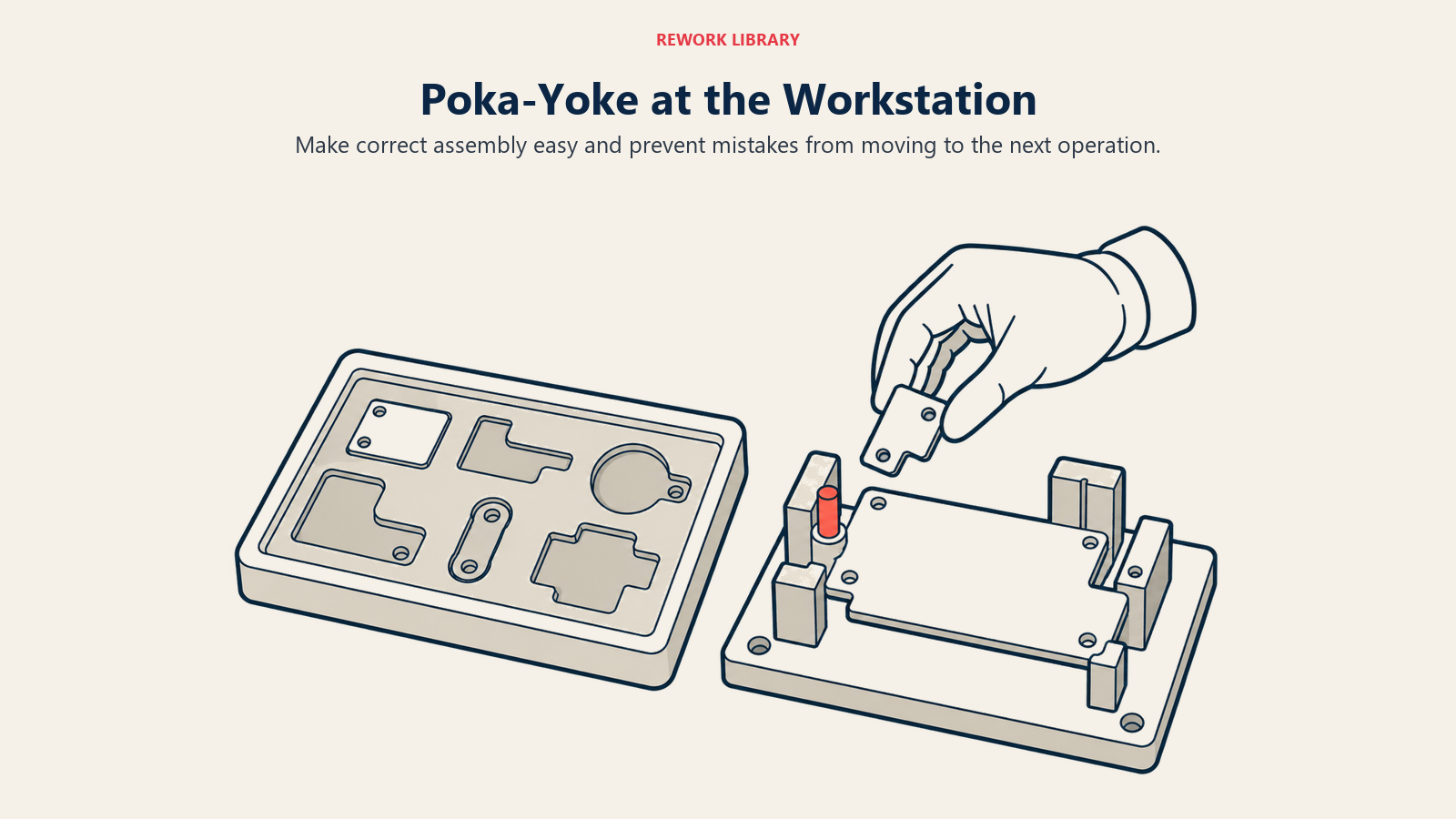
Poka-Yoke is the Japanese term for mistake-proofing: designing processes and equipment so errors are impossible or immediately obvious. According to ASQ, poka-yoke uses any automatic device or method that either makes it impossible for an error to occur or makes the error immediately obvious once it has occurred. The Lean Enterprise Institute notes that mistake proofing was formalized by Shigeo Shingo and aims to design the process so that mistakes can be detected and corrected immediately, eliminating defects at the source.
Shigeo Shingo, who developed these concepts at Toyota, distinguished between errors (inevitable human actions) and defects (bad products that reach customers). Poka-Yoke prevents errors from becoming defects.
There are four types of mistake-proofing:
Elimination: Redesign to eliminate the error possibility entirely.
Replacement: Replace error-prone processes with more reliable methods (automation, simpler steps).
Facilitation: Make correct execution so easy that errors are unlikely.
Detection: Detect errors immediately so they don't proceed to subsequent steps.
Elimination and replacement are most powerful but may be more expensive. Facilitation and detection are often simpler to implement and still prevent defects from reaching customers.
Examples of Mistake-Proofing in Action
Automotive assembly: A parts tray with shaped cutouts that match component geometries. Parts only fit in the correct positions, making it obvious if the wrong part was supplied or if one is missing.
Electronics assembly: Fixtures with asymmetric features that prevent circuit boards from being loaded backward. Correct orientation is easy; incorrect orientation is impossible.
Packaging operations: Light curtains that detect if the wrong number of items is in a box. The conveyor won't advance until count is correct.
Welding operations: Sensors that verify all fixtures are properly clamped before the weld cycle can start. Missing or loose clamps trigger immediate alarms.
Pharmaceutical filling: Vision systems that check every vial for correct fill level, cap presence, and label alignment. Defects are ejected automatically before packaging.
The key is thinking through failure modes and building countermeasures directly into the process. Don't rely on operator vigilance. Human attention wanders. Use physical design, sensors, and automation to make errors difficult or impossible.
In-Process Verification vs End-of-Line Inspection
Build verification into the process, don't push it to final inspection. Every step should include checks that confirm the previous operation was successful before proceeding.
This approach offers several advantages:
Immediate feedback: Problems are detected right away, while they're easiest to fix.
Reduced scrap: You don't add value to defective work-in-process.
Faster learning: Operators see cause-and-effect relationships immediately.
Lower total inspection cost: Simple checks at each step cost less than comprehensive final inspection.
A furniture manufacturer moved from end-of-line inspection to in-process verification at five key points. They caught defects earlier, reduced rework by 70%, and actually reduced total inspection labor because simple checks at each step were faster than comprehensive final inspection.
First Piece Inspection and Setup Verification
One of the highest-risk moments is after a setup or changeover. Equipment adjustments, new tooling, or different materials mean the first pieces produced may not meet specifications.
First piece inspection is a formal process to verify that the setup produces good parts before releasing the lot for production. Don't skip this step to save time. You'll lose more time later if the setup was wrong.
Document what passed first piece inspection: measurements, inspector, time, any adjustments made. This documentation proves the setup was verified and provides data if problems occur later in the run.
For critical operations, some manufacturers require engineering approval of first pieces before production continues. This extra verification prevents costly mistakes on high-value or safety-critical products.
Standard Work and Visual Work Instructions
Variation in how work is performed creates variation in results. Standard work documents the current best method for each task: the sequence of steps, key parameters, and quality checks.
But standard work only prevents defects if people follow it consistently. That's where visual work instructions come in.
Visual instructions use photos, diagrams, and minimal text to show exactly how tasks should be performed. They're posted at workstations where operators can reference them without searching for documentation.
Good visual instructions show:
- What the correct setup or result looks like
- Common mistakes and how to avoid them
- Critical dimensions or parameters with clear tolerances
- Inspection points and acceptance criteria
A assembly operation that documented procedures in text-heavy manuals had 6% error rates. They converted to visual work instructions with photos of correct and incorrect assembly. Error rates dropped to 1.5% within a month, even with the same workforce.
Capability Development: People and Skills
Prevention isn't just about systems and equipment. It's about people who understand quality and have the skills to maintain it.
Quality Training and Certification
Invest in training that builds real capability, not just awareness:
New employee training: Everyone should understand quality expectations, how to read specifications, when to stop production, and how to report problems.
Role-specific training: Inspectors need measurement skills, operators need process understanding, supervisors need problem-solving capability.
Advanced methods: Train quality engineers in FMEA, SPC, DOE, and other analytical tools.
Certification programs: Create internal certification for critical skills. Don't assume people are qualified; verify through testing and observation.
An injection molding company created a three-tier operator certification program. Level 1 operators run existing setups under supervision. Level 2 operators perform setups and basic troubleshooting. Level 3 operators handle complex problems and train others. Certification requires written tests and practical demonstration. Defect rates correlated directly with certification levels, validating the program's value.
Cross-Training and Job Rotation
Cross-training creates flexibility and deeper understanding. Operators who understand multiple processes see connections and potential quality issues that specialists might miss.
Job rotation prevents the complacency that comes from doing the same task repeatedly. Fresh eyes often spot problems that have become invisible to long-time operators.
But manage this carefully. Don't rotate people so frequently that no one develops deep expertise. Find a balance between specialization and cross-training that builds both depth and breadth.
Visual Management for Error Reduction
Visual management makes abnormal conditions obvious immediately. Use color coding, labels, shadow boards, and floor markings to create an environment where errors stand out.
Shadow boards: Outlines of tools show where each belongs. Missing tools are immediately obvious.
Color coding: Different colors for different products, materials, or quality statuses prevent mix-ups.
Floor markings: Clearly defined areas for WIP, inspection holds, and approved materials prevent confusion.
Kanban signals: Visual indicators of when to produce more or stop production prevent overproduction and shortages.
When the normal state is obvious, abnormalities trigger immediate attention and correction before they propagate.
Empowering Operators to Stop the Line
Quality at the source requires giving operators authority to stop production when problems occur. This is psychologically difficult. Stopping a line is dramatic and visible. But continuing production with known problems is far more expensive.
Create clear criteria for when operators should stop: specifications out of range, equipment not functioning properly, materials suspect, unclear instructions, or any situation where they're not confident the output meets requirements.
Then protect people who stop production. Never punish operators for raising quality concerns. Instead, celebrate catches that prevent defects from propagating.
Toyota's andon cord is the classic example. Any worker can pull it to stop the production line. This creates urgency to solve problems immediately and reinforces that quality trumps schedule pressure.
Supplier Quality: Prevention Across the Supply Chain
Your prevention efforts can't stop at your receiving dock. Poor supplier quality undermines internal prevention, so extend quality-at-the-source thinking to suppliers.
Supplier Quality Agreements
Clear agreements define expectations:
Specifications: Exactly what you need, with tolerances and inspection criteria.
Quality systems: What certifications or management systems suppliers must maintain.
Defect response: How supplier will respond to quality issues, including containment and corrective action.
Continuous improvement: Expectations for ongoing quality improvement and cost reduction.
Put these in writing, not as legal documents but as shared understanding of what success looks like.
Incoming Inspection vs Supplier Certification
Incoming inspection catches supplier defects but doesn't prevent them. Supplier certification programs shift from inspection to verification, allowing direct use of certified supplier materials.
Certification requirements typically include:
- Quality management system (ISO 9001 or equivalent)
- Demonstrated process capability for your parts
- Track record of consistent quality (often 6-12 months of defect-free deliveries)
- Supplier's own mistake-proofing and prevention systems
- Willingness to share quality data and participate in improvement
Once certified, you reduce or eliminate incoming inspection, lowering costs and lead times for both parties. But maintain surveillance audits to verify continued compliance.
Early Supplier Involvement in Design
The earlier suppliers engage in product development, the better they can design quality into components and suggest manufacturability improvements.
Supplier engineers may have ideas about materials, processes, or design features that improve quality and reduce cost. They've worked with similar designs for other customers and know what works well and what causes problems.
Don't just throw specifications over the wall and expect perfection. Collaborate with suppliers during design to build prevention into purchased components just as you do for internal processes.
Continuous Improvement With Suppliers
Share quality data regularly. Discuss trends, even when suppliers meet specifications. Partner on improvement projects that benefit both organizations.
Some manufacturers include supplier quality metrics in scorecards that influence business allocation. Done well, this creates healthy competition and motivation for improvement. Done poorly, it creates gaming and damaged relationships. Focus on improvement, not punishment.
Measuring Prevention Effectiveness: Metrics and Monitoring
You can't improve what you don't measure. Track metrics that reveal whether prevention strategies are working.
First Pass Yield and Right-First-Time Rates
First pass yield (FPY) measures the percentage of units that pass all quality checks the first time through production, without rework or repair.
FPY is a leading indicator of prevention effectiveness. Improving FPY means you're building quality in, not just inspecting it in. Track FPY by product, process, and time period to identify where prevention efforts should focus.
Right-first-time metrics extend this concept across entire value streams, from order receipt through delivery. What percentage of orders execute perfectly without errors, delays, or customer issues?
Defect Rates by Stage
Track where defects originate: design, incoming materials, internal processes, or handling and shipping. This breakdown reveals where prevention efforts deliver the highest return.
If most defects trace to design issues, invest in better design FMEA and validation. If supplier quality is the problem, focus there. If internal processes are the culprit, emphasize process control and mistake-proofing.
Don't just count total defects. Understand their origins so you can prevent them at the source.
Cost of Poor Quality Trending
Calculate the total cost of poor quality: scrap, rework, warranty claims, inspection labor, and expediting costs. Track this over time as a percentage of sales or cost of goods sold.
As prevention improves, COPQ should decline. If it's not declining, prevention efforts aren't working or aren't being sustained.
Break down COPQ by category (prevention, appraisal, internal failure, external failure) to see if you're shifting spending toward prevention as intended.
Leading Indicators of Quality Issues
Don't wait for defects to know there's a problem. Monitor leading indicators that predict quality issues:
Process capability indices (Cp, Cpk): Are processes capable of meeting specifications with margin?
Measurement system capability: Is your inspection system reliable enough to detect the defects you're trying to prevent?
Preventive maintenance compliance: Are you maintaining equipment on schedule?
Training completion rates: Do people have the skills they need?
Corrective action closure rates: Are you actually fixing problems when you find them?
Leading indicators let you intervene before quality degrades, which is the ultimate form of prevention.
Building a Zero-Defect Culture
Technology and methods matter, but culture determines whether prevention becomes how you really operate or just another program that fades away.
Zero defects doesn't mean perfect. It means continuous pursuit of perfection through systematic prevention. It's a mindset that rejects defects as inevitable and constantly asks, "How could we make errors impossible?"
Build this culture through:
Leadership example: When leaders emphasize prevention over expedience, everyone notices.
Celebration of prevention: Recognize teams that eliminate defect sources, not just meet quotas.
Learning from failures: Treat defects as learning opportunities, not punishment triggers.
Investment in prevention: Allocate time and resources to design reviews, process validation, training, and mistake-proofing.
Metrics that reinforce prevention: Measure and review FPY, prevention costs, and defect elimination, not just defect counts.
The aerospace manufacturer that opened this article built prevention into their culture by celebrating every quarter where they achieved new FPY records. Teams that implemented effective mistake-proofing got recognition and bonus payouts. Engineers were evaluated partly on how well new products performed in early production, a direct incentive to get design right.
Three years into their prevention journey, new employees are surprised to learn that rework areas used to be a major part of the facility. That's when you know the culture has shifted. Prevention feels normal, detection feels like failure.
Learn More
- First Pass Yield Optimization: Reducing Defects at the Source
- Root Cause Analysis Methods: Getting to the Heart of Manufacturing Problems
- Manufacturing Quality Management Overview: Building Defect Prevention Systems
- Statistical Process Control: Monitoring and Preventing Variation
- Six Sigma in Manufacturing: Data-Driven Quality Improvement
- ISO 9001 Implementation: Building a Quality Management System

Co-Founder, Rework.com
On this page
- Understanding Prevention vs Detection: A Fundamental Shift
- The Cost of Quality Framework
- The Cultural Shift Required
- Design for Quality: Prevention Starts Upstream
- Design FMEA and Risk Assessment
- Design for Manufacturability
- Robust Design and Tolerance Analysis
- Prototype Testing and Validation
- Process-Level Prevention: Building In Quality Controls
- Process FMEA and Control Plans
- Mistake-Proofing (Poka-Yoke) Devices
- Examples of Mistake-Proofing in Action
- In-Process Verification vs End-of-Line Inspection
- First Piece Inspection and Setup Verification
- Standard Work and Visual Work Instructions
- Capability Development: People and Skills
- Quality Training and Certification
- Cross-Training and Job Rotation
- Visual Management for Error Reduction
- Empowering Operators to Stop the Line
- Supplier Quality: Prevention Across the Supply Chain
- Supplier Quality Agreements
- Incoming Inspection vs Supplier Certification
- Early Supplier Involvement in Design
- Continuous Improvement With Suppliers
- Measuring Prevention Effectiveness: Metrics and Monitoring
- First Pass Yield and Right-First-Time Rates
- Defect Rates by Stage
- Cost of Poor Quality Trending
- Leading Indicators of Quality Issues
- Building a Zero-Defect Culture
- Learn More