Meeting Customer Quality Requirements: Building Trust Through Consistent Excellence
Turn this article into takeaways for your work.


Each assistant summarizes the article only for you and suggests best practices for your work.
Your salesperson quotes a tight tolerance (0.001 inches) to win the business. Production discovers this during setup. Your equipment can hold 0.003 inches reliably but 0.001 requires special fixturing, slower speeds, and 100% inspection. Cost triples. Delivery delays by two weeks.
Or consider the opposite: your quality manager rejects parts for surface finish that "doesn't look right." The customer receives the shipment, inspects it, and calls asking why you held good parts. Their specification allows the finish you rejected.
Both scenarios stem from misalignment between customer quality requirements and your quality practices. One understands requirements. The other overinterprets them. Both damage profitability and relationships.
Meeting customer quality requirements isn't about having a quality system. It's about deeply understanding what customers actually need, building processes that deliver those requirements reliably, and demonstrating conformance in ways customers trust.
Understanding Quality Requirements
Customer quality requirements come in multiple forms that must all be understood clearly.
Specifications versus performance expectations represent the difference between what's documented and what customers really want. Specifications might say "surface roughness 125 microinches maximum." Performance expectations might be "looks professional, no visible machining marks." Both matter but they're different requirements.
Always understand both the measurable specifications and the functional performance expectations behind them.
Explicit requirements versus implicit expectations creates another gap. Explicit requirements are documented in drawings, specifications, contracts, or quality agreements. Implicit expectations are assumed, like packaging that protects products, cleanliness appropriate for the application, or consistency from lot to lot.
Clarify implicit expectations early. Don't discover through complaints that customers expected something you didn't know they wanted.
Regulatory and compliance requirements apply in regulated industries. Medical devices, aerospace, automotive, food products, and pharmaceuticals all have extensive regulatory requirements beyond customer-specific specs.
These aren't negotiable. Non-compliance can shut you down. Industry-specific quality standards like ISO 9001 provide frameworks for quality management systems. Ensure you understand all applicable regulations before accepting work in regulated industries.
Industry standards and certifications demonstrate capability and conformance. ISO 9001, AS9100, IATF 16949, ISO 13485, SQF, and others provide frameworks that customers often require or prefer. A strong manufacturing quality management system supports these certifications.
Certifications signal that your quality system meets recognized standards. For many customers, they're prerequisites for business.
Capturing Complete Requirements
Incomplete understanding of requirements leads to problems later. Invest in thorough requirements capture upfront.
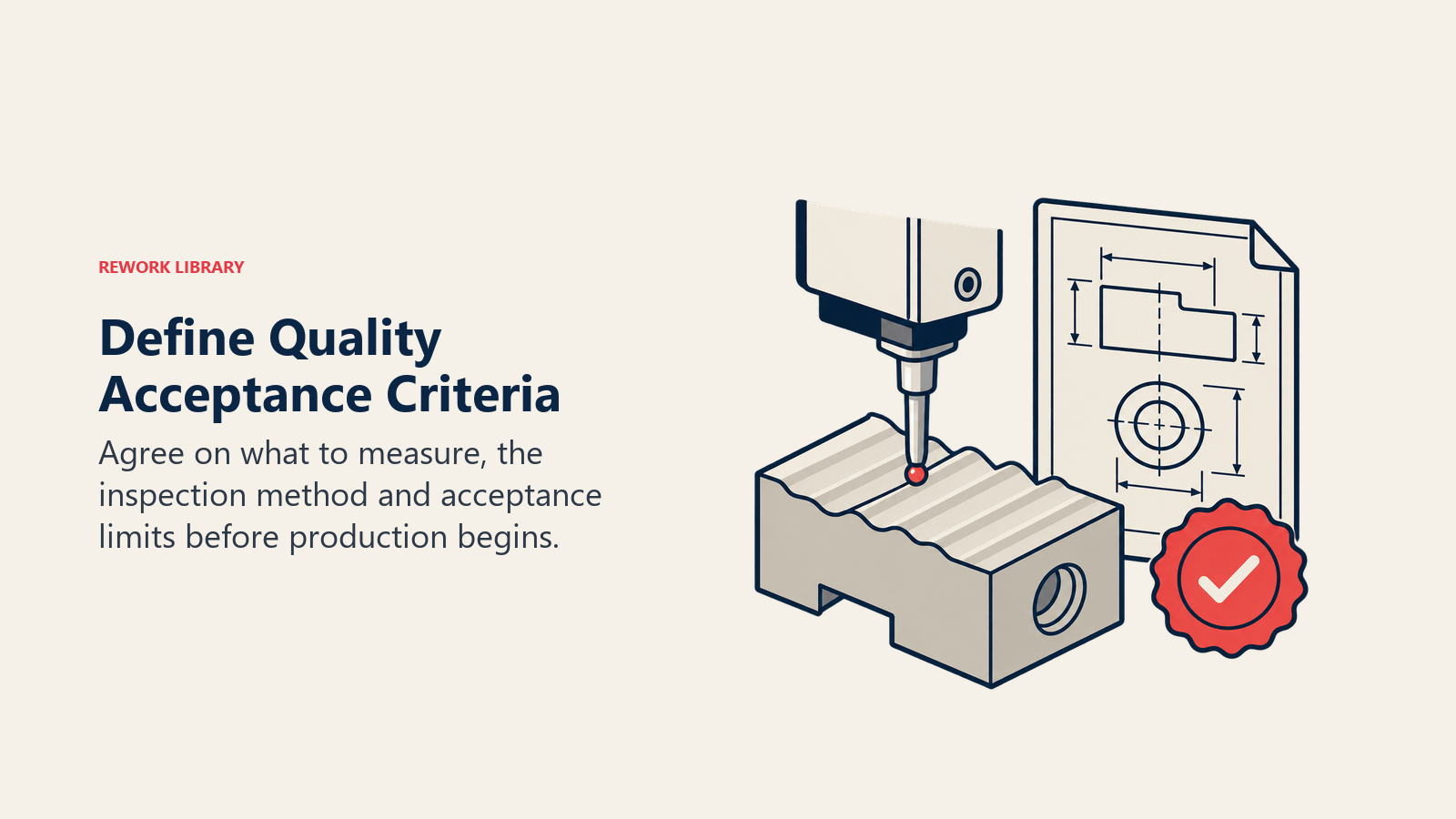
Contract review and clarification starts the process. When orders arrive, review product specifications and tolerances, material requirements and certifications, finish and appearance standards, quality inspection and testing requirements, documentation and traceability needs, and packaging and labeling specifications.
Flag ambiguities or impossibly tight requirements immediately for customer discussion.
Quality agreement development formalizes expectations for complex or critical products. Quality agreements typically cover quality specifications and acceptance criteria, inspection and testing methods, documentation and record retention, non-conformance notification procedures, change management processes, and audit rights and requirements.
Formal agreements prevent misunderstandings and provide clear reference when questions arise.
Acceptance criteria and inspection methods must be precise. "Good surface finish" isn't an acceptance criterion. It's subjective. "Surface roughness not to exceed 125 microinches Ra as measured by profilometer per ASME B46.1" is precise.
Define exactly how conformance will be evaluated, what equipment will be used, what samples sizes are required, and what constitutes acceptance versus rejection.
Documentation and traceability requirements vary by industry and customer. Some customers need full lot traceability from raw material through production. Others need certificates of conformance. Some require specific test reports or inspection data.
Understand documentation requirements before starting production so you capture needed information as you produce, not attempt to recreate it later.
Change management protocols govern how changes to products or processes are handled. Most customers require advance notification and approval before you change materials, processes, suppliers, or locations. Even changes that seem minor to you may impact product performance for customers.
Establish clear change notification and approval procedures.
Planning Quality into Production
Meeting quality requirements starts before production begins.
Advanced product quality planning (APQP) is the automotive industry framework that works well for complex manufacturing generally. APQP stages include planning and program definition, product design and development, process design and development, product and process validation, and production launch and feedback.
This structured approach ensures quality is designed in, not inspected in.
Production part approval process (PPAP) demonstrates that your production process can consistently meet specifications. PPAP submission typically includes design records, engineering change documentation, customer engineering approval, design FMEA, process flow diagram, process FMEA, control plan, measurement system analysis studies, dimensional results, material and performance test results, initial process studies, and qualified laboratory documentation.
PPAP approval from customers signals confidence in your process before full production.
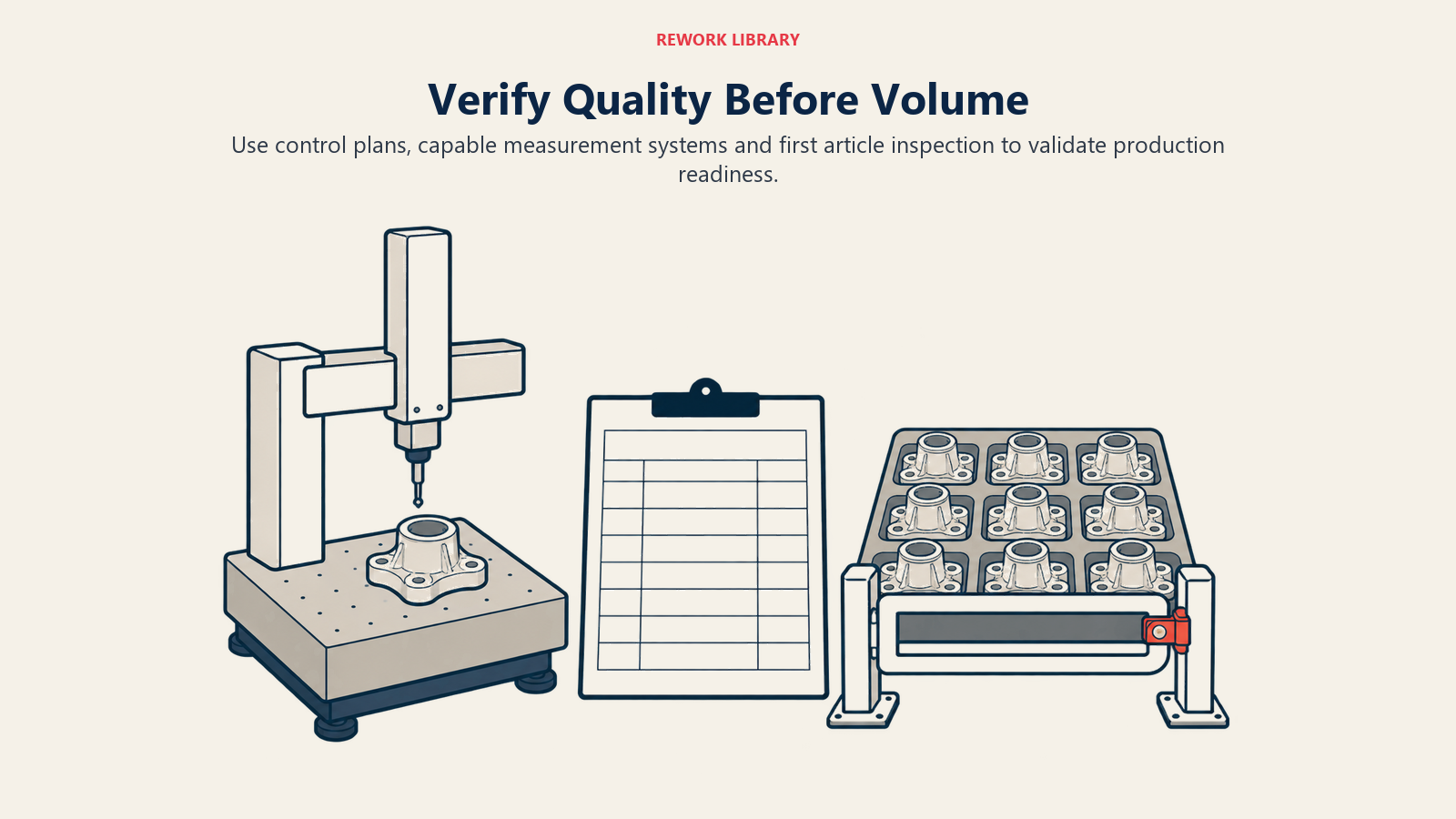
Control plans and inspection procedures document how you'll maintain quality during production. Control plans specify what characteristics to measure, where to measure them, how to measure them, how frequently to measure, acceptable ranges, and response to out-of-spec conditions.
Detailed control plans enable consistent quality execution.
Measurement system analysis ensures your gauges and methods are capable of accurately measuring what you need to control. MSA studies evaluate gauge repeatability and reproducibility, bias and linearity, and overall measurement capability.
If your measurement system can't reliably detect the variation you need to control, you can't effectively control quality.
First article inspection verifies that initial production meets all requirements before full production begins. First article inspection should include complete dimensional inspection, material verification and testing, functional performance testing, appearance and finish evaluation, and comparison against master samples if applicable.
Don't assume production will work. Verify it through first article before committing to volume production.
Maintaining Quality During Production
Planning quality is one thing. Maintaining it consistently is another.
In-process inspection and monitoring catches problems early. Implement inspection at critical control points, statistical sampling throughout production, first-piece and last-piece inspection for runs, and continuous monitoring of key process parameters.
Finding problems during production costs less than finding them at final inspection or after shipment.
Statistical process control uses data to understand and control variation. SPC charts track key characteristics over time, identify when processes drift from target, distinguish common cause from special cause variation, and trigger intervention before defects occur.
SPC prevents problems rather than just detecting them.
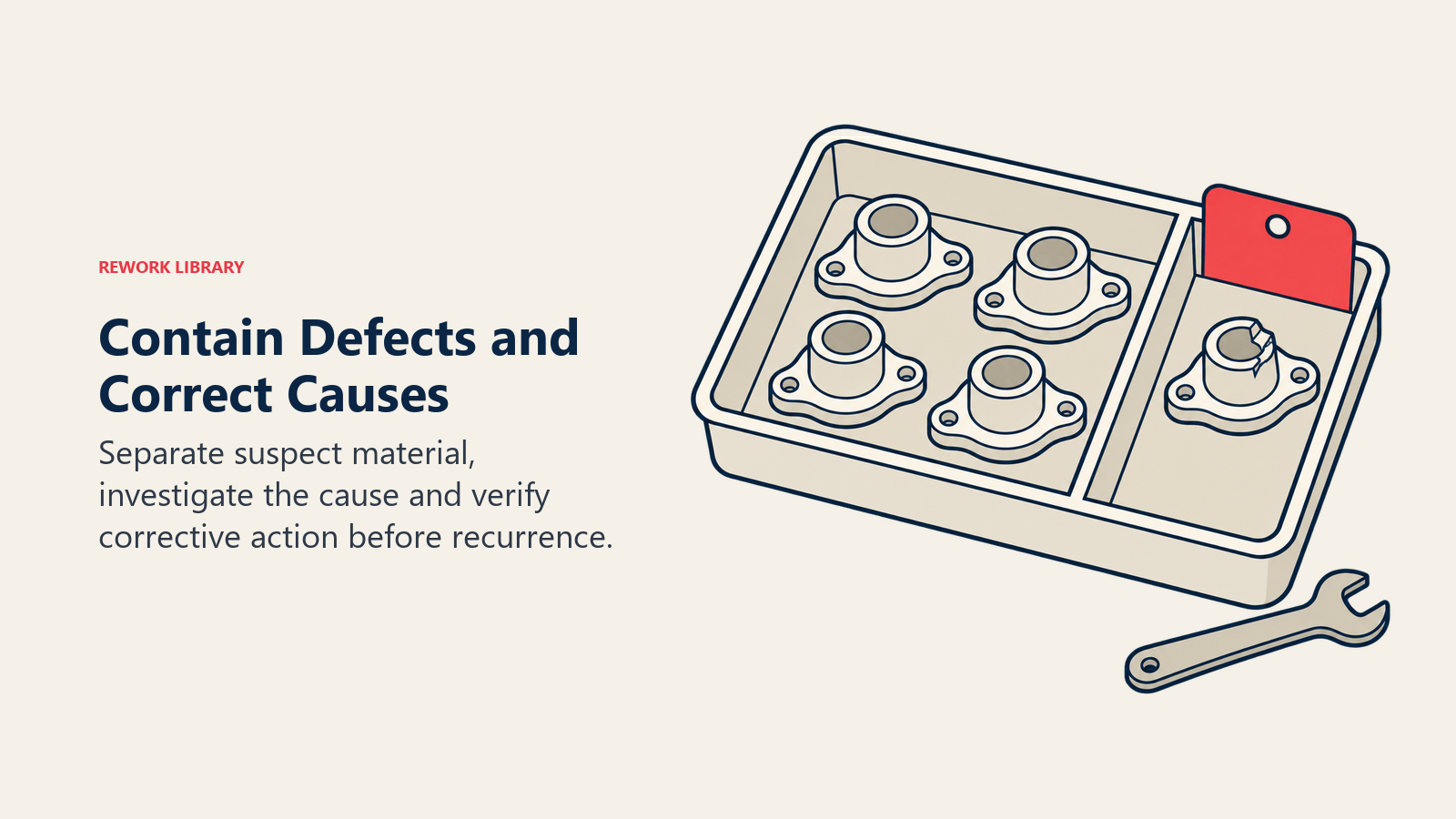
Non-conformance handling procedures address defective products systematically. When non-conformances occur, segregate suspect material immediately, evaluate root cause, determine disposition (rework, scrap, use-as-is), implement corrective action, and document the incident and resolution.
Non-conformances provide learning opportunities to prevent recurrence.
Corrective action systems ensure problems don't repeat. Effective CAPA systems identify root causes not just symptoms, implement corrective actions that address root causes, verify effectiveness of corrections, and prevent similar problems in other areas.
Fixing symptoms provides temporary relief. Eliminating root causes provides lasting improvement.
Continuous monitoring and verification ensures processes remain capable. Regular process audits, periodic capability studies, control chart review and analysis, and calibration and maintenance of measurement equipment all maintain process integrity.
Quality isn't a one-time achievement. It requires continuous attention and verification.
Extending Quality Upstream
Your quality depends partly on supplied material quality.
Supplier qualification and approval ensures capable suppliers. Evaluate supplier quality systems, conduct capability assessments, review quality history and performance, and perform supplier audits before approval.
Qualified suppliers reduce your incoming quality risk.
Incoming material inspection verifies received materials meet specifications. Inspection strategy depends on supplier reliability and material criticality. Options include 100% inspection for critical or new suppliers, sampling inspection for qualified suppliers, and skip-lot inspection for consistently excellent suppliers.
Balance inspection cost against risk of using defective materials.
Supplier performance tracking monitors quality trends. Track defect rates, lot acceptance rates, corrective actions required, and delivery performance.
Performance data guides supplier development efforts and allocation of business.
Supplier development and improvement helps suppliers meet your quality needs. Provide feedback on performance, share best practices and expertise, conduct improvement workshops, and collaborate on problem-solving.
Developing supplier capability is often more effective than replacing suppliers.
Building Customer Confidence
Meeting requirements is necessary but not sufficient. Customers need confidence that you meet them consistently.
Quality reporting and metrics sharing provides transparency. Share OTD performance, first-pass yield, defect rates by type, corrective action status, and process capability studies.
Transparency builds trust. Customers confident in your quality reduce incoming inspection, extend approvals, and increase business.
Non-conformance notification and response demonstrates integrity. When problems occur, notify customers immediately, explain what happened and root cause, describe containment actions taken, detail corrective actions to prevent recurrence, and provide verification of effectiveness.
Customers trust suppliers who surface and fix problems more than suppliers who hide them.
Corrective action documentation proves you learn from problems. Maintain thorough records of non-conformances, root cause investigations, corrective actions implemented, and verification of effectiveness.
Documentation demonstrates systematic problem-solving capability.
Quality audits and assessments allow customers to verify your systems. Prepare thoroughly for audits, address findings promptly and thoroughly, use audits as opportunities to improve, and maintain evidence of continuous improvement.
Strong audit performance reinforces customer confidence.
Continuous improvement initiatives show commitment to excellence. Share productivity improvements, quality enhancements, cycle time reductions, and cost savings achieved.
Customers value suppliers who continuously improve because it benefits their business.
Exceeding Expectations for Advantage
Meeting requirements maintains relationships. Exceeding them creates competitive advantage.
This means delivering quality better than required, solving problems customers didn't know they had, suggesting improvements that reduce their costs or improve their products, and demonstrating commitment to their success.
The suppliers who become strategic partners don't just meet specs. They contribute expertise, suggest improvements, and make customers' lives easier. That relationship transcends price competition and creates lasting value.
Your customer quality performance directly determines your reputation, your relationships, and your growth opportunities. Make quality excellence your competitive signature.
Learn More
