Safety Stock Calculation: Mathematical Approach to Demand Uncertainty

Turn this article into takeaways for your work.


Each assistant summarizes the article only for you and suggests best practices for your work.
A production line stands idle. The problem isn't equipment failure or quality issues but a missing component. Your supplier usually delivers in three weeks, so you ordered when inventory dropped to three weeks of coverage. But this time, the shipment arrived late. Or demand exceeded your forecast. Or both. Now production stops while rush orders and overnight shipping add costs far exceeding the inventory carrying costs you saved by running lean.
This scenario explains why safety stock exists. It buffers against variability in demand and supply. But how much buffer do you need? Too little and stockouts occur frequently. Too much and excess inventory wastes working capital while potentially becoming obsolete. Intuition and rules of thumb ("keep four weeks on hand") either provide excessive protection where variability is low or insufficient protection where it's high.
Statistical safety stock calculation replaces guesswork with mathematics. By quantifying demand variability, lead time uncertainty, and desired service levels, you can calculate safety stock requirements that balance protection against cost. This scientific approach rightsizes inventory buffers, holding more where uncertainty is high and less where demand is predictable, optimizing working capital while maintaining service levels.
Safety Stock Fundamentals
Safety stock is buffer inventory protecting against uncertainty in demand and supply. It sits above average inventory to prevent stockouts when actual conditions differ from expectations.
Without safety stock, you'd order based purely on average demand and lead time. If you use 100 units weekly and lead time is 3 weeks, you'd reorder when inventory drops to 300 units. But demand varies week-to-week. Some weeks you use 80 units, others 120. Lead time also varies (sometimes 2 weeks, sometimes 4) based on supplier reliability. These variations cause stockouts when actual demand or lead time exceed averages.
Safety stock absorbs this variability. If you add 50 units of safety stock to the 300-unit reorder point, you can handle weeks with 120-unit demand or 4-week lead times without stocking out. The question is determining the right amount: enough protection without excessive inventory.
The cost of stockouts versus the cost of holding safety stock creates the trade-off safety stock calculations optimize. Stockout costs include lost production, expedited shipping, and customer dissatisfaction. Holding costs include capital tied up, storage space, insurance, and obsolescence risk. The optimal safety stock minimizes total costs, accounting for both stockout and holding costs.
Service level definitions measure stockout protection. Cycle service level represents the probability of not stocking out during a replenishment cycle. A 95% cycle service level means you avoid stockouts in 95 of 100 replenishment cycles. Fill rate measures the percentage of demand satisfied from stock. A 98% fill rate means you fill 98% of demand from inventory, with 2% backordered or lost. These metrics translate business requirements into quantitative targets for safety stock calculation.
Basic Safety Stock Formula
The fundamental statistical safety stock formula multiplies demand variability by a service factor and lead time:
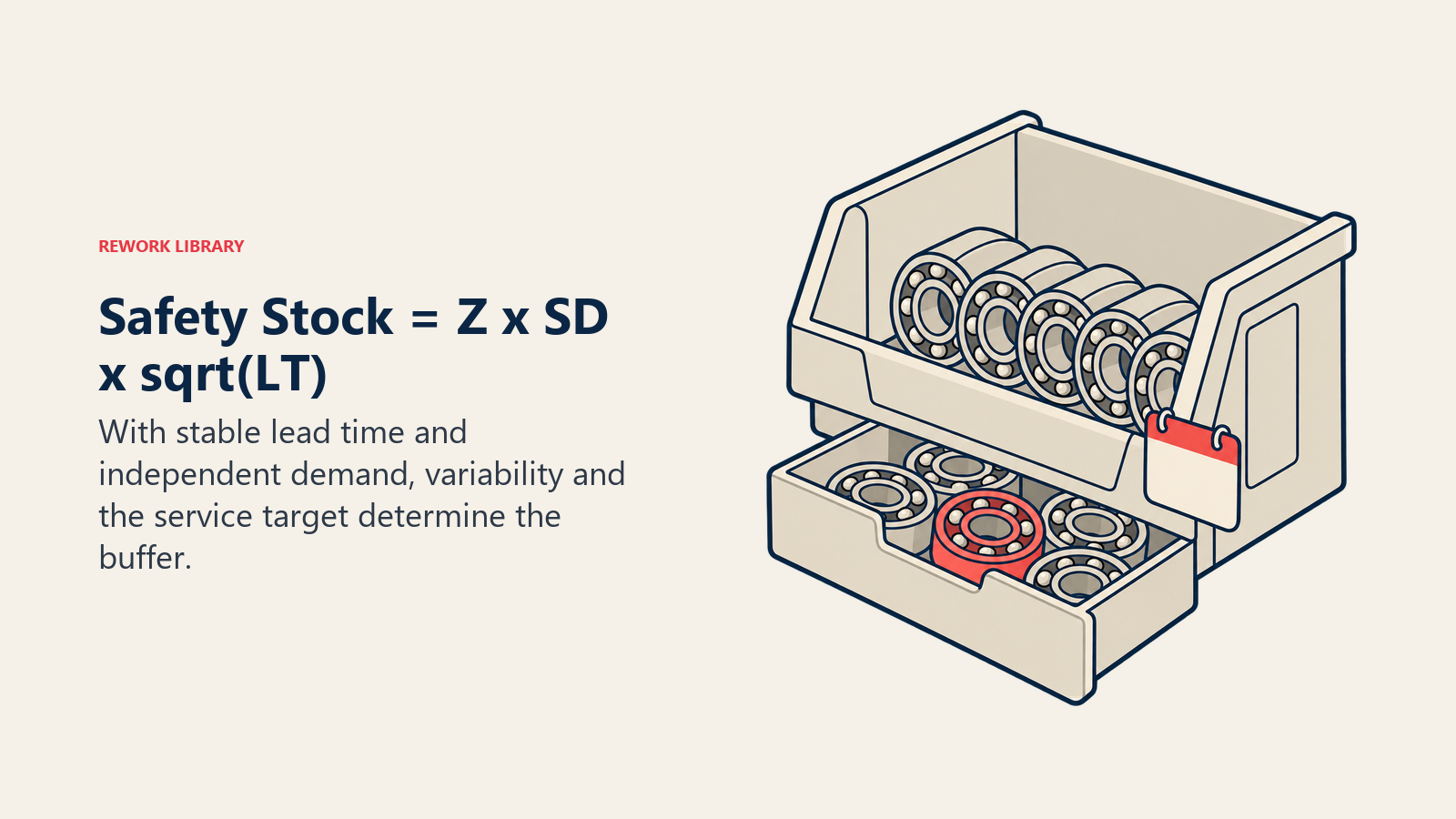
Safety Stock = Z × σ × √LT
Where Z is the service factor (Z-score) corresponding to desired cycle service level, σ (sigma) is standard deviation of demand per period, and LT is lead time in periods.
The Z-score links service level targets to standard deviations. For 95% cycle service level, Z ≈ 1.65. For 99%, Z ≈ 2.33. These come from the standard normal distribution, with higher service levels requiring more standard deviations of protection. A statistics table or calculator converts service level percentages to Z-scores.
Consider a component with 20 units per week demand standard deviation and 4-week lead time. For 95% service level (Z = 1.65), calculate safety stock: 1.65 × 20 × √4 = 1.65 × 20 × 2 = 66 units. This provides 95% confidence you won't stock out during the 4-week replenishment cycle.
The square root of lead time reflects how variability accumulates over time. Longer lead times increase variability because more periods contribute uncertainty, but variability grows with the square root of time rather than linearly. A 4-week lead time requires twice the safety stock of a 1-week lead time (√4 = 2), not four times as much.
This formula assumes demand follows a normal distribution, demand in different periods is independent, and lead time is constant. Real-world demand rarely meets these assumptions perfectly, but the formula provides a reasonable approximation for most situations. More sophisticated methods exist for situations where assumptions don't hold.
Demand Variability Analysis
Accurate safety stock calculation requires understanding demand variability. Standard deviation quantifies this variability, measuring how much actual demand fluctuates around the average.
Calculate standard deviation from historical demand data. Gather demand history for the item (typically 12-24 months of weekly or monthly data). Use spreadsheet functions (STDEV.S in Excel) or statistical software to compute standard deviation. More data improves accuracy, but very old data might not reflect current patterns.
Forecasting error provides an alternative measure of variability. Instead of raw demand standard deviation, use the standard deviation of forecast errors. This accounts for trends and seasonality your forecasts capture, focusing safety stock on the remaining unpredictable variation. Mean absolute deviation (MAD) of forecast errors is another common measure, with MAD × 1.25 approximating standard deviation.
Seasonal and trend considerations complicate demand variability. Items with strong seasonality show high variability across the full year but lower variability within seasons. Calculate seasonal demand standard deviations rather than annual ones. Trending demand requires detrending data before calculating variability, or using forecasting error approaches that account for trends.
Demand patterns affect which variability measure is most appropriate. For items with stable demand and minor fluctuations, standard deviation of historical demand works fine. For items with trends or seasonality, forecasting error standard deviation better captures relevant uncertainty. For very erratic or intermittent demand, specialized methods might be needed beyond basic formulas.
Data quality impacts calculation accuracy. Outliers from one-time orders or data errors distort standard deviation calculations. Clean historical data before analysis, removing or adjusting clear anomalies. But don't overclean. Legitimate demand spikes should remain in data since they represent real variability requiring protection.
Lead Time Variability
The basic formula assumes constant lead time, but supplier delivery times often vary. This supply uncertainty requires additional safety stock beyond demand variability alone.

Lead time variability comes from supplier production schedules, transportation delays, quality issues requiring rework, and other supply chain disruptions. Even reliable suppliers show some variation. A supplier averaging 4 weeks might deliver in 3 to 5 weeks. Less reliable suppliers might vary from 3 to 8 weeks.
Measure lead time standard deviation from historical data similarly to demand variability. Track actual lead times for past orders, calculate standard deviation. This quantifies supplier reliability, or lack thereof. A supplier with 4-week average lead time and 0.5-week standard deviation is far more reliable than one with 4-week average and 2-week standard deviation.
When both demand and lead time vary, the combined formula becomes more complex:
Safety Stock = Z × √(LT × σ_d² + d² × σ_LT²)
Where LT is average lead time, σ_d is demand standard deviation, d is average demand per period, and σ_LT is lead time standard deviation. This accounts for both sources of uncertainty and their interaction.
Supplier reliability improvement through strategic relationship management reduces required safety stock significantly. Working with suppliers to improve delivery consistency (through better scheduling, capacity buffers, or communication) enables inventory reduction without sacrificing service levels. A supplier reducing lead time standard deviation from 2 weeks to 1 week cuts required safety stock substantially, potentially saving more than you'd achieve through price negotiations.
Risk-based adjustments to lead time assumptions help when historical data doesn't capture potential disruptions. If geopolitical risks, port congestion, or supplier financial issues could extend lead times beyond historical ranges through supply chain risk factors, add buffer to lead time assumptions. This qualitative risk assessment complements quantitative calculations.
Service Level Targeting
Not all items deserve identical service levels. Differentiated service level targets optimize total inventory investment while protecting what matters most.
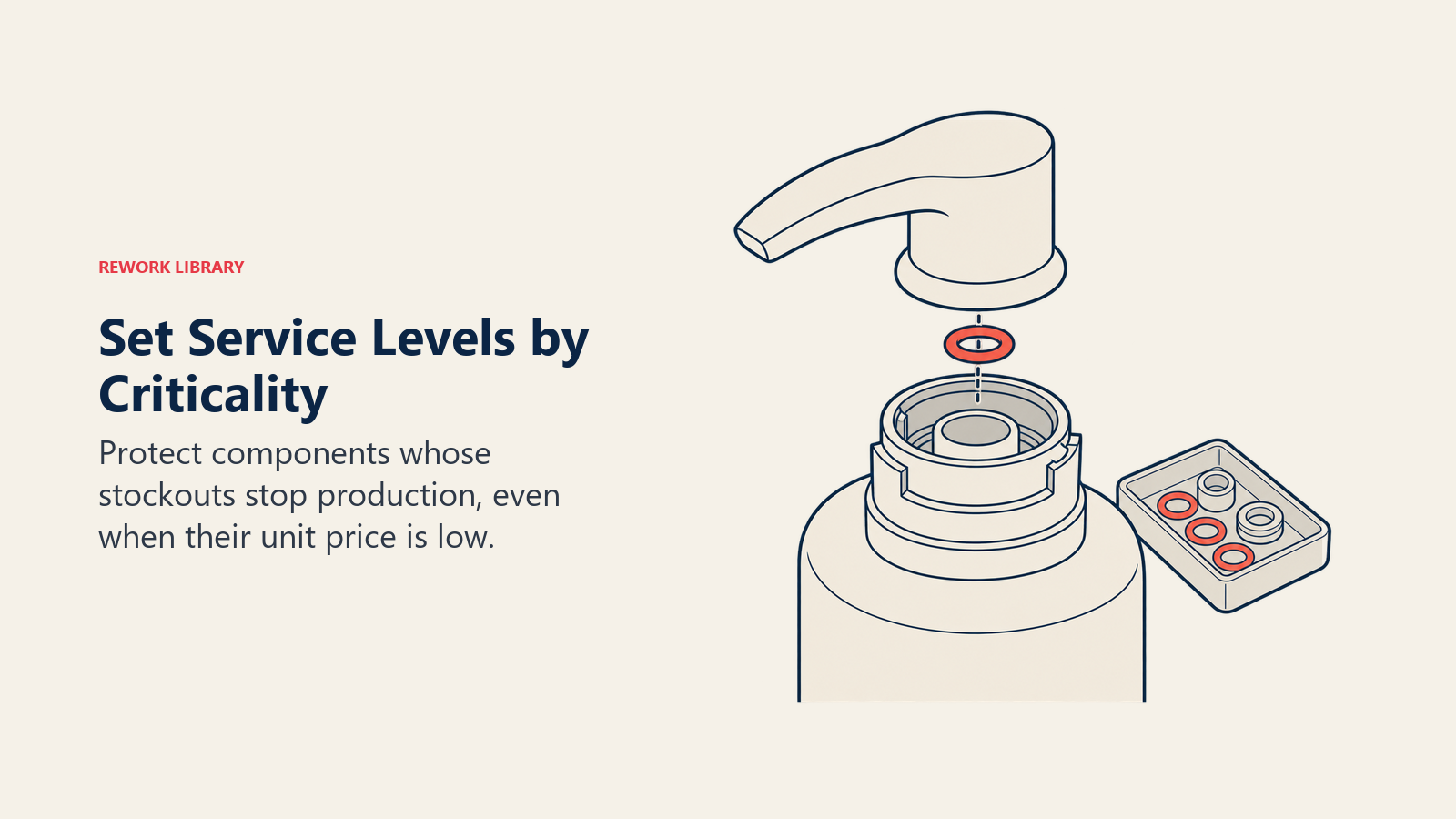
Service level decisions balance stockout consequences against holding costs. Items where stockouts cause production shutdowns, lost sales, or customer dissatisfaction justify high service levels and corresponding safety stock. Items with minimal stockout consequences can accept lower service levels and carry less inventory.
Criticality-based service levels assign targets reflecting business impact. Critical items enabling production warrant 99% or higher service levels. You can't afford stockouts stopping assembly lines or missing customer commitments. Important but non-critical items might target 95%. Low-criticality items could accept 90% or even 85%. These differentiated targets focus inventory investment where protection matters most.
ABC classification provides a framework for service level differentiation. A-items representing high value often receive high service levels. You can afford more inventory for expensive items because the service improvement justifies the cost. But consider both value and criticality. A cheap O-ring stopping production is more critical than an expensive optional component.
The cost-benefit analysis of service levels reveals diminishing returns. Moving from 90% to 95% service level requires meaningful safety stock increase but provides substantial service improvement. Moving from 95% to 99% requires even more inventory for smaller service gains. The highest service levels become exponentially expensive. Target them only where truly necessary.
Fill rate targets offer an alternative to cycle service levels. Instead of targeting the probability of no stockout, fill rate targets specify the percentage of demand satisfied from stock. A 98% fill rate allows 2% of demand to stock out, typically favoring frequent small stockouts over occasional large ones. Some businesses find fill rates more intuitive than cycle service levels.
Advanced Calculation Methods
Basic formulas work well for many situations, but complex scenarios require more sophisticated approaches.
Dynamic safety stock calculations adjust to changing conditions rather than using fixed levels. When demand increases, safety stock rises proportionally to maintain service levels. When lead times extend temporarily, safety stock increases for affected items. When conditions normalize, safety stock returns to standard levels. This responsiveness maintains service levels efficiently.
Multi-echelon inventory optimization considers inventory across multiple locations simultaneously. In complex supply chains with distribution centers, warehouses, and stores, optimal safety stock placement isn't obvious. Multi-echelon optimization determines where to hold inventory (centralizing safety stock in distribution centers or dispersing it across warehouses) to minimize total inventory while meeting service targets.
Simulation-based methods handle complex scenarios where analytical formulas struggle. Monte Carlo simulation generates thousands of scenarios with different demand and lead time combinations, determining safety stock levels that achieve target service levels across scenarios. Simulation accommodates any demand distribution, complex lead time patterns, and business rules that analytical formulas can't capture.
Intermittent demand items with sporadic orders don't fit normal distribution assumptions. Specialized methods like Croston's method or bootstrapping approaches handle these patterns better than standard formulas. Safety stock for intermittent items often bases on maximum historical demand or percentile approaches rather than standard deviation methods.
Economic considerations optimize safety stock by balancing holding costs against stockout costs explicitly. Rather than targeting arbitrary service levels, economic optimization determines the safety stock level minimizing total costs. This requires estimating stockout costs, which is challenging but produces theoretically optimal results when achievable.
Practical Implementation
Calculate safety stock for all items, but implement changes carefully to avoid disruptions and build confidence.
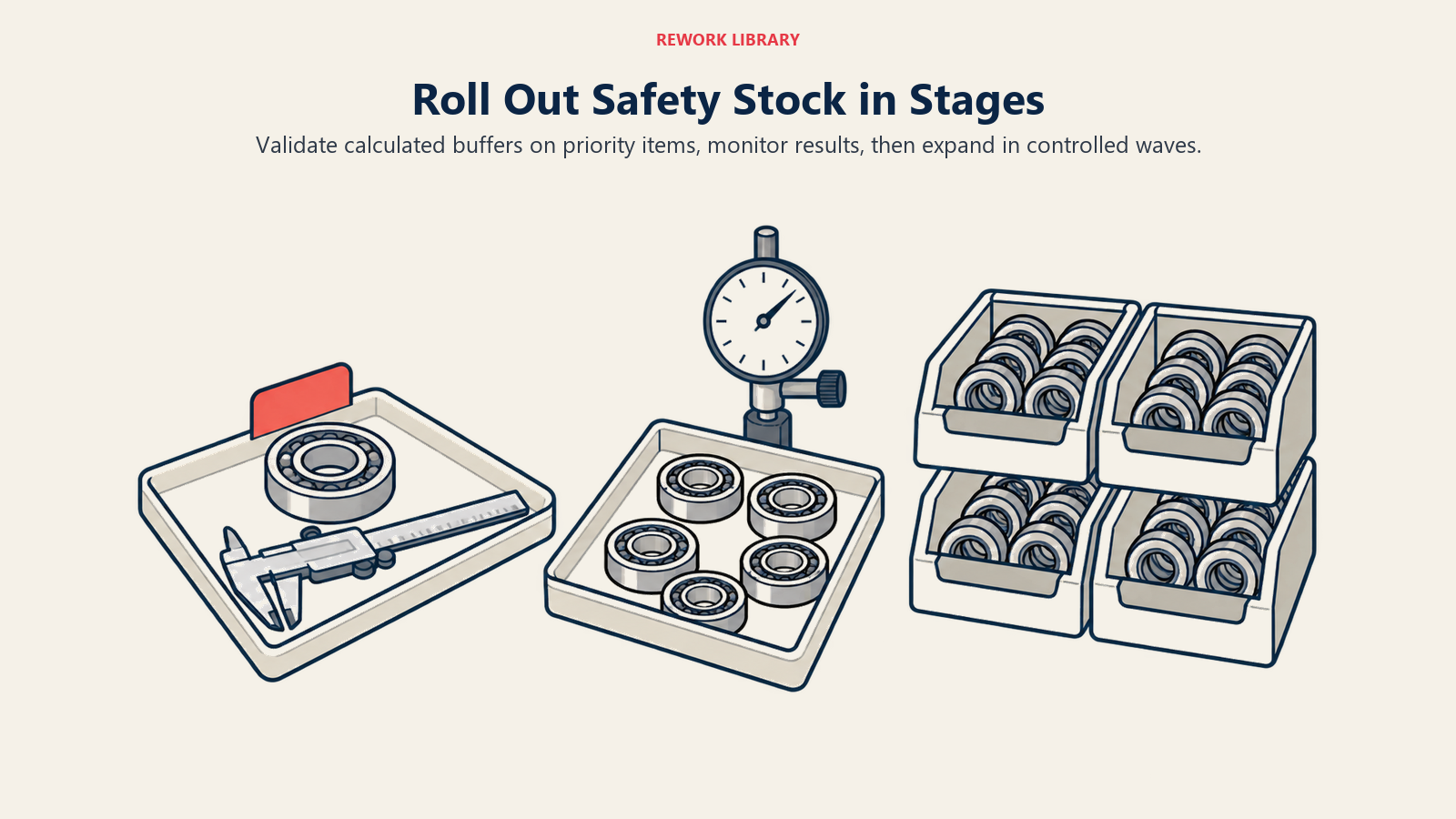
Start with high-impact items rather than attempting comprehensive implementation immediately. Calculate safety stock for A-items and critical components first. These represent the biggest opportunities for inventory optimization and justify more intensive management. Success here demonstrates value while building expertise for broader rollout.
Validate calculations against actual performance before implementing significant changes. For a sample of items, compare calculated safety stock to historical stockout rates and inventory levels. If calculations suggest reducing safety stock 40% for an item that rarely stocks out, the math probably works. If calculations suggest reducing safety stock for items with frequent stockouts, revisit assumptions and data quality.
Phase implementation gradually rather than changing all reorder points simultaneously. Reduce safety stock for some items while increasing it for others where calculations show undercoverage. Monitor results before the next wave of changes. This controlled approach catches calculation errors or data issues before they cause widespread problems.
Update calculations periodically as conditions change. Demand patterns shift, supplier reliability changes, and service level priorities evolve. Annual safety stock reviews ensure calculations reflect current reality rather than outdated assumptions. More frequent updates for critical items or rapidly changing conditions.
Exception management handles items where calculations produce questionable results. If math suggests zero safety stock for a critical component, override with minimum buffer. If calculated safety stock exceeds total demand, investigate data quality issues. Apply human judgment to recognize when formulas produce nonsensical outputs.
Document methodology and assumptions so others understand calculation basis. When someone questions why safety stock for an item is X units, you can explain the service level target, demand variability, and lead time assumptions. This transparency builds confidence and enables intelligent discussions about whether assumptions remain appropriate.
Technology and Tools
While safety stock can be calculated manually in spreadsheets, technology enables scale and sophistication that manual approaches can't match.
Spreadsheet templates work well for small-scale implementations or proof-of-concept. Build templates incorporating the safety stock formulas with cells for inputs like demand standard deviation, lead time, and service level targets. Templates demonstrate concepts and enable what-if analysis before investing in software.
Inventory optimization software automates safety stock calculation across thousands of items. These systems pull data from ERP systems, calculate optimal safety stock levels using sophisticated algorithms, and recommend reorder point changes. They handle the computational complexity and data management that make manual calculation impractical at scale.
ERP system integration ensures safety stock calculations inform actual inventory management operations. Calculated safety stock values must update reorder points in your ERP system to affect ordering decisions. Integration eliminates manual data entry and ensures planners use optimized values.
Demand forecasting system linkage connects safety stock to expected demand patterns. Instead of using historical standard deviation, use forecast error standard deviation that accounts for trends and seasonality your forecasting captures. This integration improves safety stock accuracy.
Analytics and monitoring capabilities track safety stock effectiveness over time. Monitor stockout frequency and inventory levels by item, comparing actual performance to targets. Identify items where safety stock proves insufficient or excessive. This feedback loop enables continuous refinement.
What-if analysis tools evaluate safety stock implications of changes before implementing them. What if we improve supplier lead times by 1 week? What if we raise service levels from 95% to 98%? What if demand variability increases 20%? Simulation reveals inventory impacts of potential changes, informing strategic decisions.
Continuous Improvement
Safety stock calculation isn't a one-time exercise but an ongoing process of measurement, analysis, and refinement.
Performance monitoring tracks whether safety stock levels achieve target service levels at expected inventory costs. If stockouts exceed targets, safety stock may be insufficient or calculation assumptions may be wrong. If stockouts are far below targets with very high inventory, you might be overprotecting.
Root cause analysis for stockouts determines whether issues stem from insufficient safety stock or other factors. Was the stockout caused by demand variability exceeding assumptions? Supplier delivery problems beyond historical patterns? Forecast errors not captured in calculations? Data errors in inventory records? Different root causes require different solutions.
Data quality improvement pays dividends for safety stock accuracy. Better demand forecasts reduce the variability requiring safety stock. Improved inventory record accuracy prevents phantom stockouts from inaccurate data. Cleaner historical data improves standard deviation calculations. Small data quality improvements compound through better safety stock decisions.
Supplier development through quality management programs reduces supply variability, enabling lower safety stock. Work with suppliers to improve delivery reliability and reduce lead time variation. Even small improvements in supplier consistency through strategic sourcing initiatives allow meaningful safety stock reductions while maintaining service levels.
Process refinement adjusts calculation approaches based on experience. If standard formulas consistently under or overprotect for certain item types, develop segment-specific approaches. Build organizational knowledge about what works for your business rather than rigidly following textbook methods.
The ultimate goal is balancing inventory investment with service levels through scientific methods that outperform intuition. Perfect safety stock calculation is impossible. Uncertainty exists by definition. But systematic, data-driven approaches consistently outperform guesswork, freeing working capital while improving service performance.
Learn More
