Manufacturing KPIs: Essential Metrics for Production Performance Management
Turn this article into takeaways for your work.


Each assistant summarizes the article only for you and suggests best practices for your work.
Data-driven manufacturers outperform their competitors by 20-30% in productivity and profitability. The difference isn't access to data. Every manufacturer generates operations data. The difference lies in which metrics they track, how they analyze them, and what actions they trigger. The right KPIs transform raw data into competitive advantage that drives manufacturing growth and operational excellence.
But most manufacturers track too many metrics or the wrong ones. They drown in data while missing critical signals. Effective performance management requires selecting the metrics that matter, measuring them consistently, and acting on insights they reveal.
Categories of Manufacturing KPIs
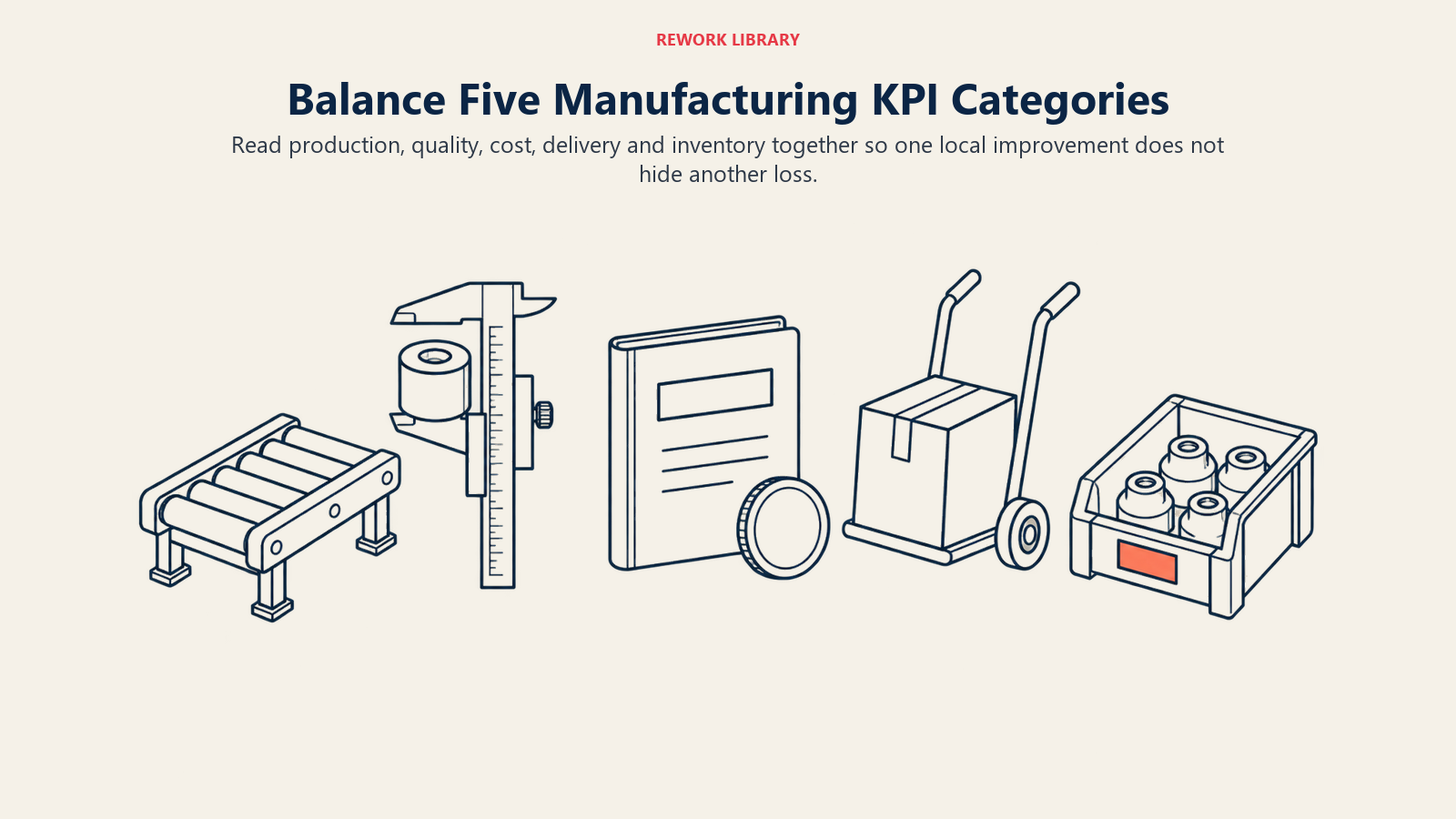
Manufacturing KPIs fall into five categories, each measuring different aspects of operational performance. The ISO22400 standard defines 41 key performance indicators for manufacturing operations management, providing an internationally recognized framework. Excellence requires balanced performance across all categories, not optimization of any single category at others' expense.
Production Metrics
Production metrics measure how effectively you convert inputs to outputs. They reveal capacity utilization, production speed, and operational efficiency. According to OEE research, OEE is the gold standard for measuring manufacturing productivity, identifying the percentage of manufacturing time that is truly productive. Strong production planning relies on accurate production metrics.
Overall Equipment Effectiveness (OEE) combines three factors: availability (uptime), performance (speed), and quality (first-pass yield). World-class manufacturers achieve 85%+ OEE. Average manufacturers run 60-70%. A 10-point OEE improvement typically increases capacity 10-15% without equipment investment.
Throughput measures units produced per time period. It reveals whether you're meeting capacity plans and identifies trends. Declining throughput signals problems with equipment, materials, or processes requiring investigation.
Cycle time measures the time required to produce one unit or complete one production cycle. Shorter cycle times mean higher capacity from the same resources. Cycle time includes setup time, processing time, and any delays within the production process itself.
Quality Metrics
Quality metrics reveal how consistently you produce products meeting specifications. Quality directly impacts costs (rework, scrap), customer satisfaction, and competitive position. Comprehensive quality management systems track multiple quality dimensions.
Defect rate measures the percentage of units failing quality standards. It's typically expressed as defects per million opportunities (DPMO) in six sigma environments. World-class manufacturers achieve less than 1% defect rates. Defect rates above 3-5% indicate systemic quality problems requiring root cause analysis.
First-pass yield (FPY) measures the percentage of units passing all quality checkpoints on the first attempt. It differs from final yield because FPY counts units requiring rework as failures even if they're ultimately acceptable. An 85% first-pass yield means 15% of production requires rework, significantly increasing costs.
Customer returns measure products rejected by customers after delivery. This is the ultimate quality metric because it reflects real-world performance, not just internal testing. Return rates above 1-2% signal serious quality problems affecting customer satisfaction.
Cost Metrics
Cost metrics reveal manufacturing efficiency and profitability. They guide pricing decisions, identify cost reduction opportunities, and measure improvement initiatives' financial impact. Understanding your manufacturing cost structure is foundational.
Cost of goods sold (COGS) as percentage of revenue reveals overall manufacturing efficiency and pricing adequacy. Healthy manufacturers run 60-70% COGS, leaving 30-40% for overhead, profit, and growth investment. COGS above 75% signals thin margins vulnerable to cost pressures.
Manufacturing cost variance compares actual costs to standard or budgeted costs. Variances highlight unexpected cost increases requiring investigation. Consistent negative variances indicate either inaccurate standards or execution problems.
Scrap and rework costs measure waste from quality failures. These costs include material waste, labor on defective units, and overhead absorbed by scrapped production. Many manufacturers don't fully track these costs, masking significant profit improvement opportunities.
Delivery Metrics
Delivery metrics measure ability to meet customer commitments. Delivery performance directly affects customer satisfaction, retention, and competitive positioning. Reliable on-time delivery is a competitive differentiator.
On-time delivery (OTD) measures the percentage of orders delivered by promised date. World-class manufacturers achieve 95%+ on-time delivery. OTD below 90% creates customer dissatisfaction and indicates planning or execution problems.
Manufacturing lead time measures time from order receipt to shipment. Shorter lead times enable competitive advantage in markets valuing responsiveness. Lead time includes order processing, material procurement, production, and shipping.
Order fill rate measures the percentage of orders shipped complete on first attempt. Partial shipments create customer dissatisfaction and increase logistics costs. Fill rates below 95% signal inventory or production planning problems.
Inventory Metrics
Inventory metrics reveal working capital efficiency and supply chain performance. Excess inventory ties up cash and risks obsolescence. Insufficient inventory creates stockouts and production delays. Effective inventory optimization balances these risks.
Inventory turns measure how many times per year you sell and replace inventory. Calculated as cost of goods sold divided by average inventory value. Higher turns indicate efficient inventory management. Most manufacturers target 6-12 turns annually, though this varies by industry.
Days inventory on hand measures how many days of demand current inventory supports. Calculated as inventory value divided by daily COGS. This metric is more intuitive than turns for operational managers. Target levels depend on lead times, demand variability, and service level requirements.
Inventory accuracy measures the percentage of inventory records matching physical counts. Poor inventory accuracy creates planning problems, stockouts, and excess inventory simultaneously. World-class manufacturers maintain 95%+ inventory accuracy through cycle counting and process discipline.
Metric Selection: Choosing the Right KPIs
Don't track every possible metric. Too many metrics dilute focus and overwhelm managers with data. Effective metric selection balances comprehensive measurement with manageable metric counts.
Strategic Alignment
Choose metrics that align with strategic priorities. A manufacturer pursuing growth through new customers should emphasize on-time delivery and quality metrics. One focused on profitability should emphasize cost and efficiency metrics. Metrics should reinforce strategy, not distract from it.
Review strategic goals and identify 3-5 metrics that most directly measure progress. These become your primary metrics tracked at executive level. Additional metrics can cascade to operational levels, but leadership focuses on the vital few.
Leading vs. Lagging Indicators
Lagging indicators measure outcomes: revenue, profit, customer returns. They tell you what happened but offer limited ability to correct problems. Leading indicators measure activities that drive outcomes: production efficiency, quality metrics, delivery performance. They enable proactive management.
Balance leading and lagging indicators. Lagging indicators track overall success. Leading indicators guide daily and weekly actions. A balanced scorecard might include financial outcomes (lagging) plus operational drivers (leading) that predict financial results.
Balanced Scorecard Approach
The balanced scorecard framework organizes metrics across four perspectives: financial, customer, internal processes, and learning and growth. This prevents over-optimization of any single dimension.
Financial metrics measure profitability and efficiency: COGS percentage, cash flow, return on assets. Customer metrics track satisfaction and retention: on-time delivery, quality, lead times. Internal process metrics reveal operational excellence: OEE, cycle time, yield. Learning and growth metrics measure improvement capability: training hours, suggestions implemented, skills development.
A manufacturer measuring only financial metrics makes short-term decisions that damage long-term capability. One measuring only operational metrics optimizes efficiency at profit's expense. Balance prevents these pathologies.
Implementation Framework: Building a KPI System
Effective KPI systems require data collection infrastructure, visualization tools, review processes, and action protocols.
Data Collection Methods
Automated data collection beats manual recording for accuracy, timeliness, and efficiency. Modern manufacturing systems capture production data automatically through sensors, PLCs, and MES systems. This enables real-time visibility without burdening operators with data entry.
But not everything can or should be automated. Some metrics:like visual quality checks or customer feedback:require human judgment. Create efficient manual collection processes with simple forms, clear definitions, and immediate data entry to minimize errors and delays.
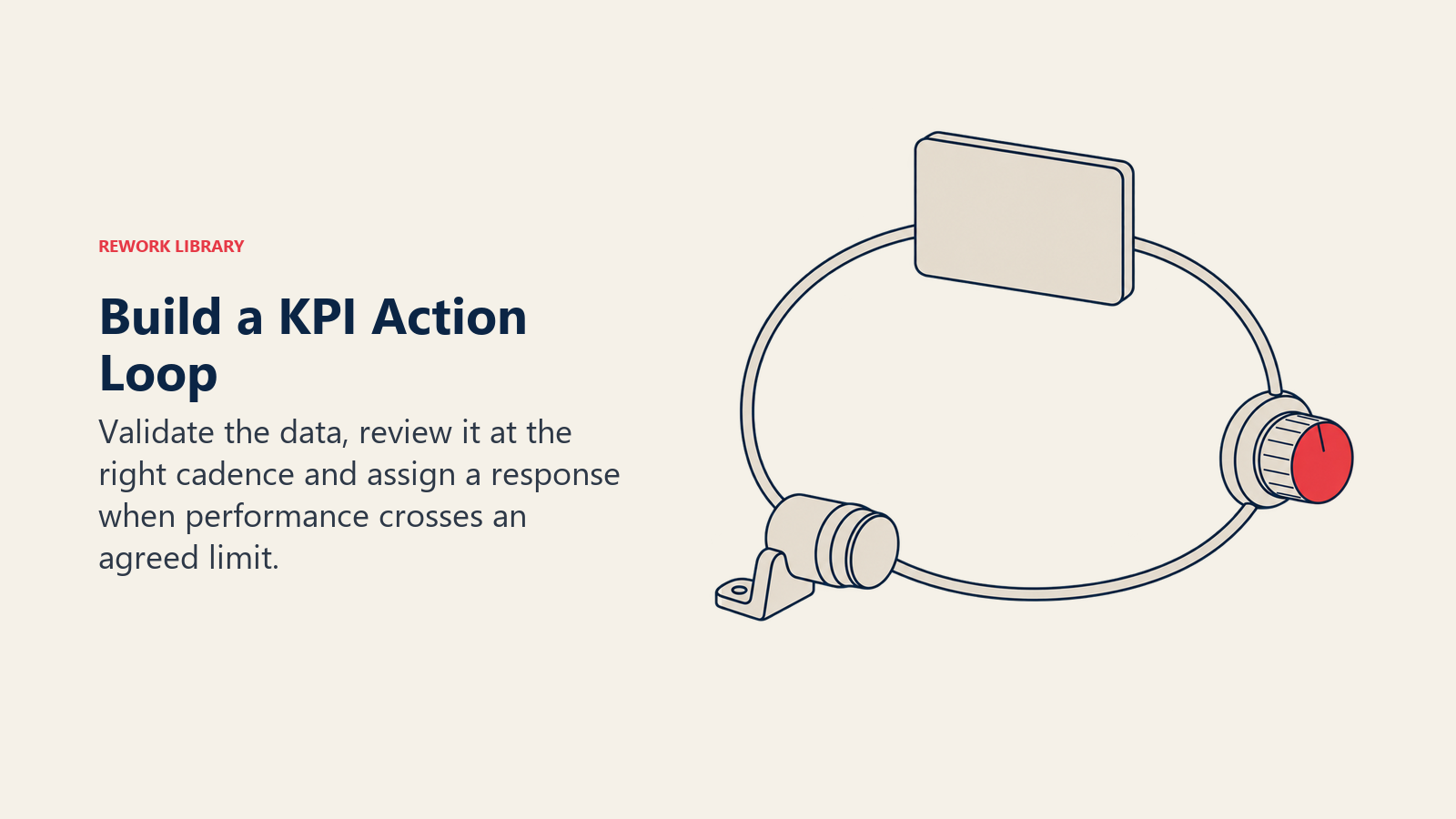
Data accuracy is critical. Inaccurate data leads to poor decisions. Implement validation rules, exception reporting, and periodic audits to maintain data integrity. Better to measure fewer things accurately than many things poorly.
Dashboard Design
Dashboards visualize KPIs for quick comprehension. Effective dashboards show current performance, trends, and comparison to targets at a glance. They highlight exceptions requiring attention rather than presenting all data equally.
Design dashboards for their audience. Executive dashboards show strategic metrics with monthly or quarterly trends. Operations dashboards show tactical metrics with daily or shift-level detail. Operator displays show real-time production status with immediate alerts.
Use visual encoding effectively. Green/yellow/red colors indicate performance vs. targets. Trend lines show improvement or decline. Charts reveal patterns that tables mask. But don't overuse visualization. Sometimes a simple table communicates more clearly than a fancy chart.
Review Cadence
Establish review cadences appropriate to each metric's nature and audience. Some metrics need hourly monitoring. Others need weekly or monthly review. Matching review frequency to metric volatility and actionability prevents both over-reaction and under-attention.
Tier I metrics (strategic, CEO-level) typically review monthly or quarterly. Tier II metrics (operational, functional leader-level) review weekly or daily. Tier III metrics (process-level, supervisor-level) review shift-by-shift or hourly. This tiered approach provides appropriate attention at each level.
Make reviews disciplined events, not just data presentations. Each review should identify trends, discuss root causes, agree on actions, and assign accountability. Without this discipline, reviews become status updates without driving improvement.
Action Protocols
Metrics without actions waste effort. Define action protocols that specify what happens when metrics fall outside acceptable ranges. These protocols prevent analysis paralysis and ensure consistent response to problems.
Action protocols might specify: Green status requires no action. Yellow status triggers investigation within 24 hours. Red status requires immediate response with corrective action within the shift. These simple rules ensure appropriate attention without micromanagement.
Protocols should escalate persistent problems. If a metric stays yellow for three consecutive periods or red for two periods, it escalates to the next management level. This prevents problems languishing at operational levels when they require senior attention.
Performance Management: Using KPIs to Drive Improvement
KPIs are tools for improvement, not just scorecards. The real value comes from analyzing patterns, identifying root causes, and implementing improvements.
Root Cause Analysis
When metrics signal problems, conduct root cause analysis rather than treating symptoms. A declining OEE might result from equipment issues, material quality problems, operator training gaps, or scheduling inefficiencies. Fixing symptoms temporarily masks problems that resurface later.
Use structured root cause analysis methods: 5 Whys, Fishbone diagrams, or Pareto analysis. Document findings and verified root causes. This prevents repeating analysis and enables organizational learning.
Verify solutions actually address root causes by monitoring metric improvement after implementation. If metrics don't improve, either the root cause identification was wrong or the solution was inadequate. Iterate until you achieve sustainable improvement.
Benchmarking
Compare your metrics against industry benchmarks or best-in-class performers. This reveals whether improvement is needed and how much improvement is possible. A manufacturer running 70% OEE might be comfortable until learning world-class manufacturers achieve 85%+.
Industry associations, consulting firms, and peer networks provide benchmarking data. But ensure comparisons are truly comparable. OEE in automotive might differ from OEE in job shops due to different production characteristics. Adjust for these differences or find truly comparable benchmarks.
Internal benchmarking across plants, lines, or products also provides insights. If Plant A achieves 85% OEE while Plant B achieves 70%, what's different? Can Plant B learn from Plant A? Internal benchmarking is often more actionable than external because conditions are more similar.
Continuous Improvement
Use KPIs to drive continuous improvement culture. Set improvement targets: reduce defect rate 20%, increase OEE 5 points, cut cycle time 15%. Break targets into manageable increments and celebrate progress.
Review metric trends in improvement team meetings. Recognize teams that deliver improvement. Use metrics to evaluate improvement ideas by measuring results. This creates accountability for improvement and makes abstract concepts like "quality" or "efficiency" concrete and measurable.
But avoid gaming. When compensation ties directly to specific metrics, people find ways to optimize metrics without improving underlying performance. They'll hit OEE targets by running easy products, meet delivery targets by holding excessive inventory, or achieve quality targets through excessive inspection. Structure incentives carefully to avoid unintended consequences.
Learn More
Explore related topics for comprehensive performance management:
- Manufacturing Growth Model explains how KPI requirements evolve through growth phases
- Manufacturing Cost Structure provides foundation for cost metrics
- Production Planning Fundamentals covers planning metrics and processes
- Lean Manufacturing Principles offers tools for metric-driven improvement
- Production Bottleneck Analysis uses metrics to identify constraints
- Statistical Process Control enables data-driven quality management
- Manufacturing Margin Analysis translates KPIs into profitability insights
From Measurement to Management Excellence
Manufacturing KPIs transform operations from intuition-based to fact-based. They make performance visible, enable objective decision-making, and guide continuous improvement. But metrics alone don't create excellence. Excellence comes from choosing the right metrics, measuring them accurately, analyzing them insightfully, and acting on what they reveal.
The manufacturers who win with KPIs balance breadth with focus. They measure enough dimensions to prevent sub-optimization but few enough to maintain clarity. They review metrics at appropriate cadences with discipline. They use metrics to drive improvement, not just evaluate performance.
Build your KPI system thoughtfully. Start with a few critical metrics and expand systematically. Ensure data accuracy before adding complexity. Use metrics to guide action, not just report status. That discipline converts measurement into management excellence that drives competitive advantage.
