Manufacturing Business Models: Strategic Options for Production Companies
Turn this article into takeaways for your work.


Each assistant summarizes the article only for you and suggests best practices for your work.
Your business model matters more than your product. Two manufacturers producing identical items with similar capabilities can experience radically different outcomes based solely on their business model choice. One thrives with healthy margins and loyal customers. The other struggles with thin margins and constant pricing pressure.
The business model defines how you interact with markets, manage inventory, allocate resources, and create value. It determines whether you compete on price or differentiation, whether you lead or follow market demand, and whether you build leverage or dependency. Understanding these models and choosing strategically separates successful manufacturers from struggling ones. Your manufacturing revenue streams and cost structure directly flow from your business model choice.
Types of Manufacturing Business Models
Five primary business models dominate manufacturing, each with distinct characteristics, advantages, and limitations. Most manufacturers combine elements from multiple models, but one typically defines their core approach.
Make-to-Stock (MTS)
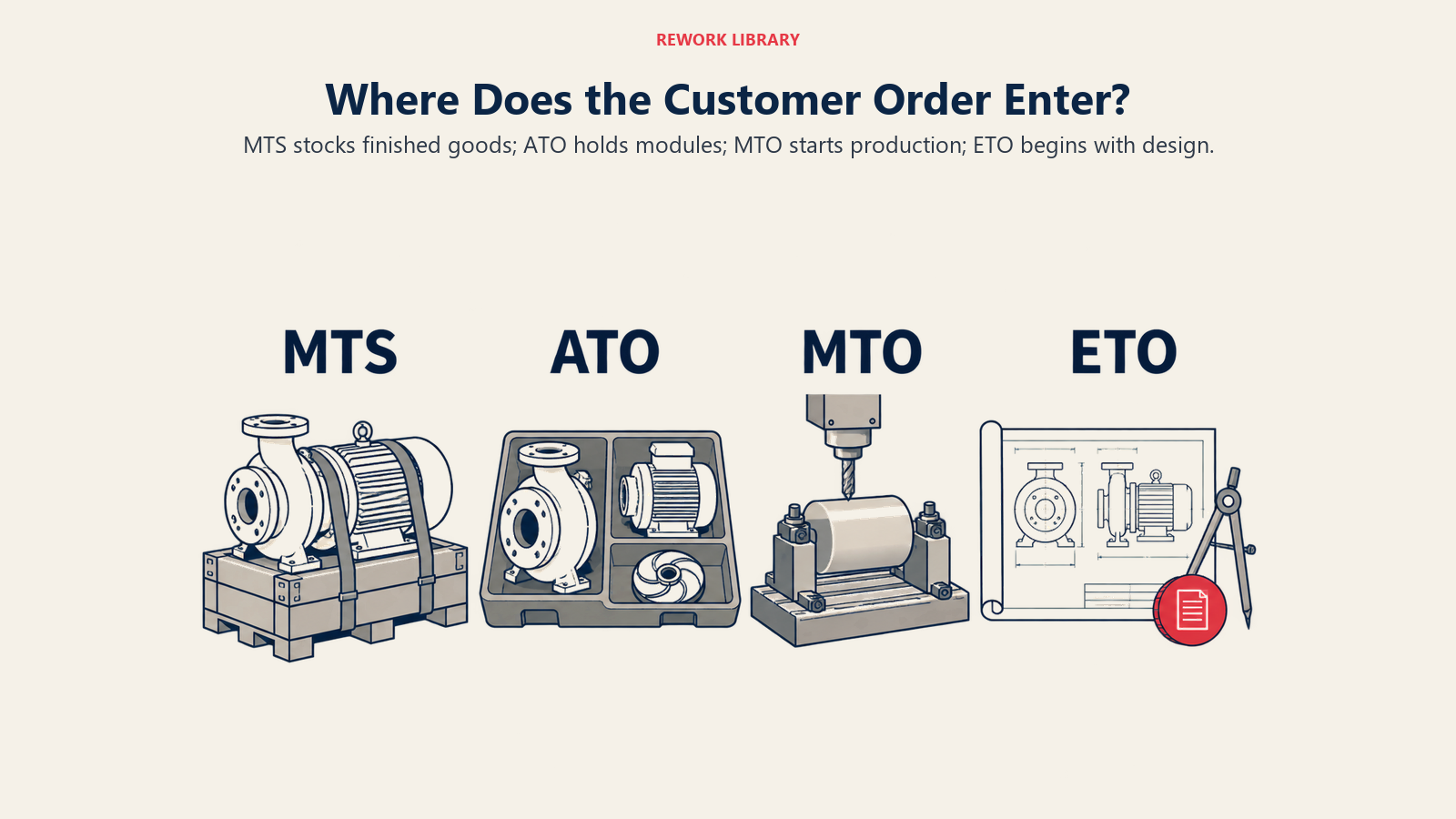
Make-to-stock manufacturers produce standardized products for inventory before receiving customer orders. They forecast demand, build inventory, and fill orders from stock. This model dominates consumer goods, commodity products, and standardized components. Success requires demand forecasting capabilities and inventory optimization.
MTS enables fast delivery and economies of scale. But it creates inventory risk and requires accurate forecasting. When demand exceeds forecast, you face stockouts and lost sales. When forecast exceeds demand, you carry excess inventory that ties up cash and risks obsolescence.
Success in MTS depends on forecast accuracy, production efficiency, and inventory management. Manufacturers who can predict demand within 10-15% and produce at high utilization win. Those who miss forecasts wildly or carry inefficient operations lose money on inventory write-offs and expedite costs.
Make-to-Order (MTO)
Make-to-order manufacturers start production only after receiving confirmed customer orders. According to research on hybrid manufacturing models, MTO and hybrid approaches are increasingly prevalent in modern manufacturing practice. They maintain minimal finished goods inventory, producing exactly what customers order. This model works well for customized products, high-value items, and situations where customers accept lead times. MTO requires sophisticated production planning and master scheduling capabilities.
MTO eliminates finished goods inventory risk and enables customization without carrying multiple stock keeping units. But it requires longer lead times and creates production scheduling challenges. Customers must wait for production, and production must constantly adapt to changing order mix.
Success in MTO requires efficient production planning, flexible manufacturing processes, and customers willing to accept lead times. Manufacturers who can produce in 2-4 weeks what competitors need 8-12 weeks to deliver win customer orders despite MTO's longer timeline.
Engineer-to-Order (ETO)
Engineer-to-order manufacturers design unique products for each customer order. They perform engineering, procurement, and manufacturing after order receipt. This model dominates complex equipment, construction, and specialized industrial applications. ETO operations need strong project management capabilities and capacity planning strategies.
ETO enables complete customization and justifies premium pricing. But it creates long lead times, complex project management, and significant engineering overhead. Each order essentially starts from scratch, limiting scale economies.
Success in ETO depends on engineering excellence, project management capability, and building customer confidence in your ability to deliver complex custom solutions. Manufacturers who can accurately scope, price, and deliver custom products profitably thrive. Those who underestimate complexity or fail to manage projects effectively lose money on every order.
Assemble-to-Order (ATO)
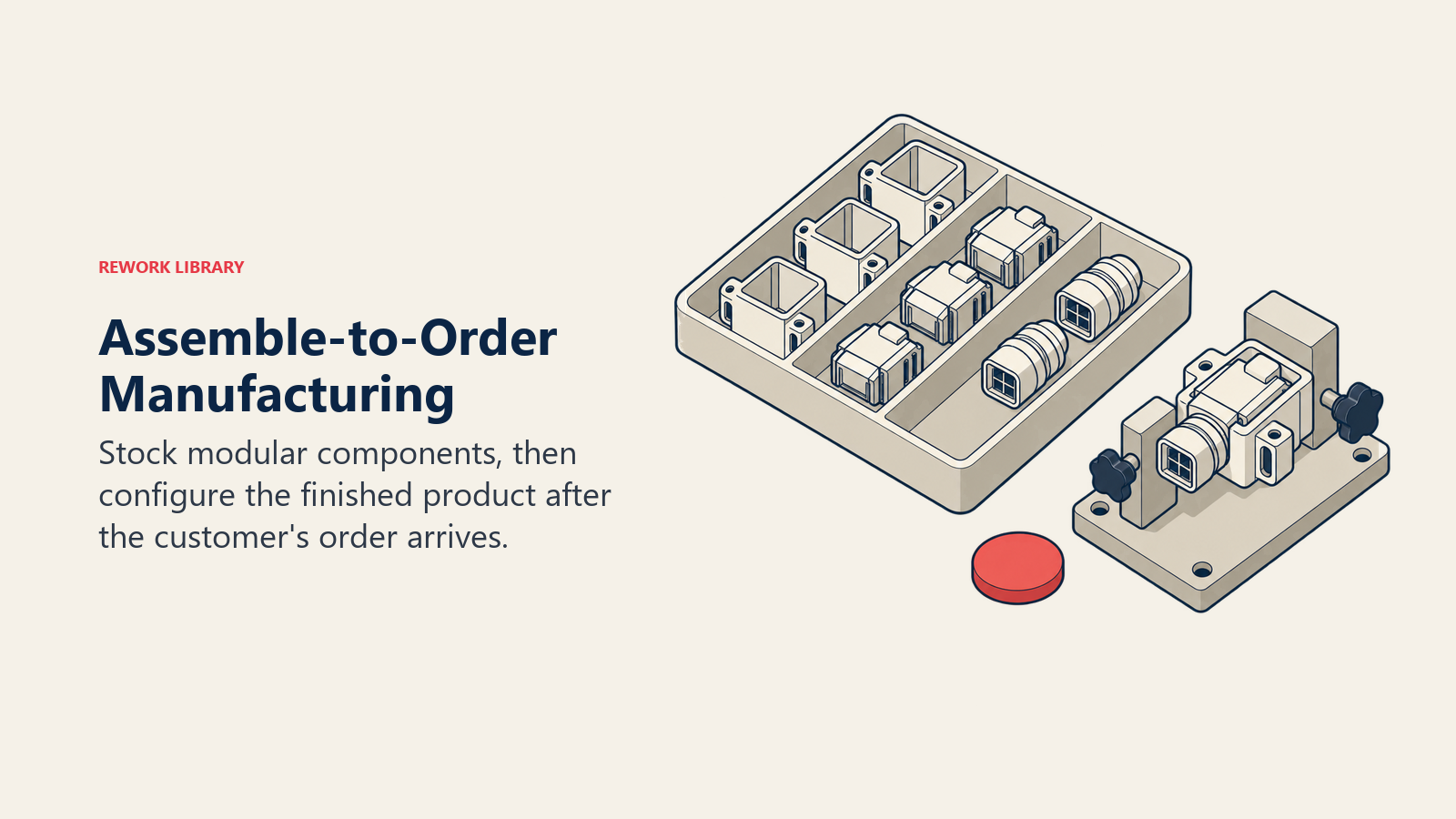
Assemble-to-order manufacturers maintain inventory of components and subassemblies, then configure final products based on customer orders. They postpone final assembly until demand is known while keeping component inventory to enable fast response.
ATO balances MTS efficiency with MTO flexibility. It enables customization with faster delivery than pure MTO by maintaining modular components. But it requires modular product design and sophisticated inventory management of multiple component variants.
Success in ATO demands product designs built for configurability, systems that manage complex multi-level inventory, and processes that rapidly configure and assemble. Computer manufacturers and automotive companies excel at ATO, turning dozens of component options into thousands of final configurations.
Contract Manufacturing
Contract manufacturers produce goods designed by other companies. They sell manufacturing capacity and expertise, not product innovation or market access. This model dominates electronics, pharmaceuticals, and consumer goods production. Success depends on quality management systems and on-time delivery performance.
Contract manufacturing enables asset-light strategies for brand companies while providing volume for manufacturers. But it creates customer concentration risk and typically operates on thin margins. The contract manufacturer competes primarily on cost, quality, and reliability rather than innovation or brand.
Success requires operational excellence, quality consistency, and customer relationship management. Contract manufacturers who deliver perfect quality, on-time delivery, and continuous cost reduction maintain relationships. Those who stumble on quality or delivery lose customers quickly.
Hybrid Models
Most manufacturers combine elements from multiple models. Gartner research on manufacturing strategy emphasizes that more than one-third of manufacturing CIOs say growth is the top priority, requiring flexible business models. A company might produce standardized products MTS while offering customized versions MTO. Another might handle simple products MTS while complex products are ETO. The hybrid approach balances the advantages and disadvantages of pure models.
But hybrid models create complexity. Different products require different planning approaches, inventory strategies, and operational processes. Manufacturers who try to apply one model's processes across products suited to different models create inefficiency and confusion.
Model Comparison: Strengths and Limitations
Each model creates different implications for capital, inventory, lead times, and margins. Understanding these trade-offs guides model selection.
Capital Requirements
MTS requires significant working capital for finished goods inventory. You must fund materials, labor, and overhead before collecting customer payments. A manufacturer holding 60 days of inventory and offering 30-day payment terms funds production for 90 days before cash collection. Understanding your manufacturing cost structure helps you calculate working capital needs.
MTO and ETO reduce finished goods inventory but still require working capital for raw materials and work-in-process. ATO falls between, requiring component inventory but minimal finished goods. Contract manufacturing timing depends on customer payment terms and inventory consignment arrangements.
Manufacturers with limited capital favor MTO, ETO, or contract models over MTS. Those with strong balance sheets can use MTS to capture market share through fast delivery.
Inventory Implications
MTS carries highest inventory costs and risks. You must forecast months ahead, build inventory, and hope demand materializes. Forecast errors create either stockouts (lost sales) or excess inventory (write-offs). Effective inventory optimization strategies and safety stock calculations are critical.
MTO carries minimal finished goods inventory but requires raw materials and component inventory. Lead times depend on supplier lead times plus production time. ATO inventory sits between MTS and MTO in both amount and risk.
ETO carries almost no inventory until orders arrive, then must procure specifically for each project. This minimizes holding costs but makes lead times longer and creates supplier coordination challenges.
Lead Time Considerations
MTS delivers immediately from stock: hours to days. This model dominates markets where delivery speed determines competitive success. Fast delivery enables premium pricing and customer loyalty.
MTO lead times span days to weeks, depending on production complexity. Customers willing to wait receive customization. Those demanding fast delivery choose MTS competitors.
ATO delivers in days to weeks for configured products, faster than MTO but slower than MTS. ETO lead times range from weeks to months or years for complex projects. These models only work in markets where customers accept longer timelines in exchange for customization.
Margin Profiles
MTS typically operates on lower margins due to standardization and competition. When anyone can order and stock the same product, price competition intensifies. Margins of 20-30% are typical, with some commodities running under 15%.
MTO and ATO enable somewhat higher margins (25-40%) through customization value. Customers pay premiums for products tailored to their requirements. But customization also creates higher costs that partially offset margin improvements.
ETO commands highest margins (often 30-50%) because each product is unique and customers can't easily compare prices. Engineering and project management overhead are high, but custom solutions justify premium pricing.
Contract manufacturing runs on thinnest margins (typically 10-20%) because you're competing primarily on cost. With no brand differentiation or market control, you must price competitively to maintain volume.
Selection Framework: Choosing the Right Model
The right business model depends on product characteristics, market demands, competitive landscape, and your capabilities. Start with these questions:
Product Characteristics
Products with high design complexity and customer-specific requirements suit ETO. Those with moderate complexity and options suit ATO or MTO. Standardized products with low variation suit MTS. The more customer-specific your product, the further toward ETO you should move.
Product value also matters. Low-value, high-volume products need MTS to compete on delivery and price. High-value, low-volume products can justify ETO or MTO approaches where lead times are acceptable in exchange for customization.
Lifecycle matters too. Mature, stable products work well as MTS. New products with uncertain demand fit MTO better until you understand market requirements. Transitioning too early to MTS creates inventory risk. Staying too long in MTO surrenders market share to faster competitors.
Market Demands
Markets demanding immediate delivery require MTS. Those accepting 2-4 week lead times enable MTO. Markets expecting unique solutions need ETO. Understanding what customers value (delivery speed versus customization) guides model choice. Your manufacturing sales strategy must align with your business model.
Price sensitivity also influences model selection. Price-sensitive markets favor MTS where scale economies reduce costs. Premium markets tolerate MTO or ETO where customization justifies higher prices.
Volume and predictability matter as well. High-volume, predictable demand suits MTS. Low-volume, unpredictable demand fits MTO or ETO. Variable demand with some predictability enables ATO.
Competitive Landscape
Observe how successful competitors operate. If market leaders use MTS and deliver overnight, you probably need MTS to compete. If leaders operate MTO with 3-week lead times, that's the market expectation.
But competitive model doesn't determine your model. You might find advantage in a different approach. If everyone operates MTS with lengthy inventory and struggles with forecast accuracy, maybe MTO with short lead times creates differentiation.
Capability Alignment
Choose models that match your strengths. Manufacturers with excellent demand forecasting and inventory management succeed with MTS. Those with flexible production and fast changeovers thrive with MTO. Companies with strong engineering and project management win with ETO. Understanding your manufacturing KPIs reveals which capabilities you've mastered.
Don't choose models that require capabilities you lack. A manufacturer with poor forecasting accuracy who tries MTS will carry excessive inventory or face chronic stockouts. One with inflexible production who attempts MTO will struggle with schedule changes and long lead times.
Transition Strategy: Evolving Your Business Model
Business models aren't permanent. As markets evolve and capabilities develop, you might need to transition. But transitions are risky and expensive.
MTS to MTO or ATO
Manufacturers sometimes transition from MTS to MTO or ATO to reduce inventory and improve customization. This works when customers accept modest lead time increases in exchange for tailored products.
The transition requires developing production planning capabilities, shortening manufacturing lead times, and potentially reconfiguring products for modular assembly. You'll reduce finished goods inventory but increase raw materials and components. Customer education about lead times is critical.
MTO to MTS
Manufacturers sometimes transition from MTO to MTS to improve delivery and scale. This works when demand becomes predictable and customers value delivery speed over customization.
The transition requires building forecasting capabilities, investing in inventory, and potentially standardizing products to reduce SKU complexity. You'll accelerate delivery but increase capital requirements and inventory risk.
ETO to MTO or ATO
As custom products mature, some manufacturers transition toward more standardized offerings. This works when market requirements converge and customers accept predefined options instead of complete customization.
The transition requires identifying common customer requirements, modularizing designs, and building repeatable processes. Engineering shifts from custom design to configuration, and margins may compress but volume increases.
Learn More
Explore these topics to deepen your understanding of manufacturing business models:
- Manufacturing Growth Model explains how business models evolve through growth phases
- Manufacturing Revenue Streams shows how different models enable different revenue streams
- Production Planning Fundamentals covers the planning requirements for each model
- Demand Forecasting for Manufacturing provides forecasting approaches for different models
- Batch vs Continuous Production discusses production methods that align with different models
- Manufacturing Value Chain shows how business models affect value chain configuration
- Lean Manufacturing Principles provides optimization tools applicable across models
- Make vs Buy Decision Framework guides sourcing decisions within your business model
Aligning Business Model with Strategic Goals
Your business model isn't just an operational choice. It's a strategic decision that shapes your competitive position, determines your economics, and influences your growth trajectory.
The manufacturers who succeed choose business models deliberately based on market requirements, competitive dynamics, and their own capabilities. They resist chasing every opportunity that might require a different model. And when they do transition models, they invest adequately in the capabilities needed to succeed.
Choose your business model based on where you can win, not where you wish to compete. Build the capabilities your chosen model requires. And be willing to say no to opportunities that don't fit your model. That discipline creates focus, builds distinctive capabilities, and generates sustainable competitive advantage.
