Manufacturing Capacity Expansion: A Strategic Framework for Growth Investment Decisions
Turn this article into takeaways for your work.


Each assistant summarizes the article only for you and suggests best practices for your work.
A medical device manufacturer faced a familiar dilemma. Orders exceeded capacity by 15%. Customers were getting frustrated with lead times. But the last time they expanded capacity aggressively, demand softened and they operated at 60% utilization for three years. The financial impact nearly killed the company. Now they were paralyzed, unable to decide whether to expand, how much to add, and when to pull the trigger.
Capacity decisions rank among the most consequential choices manufacturers make. Add too little capacity too late and you lose market share to competitors who can deliver. Add too much too early and you saddle the business with fixed costs that destroy profitability. The timing, scale, and form of capacity expansion determine whether growth creates value or destroys it.
Understanding Capacity Options
Capacity isn't binary. You don't just add it or not. Multiple expansion paths exist, each with different cost structures, timelines, flexibility, and strategic implications. Understanding your options prevents defaulting to familiar solutions that might not fit current circumstances.
Incremental capacity addition works within existing facilities. Add a machine, extend a shift, eliminate bottlenecks, improve throughput. This approach requires modest capital, delivers quick results, and preserves flexibility. If demand doesn't materialize, you haven't overextended. The limitation is magnitude. You can grow 10-30% incrementally. Doubling capacity requires different approaches.
Brownfield expansion enlarges existing facilities. Add a building wing, acquire adjacent property, reconfigure layout to accommodate more equipment. This builds on existing infrastructure, management teams, and supplier relationships. Construction costs less than greenfield facilities because utilities, access, and support structures exist. But brownfield expansion only works when space and zoning allow growth. Many facilities are landlocked or prohibited from expansion.
Greenfield facilities start fresh at new locations. This enables optimization from scratch. Layout supports current products and processes without legacy constraints. Equipment reflects current technology. You can locate near customers, materials, or labor markets strategically. McKinsey research emphasizes that site flexibility and understanding risks to supply chain and workforce availability are essential when selecting greenfield locations. But greenfield means duplicating infrastructure, building management teams, and absorbing startup costs and risks. The capital requirement is large and the timeline long.
Outsourcing supplements internal capacity without capital investment. Contract manufacturers absorb volume overflow while you retain core production. This provides flexibility and speed. When demand exceeds internal capacity, external partners fill gaps. When demand drops, you reduce external volume without carrying unutilized assets. The trade-off is margin. External manufacturing costs more per unit than internal production. Outsourcing makes sense for peaks and valleys but not for sustained base volume.
Analyzing Capacity Needs
Capacity decisions demand rigorous analysis. Gut feelings about growth don't justify seven-figure investments. You need demand forecasts, scenario planning, and financial modeling that illuminates returns and risks.
Demand forecasting starts with historical data but can't stop there. What drove past growth? Are those factors accelerating or decelerating? Which customer segments are growing? Which products have momentum? Historical trends extrapolated forward often miss inflection points. Growing 10% annually for five years doesn't guarantee 10% next year when market dynamics shift.
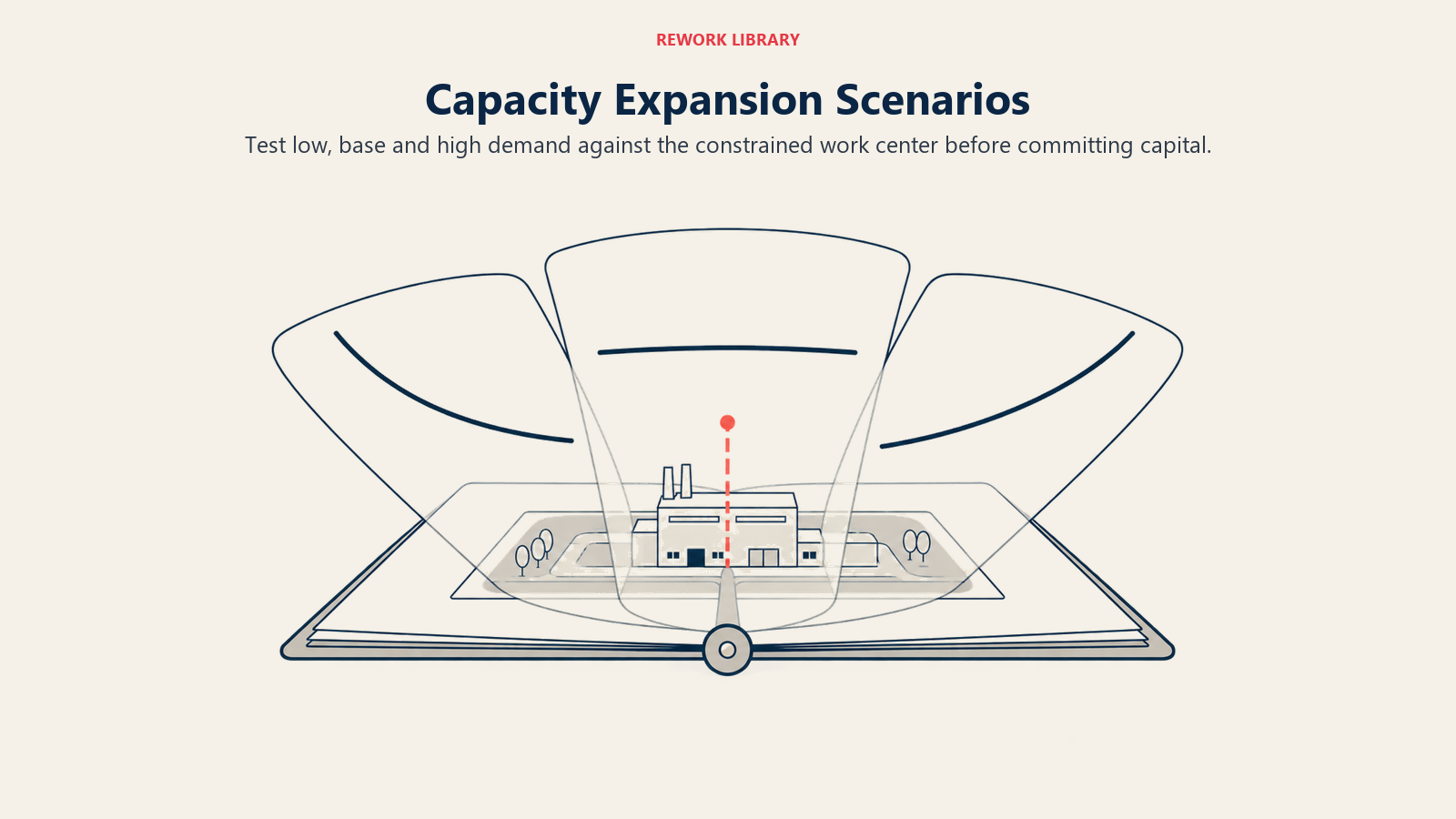
Build multiple demand scenarios. Best case assumes strong economic conditions, market share gains, and successful new products. Base case projects modest growth with stable share. Worst case considers recession, competitive pressure, or product transitions. Calculate capacity needs for each scenario. If all three scenarios fit within incremental expansion, that's low risk. If base case requires greenfield while worst case needs capacity reduction, you're facing major risk.
Capacity utilization analysis reveals how much headroom exists. If you're running 60% utilization, you have substantial capacity before investment is needed. If you're at 95% with rising demand, you're capacity-constrained now. But measure utilization carefully. Plant-wide utilization obscures bottlenecks. One work center at 98% constrains the entire facility even if others run at 70%. True capacity equals the bottleneck's capacity.
Bottleneck analysis identifies where constraints exist and what it costs to relieve them. Sometimes the bottleneck is a single machine that costs $200,000 to duplicate. Sometimes it's a complex process requiring $5 million in equipment and facility modifications. Sometimes the constraint is labor, not equipment. According to research on capacity expansion strategy, understanding bottlenecks is one of the most significant strategic decisions measured both in capital and complexity. Understanding the bottleneck reveals whether incremental additions solve the problem or whether fundamental expansion is necessary.
Financial Modeling
Capacity expansion requires capital. That capital has cost. The expansion must generate returns exceeding that cost or it destroys value. Financial analysis separates good investments from capital traps disguised as growth opportunities.
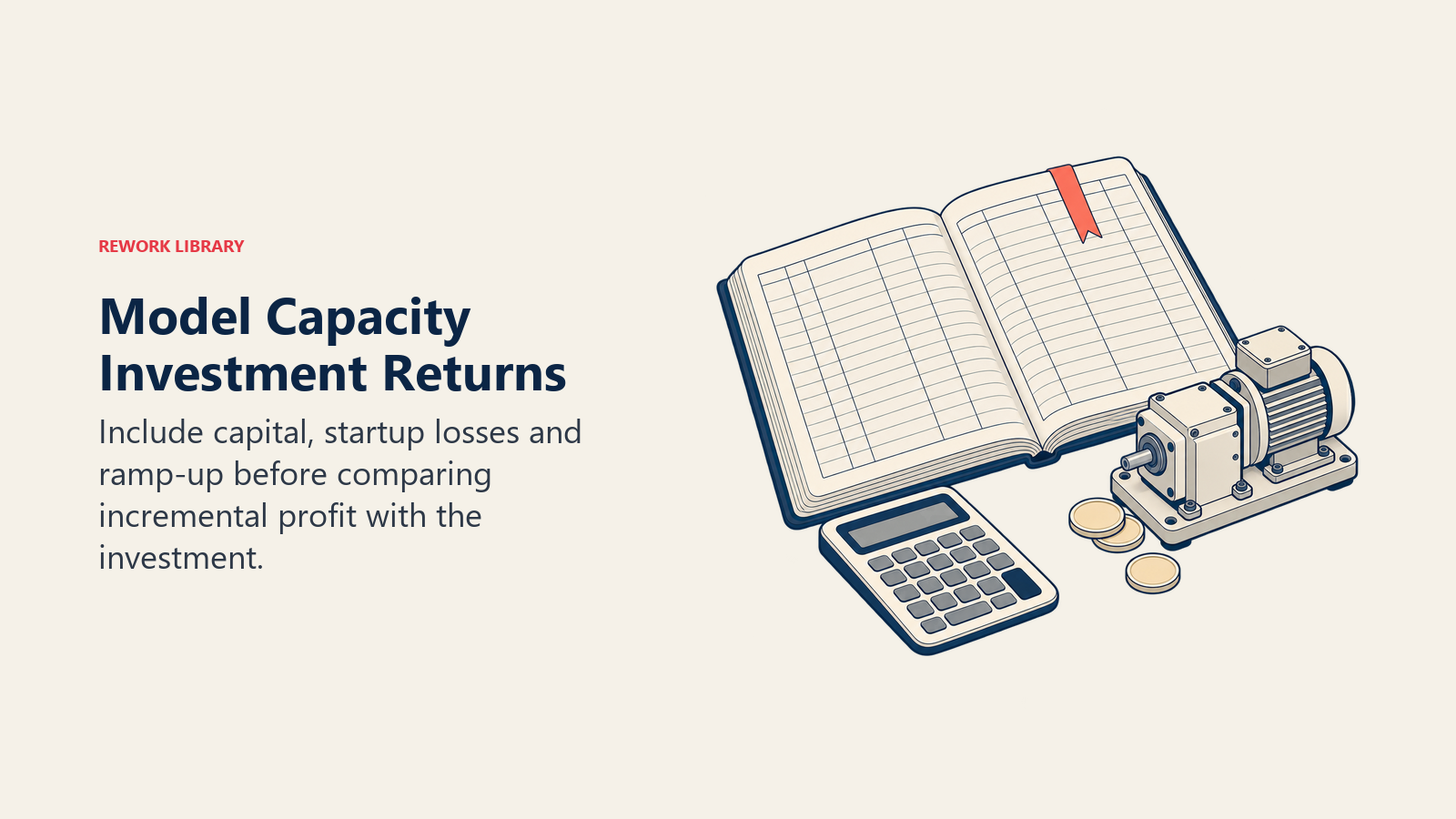
Build a capacity investment model showing capital required, volume growth enabled, revenue increase, cost structure impact, and resulting profit. Model at least five years because capacity investments deliver returns over time, not immediately. Include startup costs, training expenses, and the learning curve. First-year performance never matches steady-state performance.
Calculate return on investment (ROI) and payback period. If capacity expansion costs $3 million and generates $750,000 annual incremental profit, ROI is 25% and payback is 4 years. These metrics let you compare capacity investment to other uses of capital. Is 25% ROI adequate given risk? How does it compare to your cost of capital? Can you deploy capital more productively elsewhere?
Sensitivity analysis reveals which assumptions matter most. Vary demand growth rates, pricing, material costs, and utilization assumptions. If ROI stays attractive across reasonable assumption ranges, the investment is sound. If it only works with optimistic assumptions, you're betting on best-case outcomes. That might be appropriate in some situations but deserves conscious recognition.
Don't forget to model the cost of not expanding. If capacity constraints cause lost sales, customer defections, or margin erosion from rush charges and overtime, staying at current capacity isn't free. Sometimes the best risk-adjusted decision is expansion even when returns look modest, because the alternative is worse.
Timing Considerations
When you expand matters as much as how much you expand. Expand too early and you carry excess capacity. Expand too late and you lose sales. Getting timing right requires balancing lead time against uncertainty.
Lead time for capacity varies dramatically by approach. Incremental equipment additions might take 3-6 months. Brownfield expansion runs 12-18 months. Greenfield projects span 24-36 months. These timelines determine how far ahead you must commit. Greenfield facilities require decisions based on forecasts three years out. Incremental additions let you wait until demand is nearly certain.
Uncertainty affects timing strategy. In stable markets with predictable demand, you can commit early with confidence. In volatile markets, preserve flexibility by deferring commitment. This might mean accepting some lost sales in the near term to avoid major overcapacity risk. Risk tolerance and strategic position determine whether aggressive or conservative timing makes sense.
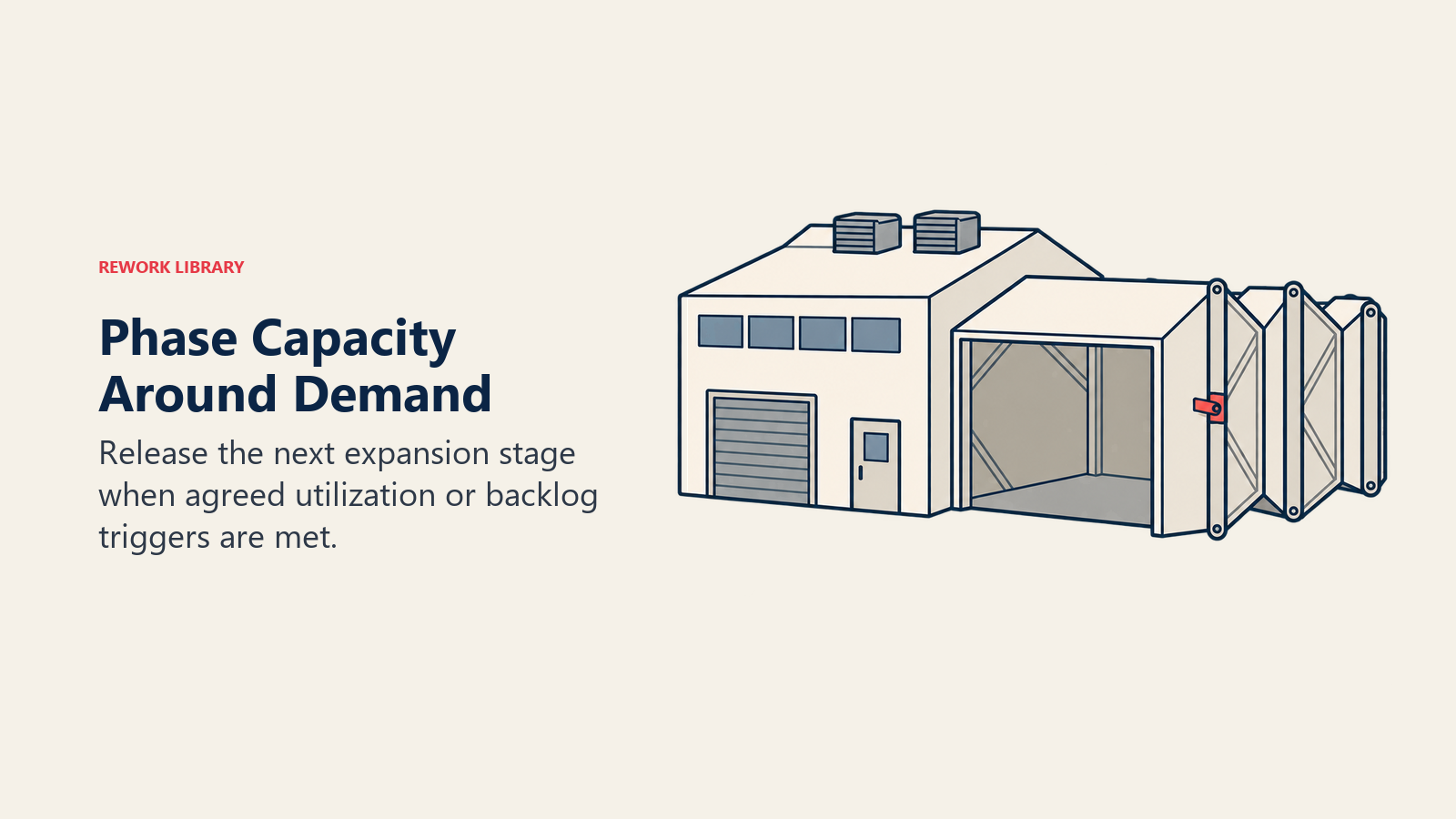
Phased expansion splits large capacity additions into stages. Instead of doubling capacity at once, add 30% now and another 30% in two years if demand materializes. This reduces risk but increases total cost. Building twice costs more than building once. The question is whether the risk reduction justifies the cost premium. Usually it does unless demand is highly certain.
Trigger points establish conditions that prompt expansion. Define specific metrics: when utilization exceeds 85% for two consecutive quarters, initiate Phase 2. When backlog reaches 8 weeks, add second shift. When quote decline rate due to capacity exceeds 10%, expand. Trigger points remove emotion from timing decisions and ensure action happens before constraints damage the business.
Implementation Planning
Capacity expansion projects fail more often in execution than in concept. Sound strategic decisions get undermined by poor project management, coordination breakdowns, and startup problems. Implementation planning determines whether expansion delivers expected benefits on schedule and budget.
Project governance starts with clear accountability. Someone owns the expansion project with authority to make decisions and budget to deliver results. McKinsey research on scaling production emphasizes conducting thorough reviews of current infrastructure and evaluating organizational readiness in critical areas. Cross-functional steering committees provide input but shouldn't diffuse ownership. One person accountable beats a committee responsible to everyone and no one.
Critical path management identifies the sequence of activities that determines project duration. Equipment procurement might take 16 weeks. Facility construction takes 24 weeks. What can happen in parallel and what must happen sequentially? Understanding dependencies prevents delays and enables active management of timeline risk.
Risk mitigation plans address potential problems proactively. What if key equipment delivery is delayed? What if startup takes longer than expected? What if demand grows faster than capacity comes online? Good plans include contingencies for plausible problems. You can't anticipate everything, but you can prepare for common failure modes.
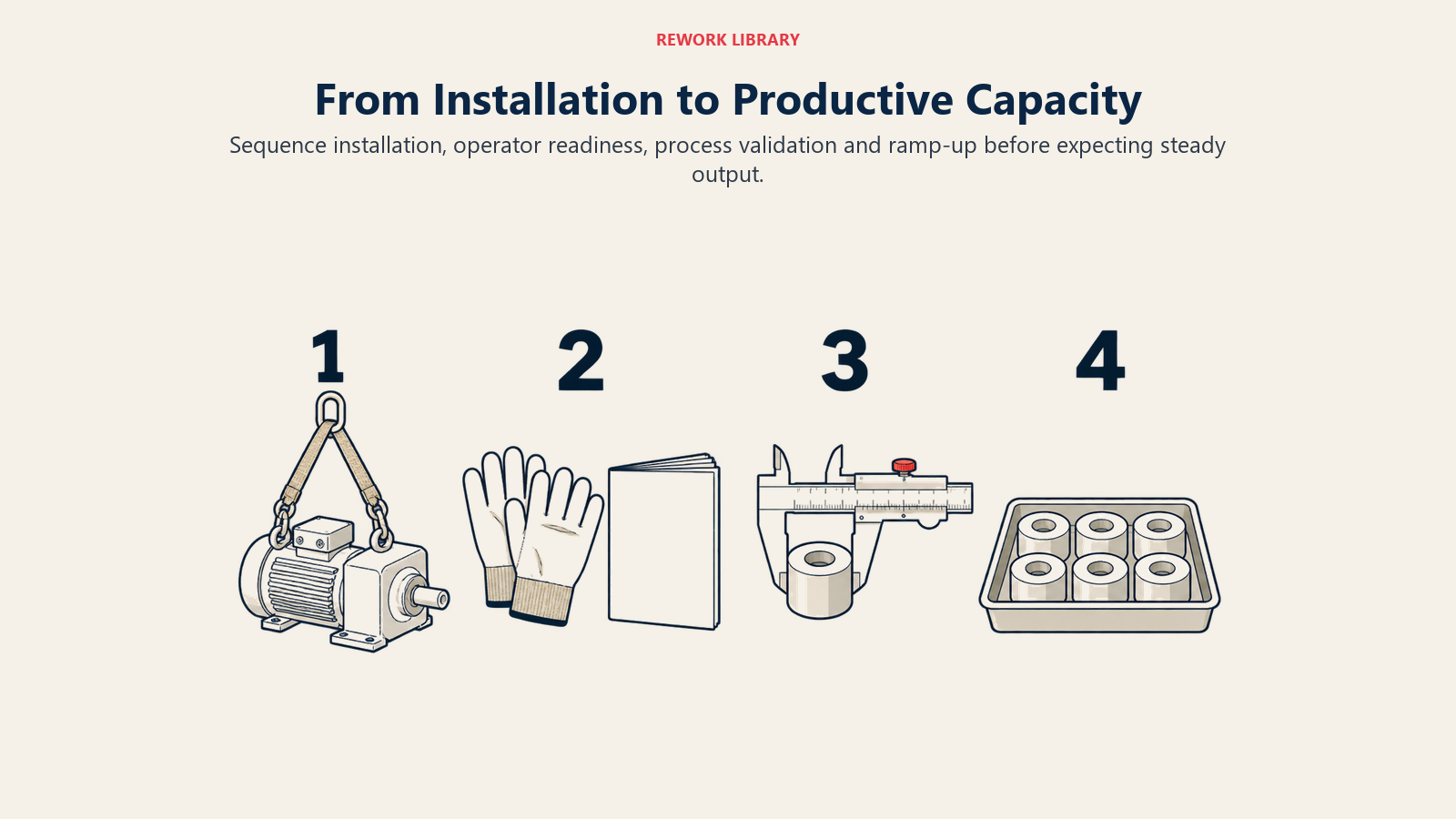
Startup planning bridges the gap between construction completion and full productive operation. New equipment requires debugging. Staff needs training. Processes need validation. Quality systems need verification. Startups always take longer than hoped and uncover unexpected issues. Build learning curves and startup losses into your financial model. Optimistic assumptions about instant full productivity disappoint every time.
Managing Risk
Capacity investments involve substantial risk. Demand forecasts prove wrong. Technologies change. Competitors respond. Economic conditions shift. You can't eliminate risk, but you can structure decisions to manage it intelligently.
Flexibility preserves options when uncertainty is high. Leasing equipment costs more than buying but lets you return it if demand disappoints. Modular facility designs enable future reconfiguration. General-purpose equipment serves multiple products unlike dedicated lines optimized for single products. Flexibility has cost but provides insurance against uncertainty.
Scalability allows gradual capacity addition rather than large steps. If you can add 10% capacity increments as needed, you match investment closely to demand. If capacity only comes in 50% chunks, you face extended periods of over or under capacity. Sometimes production economics force large increments, but when scalability is possible, it reduces risk significantly.
Diversification spreads risk across products, markets, and customers. Capacity dedicated to one product becomes worthless if that product fails. Capacity serving diverse products retains value even when individual products struggle. When evaluating capacity investments, consider how specialized versus flexible the capacity is and what that implies for risk.
Strategic partnerships can share capacity investment risk. Joint ventures, tolling arrangements, or shared facilities split capital requirements and utilization risk. The trade-off is shared control and potential conflicts. But in high-risk situations, partnerships can enable growth that neither party could pursue alone.
Performance Monitoring
Adding capacity doesn't guarantee value creation. You need to monitor whether expansion delivers expected results and adjust when it doesn't. Disciplined tracking separates hope from reality.
Track capacity utilization post-expansion. Are you running at projected levels? If utilization lags expectations, is it demand shortfall or operational issues? Low utilization due to startup problems is temporary and solvable. Low utilization due to demand misses is strategic problem requiring different response.
Measure cycle time and throughput. Did the expansion actually increase output to target levels? Sometimes new capacity gets installed but old bottlenecks resurface elsewhere. You added equipment but now material handling constrains throughput. Or you added production capacity but quality inspection became the bottleneck. Measuring actual output reveals whether expansion achieved operational goals.
Calculate financial returns against projections. Is the expansion generating expected profit contribution? Track revenue, costs, and margins for products using new capacity. When actual returns fall short, understand why. Pricing lower than expected? Volume growth slower? Costs higher? Specific causes suggest specific remedies.
Compare performance across scenarios. If you modeled best, base, and worst case demand scenarios, which materialized? If worst case, does the expansion still make sense or should you adjust strategy? If best case, should you accelerate additional expansion? Scenario planning during analysis should inform scenario response during execution.
Building Organizational Capability
Companies that excel at capacity expansion don't just get lucky. They build organizational capabilities that improve decision quality and execution reliability. These capabilities compound over time into competitive advantage.
Develop demand forecasting competence that balances analytical rigor with market insight. Good forecasting combines quantitative analysis of historical data with qualitative understanding of market drivers. Neither pure data science nor pure intuition works as well as their thoughtful combination.
Build project management expertise specific to manufacturing capacity projects. These projects combine construction, equipment installation, process validation, and startup management. Generalist project managers often struggle with manufacturing-specific complexities. Developing specialized capability improves execution success rates.
Create learning systems that capture lessons from past expansions. What went well? What problems occurred? What would we do differently? Organizations that systematically learn from experience make better decisions and avoid repeating mistakes. Organizations that don't learn repeat the same errors every time.
Establish financial analysis discipline that evaluates capacity investments as rigorously as any other capital allocation. Don't give capacity expansion a pass because it's "necessary for growth." All capital uses compete. Capacity expansion should meet return requirements just like other investments. Discipline prevents marginal projects from consuming resources better deployed elsewhere.
Making the Decision
All the analysis in the world doesn't eliminate judgment. You'll never have perfect information. Uncertainty is inherent. At some point, you have to decide whether to expand, how much, and when.
Start with strategic fit. Does the expansion align with your long-term direction? If you're shifting toward higher-value products, adding capacity for commodity products doesn't make sense even if current demand justifies it. Capacity investments lock you into strategic paths for years. Make sure the paths align with where you want to go.
Assess competitive dynamics. What are competitors doing? If they're adding capacity aggressively, not expanding might cede market position permanently. If competitors are rational about capacity discipline, aggressive expansion might trigger price wars that destroy returns for everyone. Capacity decisions happen in competitive context, not in isolation.
Evaluate financial constraints honestly. Can you afford the investment without creating dangerous leverage or starving other critical needs? Sometimes the right strategic decision is financially unaffordable. Recognize when financing constraints prevent otherwise good decisions and explore creative financing or partnership structures.
Consider irreversibility. Some capacity decisions are easy to reverse if they prove wrong. Leased equipment, outsourcing partnerships, shift additions can be undone relatively painlessly. Greenfield facilities are nearly irreversible. The more irreversible the decision, the more certain you need to be before committing.
Moving Forward
Capacity expansion decisions determine whether manufacturers capitalize on growth opportunities or stumble under fixed cost burdens. The difference isn't luck. It's the quality of analysis, the clarity of strategy, and the discipline of execution.
Don't default to habitual approaches. What worked last time might not fit current circumstances. Evaluate all options objectively based on current strategy, market conditions, and risk tolerance. Incremental, brownfield, greenfield, and outsourcing each suit different situations. Choose the fit, not the familiar.
Build margin of safety into decisions. Optimistic case analysis makes every expansion look attractive. Reality rarely matches optimism. Ensure expansions work under conservative assumptions. If you need best-case outcomes to justify expansion, you're probably overextending.
Execute with discipline once committed. Capacity expansion projects are complex and prone to delays and cost overruns. Tight project management, clear accountability, and active risk management make the difference between expansions that create value and those that disappoint.
Capacity expansion is inherently about the future, which is uncertain. Accept that uncertainty is part of the decision, not a failure to analyze thoroughly enough. Make the best decision you can with available information, structure it to manage risk intelligently, and execute with excellence. That's all you can do. It's also enough.
Learn More
